Showing posts with label iconography. Show all posts

Monday, June 18, 2012

Shackled in leg irony: black humour of the lower limb

Mezzotint by Jacob Gole (1660?-1737?) after Annibale Carracci.
Wellcome Library no. 24994i
It is a common experience to have enough feet but not enough shoes. The man shown here is, paradoxically, in the opposite situation: he has plenty of shoes but lacks a foot. The irony has a further twist: he is a shoe-seller whose single surviving foot is unshod, presumably because he cannot afford his own wares. No wonder he needs to keep up his spirits with a tobacco pipe.

Black humour (gallows humour, Galgenhumor) is a common feature of discourse about disability. However much we may deplore the fact, loss of mobility due to amputation of the lower limb -– at the thigh, leg or foot -- has been considered a particularly appropriate subject for such humour, perhaps owing to suppressed fear of losing such mobility as we may have. Irony is a way of playing down the horror of immobility while at the same time acknowledging it; and there can be intellectual pleasure (at least for functional bipeds) in the various paradoxes that can arise from limblessness, which are prominent in the drawings, photographs, prints and paintings in the Wellcome Library shown here.

Watercolour by C.W.D., 1866. Wellcome Library no. 12109i
Loss of a limb in a railway accident elicits no sympathy from this compensation board.
The victim (to Chairman) "Sir, in consequence of the carelessness of your servants. I have been compelled to have my leg amputated, besides suffering other injuries, and I consider myself entitled to compensation."
Facetious director. "Lost your leg have yer? Regular stumps etc? - Well! If yer any-think of a cricketer it must be an ill-convenience!"
Benevolent chairman. "Quite right sir - qu-i-te right, compensation by all means, loss of leg - eh? - an unfortunate accident that for all of us." (To secretary) "Here Mr Jones award this gentleman twelve shillings for a wooden one - and enter it on the minutes."'
Jones replies: "The usual discount sir I suppose for ready money? That'll make it eleven shillings." Another director adds: "One can't be too cautious but he don't look like a malingerer!".

Coloured etching, 19th century. Wellcome Library no. 44050i
To break one's natural leg is bad enough, but then to break its wooden replacement adds insult to injury. Two approximately contemporary prints show this subject. In the one above, the driver of the offending vehicle is asleep at the reins.

Coloured engraving published by Laurie and Whittle, 24 February 1800. Wellcome Library 44090i
But at least here the victim can smile as he sees the irony of his situation – and it's much less painful this time round for the young sailor who had lost his leg in the Far East. Fortunately a carpenter is passing with a saw and pot of glue in hand; "A broken leg, or the carpenter is the best surgeon. Haloo! Young Glewpot, de ye see Jack Junk has shivered his timbers, and we want a splice here." The surgeon coming out of his house on the left has no part to play on this occasion, and is pushed away.


There are even positive advantages to losing a leg!


Here another seadog has lost both his legs to the naval surgeon, but there's one compensation: no more suffering from corns ("Keine Hühneraugen mehr!").


Lithograph after Johann Bahr, 1909. Wellcome Library no. 577262i


Etching by Frederick Carter, 1928. Wellcome Library no. 44343i (Wellcome Library/©RG Clark)
"What, no legs? Lucky man!" are the words spoken by Ahasuerus (the Wandering Jew) to an immobile Spanish beggar in Frederick Carter's gloomy etching. It is the Jew's misfortune to be forever moving over the face of the earth without respite; the beggar's not to be able to move at all. You can see the world, or you can have a rest, but you can't do both.

Discarded crutches at Lourdes. Photograph, 1937. Wellcome Library no. 578619i
Once a leg has been lost, surely only a miracle could make it grow again. It was a friend of the writer Anatole France (1844-1924) who, contemplating the hundreds of discarded crutches at Lourdes, murmured "Une seule jambe de bois en dirait bien davantage" (Just one wooden leg would be much more significant). [1]

Coloured lithograph by C.J. Grant, 1834.
Wellcome Library no. 11854i
.
The regrowth of a natural leg from an amputation stump was considered absurd enough to be worthy of an advertisement for Morison’s pills – the heavily-advertised vegetable remedy for diseases attributed to iatrogenic blood poisoning. The man on the left went to bed with wooden legs, took a dose of Morison's Universal Pills, and "when I awakes in the morning to kick off the clothes, I'm blessed if I didn't find myself with these 'ere couple of jolly good legs and my old wooden ones right at the bottom of the bed!!!".

 Yet … looking towards a future age of stem-cell therapy, who would claim that regeneration of a limb could not occur?


Colour lithograph by H.G. Banks, ca. 1899.
Wellcome Library no. 556713i

It would need more than stem-cell therapy to put poor Callaghan together again. In the song What will poor Callaghan do? a disabled soldier has his wooden legs stolen by four drinking companions in a bar.

The song describes an evening out for four stage-Irishmen called Hogan, Casey, Murphy and "me"; originally "me" was Michael Nolan, a popular Irish music-hall performer. They had spent all their money drinking beer in a pub with an ex-Highland soldier called Patsy Callaghan, who had had his legs shot off from under his kilt when at war. To recover their funds, they got Callagahan drunk, removed his wooden legs and false teeth, pawned them, and left Callaghan literally legless on the pub bench. His plight, depicted on the front cover of the songsheet, is regarded by all as hilarious, though the speaker can't help wondering (in the words of the chorus) "What will poor Callaghan do?".

Michael Nolan asking "What will poor Callaghan do?"
Poor Callaghan was a precursor (or, from another point of view, a post-mediaeval successor) to The Black Knight in Monty Python and the Holy Grail (1975) who unwillingly makes comedy out of limb-deprivation. "'Tis but a scratch!" he says after losing one arm, "It's just a flesh-wound!" after losing the other, and "All right, we'll call it a draw" after finally losing both legs. Before the Black Knight, one-leggedness had been the subject of another piece of tasteless comedy: One leg too few, a sketch written by Peter Cook while a Cambridge undergraduate in 1960. For this sketch Cook appears to have coined the Latin-derived word "unidexter" to denote a person with one leg, although there was already a Greek-derived word in English, namely "monopod". Again there was an ironic twist of which some audiences were unaware: the actor playing the one-legged role (Dudley Moore) had had club-feet as a child and still had one ineffective leg. Irony and club-foot lead us on the well-intentioned but disastrous operation in Flaubert's Madame Bovary (1856), but we have enough space here merely to allude to it.

Oil painting attributed to the Master of Los Balbases, Burgos, ca. 1495.
Wellcome Library no. 46009i
Conversely, many people are shocked by the absence of irony in this Spanish altarpiece showing a verger's dream. The verger dreams that his bad leg is substituted by Saint Cosmas and Saint Damian with the leg of a black man, and on waking, finds it is true. Some viewers tend to resort to jocularity, showing that they are sophisticated enough to realize that transplants cannot routinely be performed by such means, but not knowledgeable enough to understand the episode as a miracle that could, for example, comfort diabetics. 
The dream of Saint John Damascene: the Virgin attaches his severed right hand.
Drawing, 16--. Wellcome Library no. 651341i
Similar pictures showing the reattachment of a hand do not seem to arouse the same facetiousness. But then in favourable circumstances, surgical reattachment of a hand (or for that matter a foot) to its original limb is not impossible today, according to this popular webpage about "fascinating reattachment surgeries". That really is something to be glad about.

The first examples discussed here have irony and humour, while the last two examples show that in religious contexts lack of a limb could be represented without humour and without irony. Let's end with an example that has irony but not (I suggest) humour.
Engraving by L. Gaultier, ca. 1613. Wellcome Library no. 571261i
This engraving by Léonard Gaultier (1561-1641) shows a man with a wooden leg carrying arms, legs and feet in a basket. At first sight it appears to have a similar subject to the Dutch mezzotint after Annibale Carracci (top).

However, it is a detail of a broadsheet designed by the Franciscan friar Martin Meurisse (1584-1644) to teach logic in Paris in 1613. If it is the nature of man to be a biped, is a "unidexter" a man? And if the function of a foot is locomotion, does a detached foot have the nature of a foot? The answer is that parts that naturally belong to an entity and are necessary for its completion, if removed from that entity, are reduced to predicates of it. Students whose minds have been befuddled by the many distinctions in Aristotle's writings on logic will have been glad to have had such a vivid and ironic image to remind them of how the contingencies relate to the substance of human life.

[1] Anatole France, Le jardin d’Epicure (1895), Paris 1923, p. 158

Wednesday, May 2, 2012

Interpreting caricatures

By their very nature, caricatures (in the sense of graphic works) distort the truth for humorous effect, but not quite enough to make their subjects unrecognizable. Quite how caricature artists have steered between the Scylla of distortion and the Charybdis of incomprehensibility was one of the questions explored in "Interpreting caricatures" at the Wellcome Library on 27 April 2012.

The event was the first in a series of "Masterclasses" intended to help with the interpretation of documents in the Wellcome Library, many (if not all) of which require a certain level of expertise for their understanding. Last week's Masterclass was given by Professor Ludmilla Jordanova of King's College London (above) and William Schupbach of the Wellcome Library, with participation from the fifteen people attending.

Wellcome Library no. 29318i
The meeting focused on caricatures in the Wellcome Library, and a number of points emerged. In the Wellcome Library the term "caricatures" is used to apply to distortions of events and situations as well as of persons. Some caricatures are satirical, others merely humorous without satirical intent. The Dutch caricatures of the financial crisis of 1720 (published in the compilation Het groote tafereel der dwaasheid) show the need to compare and contrast within a set of caricatures of the same subjects, and to link them with plays and poems. The print Modern moonshine, or the wonders of Great Britain (1774: above) shows that even with the aid of the internet and online reference sources, some caricatures still resist complete understanding. For British caricatures up to 1832, the catalogue records created by Mary Dorothy George are still fundamental.

Wellcome Library no. 12182i
 Much can be learned not only by analysis and comparison but also by studying the penumbra of radiating allusions, and by taking account of the artists' visual modes of expression (such as the dividing lines in A right hon.ble democrat dissected, 1793, right).

Some caricatures are valuable additions to an individual's portraiture, as in the case of William Hunter. In others, subsidiary figures such as the chimney-sweep in Thomas Rowlandson's A midwife going to a labour (1811) can be as important for social history and for telling the story as the principal figures (in this case the rumbustious midwife herself).

It is doubtful whether any of those attending failed to learn something new about caricatures, and new interpretations were put forward for several prints. Future Masterclasses will be announced on this blog.

Thursday, April 26, 2012

Soyez le bienvenu!

The Wellcome Trust was honoured to receive a visit today by H.E. The French Ambassador, M. Bernard Emié. Among the items shown to him was the most splendid of the Wellcome Library's recent French acquisitions, the portrait of the surgeon A.B. Imbert-Delonnes by Pierre Chasselat, 1799-1800, which has been described elsewhere on this blog (here and here).

The Ambassador was interested to hear that the gigantic tumour shown in a glass jar on the right of the drawing had belonged to a Minister of Foreign Affairs in the young French Republic, Charles Delacroix.

Above, Sir William Castell (left), Chairman of the Wellcome Trust, shows the drawing to M. Emié.

Tuesday, April 17, 2012

Health of the People -- British style

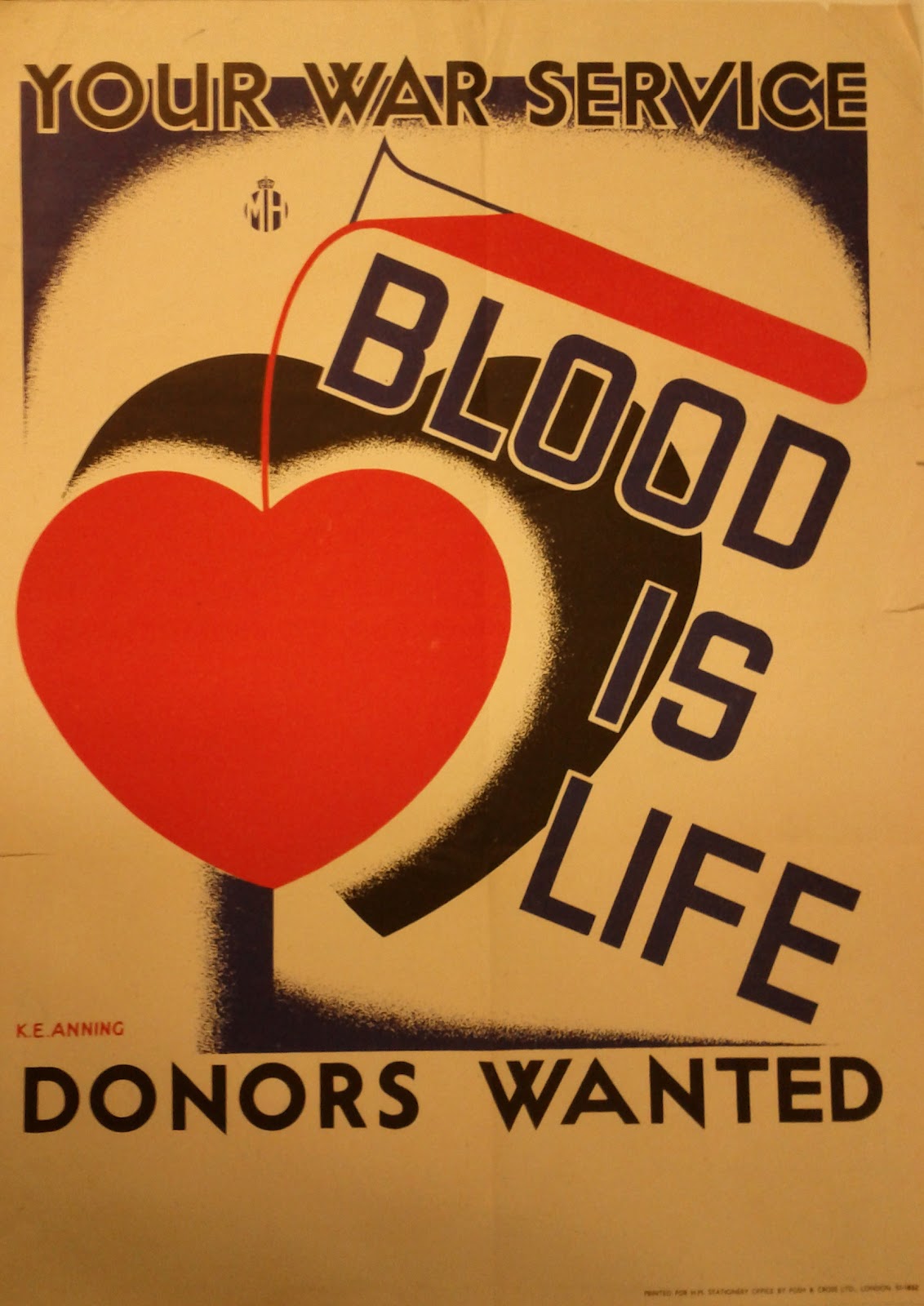
The Wellcome Library has acquired a collection of 600 British posters dating from the 1940s to the 1990s advertising the health-maintenance activities of the British state. Most were produced by the Central Office of Information for the U.K. Ministry of Health (subsequently Department of Health and Social Security, subsequently Department of Health).

The posters cover the following subjects: Blood donation (135); Children (44); Diseases (121: AIDS, asthma, colds and flu, diphtheria, epilepsy, meningitis, rabies, rubella, tetanus, tuberculosis); Drugs or narcotics (53); National Health Service services and charges (80: ambulance service, cervical screening, community care, emergency GPs, evaluation, fares to hospital, NHS 30th anniversary, prescription charges, spectacles); Nurses and midwives (87, including recruitment, Queen's Institute of District Nursing, etc.); Organ donation (44), Travel and health (8); and Miscellaneous (26: air-raids, disability, health and safety, health of the nation, hearing, incontinence, mental health, and teeth).

Proof pulls and storyboards are included as well as finished versions. Named designers include Reginald Mount, K.E. Anning (above), and Abram Games.

The posters are accompanied by a large collection of photographs, drawings, etc. which have not yet been explored, except for one item, a photograph album (Wellcome Library no. 811058i) recording an exhibition from 1948 called Health of the People. This exhibition was put on by the Central Office of Information in Oxford Street, London (but where in Oxford Street?) apparently to publicize the introduction of the National Health Service (NHS) in that year. On display from May to June 1948, the exhibition was an ambitious attempt to communicate the history of public health and the difference that the NHS would make between the past and the future. Much attention was given to new laboratory-based services.

The photographs makes it look like a halfway-house between Britain can make it at the V&A in 1946 and the Festival of Britain on the South Bank in 1951. No names of contributors (commissioners, writers, designers, manufacturers) are given, but surely they must be recorded somewhere; possibly in the unexplored parts of this same collection. The script which accompanies the album makes much reference to the Public Health Act of 1848, the centenary of which was being celebrated.

Did this period see the high-water mark of state involvement in health in the British Isles? If so, our successors will no doubt look on these documents with incredulity. Only time will tell. 
Displays in the Health of the People exhibition, 1948. Left, "the health team, consisting of the family doctor, dentist, nurse etc". Above, stands on protection of towns, water supply etc. Top, the staircase between floors.

Wednesday, April 11, 2012

New article on a portrait of record

Drawing by Pierre Chasselat.
 Wellcome Library no. 729420i
An exceptional neoclassical portrait drawing that was acquired by the Wellcome Library in 2010 is the subject of an article in the current (April 2012) issue of The Burlington magazine. [1] The drawing, by Pierre Chasselat (1753-1814), is a portrait of the French surgeon A.-B. Imbert-Delonnes who, in the same year as the creation of the drawing (1800), served under Napoleon at the battle of Marengo. He was also involved in a number of controversial episodes, some of which are commemorated in the drawing.

 Following Marc Fecker's identification of the previously unidentified sitter as Imbert-Delonnes, the article, by Marc Fecker and William Schupbach, places  the drawing in the context of other works by Chasselat and by Jacques-Louis David (they were both pupils of Joseph-Marie Vien), and identifies the various works of furniture, painting, and sculpture shown in the portrait, among them (in the lower left corner) an oval portrait of the mayor of Angoulême, Perier de Gurat. Perier de Gurat suffered from appalling facial tumours which Imbert-Delonnes removed through a long and painful surgical operation. The engravings below, published by Imbert-Delonnes, show Perier de Gurat before and after that operation.


Above, Perier de Gurat before and after surgical removal of his tumours by Imbert-Delonnes in 1798/1799. 
Plates to Ange-Bernard Imbert-Delonnes, Nouvelles considérations sur le cautère actuel, Avignon 1812.

Here (right) is the detail from the lower left corner of Chasselat's drawing, showing the painting by Joseph Bose from which the first engraving of Perier de Gurat was made. The open book in front of it is a volume of the works of one of Imbert-Delonnes's professional role-models, Ambroise Paré (1510?-1590).

 Other details of the drawing are elucidated in the article. The drawing was purchased by the Wellcome Library with the aid of the MLA/V&A Purchase Grant Fund and The Art Fund, to whom go the renewed thanks of the Library.

 [1] Marc Fecker and William Schupbach, 'A recently discovered portrait of the surgeon Ange-Bernard Imbert-Delonnes (1747-1818) by Pierre Chasselat', The Burlington magazine, April 2012, 154: 236-240.

Thursday, April 5, 2012

Easter 2012: "O death where is thy sting?"

Easter week celebrates the moment when, in Christian metaphysics, mortality is overcome by everlasting life. The crucifixion of Jesus Christ redeems mankind from the sinful state into which mankind fell through Adam's disobedience to the will of God in the garden of Eden. His resurrection liberates us from eternal perdition: in Saint Paul's famous words (I Corinthians, XV.54-55) "So when this corruptible shall have put on incorruption, and this mortal shall have put on immortality, then shall be brought to pass the saying that is written, 'Death is swallowed up in victory'. O death where is thy sting? O grave where is thy victory?".
These concepts were articulated with fresh force in the later sixteenth century through the Counter-Reformation, in media such as altarpieces, sermons, the educational work of the Jesuit Order, and through devotional prints which were widely disseminated. Here we present four such prints from the holdings of the Wellcome Library.
Engraving by B. van Bolswert after Rubens. Wellcome Library no. 24606i.
The print above publishes an altarpiece painted for a church in Antwerp in 1619-20. The lettering names Pieter Paul Rubens as the painter, and Boëce van Bolswert (in Latin, Boethius à Bolswert) as the engraver and printer. Bolswert (ca. 1580-1633) worked in Antwerp in collaboration with the Rubens studio. The lettering describes the scene in the words of Saint John's gospel (XIX.19-34), which is also closely followed in the depiction.

For instance, Saint John mentions that the mocking inscription on Christ's cross "was written in Hebrew and Greek and Latin" (XIX.20), as it is here. The print also illustrates an act of casual cruelty which is described by Saint John: the soldiers broke the legs of the two men crucified with Jesus, but when they got to Jesus himself, they saw that he was already dead so did not waste any effort in breaking his limbs. Thus the print emphasizes the sinfulness of mankind and its need for the "corruptible to put on incorruption".

The altarpiece was seen in Antwerp in 1781 by the painter Joshua Reynolds. He describes it as "famous", meaning that it was widely known from  Bolswert's print. He commented in his diary:
'The altar of the choir is the famous crucifixion of Christ between the two thieves, by Rubens. To give animation to this subject, he has chosen the point of time when an executioner is piercing the side of Christ, whilst another with a bar of iron is breaking the limbs of one of the malefactors, who in his convulsive agony, which his body admirably expresses, has torn one of his feet from the tree to which it was nailed. The expression in the action of this figure is wonderful: the attitude of the other is more composed; and he looks at the dying Christ with a countenance perfectly expressive of his penitence. This figure is likewise admirable.

'The Virgin, St. John, and Mary the wife of Cleophas are standing by with great expression of grief and resignation, whilst the Magdalen, who is at the feet of Christ, and may be supposed to have been kissing his feet, looks at the horseman with the spear, with a countenance of great horror: as the expression carries with it no grimace or contortion of the features, the beauty is not destroyed. This is by far the most beautiful profile I ever saw of Rubens, or, I think, of any other painter …

'The genius of Rubens nowhere appears to more advantage than here: it is the most carefully finished picture of all his works. The whole is conducted with the most consummate art; the composition is bold and uncommon, with circumstances which no other painter had ever before thought of; such as the breaking of the limbs, and the expression of the Magdalen, to which we may add the disposition of the three crosses, which are placed prospectively in an uncommon picturesque manner: the nearest bears the thief whose limbs are breaking; the next the Christ, whose figure is straighter than ordinary, as contrast to the others: and the furthermost, the penitent thief: this produces a most picturesque effect, but it is what few such a daring genius as Rubens would have attempted. . . . I have dwelt longer on this picture than any other, as it appears to me to deserve extraordinary attention: it is certainly one of the first pictures in the world, for composition, colouring, and, what was not to be expected from Rubens, correctness of drawing.'
Although Reynolds's appreciation is primarily technical, written from the point of view of a professional painter, his feeling for the subject matter is also strongly expressed. In the 19th century the composition continued to be well known under the name Le coup de lance given to it in 1876 by the French painter Eugène Fromentin. Even today some writers call it Le coup de lance, even though many other incidents are shown in addition to the centurion piercing Christ's side with the lance. Although the lettering on the print and other evidence state that the author was Pieter Paul Rubens, there are reasons for thinking that, while Rubens designed the composition, his pupil Antonie Van Dyck may have been responsible for some of the detailing. [1] The painting now belongs to the Koninklijk Museum voor Schone Kunsten, Antwerp.
At some stage Christ's body had to be taken down from the Cross. An episode after that, known in English by the Italian word Pietà, in which the Virgin Mary mourns her son, is recorded in many pictures and sculptures.

 Engraving by Lucas Kilian after Hans von Aachen, 1602. Wellcome Library no. 23231i.

This is one of the most finely worked prints of that subject. It is a truly international production. The designer was Hans von Aachen (1552-1615) who was born in Cologne, worked in Italy where he learnt a good deal about painting and design, and eventually became court painter to the Emperor Rudolf II in Prague, where he died. Our print is dated 1602, when Hans was in Prague. It bears a dedication from Dominicus Custos (the printer and/or publisher), dated to the day: "MDCII. VIII. Id. Maÿ", i.e. 8 May 1602. The dedicatee is Johann Philipp von Gebsattel (1555-1609),  Prince-Bishop of Bamberg from 1599 to 1609, not a man renowned for piety, which is perhaps why he was glad to be recognized as the patron of this magnificent print. He could hardly fail to be impressed by the engraver's work on the Virgin's halo. The engraver was the stepson of Dominicus Custos, Lucas Kilian, who was from Augsburg in Bavaria but carried out the work for this print in Venice.
The episode is not mentioned in the Gospels but became one of the standard Stations of the Cross in the Middle Ages. Evidently it was thought necessary to have a time for grieving between the killing of Christ and his burial. The Virgin's expression is one of bewilderment, while Mary Magdalene devotes herself to the wounded body of Christ. In the foreground are the causes of the sacred wounds, including the nails, a hammer, and the crown of thorns.

Engraving by Lucas Kilian after Tintoretto. Wellcome Library no.23236i.
The carrying of Christ's body to the tomb is shown in another print made by Lucas Kilian, again in collaboration with his stepfather Dominicus Custos as printer and/or publisher, but this time Lucas is engraving a design by a Venetian painter, Jacopo Robusti, called il Tintoretto. The patron to whom the print is dedicated is also Italian:  Anna Caterina Gonzaga (1566-1621), daughter of Guglielmo Gonzaga, Duke of Mantua, and at this time the consort of her uncle, Ferdinand II, Archduke of Austria. Unlike the Prince-Bishop of Bamberg, she was indeed renowned for her piety: as a child she had received visions of the Virgin, and after her husband's death she abandoned the trappings of wealth and devoted herself entirely to religion and good works.
It is clear why the archduchess would have been happy to be associated with an engraving in which the suffering Virgin Mary is literally so prominent: the three Maries are almost falling out of the front of the picture, with the Blessed Virgin in the centre, Mary Magdalene on the right and Mary the wife of Cleophas (John XIX: 25) on the left. Remarkably, what we might regard as the main subject, the carrying of the body of Christ, appears only in the background. The reaction of the Virgin to the sight of Jesus's body implies that a distinct earlier phase corresponding to the Lamentation or Pietà did not take place.
Engraving after Maerten de Vos, late 16th century. Wellcome Library no. 23283i.
Finally in this sequence, we have the powerful figure of Christ triumphing over death. The upper part combines two scenes: Christ is simultaneously resurrected from the tomb and ascends into heaven. In the lower left corner, Death itself is about to be swallowed up by a monster, while in the centre the snake that led Adam and Eve astray, and who is entwined around the secular world, is about to be trampled down by the wounded foot of Christ. On the right a tablet engraved with the Ten Commandments faces upwards, indicating that Christ is triumphing over righteousness of the law, replacing it with righteousness of faith.
The composition is by Maerten De Vos (1532-1603), and the engraving was produced by the publishing house of Hieronymus (Jeroen) Cock (c. 1510–1570) at the sign of the four winds ("Aux quatre vents") in Antwerp.

Thanks to Erika Delbecque for cataloguing the Wellcome Library's prints by Lucas Kilian.
[1] N. Van Hout, 'On the invention and execution of the Coup de Lance', in Rubens Bulletin Koninklijk Museum voor Schone Kunsten Antwerpen (KMSKA), 2011, 3: 2-39. Online at http://www.kmska.be/nl/Onderzoek/Rubens/Rubensbulletin_3.html

Thursday, March 29, 2012

The Georgian medicine vendor as physician: William Brodum

Wellcome Library no. 20131i
A watercolour in the Wellcome Library (left) shows an interior with three figures.  In the centre a plump, self-satisfied looking man  looks down with approval at the work of the second figure, on the right, who is Death himself. Death is a tall and physically active skeleton wearing a tie-wig: he vigorously stirs a pestle in a mortar to grind up ingredients for medicines. Some pharmaceutical vessels are shown on the floor around them, and the shelves in the background are full of apothecary's glassware.  The third figure is a woman patient who sits in front of the fireplace on the left, gripped by illness.

The obvious interpretation is that the man is an apothecary (pharmacist), hence the glassware on the shelves of his house. Death is the apothecary's business partner, making up medicines with lethal side-effects: clearly the woman is going to die as a result of taking the harmful medicine. Right?

No, not exactly.  If the setting is an apothecary's shop, the sick woman wearing night-clothes would be sitting in front of the fire in the pharmacist's establishment, not in her own home. To explain that improbability, one would have to assume that she is meant to be a member of his household -- which would rather reduce the applicability of the joke and take the edge off the humour. As the watercolour is attributed to the ever-humorous Thomas Rowlandson (1756-1827), that would be a problem.

A possible clue to the subject came to light in January 2012 when Christie's in New York offered at auction another watercolour version of the same composition, inscribed in what looks like Rowlandson's hand "Dr Brodum and his assistant at work pro publico bono". [1] So who was Dr Brodum?

Wellcome Library no. 1397i
William Brodum (right) was one of several members of the Georgian medical fringe who were portrayed by caricaturists. Samuel Phillips Eady, also portrayed by Rowlandson and discussed in this blog-post, was another who could be so described. Unlike Eady, Brodum is dignified by an entry in the Oxford Dictionary of National Biography (ODNB), where evidence is cited that he was a Danish Jew, born Issachar Cohen in Copenhagen around 1767. [2] He came to England around 1787 to work for another medicine vendor (Dr Bossy), using the name William Brodum. He obtained an Aberdeen M.D. degree in 1791, and from his house at 9 Albion Street, Blackfriars Road, London, launched his own career as a medicine vendor, specializing in two product lines: "Doctor Brodum's Botanical Syrup for the cure of scorbutic, leprous and scrofulous complaints" and "Doctor Brodum's Nervous Cordial for the cure of consumptive, nervous and debilitated constitutions, and people who have been in hot countries". His advertising for these products included a lot of code words that were euphemisms for syphilis (debility, leprosy, nervous weakness etc.), and the same insinuation was gracefully made in the title and body of a two-volume publication, Guide to old age, or, A cure for the indiscretions of youth (1795), dedicated to King George III, whose favour he received. A miniature portrait of him around this time was published in an engraving by Ezekiel Abraham Ezekiel (1757–1806), a member of the Jewish community in Exeter (above).

Brodum was therefore both a commercial medicine vendor and a doctor of medicine. Since the two professions were theoretically distinct and incompatible, problems could arise with the regulatory bodies, one of which was the Royal College of Physicians of London. In practice, this combination was not unusual at the time: Sir Hans Sloane, Dr Robert James, and Dr Richard Mead were among physicians associated with proprietary medicines (chocolate in Sloane's case), a fact which led one commentator to ask "Have not members of the College dined at Dr Brodum's table?". [3] In any case, Brodum was summoned before the College and told he could not accept consultation fees and should remove from his house the brass plate which described him as “Dr Brodum”. Brodum refused to accept this ruling, and the academic authorities in Aberdeen did not appreciate the College’s scorn for the value of their doctorate. Brodum continued to visit patients for an advertised cost of 5 guineas a week, while outpatients could visit him at his house every Monday, Tuesday or Wednesday. [4]

Whether by accident or design,the goings-on in Rowlandson's watercolour fit this situation perfectly. If the man is meant to be identified with Brodum -- he died in 1824 and Rowlandson in 1827 -- we need not ask whether it shows a medicine vendor or a physician. Brodum and Death together make up the medicines at Brodum's pharmaceutical laboratory in Southwark, while the patient in the background, huddled in front of her own fireplace, represents the use to which the medicine will be put in Brodum's medical practice.

[1] Christie's, Old Master and early British drawings and watercolors, New York, Rockefeller Plaza, 26 January 2012, lot 38
[2] Edgar Samuel, 'Brodum, William (fl. 1767–1824)', Oxford dictionary of national biography, Oxford University Press, 2004; online edn, Jan 2008. Brodum wrote that he was "born and bred" in the same country as the Queen, Charlotte of Mecklenburg-Strelitz, in north Germany (Guide to old age, or, A cure for the indiscretions of youth, 1795, vol. 1, fol. A2r)
[3] Roy Porter, Health for sale, Manchester 1989, p. 9
[4] William Brodum, Guide to old age, or, A cure for the indiscretions of youth, 1795, pp. 153-155

Friday, March 2, 2012

The 'Orphans' go for a short walk


In 2009 the Wellcome Library acquired four large paintings known as the Acts of Mercy. They had been painted by Frederick Cayley Robinson between 1915 and 1920 for display in the Middlesex Hospital, in the Fitzrovia district of central London. The Middlesex Hospital building was demolished in 2005 (except for its chapel, which still stands), and its assets, archives and responsibilities passed to the University College London Hospitals NHS Foundation Trust. The paintings, being homeless, were then acquired by the Wellcome Library. From the Wellcome Library they were lent in 2010 to the National Gallery for a temporary exhibition focused on them and their painter. More information about the paintings is available in several postings on this blog.

University College London Hospitals NHS Foundation Trust is now constructing a new cancer hospital, the UCH Macmillan Cancer Centre, in Huntley Street, London, south of the present University College Hospital and not far east of the site of the demolished Middlesex Hospital. 'The Orphans', one of the two pairs of paintings by Cayley Robinson that make up the Acts of Mercy, is being lent to the new cancer hospital, which will open next month, in April 2012. There is a certain appropriateness in the loan because the former Middlesex Hospital had a longstanding interest in, and reputation for, the treatment of cancer. [1]

That tradition went back to 1791 when a surgeon called John Howard sent a letter to "the medical gentlemen of the Middlesex Hospital" proposing that a ward be opened for "paupers afflicted with the disease called cancer". The purpose of this initiative was twofold: to afford relief to the patients and to investigate the causes of cancer. For the relief of patients, an out-patient as well as an in-patient service was suggested. For the purposes of investigation, Howard suggested that notes on cases be kept carefully and made available "to any intelligent or scientific person".

Howard was invited to put his proposals to the Middlesex Hospital Board: he not only did so but also produced an anonymous sponsor who was prepared to pay 3,000 guineas towards the costs. The hospital governors accepted the offer, and the ward opened in 1792. A few years later the sponsor was revealed to be the (by now deceased) Samuel Whitbread (1720–1796), the Bedfordshire brewer whose brewery was based in Chiswell Street in the City of London.

Whitbread's funds created the Cancer Charity, which has been described as "the centre and inspiration of the researches into malignant disease which have flowed from the Middlesex Hospital ever since." In 1914 the Barnato-Joel trustees endowed it with funds to build a new research laboratory. It was absorbed into the Middlesex Hospital's radiotherapy department in 1937. Both before and long after that date, many distinguished researchers, surgeons and physicians carried out at the Middlesex Hospital work towards the two objectives of the charity, relief of cancer patients and advancement of understanding of cancer.

It is that tradition of the Middlesex Hospital that will be continued in the new UCH Macmillan Cancer Centre in Huntley Street. It is remarkable that three specific features of John Howard's proposal to the Middlesex in 1791 are retained in the new building: out-patient treatments, in-patient facilities, and (in collaboration with the UCL Cancer Institute on the other side of the road), making the results of research available by open access publishing. As in the former Middlesex Hospital entrance hall, Cayley Robinson's 'Orphans' will be watching over patients in the atrium of the new building.

The other pair of paintings that makes up Acts of Mercy will remain in the Wellcome Library, and after 8 March 2012 will be redisplayed on facing walls, as Cayley Robinson originally intended. However, anyone wishing to see the four paintings together should revisit the Wellcome Library before that date for a last view of the quartet.

[1] R.S. Handley, 'Gordon-Taylor, breast cancer and the Middlesex Hospital', Annals of the Royal College of Surgeons of England, 1971, 49: 151-164

Images: 'Orphans', by Frederick Cayley Robinson. Wellcome Library nos. 672831i and 672832i

Tuesday, February 28, 2012

Portrait of a lady in Nizamabad: Isabel Kerr. Wellcome Library Item of the Month.

Photograph by G.M. Kerr, 1926. Wellcome Library no. 726380i.
This photographic print is one of the apparently few and elusive portraits of Isabel Kerr (1875-1932), a Methodist missionary who founded the Victoria Treatment Hospital for people with leprosy at Dichpali, near Nizamabad in the state of Andhra Pradesh in India.

Born Isabel Gunn, she had graduated MB ChB at Aberdeen in 1903, and arrived in India with her husband, the Rev. George McGlashan Kerr, in 1907. They noticed the frequency of leprosy and the unsatisfactory treatment of its victims, and having resolved to do something about it, received a donation of 10,000 rupees (£590) from a citizen of Nizamabad, Narsa Gowd, towards a leprosy hospital. In 1913 a gift of 60 acres of land at Dichpali (also called Dichpalli), a village ten miles down the railway line from Nizamabad to the city of Hyderabad, was received from the Nizam of Hyderabad. With further funds from Narsa Gowd and others, the hospital opened on 18 April 1915. [1]

The hospital expanded rapidly owing to demand, and by 1921 it consisted of 120 buildings. Further buildings were added in 1923 when the Minister of Finance of Hyderabad, A. Hydari (later Sir Akbar Hydari) opened more new buildings, again paid for by the Nizam. The running costs from 1910 to 1944 were subsidised by the Mission to Lepers, from 7 Bloomsbury Square, London (since 1965 known as The Leprosy Mission).

In 1920 Isabel Kerr adopted the treatment using oil of the chaulmoogra tree, which she learnt from Ernest Muir in Calcutta. It is presumably a chaulmoogra injection (excruciating for the patient) that is shown in the photograph. An Indian variation of the treatment used the related hydnocarpus plant, which was cultivated along with cinchona in the Nilgiri hills.

At Dichpali there was no shortage of patients, but in too many cases they were the wrong kind for treatment. The Rev. G.M. Kerr described how, in the early stage, when the disease was infectious and treatment would be most effective, patients would hide their symptoms. Only much later would they go for treatment, when the hydnocarpus oil could do nothing to undo the mutilations caused by the bacillus decades previously. Kerr compared the treatment-after-the-event at Dichpali to a clifftop where people were in danger of falling off: it would be better to install a rail at the top than a casualty station at the bottom. To encourage people to be treated in the early stages of leprosy, the Kerrs therefore opened an outpatient clinic in Hyderabad in 1928, with the desired effect: "Students from the colleges, clerks from their offices, and Government officials from their posts" all flocked to the clinic. [2]

A second photograph in the Wellcome Library (below) shows yet another foundation-stone laying ceremony, this time in 1935.
The foundation stone was laid this time by Amena, Lady Hydari. By this time Isabel Kerr had died: she died in 1932, aged 57. [3] The Rev. George McGlashan Kerr continued to run the hospital after her death, until his retirement to Scotland in 1938. His archive including three photographs is in Edinburgh University. He died in 1950.

Isabel Kerr was described as "modest, shy and diffident, and reluctant to speak in public". Hence no doubt the lack of photographs of her: the opposite of the much-portrayed Albert Schweitzer, renowned for his skilful use of publicity.

As a Methodist, Isabel Kerr was doubtless familiar with, and motivated by, the words of John Wesley (1703-1791), the founder of Methodism:

"Do all the good you can. By all the means you can. In all the ways you can. In all the places you can. At all the times you can. To all the people you can. As long as ever you can."


[1] Dermott Moynahan, The story of Dichpalli, London: The Cargate Press, 1949, is the source for most of what is written here. It is a revision of his earlier book The lepers of Dichpali, London: The Cargate Press, 1938. In the earlier edition but not in the later, the present photograph of Isabel Kerr is reproduced with legend "Dr Isabel Kerr giving an injection" (facing p. 28) 

[2] Rev. G.M. Kerr, 'Tackling a great social problem: the fight with leprosy', The foreign field (of the Wesleyan Methodist Church), April 1926, pp. 155-158 

[3] Her obituary in The Lancet reads as follows (in its entirety). "Isabel Kerr, M.B. Aberd. The death is reported from Dichpali, the Leper hospital settlement outside Nizamabad, of Dr. Isabel Kerr, the Scottish medical missionary, who has made this institution the outstanding centre in South India for the treatment of leprosy, and for training in diagnosis and treatment. Born at Fochabers-on-Spey in 1875, she graduated in medicine at Aberdeen in 1903, and went to India with her husband, the Rev. George M. Kerr, who is superintendent of the Wesleyan Mission Station at Nizamabad. She had charge for 12 years of the mission hospital there until the foundation of the Dichpali Home, where husband and wife have worked devotedly ever since. In 1923 she was awarded the Kaisar-i-Hind gold medal in recognition of her services." (The Lancet, 31 December 1932, pp. 1460-1461) 

Portrait of John Wesley: mezzotint by J. Faber after J. Williams, 1743. Wellcome Library no. 9621i.

Tuesday, February 21, 2012

A treat at the Chester Beatty Library in Dublin

© The Trustees of the Chester Beatty Library, Dublin
Only a few more days for readers in Ireland to see the exhibition China through the lens of John Thomson: 1868-1872, which comes to an end at the Chester Beatty Library in Dublin on Sunday 26 February, before moving on to Northern Ireland.

The Chester Beatty Library is a gem in its own right, with valuable and exquisite works displayed in two permanent exhibitions: one covering the principal religions of the world and the other the arts used in the making of books, including printmaking and painting. The latter starts with a magnificent George Stubbs mezzotint of a tigress, acquired in 2007 from the Christopher Lennox-Boyd collection. Other prints of particular interest include etchings by 17th-century masters such as Abraham Bosse, Jacques Callot and Antonie Van Dyck. A collection of etchings by Romeyn de Hooghe (1692) of King William III's return from Ireland to Holland is a work by the anatomist and courtier Govaert Bidloo. A rare book illustrated by Raoul Dufy, Mon docteur le vin(Paris 1936), claims that wine prevents appendicitis by killing germs in the intestines and resists typhoid, infant sicknesses, and diabetes (the WellcomeLibrary has the 2003 English translation).

A remarkable story is told by a box of Manichaean manuscripts which were entrusted to a conservator in Berlin in the 1920s, were removed to Leningrad in 1945, went back to East Germany in the 1960s, and finally returned to the Chester Beatty Library after 1990. Among the most recent works is a print of the physician and fable-writer Lu Xun (1881-1936), of whom the Wellcome Library has also recently acquired a portrait: the portrait in the Chester Beatty Library (by Wu Biduan, 1998) is appropriately a woodcut, as Lu Xun championed the woodcut technique as the medium of the people.

The other exhibition, Sacred Traditions, also contains many works which have their counterparts in the Wellcome Library, such as Burmese parabaik and Jain cosmological paintings – as well of course as splendid Qur'an manuscripts and other unique works.

The John Thomson photographs on exhibition until Sunday complement the Chinese collections of the Chester Beatty Library, which shows its own related objects in showcases in the exhibition: they include a Chinese lady's shoes and 19th-century Chinese spectacles similar to those shown in the photographs. Outside the exhibition, the reading room of the Library has a fine Chinese lacquer ceiling(right) acquired in China by Chester Beatty, the founder of the Library.

Here's an article by the Irish travel writer Manchán Magan in the Irish Times about Chinese students from Birmingham visiting the exhibition in Dublin "to see their ancestors in the Chester Beatty Library". Admission is free, opening hours here, location here.

Saturday, February 18, 2012

New online resources: Your Wellcome Library Paintings, and National Trust Collections

The free online database Your Paintings was launched last year. [1] It makes available information on more than 100,000 paintings in public and private collections in the United Kingdom that are accessible to the public.

The collections include not only art institutions but also for example local government offices, schools, almshouses, libraries and police stations. It is an online counterpart to the printed catalogues of paintings being produced by the charity The Public Catalogue Foundation. Indeed the data for Your Paintings are produced by staff of The Public Catalogue Foundation in collaboration with the contributing institutions, while the website is hosted as a public service by the BBC.

The database is expanding towards its estimated target of 200,000 paintings. This week saw the addition of around 7,000 paintings including 1,291 items from the Wellcome Library. The others added this week include paintings from four other collections in the London Borough of Camden (Royal Free Hospital, Central Saint Martins College of Arts and Design (no longer in the City of Westminster but now in its spectacular new home at 1 Granary Square, Kings Cross); the London Borough of Camden collection; and Sir John Soane's Museum) and from seven Liverpool collections forming the National Museums Liverpool.

Five other Camden institutions (British Library, British Museum, Royal College of Physicians, the Foundling Museum, and the Zoological Society of London) will be added shortly, while others such as SOAS, the London School of Hygiene and Tropical Medicine, UCL, and UCL Hospitals Arts, are already there.

Although the Wellcome Library has contributed catalogue data to many other online union catalogues (COPAC, the Karlsruhe Virtual Catalogue (KVK), the National Inventory of Continental European Paintings, OCLC WorldCat, etc.), the Your Paintings database is at present probably the best source from which to display online images of paintings in the Wellcome Library. The cut-off date for inclusion was April 2011: new acquisitions after that date (eight paintings so far) are excluded, as are new attributions and identifications of subjects; it may be possible to add them later. They are of course included in the Wellcome Library catalogue.


Above left, the UCLH "Vesalius" portrait. Above right, the Wellcome Library version (Wellcome Library no. 45840i)
For most people looking at the database there will be surprises. From the Wellcome Library's point of view, the great revelation of the database is the ability to find related paintings in other, hitherto unfamiliar, collections. For instance our neighbour UCL Hospitals have a version of the same Venetian portrait (long regarded as a portrait of Andreas Vesalius) as the Wellcome Library (above left and right).

Finding other works by relatively obscure artists could not be easier. The Wellcome Library has a portrait (right: no. 47408i) of William Russell, a Worcestershire worthy, painted by one Stephen Hewson (fl. 1775-1812): Your Paintings reveals Hewson's itinerant life by showing ten portraits by him from Canterbury, Deal, and Dover, and one of the actor Tate Wilkinson (1739–1803) painted in York. Negative evidence is also useful: we discover that the only two paintings in the database by the still-life painter Gian Domenico Valentino (fl. 1661-1681) are (so far) the two in the Wellcome Library.
Many of the paintings shown here have never been photographed before, while others are the first online reproductions in colour. A notable example is the painting in the Royal Free Hospital of Dame Mary Scharlieb – Memsahib, gynaecologist, surgeon and Christian apologist—by Hugh Goldwin Riviere. The online image (left) portrays passionate commitment shining in her eyes and energy in her body-language. Her costume is also significant: she wears her MD gown while holding what looks like a pair of obstetric forceps.


Another new free online database, National Trust Collections [2], currently has around 750,000 records, about the same as the Wellcome Library catalogue, but of course the items described are much more diverse and are housed in buildings all over England, Wales and Northern Ireland (Scotland has its own separate organization, The National Trust for Scotland).

Like the Wellcome Library catalogue, National Trust Collections interfiles records for books (around 190,000 records), prints, photographs, and paintings, but also for scientific instruments, ethnographic objects and other things. Like Your Paintings, it is well worth a bookmark on the computer of any historical researcher.

[1] Your Paintings: http://www.bbc.co.uk/arts/yourpaintings

[2] National Trust Collections: http://www.nationaltrustcollections.org.uk