Showing posts with label drawings. Show all posts

Monday, June 18, 2012

Shackled in leg irony: black humour of the lower limb

Mezzotint by Jacob Gole (1660?-1737?) after Annibale Carracci.
Wellcome Library no. 24994i
It is a common experience to have enough feet but not enough shoes. The man shown here is, paradoxically, in the opposite situation: he has plenty of shoes but lacks a foot. The irony has a further twist: he is a shoe-seller whose single surviving foot is unshod, presumably because he cannot afford his own wares. No wonder he needs to keep up his spirits with a tobacco pipe.

Black humour (gallows humour, Galgenhumor) is a common feature of discourse about disability. However much we may deplore the fact, loss of mobility due to amputation of the lower limb -– at the thigh, leg or foot -- has been considered a particularly appropriate subject for such humour, perhaps owing to suppressed fear of losing such mobility as we may have. Irony is a way of playing down the horror of immobility while at the same time acknowledging it; and there can be intellectual pleasure (at least for functional bipeds) in the various paradoxes that can arise from limblessness, which are prominent in the drawings, photographs, prints and paintings in the Wellcome Library shown here.

Watercolour by C.W.D., 1866. Wellcome Library no. 12109i
Loss of a limb in a railway accident elicits no sympathy from this compensation board.
The victim (to Chairman) "Sir, in consequence of the carelessness of your servants. I have been compelled to have my leg amputated, besides suffering other injuries, and I consider myself entitled to compensation."
Facetious director. "Lost your leg have yer? Regular stumps etc? - Well! If yer any-think of a cricketer it must be an ill-convenience!"
Benevolent chairman. "Quite right sir - qu-i-te right, compensation by all means, loss of leg - eh? - an unfortunate accident that for all of us." (To secretary) "Here Mr Jones award this gentleman twelve shillings for a wooden one - and enter it on the minutes."'
Jones replies: "The usual discount sir I suppose for ready money? That'll make it eleven shillings." Another director adds: "One can't be too cautious but he don't look like a malingerer!".

Coloured etching, 19th century. Wellcome Library no. 44050i
To break one's natural leg is bad enough, but then to break its wooden replacement adds insult to injury. Two approximately contemporary prints show this subject. In the one above, the driver of the offending vehicle is asleep at the reins.

Coloured engraving published by Laurie and Whittle, 24 February 1800. Wellcome Library 44090i
But at least here the victim can smile as he sees the irony of his situation – and it's much less painful this time round for the young sailor who had lost his leg in the Far East. Fortunately a carpenter is passing with a saw and pot of glue in hand; "A broken leg, or the carpenter is the best surgeon. Haloo! Young Glewpot, de ye see Jack Junk has shivered his timbers, and we want a splice here." The surgeon coming out of his house on the left has no part to play on this occasion, and is pushed away.


There are even positive advantages to losing a leg!


Here another seadog has lost both his legs to the naval surgeon, but there's one compensation: no more suffering from corns ("Keine Hühneraugen mehr!").


Lithograph after Johann Bahr, 1909. Wellcome Library no. 577262i


Etching by Frederick Carter, 1928. Wellcome Library no. 44343i (Wellcome Library/©RG Clark)
"What, no legs? Lucky man!" are the words spoken by Ahasuerus (the Wandering Jew) to an immobile Spanish beggar in Frederick Carter's gloomy etching. It is the Jew's misfortune to be forever moving over the face of the earth without respite; the beggar's not to be able to move at all. You can see the world, or you can have a rest, but you can't do both.

Discarded crutches at Lourdes. Photograph, 1937. Wellcome Library no. 578619i
Once a leg has been lost, surely only a miracle could make it grow again. It was a friend of the writer Anatole France (1844-1924) who, contemplating the hundreds of discarded crutches at Lourdes, murmured "Une seule jambe de bois en dirait bien davantage" (Just one wooden leg would be much more significant). [1]

Coloured lithograph by C.J. Grant, 1834.
Wellcome Library no. 11854i
.
The regrowth of a natural leg from an amputation stump was considered absurd enough to be worthy of an advertisement for Morison’s pills – the heavily-advertised vegetable remedy for diseases attributed to iatrogenic blood poisoning. The man on the left went to bed with wooden legs, took a dose of Morison's Universal Pills, and "when I awakes in the morning to kick off the clothes, I'm blessed if I didn't find myself with these 'ere couple of jolly good legs and my old wooden ones right at the bottom of the bed!!!".

 Yet … looking towards a future age of stem-cell therapy, who would claim that regeneration of a limb could not occur?


Colour lithograph by H.G. Banks, ca. 1899.
Wellcome Library no. 556713i

It would need more than stem-cell therapy to put poor Callaghan together again. In the song What will poor Callaghan do? a disabled soldier has his wooden legs stolen by four drinking companions in a bar.

The song describes an evening out for four stage-Irishmen called Hogan, Casey, Murphy and "me"; originally "me" was Michael Nolan, a popular Irish music-hall performer. They had spent all their money drinking beer in a pub with an ex-Highland soldier called Patsy Callaghan, who had had his legs shot off from under his kilt when at war. To recover their funds, they got Callagahan drunk, removed his wooden legs and false teeth, pawned them, and left Callaghan literally legless on the pub bench. His plight, depicted on the front cover of the songsheet, is regarded by all as hilarious, though the speaker can't help wondering (in the words of the chorus) "What will poor Callaghan do?".

Michael Nolan asking "What will poor Callaghan do?"
Poor Callaghan was a precursor (or, from another point of view, a post-mediaeval successor) to The Black Knight in Monty Python and the Holy Grail (1975) who unwillingly makes comedy out of limb-deprivation. "'Tis but a scratch!" he says after losing one arm, "It's just a flesh-wound!" after losing the other, and "All right, we'll call it a draw" after finally losing both legs. Before the Black Knight, one-leggedness had been the subject of another piece of tasteless comedy: One leg too few, a sketch written by Peter Cook while a Cambridge undergraduate in 1960. For this sketch Cook appears to have coined the Latin-derived word "unidexter" to denote a person with one leg, although there was already a Greek-derived word in English, namely "monopod". Again there was an ironic twist of which some audiences were unaware: the actor playing the one-legged role (Dudley Moore) had had club-feet as a child and still had one ineffective leg. Irony and club-foot lead us on the well-intentioned but disastrous operation in Flaubert's Madame Bovary (1856), but we have enough space here merely to allude to it.

Oil painting attributed to the Master of Los Balbases, Burgos, ca. 1495.
Wellcome Library no. 46009i
Conversely, many people are shocked by the absence of irony in this Spanish altarpiece showing a verger's dream. The verger dreams that his bad leg is substituted by Saint Cosmas and Saint Damian with the leg of a black man, and on waking, finds it is true. Some viewers tend to resort to jocularity, showing that they are sophisticated enough to realize that transplants cannot routinely be performed by such means, but not knowledgeable enough to understand the episode as a miracle that could, for example, comfort diabetics. 
The dream of Saint John Damascene: the Virgin attaches his severed right hand.
Drawing, 16--. Wellcome Library no. 651341i
Similar pictures showing the reattachment of a hand do not seem to arouse the same facetiousness. But then in favourable circumstances, surgical reattachment of a hand (or for that matter a foot) to its original limb is not impossible today, according to this popular webpage about "fascinating reattachment surgeries". That really is something to be glad about.

The first examples discussed here have irony and humour, while the last two examples show that in religious contexts lack of a limb could be represented without humour and without irony. Let's end with an example that has irony but not (I suggest) humour.
Engraving by L. Gaultier, ca. 1613. Wellcome Library no. 571261i
This engraving by Léonard Gaultier (1561-1641) shows a man with a wooden leg carrying arms, legs and feet in a basket. At first sight it appears to have a similar subject to the Dutch mezzotint after Annibale Carracci (top).

However, it is a detail of a broadsheet designed by the Franciscan friar Martin Meurisse (1584-1644) to teach logic in Paris in 1613. If it is the nature of man to be a biped, is a "unidexter" a man? And if the function of a foot is locomotion, does a detached foot have the nature of a foot? The answer is that parts that naturally belong to an entity and are necessary for its completion, if removed from that entity, are reduced to predicates of it. Students whose minds have been befuddled by the many distinctions in Aristotle's writings on logic will have been glad to have had such a vivid and ironic image to remind them of how the contingencies relate to the substance of human life.

[1] Anatole France, Le jardin d’Epicure (1895), Paris 1923, p. 158

Thursday, April 26, 2012

Soyez le bienvenu!

The Wellcome Trust was honoured to receive a visit today by H.E. The French Ambassador, M. Bernard Emié. Among the items shown to him was the most splendid of the Wellcome Library's recent French acquisitions, the portrait of the surgeon A.B. Imbert-Delonnes by Pierre Chasselat, 1799-1800, which has been described elsewhere on this blog (here and here).

The Ambassador was interested to hear that the gigantic tumour shown in a glass jar on the right of the drawing had belonged to a Minister of Foreign Affairs in the young French Republic, Charles Delacroix.

Above, Sir William Castell (left), Chairman of the Wellcome Trust, shows the drawing to M. Emié.

Wednesday, April 11, 2012

New article on a portrait of record

Drawing by Pierre Chasselat.
 Wellcome Library no. 729420i
An exceptional neoclassical portrait drawing that was acquired by the Wellcome Library in 2010 is the subject of an article in the current (April 2012) issue of The Burlington magazine. [1] The drawing, by Pierre Chasselat (1753-1814), is a portrait of the French surgeon A.-B. Imbert-Delonnes who, in the same year as the creation of the drawing (1800), served under Napoleon at the battle of Marengo. He was also involved in a number of controversial episodes, some of which are commemorated in the drawing.

 Following Marc Fecker's identification of the previously unidentified sitter as Imbert-Delonnes, the article, by Marc Fecker and William Schupbach, places  the drawing in the context of other works by Chasselat and by Jacques-Louis David (they were both pupils of Joseph-Marie Vien), and identifies the various works of furniture, painting, and sculpture shown in the portrait, among them (in the lower left corner) an oval portrait of the mayor of Angoulême, Perier de Gurat. Perier de Gurat suffered from appalling facial tumours which Imbert-Delonnes removed through a long and painful surgical operation. The engravings below, published by Imbert-Delonnes, show Perier de Gurat before and after that operation.


Above, Perier de Gurat before and after surgical removal of his tumours by Imbert-Delonnes in 1798/1799. 
Plates to Ange-Bernard Imbert-Delonnes, Nouvelles considérations sur le cautère actuel, Avignon 1812.

Here (right) is the detail from the lower left corner of Chasselat's drawing, showing the painting by Joseph Bose from which the first engraving of Perier de Gurat was made. The open book in front of it is a volume of the works of one of Imbert-Delonnes's professional role-models, Ambroise Paré (1510?-1590).

 Other details of the drawing are elucidated in the article. The drawing was purchased by the Wellcome Library with the aid of the MLA/V&A Purchase Grant Fund and The Art Fund, to whom go the renewed thanks of the Library.

 [1] Marc Fecker and William Schupbach, 'A recently discovered portrait of the surgeon Ange-Bernard Imbert-Delonnes (1747-1818) by Pierre Chasselat', The Burlington magazine, April 2012, 154: 236-240.

Wednesday, December 21, 2011

Spades, Hearts, Diamonds

A game of cards. Oil painting by Stephen Jenner. Wellcome Library no. 47409i

In England in 1840, Queen Victoria married Prince Albert, Charles Dickens published The Old Curiosity Shop, and a certain E. Estridge passed the time by drawing on playing cards. He (or she, but perhaps more probably he) took a complete pack manufactured by the firm of Hardy & Sons, and doodled contemporary scenes on each of the numbered cards, using the pips (the spades, hearts, diamonds and clubs) as human heads. Each of the royal cards carried a letter or number which together spell out "E. ESTRIDGE 1840".

The complete pack was acquired by the firm of Abbott & Holder from whom the Wellcome Library has acquired three cards, thus adding a new and bizarre species to the variety of genres represented in the Wellcome Library's collections. In the Wellcome Library they have the number 780448i and they can be found in the Wellcome Library catalogue here.

The Two of Spades (left) must be either a meeting or a confrontation between two black figures (since Spades and Clubs are black). Estridge has shown them as two black pugilists exercising the science of boxing. Many books had been published about the science of boxing, including Captain John Godfrey’s A treatise upon the science of defence of 1747 and Thomas Fewtrell’s Boxing reviewed; or, the science of manual defence, displayed on rational principles, London, 1790. And at some stage boxing acquired the sobriquet "the sweet science". The Oxford English Dictionary also gives as the meaning of spade “Slang (orig. U.S.) depreciative and offensive. As a term of contempt or casual reference among white people: a black person, esp. a black man. Formerly (among African Americans): a very dark-skinned black person.” But as the earliest quotation given is American and dates from 1928, it would surely be incorrect to read that meaning into this English drawing.

The Three of Diamonds (right) contains three figures: what about two people helping a third? Estridge does that by showing two men carrying an injured person on a stretcher "To Guy’s", i.e. to Guy’s Hospital, then as now in Southwark, near London Bridge. This patient there follows in the tracks of those Southwark residents who had recently been taken to Guy’s and immortalised in the pages of Richard Bright’s Reports of medical cases (1827-1831).

The Ten of Hearts suggests a team game with ten players or a well-ordered ceremony of some sort. Estridge makes it a post-mortem examination (above), conducted by a Georgian surgeon in a wig, in the presence of eight other witnesses. Several other scenes in the pack also show people in Georgian dress, suggesting that Estridge was old enough to recall life from before 1800. His post-mortem examiners are not modern medical coroners of the Thomas Wakley generation, but perhaps members of the old Company of Surgeons, dissecting a body in Surgeons' Hall in the Old Bailey, and living on in folk memory into the reign of Victoria. The subject has certainly given the artist a lot of amusement in turning hearts into heads, with the closed eyes of the deceased contrasted with the staring eyes of the watchers.

Thursday, May 19, 2011

New acquisition: a portrait of Ange-Bernard Imbert-Delonnes

The great aspirations, dramatic events, heroic deeds and terrible crimes against persons that occurred in France between the first stirrings of the Revolution in 1789 and the end of the First Empire in 1815 remain stamped in the public memory even after two centuries. The Scarlet Pimpernel, A tale of two cities and La Chartreuse de Parme are some of the literary works inspired by this unprecedented episode, and there are innumerable works of history and iconography. Everything that happened in France at that time seems to have a heightened presence -– especially its fine arts, as many brilliant French painters, sculptors, craftsmen and draftsmen lived and died in those turbulent years.

Drawing by Pierre Chasselat, 1799-1800. Wellcome Library no. 729420i
It is therefore a pleasure for the Wellcome Library to be able to acquire a magnificent drawing from that period which has remained unknown until very recently (above). It is a portrait of the French surgeon Ange-Bernard Imbert-Delonnes (1747-1818) by Pierre Chasselat, signed by him and dated in the revolutionary calendar "L'an 8" (1799-1800).

The drawing, without identification of its subject, was discovered by Marc Fecker of the firm of Didier Aaron Ltd. (right), who also carried out independent research in the Wellcome Library in order to re-identify the sitter. The identity was clinched by the discovery of a rare engraving (Bibliothèque Nationale de France) of the head and shoulders of our sitter, which was copied from the Wellcome Library's drawing and was published as a portrait of Ange-Bernard Imbert-Delonnes in his lifetime.

Imbert-Delonnes was born at Vacqueyras near Avignon (then in the Papal States) and spent much of his career as a military surgeon, serving under Napoleon at the battle of Marengo (1800). At one time a member of the new French Republic's Conseil de Santé, he later became the director of the veterans' hospital in Avignon – now in a different country, France. He died in Paris in 1818. His life and works formed the subject of a doctoral thesis by J. Robert in 1976, but, though Robert's thesis was well researched, he did not know of this drawing.[1] Robert did however reproduce the engraving in the Bibliothèque Nationale de France which led to the identification of the subject of the drawing.

The drawing shows the lordly figure of Imbert-Delonnes sitting in his study surrounded by mementos of his professional life. In the left background is his scholarly library presided over by a statue of Aesculapius (left). Above right is a portrait of his surgical role-model Ambroise Paré (1510-1590), while a volume of Paré's works is seen in the lower left corner. That volume leans against another portrait, of a man disfigured by tumours: he was a star patient of Imbert-Delonnes, Périer de Gurat, portrayed for Imbert-Delonnes by Joseph Boze the evening before the operation in which Imbert-Delonnes removed the tumours. On the far right, in a belljar, is a colossal tumour removed controversially from another prominent patient, Charles Delacroix (1741-1805); and neoclassical furniture, about which more is still being discovered. The highlights of white gouache applied to the rendering of the chair represent the hardness and smartness of these magnificent ebony or mahogany surfaces.

Despite the many disparate and in two cases unattractive objects which the patron wished to include in the drawing, the artist managed to provide a coherent portrait of the sitter and his attributes in a lifelike and welcoming setting. Its plethora of detail, secure documentation, and high-quality draftsmanship together make this one of the most remarkable French drawings to have emerged from obscurity in recent years. It has been acquired by the Wellcome Library with the aid of grants from the MLA/V&A Purchase Grant Fund and The Art Fund.

For further details please see the description in the Wellcome Library on-line catalogue and this press release issued by the Wellcome Trust. A further publication by Marc Fecker and William Schupbach will present a fuller analysis of the drawing, its subject, and the episodes which individual details in the drawing refer to.

The drawing is available for viewing in the Wellcome Library, where it joins a collection of some 15,000 portraits of public figures from Greek philosophers and Roman emperors to our own contemporaries.

[1] Jacques Robert, La vie et l'oeuvre du chirurgien Imbert-Delonnes (1747-1818), thesis, Université Claude-Bernard, Lyons, 1976

Monday, August 16, 2010

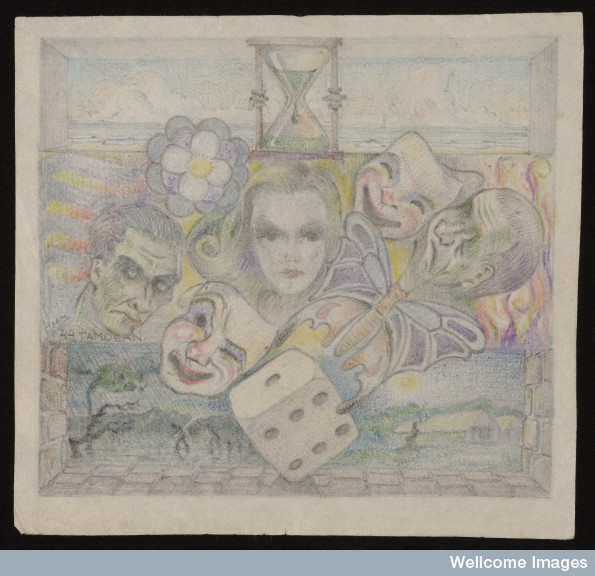
Item of the Month: Pencil drawings by an unknown Prisoner of War


The picture above was drawn in 1944, when the artist was interned in Tamuang camp, Thailand. This drawing, along with two others by the same artist, came to the Wellcome Library as part of a small collection of papers belonging to Dr. John Simpson. We do not know how Simpson acquired this drawings, but the signature is clearly not his. John Simpson was a Flight Lieutenant in the medical branch of the RAF. In late 1941 24 year old Simpson was posted to Singapore, which fell to the Japanese shortly afterwards.

From the time of his arrival in Singapore until June 1943, Simpson kept a record of his movements by making brief notes in his RAF ID. From this, we can see that he spent the first months of his internment being moved around between a total of six different camps within Indonesia. On 25th February 1943 he was put on board the former SS Kinta, one of the notorious hell ships, and transported to Thailand, via Singapore, to become one of the 60,000 allied POW's working on the Thailand-Burma railway.

Whilst he was a Prisoner of War, John Simpson treated his fellow POW's for conditions such as oedema and cholera, both of which were common results of the poor conditions within the camps. He recorded details of the patients he saw on scraps of paper. Unfortunately, however, the high turnover of people within the camps means that it is not possible to see how often his advice was followed, or what happened to his patients.

Despite a 6 month long battle with diarrhea in 1943, and an eighteen month bout of fever in 1943-1944, Simpson was one of the lucky ones. The Burma-Thailand railway was nicknamed the “Death Railway” because of the number of people who died during its construction, estimated to be over 100,000. The building of the Thailand–Burma railway is considered a war crime.

After the war, John Simpson returned home to Britain. He used his experiences of treating prisoners of war to write his thesis “A Syndrome of Painful Feet and Retrbular Neuritis Occurring Amongst British Prisoners of War in the Far East”, a copy of which is included in the archive.

Nothing is known about the fate of the artist.

The Wellcome Library Archives and Manuscripts department holds a number of items relating to the experiences of Prisoners of War in the Far East, including the papers of Cicely Williams, Surgeon-Captain John Allison Page, and the Royal Army Medical Corps.

Saturday, October 24, 2009

The Exhibition of Living Patients, 1881

A man with Lupus erythematosus. Watercolour by Mabel Green, 1902.
Wellcome Library no.
672807i

The International Medical Congress which took place in London in 1881 was the seventh in the series, sandwiched between the sixth congress in Amsterdam and the eighth in Copenhagen. It was a crystallization of the medical knowledge of the time. Some 3,000 people attended from every continent. The four massive volumes of its Transactions make fascinating reading for the historian, and no doubt also for the historically-minded clinician.

The organizers of the Congress decided to include among the attractions a museum in which specimens of one sort or another could be shown. These were mainly drawings, photographs and casts, but in addition there were two special exhibits. The renowned neurologist Jean-Martin Charcot (1825-1893) brought over from Paris a life-size wax model of a recumbent woman with locomotor ataxy and disordered joints, together with her preserved skeleton, illustrating one of Charcot's many clinical discoveries; and Jonathan Hutchinson, the chairman of the Museum Committee, organized an "Exhibition of Living Patients".

The Exhibition of Living Patients was something of an experiment, and it turned out to be a victim of its own success. It was allotted one of two rooms (the museum room and the boardroom) of the Geological Society, one of the Learned Societies which have been housed since 1874 in magnificent buildings around the courtyard of Burlington House on Piccadilly.


Right: Burlington House and Piccadilly. Wood engraving, Illustrated London news, 1873. The Geological Society's rooms are on the right of the entrance archway.

According to Hutchinson there was "confusion and crowding … Our exhibition was more popular than we had expected: every morning at the hour announced, the room filled. The weather chanced to be very hot [this was the first week of August], and as the room looked into Piccadilly, it was exceedingly noisy." One of the reasons for the noise was that, while the hubbub of Piccadilly entered through the open windows, not only did the doctors presenting their patients have to speak over it but at the same time visitors were continually jostling in and out of the crowded room. [1]

Left: Jonathan Hutchinson. Oil painting by W. Swainson, one of the artists who produced pathological illustrations for Hutchinson. Wellcome Library no. 45691i

For those who could get near it, the exhibition was evidently quite a sight. Beneath the chandeliers in the fine rooms sat seven patients with leprosy, four of them supplied by Hutchinson. Six patients with diseases designated as myxoedema sat in a row and "the peculiarities of their features, and the sameness in their peculiarities, became very conspicuous". There were also many cases diagnosed as Lupus, a disease which fascinated connoisseurs of clinical conundrums. In Hutchinson's words:

All the varieties of Lupus Erythematosus were plentifully illustrated by cases produced by Mr Malcolm Morris, Mr James Startin, Mr Waren Tay, and myself. Some of the cases were very exceptional ones. Several were of the form known as lupus sebaceus; and of these, two showed the remarkable tendency to occur in the concha of the ear (symmetrically) just where a group of glands is placed, which are often the site of comedones. Other exceptional forms of Lupus, especially Lupus of Mucous Membranes, and the punctate form known as Acne Lupus, were also illustrated. In several of these cases, portraits showing the state of the disease several years before were placed by the side of the patient, thus making the cases more than doubly instructive.

One of the visitors to the museum was the young Professor William Osler from McGill University in Montreal, who recorded his experience of the congress in the Canada medical and surgical journal [2]. Osler described the museum as follows:

For working purposes the Congress divided into fifteen sections, the meetings of which took place in the rooms of the various learned societies at Burlington House and of London University, and one or two other contiguous institutions. One of the most instructive parts of the congress was the Museum, held in the Geological Society's rooms. This consisted of illustrations of disease in the living subject, as well as a large assortment of rare and interesting prepared specimens. … Mr Jonathan Hutchinson had a number of cases each morning, and his demonstrations on leprosy, rheumatic arthritis and inherited syphilis attracted large audiences. Rare forms of skin diseases were exhibited by many of the leading dermatologists. The museum of specimens contained about 700 examples of interesting and rare illustrations of morbid anatomy. … The walls of the rooms in which the specimens were collected were covered with coloured drawings. Among the most remarkable of these was a set of watercolours by Sir Chas. Bell, illustrating gunshot and other wounds seen by him after Waterloo. Mr Hutchinson's enormous collection attracted particular attention, and illustrated most of the special departments in which he has become so famous. What struck me as most remarkable among them was a set illustrating eruptions due to iodide and bromide of potassium, particularly two portraits of a man, the subject of an extensive eruption of tuberous masses on the skin, many of them ulcerated. … Several beautiful coloured drawings by Raphael of Montreal were exhibited by our townsman, Dr Roddick. An excellent catalogue greatly facilitated the inspection of the specimens, and perhaps as much direct benefit to the working members of congress was obtained during the time spent in the museum as in any of the other departments.
The watercolour of a man with Lupus erythematosus shown above is one of twenty-six watercolours which have recently been acquired by the Wellcome Library and which are believed to be strays from Jonathan Hutchinson's "Clinical Museum", though their connection with Hutchinson is at present only circumstantial. The Oxford dictionary of national biography says of Hutchinson "His vast collection of pathological drawings was probably unequalled." The artist of this watercolour, Mabel Green, was one of the small band of artists who worked for Hutchinson. After Hutchinson's death in 1913 most of his watercolours were sold, and they were acquired in 1915 for the Hospital of Johns Hopkins University in Baltimore: the acquisition was celebrated by William Osler (by now Regius Professor of Medicine at Oxford) some thirty years after his first sight of them in Piccadilly. [3] They are now in the Institute of the History of Medicine at Johns Hopkins. The reason why the Wellcome watercolours did not join them is currently obscure. Another of them, also by Mabel Green, is shown below, and the catalogue records for all the 26 drawings in the Wellcome Library will be found in the Wellcome Library catalogue.
Watercolour by Mabel Green, 20 May 1896. Wellcome Library no. 675950i

[1] Transactions of the International Medical Congress, 7th session, London 1881, vol. 1, pp. 109-132

[2] Digital page-images of the Canada medical and surgical journal are available free online in the corpus Early Canadiana Online (ECO, http://www.canadiana.org/ECO ), produced by Canadiana.org. Osler's paper describing the Congress is at http://www.canadiana.org/view/8_05177_110/58

[3] William Osler, 'The Jonathan Hutchinson iconography: a preliminary note', The Johns Hopkins Hospital bulletin, vol. 26 (1915), no. 289, pp. 82-83

Thursday, July 2, 2009

Apple pie order

Ayurveda all in a row
The Wellcome Library is closed this week (29 June-5 July) to enable the staff to carry out numerous stocktaking and ordering projects for the benefit of its users. For example books on the open shelves inevitably get out of order during the year and need to be put back into sequence.

Essentials of fevers

The Library has a formidable collection of old textbooks on selected medical subjects. Browsing the open shelves is in itself an education in medical history, provided the books are in the correct order: the sort order is first subject and then date. The order enables one to pinpoint changes in thought and vocabulary, for example from "fevers" to "communicable diseases".


Revising in hospital, by Moyra Sheldon. Wellcome Library no. 532906i

Moyra Sheldon was a medical illustrator at Addenbrooke's Hospital in Cambridge around 1971. The Wellcome Library has had since 2001 a sample of her drawings, and Closed week has provided an opportunity to get this collection into order. It shows the range of work that an illustrator might be called on to carry out in a teaching hospital, whether illustrating research papers for scientists or creating posters for common rooms.


All done by hand of course -- no Apple Macs or Clipart in those days. Some of the subjects are always with us: a broken leg does not excuse a young patient from maths revision when exams are imminent(above). By contrast this drawing (right) of a 1971 hippy is a real period piece.


"Then there are the ones my doctor gives me". Pen and ink drawing by Moyra Sheldon, 1971. Wellcome Library no. 532906i


This is the time of year for work experience placements (interns). Thanks to Lydia Figes, Mae Hazell, Artan Perjuci and Isabel Errington for their help with the above and similar projects.

Tuesday, April 28, 2009

Centenary: Stacey Hopper, born 28 April 1909

The artist Stacey Hopper was born exactly 100 years ago, at Aberaman, now part of the town of Aberdare, South Wales, on 28 April 1909. Thousands of people will have seen his work without knowing his name. His claim to fame is that, in the role of cartoonist and illustrator, he saved many Allied soldiers in World War II from the horrors of such diseases as malaria and syphilis, and thereby played a part in the Allied victory.
Left: Mussolini and Hitler. Wellcome Library no. 583972i

The Wellcome Library has two collections of Stacey Hopper's works, one from the Royal Army Medical Corps and one from Stacey Hopper himself; the latter was acquired from his family in 2003, together with valuable contextual information about his life and work. Other works by him are in the Imperial War Museum and the National Army Museum in London.

Before the war, Stacey Hopper taught art in Ealing and was an accomplished caricaturist. In 1934 he published a caricature "The origin of the Nazi salute" which was reproduced in newspapers at home and abroad: it showed the Nazi salute evolving from the action of Hitler holding up a paintbrush when painting. Stacey Hopper was called up and joined the Royal Corps of Signals in August 1941, and was initially posted to Prestatyn, North Wales. In November 1942 he was among the troops sent to Algeria. There his artistic ability and sense of humour brought him to the attention of Major General Ernest Cowell, who asked him to help with health promotion for the Army Medical Department (the initials "AMD" appear on many of his works).

In Algeria the main problem was malaria. The disease was attacked in several ways. In the first place it was necessary to get into the minds of soldiers that mosquitoes were vectors of disease. As the Australian hygiene expert Neil Hamilton Fairley impressed on General Wavell, there was a danger of losing more men through malaria than through military casualties at the hands of Hitler and Mussolini.


These mosquitoes (right) discuss sucking blood from the troops as if they were ladies discussing tea at the Ritz.
Wellcome Library no. 584189i


Practical measures included blocking off the mosquitoes' breeding grounds, for example by excluding them from the latrines …

Wellcome Library no. 584263i

Another method was to spray everything in sight with "Paris Green" (copper (II) acetoarsenite), a toxic substance used as an insecticide …

"But he distinctly said - spray every drop of water and all the female adults".

Above: Wellcome Library no. 584264i

The medicine of choice against malaria was Atebrin, which was strongly supported by Hamilton Fairley and eventually replaced quinine as the main prophylactic against malaria. However, compliance was so difficult to enforce that eventually officers were ordered to place the pills in the men's mouths themselves. This exercise (below) in the style of H.M. Bateman refers to Atebrin.

"Tablet day -- the man who forgot". Wellcome Library no. 584428i


In November 1943 Stacey Hopper was promoted to Second Lieutenant and took part in the invasion of mainland Italy. Some wash drawings by him in the Wellcome Library record the bringing of casualties by air from the Anzio campaign in Lazio to Capodichino airport near Naples. This example, dated Naples 1944, shows the wounded being carried by stretcher-bearers into a tent where they are served with mugs of tea by the Red Cross. A lot of casualties are anticipated, for the first arrivals are being laid down at the back of the tent, and the tea urn and a quantity of mugs are on a table near the front. After tea, they were taken by ambulance to military hospitals for treatment. Above left: Wellcome Library no. 583973i

As the troops fought their way northwards towards Rome, Stacey Hopper's artistic skills were again called on to protect the troops, no longer from malaria but from typhus and dysentery.


Left, Wellcome Library no. 585129i. Above, a detail from it.


Right: Wellcome Library no. 585148i


And as Italians went over to the Allies in the areas liberated from the Axis, thought was given to Italian women who were infected with sexually transmitted diseases by Allied soldiers. Right: Wellcome Library no. 585150i


It was also now in the Allies' interest to make sure that Italian cooks recruited to serve the troops obeyed the stricter hygiene regulations that were required when catering for large numbers. Left: Wellcome Library no. 585122i


Having returned safely from the war Stacey Hopper returned to his pre-War profession as a teacher of art, at first in Ealing in West London and later in Somerset. He also continued to produce caricatures for publication, especially of popular entertainers and of actors in the West End theatres: his work was published in the Musical Express. He died in Bristol on 6 February 1996.

Works by Stacey Hopper are in copyright and are reproduced here under a licence granted to the Wellcome Library.