Thursday, May 17, 2012
Norway in archives and manuscripts
Given Sir Henry Wellcome's interests in travel and exploration it is perhaps not surprising that Norwegian Polar explorers are to be found represented in the Explorers Cuttings Books among the archives of the Wellcome Foundation and that there is correspondence with Otto Sverdrup in the 1890s about the gift of Burroughs Wellcome products in Private Letter Book 2, besides substantial materials relating to the marketing of pharmaceuticals in the Nordic countries at a rather later date. We can also note the acquisition of artefacts relating to medicine in Norway by the Historical Medical Museum, and the mention of several institutions there as recipients of transferred museum objects in the 1980s.
Records of British travellers to Norway can be found from the late nineteenth century, from individuals such as Charles Brodie Sewell, whose travel diary of a trip to Norway in 1888 can be found at MS.4512 (his very extensive documenting of his travels was described in an earlier post on this blog), and Sir Thomas Lewis, who made a hunting trip there c. 1900 (PP/LEW/B.2), to groups such as the Travelling Surgical Society, which visited Oslo and Bergen in 1949 (SA/TSS.2/17) and the Medical Pilgrims, whose Norwegian 'pilgrimage' took place in 1982 (SA/PIL/A.2/2). It also formed a popular venue for numerous conferences throughout the twentieth century, for a wide assortment of groups including district nurses, midwives, health visitors, women doctors, microbiologists.
The persistence of leprosy in Norway after it had died out in the rest of Europe is reflected among the papers of leading leprologist Sir Leonard Rogers (PP/ROG/C.13/7).
The papers of Lieutenant-Colonel J.W. Wayte, RAMC, among the Royal Army Medical Corps Muniment Collection, include his War Diary as officer commanding 189 Field Ambulance during evacuation from Norway, April-May 1940, and an appreciation of the operations in April 1940 from a medical viewpoint (RAMC/1952/2-4). The papers of Papers of Brigadier Sir John Knox Smith Boyd also include, among other reports from blood transfusion teams in the field, those of North West Europe force in Norway, 1940.
Records of a number of organisations among our holdings contain material relating to their interactions with Norwegian counterparts and collaborators.
This little exercise not only illuminates our holdings specifically relating to Norway, it indicates the extent to which material in A&M is very far from being relevant only to the UK and that it has a significant geographical reach reflecting connections with continental Europe as well as the Americas and areas formerly part of the British Empire.
Friday, March 9, 2012
War and the psyche
![]() |
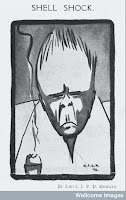
| Lt J P D Hewatt, 'Shell Shock', 1917 |
We already held some important materials on these latter subjects, such as the observations by Charles McMoran Wilson, later Lord Moran, of the new phenomenon of 'shell shock' on the Western Front during the Great War, material in the Bowlby and Winnicott papers on the effects of wartime evacuation on children, records of S H Foulkes' work with the 'Northfield Experiment' during the Second World War. However, a number of more recent acquisitions, such as the papers of H V Dicks relating to his involvement in 'de-Nazification' of Germany after the war and his writings on the psychology of totalitarianism, and several collections of papers of individual psychologists received along with the records of the British Psychological Society have additionally developed our strengths in this area and this is reflected in the creation of this new guide.
This turns out to be especially timely given the news of this forthcoming event, Psychoanalysis in the Age of Totalitarianism, bringing together historians, social theorists and psychoanalysts to explore the impact of the Second World War and totalitarianism on psychoanalysis, and of psychoanalysis on the understanding of the war and totalitarian systems. Organised under the auspices of the Institute of Psychoanalysis, the Pears Institute for the study of Antisemitism (Birkbeck, University of London), Birkbeck College, University of London, and the Centre for Psychoanalytic Studies of the University of Essex, it will take place in the Wellcome Collection Conference Centre, 21-22 September 2012.
Saturday, June 25, 2011
The lost world of Snow Hill

The image above captures the popular conception of London's reaction to the Blitz, which was arguably at its most fearsome during May and June 70 years ago. During the night-time bombings, lives were lost and buildings were destroyed. But come the morning... a cyclist trundles by, a roadsweeper brushes up: life goes on.
The remains of the building you see here are actually enormously important to the story of our founder Henry Wellcome, as this is the corner of Snow Hill and Holborn Viaduct in London, the site of the head office of the pharmaceutical company he co-founded, Burroughs Wellcome & Co.

Opened in 1883, three years after Silas Mainville Burroughs and Henry Wellcome entered into partnership, the scale of their head office matched the expectations Burroughs and Wellcome had for their nascent pharmaceutical company.
The imposing building was constructed of red brick, with granite pilars guarding the entrance. The tiled mosaic floor of the was illustrated with images of Commerce and Industry and the rich wood used for the walls was best American Walnut. [1]

Henry Wellcome was personally involved in designing and furnishing the interior of the building: no easy task given the building's curved shape. As the image above shows, Moorish curves were ideal for a building Wellcome himself described as having "not a single right-angle". The interior arrangements were executed under the direction of Christopher Dresser, now regarded as Britain's first industrial designer. Snow Hill was also one of the first business houses in London to be lit using electric light.
The interior alluded to Burroughs and Wellcome's country of birth with models of the Statue of Liberty and the American Eagle (visible towards the back of the image above) and the building captured something of the entrepreneurial get-up-and-go of these two salesmen.
The building also hinted at another aspect of Wellcome's personality: his growing interest in collecting. This is how Wellcome's office was described in a praiseworthy report on the building in Chemist and Druggist:
"It is furnished as a library, although hunting trophies, works of art from countries visited by the occupant...and a varied selection of general literature give it less the look of a commercial room and more the appearance of a bachelor's den". [1]
Fast forward to 1941 and it seems this example of late Victorian architecture was no longer fit for the purposes of twentieth century business: five years after Henry Wellcome's death, the Wellcome Foundation still retained Snow Hill as offices, but sought to build new premises elsewhere in London.
On the night of 10-11 May 1941, during one of the heaviest nights of the Blitz, the Snow Hill building was destroyed. Afterwards, staff were temporarily moved to other Wellcome owned sites - such as the main warehouse where Wellcome's collection was stored in Willesden and to the Wellcome Research Institution on Euston Road (which is now, of course, where the Library and the rest of Wellcome Collection is situated). Not ideal accommodation, but just as for the figures beside the bombed out Snow Hill offices shown above, life had to go on for the employees as well.
But with its carefully designed interior - and his collection-rich office - the lost world of Snow Hill captures something of Henry Wellcome's - often elusive - personality.
[1] Clues to the furnishings of the Snow Hill office remain through drawings which survive in the papers of the Wellcome Foundation Archive, WF/CA/P/01
[2] Chemist and Druggist, 28th January, 1888
Images:
- Burroughs Wellcome & Co Headquarters, Snow Hill, London, after being destroyed in the Blitz, 1941 (Wellcome Images, M0020173)
- Burroughs Wellcome & Co Head Office, Snow Hill, London (Wellcome Images, M0007868)
- Interior of the Burroughs Wellcome & Co building, Snow Hill, London (Chemist & Druggist, 28th January 1888)
Friday, June 3, 2011
Archives and manuscripts cataloguing, May 2011
May was, for the most part, a month of steady progress in the Archives and Manuscripts department, with several collections in train but the majority carrying on into June rather than being completed within the month. Nearly 400 records were added to the online database before the month's end. The majority remain invisible for the moment, awaiting the completion of the projects to which they belong, but May did see the release of several noteworthy sets of papers, now available for study in the Wellcome Library.Our long-running project to repackage and make available material deposited here by the British Psychological Society passed another milestone, with the papers of Charles Wilfred Valentine (1879-1964) (PSY/VAL) being made visible in the database. Valentine was a specialist in educational psychology (and a life-long friend and colleague of Cyril Burt) and many of the papers relate to child development. In some tests, for example, he tracked the reactions of infants from birth to the age of three, monitoring such things as whether the sound of a ticking watch obtruded on their attention enough for them to stop feeding and whether this changed over time. He also wrote on the psychology of aesthetics, and on dreams. One particularly interesting section of the collection comprises notes kept by his one-time research student, Kenneth Davies Hopkins (d.1942). Hopkins, a Birmingham teacher, studied for an MA in Education under Valentine's supervision in the 1930s. A Territorial Army officer, he served in the Second World War and was captured in northern France in 1940. Whilst interned as a Prisoner of War, he embarked on a project to record his dreams and those of his fellow PoWs, with Valentine's encouragement. (Prisoners of war, with all too much time on their hands, undertook many scientific projects during the Second World War: much pioneering work on bird behaviour, for instance, dates from this time.) Sadly, Hopkins died of a lung condition in a PoW camp in 1942; his notebooks were found when the Allies took control of the vacated camp in 1945, and sent to Valentine. The Library is pleased to make them available now, as a small tribute to Major Hopkins' determination to continue scientific work under the most unpromising of circumstances.
War is a leitmotiv of this month's new material: another major tranche of papers relates to the Strangeways Research Laboratory's work during the Second World War. The papers form part of the existing SA/SRL collection of papers from the laboratory (SA/SRL), described as a new section M. The Laboratory spent the war researching substances that might be used in chemical warfare, and agents that might counteract them, in collaboration with the War Ministry's Porton Down Laboratory. An earlier blog post has described these papers in some detail.
On a lighter note, MS.8767 takes us travelling in nineteenth-century Italy. It comprises an account of a journey undertaken in 1855 by C.J.W. Bosanquet, whose identity remains unknown. Starting in Milan, Bosanquet takes us eastwards to Como and the Lakes, then into Switzerland and via Geneva to Lyon; he records sights seen, the weather, his experiences with officials when crossing borders, and religious reflections inspired by all of these. Drinkers of bottled water may be a little unsettled by his note that "We slept at a dirty little place called Evian." We can only applaud his taste, however, in how he opens the journal: its first words are "There are some very curious manuscripts in the Library." There are indeed; and several more are now available to be seen in the reading room.
Image: the travel journal of C.J.W. Bosanquet, 1855, showing geological formations near Geneva (MS.8767).
Thursday, May 19, 2011
The Strangeways Laboratory, ‘The Mustard Club’, and Honor Fell’s ‘aliens’

You may remember that when the Mustard Club met here last time we were asked to provide some chemical or physical proof that the globules which entered the cells of our cultures were really mustard.
Honor Fell, Director of the Strangeways Research Laboratory, wrote this to Sir Joseph Barcroft on 6th May 1940. She was not alluding to the wildly successful organisation for the promotion of the condiment devised by the novelist Dorothy Sayers while working at Benson’s advertising agency. With the outbreak of World War II, along with other war-related projects, the Strangeways undertook research, using their pioneering techniques of tissue culture, on the biological action of toxic gases used in chemical warfare, including ‘mustard gas’, so widely deployed during the Great War, in collaboration with other institutions, specifically the Ministry of Supply Chemical Defence Research Department’s Experimental Station at Porton. Fell was also in correspondence with Professor R. A. Peters in Oxford, whose related work on British Anti-Lewisite can be found in GC/197.
The archives of the Strangeways and the papers of Honor Fell and her colleague F. G. Spear have been available in the Wellcome Library for nearly two decades and an article on them was published in Medical History in 1996. Archives and Manuscripts fairly recently received an additional accession of the files relating to the Strangeways’ war work and other government-sponsored research in the 1940s: these have now been catalogued as SA/SRL/M.
Work under wartime conditions and the constraints of official secrecy raised numerous practical problems. By March 1940 Honor Fell was becoming rather anxious about the safety of the increasing accumulation of top secret documents and reports relating to the project, and wondered whether locked cupboards inside locked rooms were adequately secure. She asked Lord Rothschild whether the Ministry of Supply could provide them with a small safe. She also asked him whether he was able to procure for them a small sloughed snake skin to their experiments:
I am sorry to trouble you about this, but it would be rather difficult for me to get hold of the material without being asked awkward questions.
(Rothschild’s contacts at the Zoological Society of London did in fact expeditiously produce an ‘almost complete’ garter snake skin.) They also had to ask permission to discuss research matters with individuals who were not already on the approved list. In November 1940 the Ministry of Supply suffered losses through enemy action and had to request Fell to send copies of documentation. Acquiring the necessary equipment and its maintenance in adequate working order also presented problems, as the long-drawn out saga of gaining access to a functioning absorptiometer in the face of competing claims to the few available indicates.
As well as the general concerns over preserving the secrecy of the work Fell and Allsopp were doing, for which guarantees had to be provided, the Strangeways during the 1930s had come to employ a significant number of refugee scientists. Honor Fell’s concerns over her ‘aliens’ and her desire to protect them is reflected in this correspondence. In Jan 1939 she wrote to the Director of Military Intelligence refusing to supply information about ‘the aliens in this laboratory’, having learnt from Lord Rothschild that this was in order that the aliens in question could be secretly supervised by military police:
Since these people are not only my colleagues but personal friends in some cases of long standing, the idea of assisting in this matter is extremely distasteful to me… I believe that I am under no legal obligation to supply the information and I am prepared to guarantee the reliability of anyone in my department and to accept full responsibility for them.
She added that scrupulous care was taken to preserve secrecy about the work they were doing for the Ministry of Supply, with only staff who had signed the Official Secrets Act having access to the relevant laboratories.
For a significant period Fell was deprived of the assistance of ‘my aliens’, who had been carrying on the non-secret research in which the Laboratory continued to be engaged but by late 1940 the Ministry of Supply was able to get the Aliens War Service Department to give them provisional permits enabling their return. By the end of 1942 they were even providing indirect assistance to the secret work by translating an ‘immensely long’ scientific paper in German which Porton were anxious to have for reference.
An unexpected outcome of the research into agents of chemical warfare and the means to counter their effects during the Second World War was the discovery that some of them had therapeutic uses.
An extensive sources leaflet provides further information on War, Medicine and Health at the time of the Second World War and a number of other collections illustrate the important contributions of refugee doctors and scientists.
Wednesday, May 11, 2011
Archives and manuscripts cataloguing, April 2011
It’s (almost) all in the mind: the focus of this month’s completed cataloguing is largely on the mind, on psychology and psychiatry. As has been mentioned in previous blog posts, the archives of the British Psychological Society have been deposited at the Library and there is a long-running project making these available: the material is being repackaged in acid-free folders, and the catalogue records updated to take account of its new format. Last month we highlighted several collections from this source that had been released and this month another became available: papers relating to the behavioural psychologist Edward Chace Tolman (1886-1959) (PSY/TOL). Tolman’s papers are described in detail in their own blog posting; of particular interest are the items relating to his work on rats learning in mazes and, in complete contrast, those on his political stance during the McCarthyite period in the USA, when in the interests of academic freedom he took legal action against the imposition of a Loyalty Oath.Remote on the spectrum from Tolman’s behaviourism is the work of Roger Money-Kyrle (PP/RMK), a leading Kleinian psychoanalyst with personal links to many other figures already documented in our holdings (for example, Melanie Klein herself, and Henry Dicks whose papers were recently released and described in another blog post). Money-Kyrle’s papers have been described here; the bulk of them consist of case histories and his development of these into writings.
Turning from the mind to the brute physical facts of war, this month the archives and manuscripts department acquired and catalogued a fascinating memoir of service by a woman doctor in the Second World War. Dr Muriel "Molly" Newhouse is primarily remembered for her work in occupational health and in particular establishing the connection between asbestos and mesothelioma: however, like many other medical men and women she found herself in 1942 (having qualified in 1936) called up into the Royal Army Medical Corps. Her unit followed the D-Day forces into Normandy and, as is described in a blog post, she found herself called upon to treat the sick, carry out surgery and on at least one occasion plunge into midwifery, delivering the baby of a local farmer’s wife. In her time in Normandy she never went more than seven miles inland: subsequent postings took her further afield, to India and to Singapore, where she cared for prisoners recently released from the horrific conditions of Japanese PoW camps. A blog post has described her memoir, and the item itself can be viewed in the catalogue as MS.8766.
Image: Fowler's phrenological head, from Wellcome Images (image number L0057592).
Tuesday, May 3, 2011
Roger Money-Kyrle papers
Archives and Manuscripts is extremely pleased to announce that the papers of the eminent Kleinian psychoanalyst, Roger Money-Kyrle are now catalogued and available for research, subject to certain Data Protection restrictions on parts of the collection.Money-Kyrle (1898-1980) had an extremely distinguished analytic pedigree, having been analysed by Ernest Jones and Freud, and later on by Melanie Klein. His initial interest in psychoanalysis was spurred by a belief in what it could contribute to understanding of wider questions of politics, economics, and society in general. He acquired two PhDs – one, working in Vienna, while also undertaking analysis with Freud, with Professor Morris Schlick, on ‘Contribution to the Theory of Reality’, and one at University College London working with Professor J C Flugel, on ‘The Meaning of Sacrifice’. The collection includes two boxes of papers relating to this early, largely philosophically and anthropologically-orientated, work. Although Money-Kyrle was elected an associate of the British Psycho-Analytical Association in 1928 this was on condition that he did not practise.
During the 1930s he published a number of books and articles developing his ideas relating psychoanalysis to wider social issues. In 1936 he was persuaded by John Rickman to undertake a training analysis with Melanie Klein, and in 1945 he became a full member of the British Psycho-Analytical Association, started seeing analysands, and subsequently also qualified as a training analyst.
During the War he was employed at the Air Ministry (he had served in the Royal Flying Corps in World War I). After the War he joined Henry Dicks in Germany, working with the German Personnel Research Branch, which was concerned with identifying individuals who could be trusted to build up the new Germany following the fall of the Third Reich. There is a small amount of material in the collection relating to this period.
The bulk of the collection, however, consists of case histories, and Money-Kyrle’s development of his ideas in his writings. There are many notes and drafts and early versions of material that was later published in various forms. There is a little personalia, some correspondence with colleagues, and a few files relating to professional organisations with which he was involved, including the Melanie Klein Trust. The collection also includes correspondence and drafts relating to his role in editing the special issue of the International Journal of Psychoanalysis to mark Melanie Klein’s 70th Birthday, and the volume New Directions in Psychoanalysis (1955), an important statement of the thinking of the Kleinian school.
The survival of Money-Kyrle’s papers appears to have been somewhat haphazard, and there are a number of lacunae in the materials here. However this is an important collection of papers of a key figure in the promotion and development of Klein’s ideas and also shows his interactions with a number of other colleagues. It adds to our existing strong holdings in this area.
Tuesday, April 26, 2011
A woman in wartime: Molly Newhouse

Newhouse records that in 1942 she was intending taking a post as a medical officer at an ordinance factory - 'undoubtedly extremely worthy war work, but considerably dull' - when she was called up for the RAMC, She thus spent 4 years in the Army without any great enthusiasm, but found herself later looking back 'with amusement and affection' on those years and thus wrote this memoir.
As a woman she was very much in a minority in the RAMC, but claims to have found 'very little prejudice' on account of her sex, and that 'the Doc's word, man or woman, was law'. There was apparently some hostility among officers of the ATS towards women medical officers, at least partly due to the fact the latter were entitled to wear a cross strap to their Sam Browne, a privilege not accorded to the ATS.
Wednesday, April 6, 2011
Archives and Manuscripts cataloguing, March 2011
Last month's archive cataloguing saw the release of three complete archive collections, as well as various manuscripts and supplementary items. The highlights are described below.John Wilson Boag (1911-2007), radiation physicist and peace campaigner: papers of the influential radiation physicist and peace campaigner Jack Boag (1911-2007) were transferred to the Library last month thanks to the good offices of his colleague, G. Gordon Steel, the National Cataloguing Unit of the Archives of Contemporary Scientists and the Centre for Science Archives @ The Science Museum. With radiation hitting the headlines for all the wrong reasons recently, it is timely that the Library is releasing a new archive collection on this topic, which takes its place beside our other archive resources on radiology, radiotherapy and radiobiology. Although a rather patchy representation of Boag’s career, the eight boxes of his papers do contain interesting material relating his early work at the Radiotherapeutic Research Unit, Hammersmith Hospital in the 1940s-1950s, and later research, including at the Institute of Cancer Research; in addition, material relating to lectures and papers that Boag gave during the 1990s on the history of x-rays and radiation dosimetry. (PP/JWB)
Captain George Blair, RAMC (1917-1979): material mainly relating to Blair's service in World War II and period as a prisoner of war of the Japanese: letters to and from family members, friends and relatives, personal documentation, photographs, and bound copy of a typescript thesis by Blair on malnutrition among PoWs in the Far East. The letters from him to his family give some details of his experiences, though some correspondence takes the form of preprinted formulaic postcards. His family and friends' letters give details of life on the home front and in other parts of the world. His sister Lydia's letters often mention her experiences as a Kitchen Supervisor at King's Cross Hospital, Dundee. (PP/GBL)
Otto Neubauer (1874-1957), German biochemist: papers relating mainly to his experiments on liver and kidney function prior to his leaving Nazi Germany for Britain. (GC/207)
Sir John Robert Vane (1927-2004), pharmacologist: two audio visual items were added to Vane’s papers, both recordings on CD: namely, a 1960 Ciba Foundation symposium (PP/JRV/F/8), and the speeches made in 1955 at Sir Henry Dale's 80th birthday dinner, 1955 PP/JRV/F/9), which include numerous anecdotes on the history of physiology and physiologists.
Adolf Stempel (fl.1868-1882): gymnastics notebook, giving highly detailed and numbered instructions on gymnastic excercises, movements and floor routines to be performed, and information on various events and competitions in London (including at the Orion gymnasium and the Bow and Bromley Institute). The notebook also includes several intricate diagrams for the excercises. (MS.7981)
Anna Maria Meysey of Shakenhurst Hall, Worcestershire: domestic recipe book including medical and culinary material and also instructions for household tasks (including one how to wash silk stockings). Late 18th – early 19th century. (MS.8685)
8685)
German Household Remedy Book: 17th century medical recipe book and herbal including recipes for cures for common illnesses and for veterinary medicine; also various remedies for the plague. The herbal section includes information on the properties of quinces, lemons, lime, aloe and sage, as well as herbs from the New World such as sarsaparilla. (MS.8454)
“Chyromancy or Palmestrye. Also Physiognomy and Metoposcopie”: an English manual of practical chiromancy or palmistry dated 1648, which will be described in more detail in a future blog post. (MS.8727)
In addition, as noted previously, work continues on the retroconversion of the Chartered Society of Physiotherapists catalogue (SA/CSP). Finally, in an earlier posting we flagged up the impending release of the final tranche of Francis Crick's papers (PP/CRI). There has been a slight change of plan here: the catalogue is completed but rather than release them at once the opportunity is being taken to digitise the papers immediately, bringing them forwards in our digitisation schedule, which means that there will be no need at a later date to take them out of circulation again for 2-3 months, as has been the case for the other Crick material to be digitised, and thus once this material is finally opened to the public it will stay opened. As soon as photography is completed these papers will be released, and an announcement will be made on this blog to herald the end of this long-running project.
The image of the X-ray warning sign at the head of this posting comes from Wellcome Images, image no.C0022404.
Saturday, January 1, 2011
Their finest hour: Lord Moran papers open for study
In May 1940 Sir Charles Wilson (1882-1977) received a summons from the War Cabinet: he was to become the personal physician of Winston Churchill, who had become Prime Minister just two weeks before. The health of a political leader is always important; when he is in his mid-sixties and has taken office at a time when nothing less than national survival is at stake, his every move, cough or dizzy spell is a matter of historic importance. For the next twenty-five years Wilson – who became Baron Moran of Manton in 1943 – was Churchill’s doctor, until doctor and patient were in their eighties and nineties respectively and Moran had long retired from any other practice.Moran was thus privileged to have a front-row seat at the making of history; and we, decades later, are lucky that it was this man who filled the seat. Moran’s life was marked by an almost Puritanical commitment to honesty, to facing facts squarely (he was described, according to his DNB entry, as “a Roundhead among Cavaliers” in Churchill’s circle) and by an unwillingness to play the game of medical politics even at cost to his career. When summoned by the War Cabinet, he was Dean of the medical school at St. Mary’s Hospital, Paddington, and a Harley Street physician (counting among his patients both Brendan Bracken and Lord Beaverbrook, both Churchill confidantes: hence his appointment); he was, however, poor by Harley Street standards and had long looked forward to the establishment of some form of National Health Service, coming into conflict with his fellow-professionals over this. Like many of the men who directed the Second World War effort, he brought to it memories of the First: he had served in the front line as a member of the Royal Army Medical Corps and become fascinated by issues of morale and courage, of how it is that one man could endure shattering bombardment and pitched combat whilst another collapsed under the strain. His notes on this subject formed the basis of lectures on “The Mind in War” in the 1930s and eventually of his 1945 book The Anatomy of Courage. He was, therefore, ideally placed to study and analyse the effects on Churchill of long-term stress, and whilst he regarded his patient as the greatest Englishman since Pitt the Elder (see, again, his DNB entry) he was clear-eyed about Churchill’s character failings or lapses of behaviour.
Controversially, Moran published a book of his experiences not long after Churchill’s death: Winston Churchill: the Struggle for Survival, 1940-1965 (1966): his commitment to honesty and in this instance to capturing his observations for the historical record taking precendence over what was prudent in terms of his popularity. The manuscripts on which Moran drew for this book have remained closed for sixty years after their creation (the closure was initially a condition stipulated by Moran’s family when his papers were deposited at the Wellcome Library and of course has been sharpened subsequently by the passage of the Data Protection Act, some thirty years after Moran published his work and sixteen years after the papers were deposited). Now their closure period begins to elapse: last year one notebook was released (along with two other files relating to medical administration) and today a major batch of drafts relating to the war becomes available for study, along with other papers from Moran’s archive (full listing below). Over the next fifteen years there will be a steady flow, until, by 1st January 2026, the majority of the Moran papers will have been opened (a few papers containing detailed medical information will have longer closure periods).In the papers released today, we read Moran’s accounts of journeys to Canada to meet Roosevelt and to Casablanca for the first big conference of the three Allied leaders, Churchill, Roosevelt and Stalin. The interpersonal tensions between men stretched to the limit are clear. Stalin is particularly difficult to work with, as one would imagine:
“As for the twelve different items the Allies had in mind to put on the Agenda [for the Casablanca summit], Stalin brushed them aside: they did not interest him, he said in his rude way.” (PP/CMW/K.5/1/2)
Closer to home, another ally proves hard to take for the stressed Prime Minister:
De Gaulle is another story, for he does seem to go out of his way to be difficult. He first dawned on me in the hall at Chequers when he was about to leave for London; an improbable creature, like a human giraffe … he seemed to sniff down his nose at mortals beneath his gaze. … The P.M. is a bad hater, but in these days when he is stretched taut certain people seem to get on his nerves. De Gaulle is one of them. His cold austerity chills him. (PP/CMW/K.5/1/1)
Churchill himself is examined closely, in passages written towards the end of the conflict when Moran takes stock of the traits of character that both helped and obstructed the war effort: the supreme self-confidence that enabled Churchill to take on and hold the responsibility of wartime leadership leading also to problems in his management of his subordinates. In a particularly revealing file, PP/CMW/K.5/5/1, we read
While he could concentrate for six hours at a stretch on intricate documents and feel at the end of it that he was just beginning the night’s work … he also had grave disabilities which added to the strain. He had no gift of devolution. He liked a finger in every pie. Rowan [Leslie Rowan, Churchill’s private secretary] complained at Potsdam that he could not get the P.M. to read important papers and yet he would not hand over anything…
Perhaps Winston found that when he did choose a man to do a job of work he so often let him down. For he had no gift of picking people. It was his Achilles heel… he is always losing opportunities of learning by his desire to instruct, or at any rate by his urge to lay down some proposition. That is the secret of his inability to pick the right people, he isn’t interested in them.
Later in the same file Moran quotes Clementine Churchill as saying that "Winston has all his life been surrounded by charlatans and quacks", with "Brendan [Bracken] and Max [Aitken, Lord Beaverbrook]" cited as examples.When Moran published his memories in 1966 Churchill the war hero was still fresh in people’s memories and the candour of his physician was bound to be controversial. Yet the picture that emerges from the book and from these manuscripts, scribbled with corrections, jottings and fine-tunings, is a more human one and in the end – as Moran himself asserted – one that if anything adds to our admiration of the wartime leader. What we see here is a man stretched to the limit, dealing day by day with matters of global significance, driving himself on without rest and – let us remember – someone who does not have the benefit of hindsight and unlike us does not know that the story will come to a victorious conclusion. That he should be fallible is human; the character failings that Moran notes are, as he surmises, perhaps inevitable concommitants of the self-confidence and drive that made it possible to take the job on in the first place. In Moran’s papers we can see the sheer human wear and tear of life at the nerve-centre during the nation’s finest hour; catch our breath, and wonder how we might have measured up. It is our good fortune that these pivotal years in the nation’s history were recorded by this clear-eyed observer and that he captured his impressions for us.
Items from the Moran papers opened today:
Lord Moran papers
PP/CMW/D.1/2: Minutes, 2nd-4th meeting, 22 Jul, 29-30 Dec 1949 and 17-18 Jan 1950; 1949-1950.
PP/CMW/D.1/3: Agendas and minutes, 5th-13th meeting; Jan-Dec 1950.
PP/CMW/D.2/1: Official lists of consultants and proposed awards (papers A3-A7, A12-A16); Jan-Feb 1950; Also lists of regional hospital boards, chairmen of medical committees of teaching hospitals and notes on grading of specialists.
PP/CMW/D.2/2: Further official lists of doctors and recommended awards with associated documents (papers A21-24, A28-29, A31-33); Feb-Mar 1950.
PP/CMW/D.2/3: Review of the Committee's Work up to June 1950' (Paper A35); Jun-50.
PP/CMW/D.6/1/2: Lists for London regions, some headed 'not on photostat list', surgeons (carbon typescript) with covering letter to selectors Jan 1950, paediatricians (carbon typescript), general medicine (carbon typescript), lists of surgeons (pencil manuscript, not Moran); c.1950.
PP/CMW/D.6/2: Schedules of consultants listed by speciality for Professional Assessment Committee; c.1949-1950.
PP/CMW/D.6/2/1: South East metropolitan region, with recommendations; c.1949-1950.
PP/CMW/D.6/2/2: South West metropolitan region, annotated by Moran with recommended grades; 1950.
PP/CMW/D.6/2/3: North West metropolitan region, Supplementary list, annotated by Moran with recommended grades; 1950. .
PP/CMW/D.6/3: 'Results of 1950 Voting'. Manuscript lists, annotated by Moran, for Birmingham, Bristol, East Anglia, Leeds, Liverpool, Manchester, Newcastle, Oxford, Sheffield, Wales and London regions; 1950.
PP/CMW/D.6/4: Surgeons. Lists of recommendations by Association of Surgeons and Royal College of Surgeons; 1949-1950.
PP/CMW/D.6/5: Whole-time clinical teachers. Lists and manuscript notes by Moran; 1950.
PP/CMW/D.13/1: 1950 (?) Awards; 1945-1950.
PP/CMW/D.13/1/1: Bristol, Sheffield, North East, North West, South East Metropolitan Regions, Association of Surgeons (with partial index); 1949-1950.
PP/CMW/D.13/1/2: London Teaching Hospitals (with index); 1949-1950.
PP/CMW/D.13/1/3: 'Faculties', Anaesthetics, ENT, Orthopaedics, Radiology, Ophthalmology, Royal College of Surgeons and Royal College of Physicians recommendations. All areas; 1945-1950.
PP/CMW/K.5/1/1: Casablanca (1st Version, with Sir Desmond MacCarthy's comments), covering Jan-Feb 1943; c.1950.
PP/CMW/K.5/1/2: Untitled typescript, with Desmond MacCarthy's comments, covering Feb-Oct 1943; c.1950.
PP/CMW/K.5/1/3: Red Twinlock, revised version of Casablanca by CMW with comments and annotations by CMW, John Wilson and others. Covering Dec 1941-Feb 1945; c.1950.
PP/CMW/K.5/5/1: Mr Churchill's fall from Power, '1st typing, with Sir Desmond MacCarthy's comments'. Period covered Feb 1945-Dec 1947; c.1950.
PP/CMW/K.6/1/1: 'Mr Churchill's Fall from Power' (1945 period); c.1950.
PP/CMW/K.6/2: Early revisions of war-time volumes; c.1949-1950.
Images, from top:
1/ Lord Moran, PP/CMW/P.61 (available via Wellcome Images).
2/ Jottings from file PP/CMW/K.6/1/1,'Mr Churchill's Fall from Power', written c.1950, in which Moran analyses Churchill's defeat in the 1945 General Election.
3/ From file PP/CMW/K.5/5/1, discussion of Churchill's difficulty in picking subordinates.
Monday, November 1, 2010
The Sausage follows the Flag
British Sausage Week, running from Monday 1st to Sunday 7th November, celebrates this key component of the national cuisine. For regular readers of this blog it will come as no surprise that the Wellcome Library has relevant holdings: diet is a major contributor to health or ill-health, and what we eat, accordingly, has always been well represented in the Library.
We can begin, as so often when food is the subject, with our recipe books, and in particular with the mostly seventeenth-century ones now digitised. Searching these for “sausage” yields no hits but all this indicates is a need to take one step back: look for “force meat” and the search is more fruitful. To take an example, MS.7998 – one of a series of recipe books from the Godfrey and Faussett families of Heppington, Nackington, Kent – describes how meat is chopped fine and mixed with suet, breadcrumbs and spices to make a substance that can be rolled into meatballs and cooked that way, or – of course – put into a tubular casing (at this stage, probably the animal’s own intestines) and made into sausages. The presence of breadcrumbs, incidentally, is a demonstration to our coeliac readers of why it can be so hard to find gluten-free sausages; the ratio of bread and other padding to meat, of course, is an indicator of the quality and cost of the sausage.
Coming right up to date, the Library’s Ephemera collection continues to document the British diet, in part by scooping up supermarkets’ flyers and leaflets. From 1994 we hold a leaflet issued by Tesco to promote their Superior Sausage Selection and offering membership in the British Sausage Appreciation Society. The varieties span the globe: Tandoori Pork, French & Garlic, Mexican (featuring chilli and mixed beans as well as meat) and Venison Game, as well as the Traditional Pork Sausage and the Hot Mustard Porker. Fast forward to this year, and another Tesco leaflet gives the recipe for a sweet potato, red onion and sausage frittata (rather appetising, we must say, although one blenches at how Dennis the Menace might react to the word “frittata”). Notably, by now the recipe comes with indications of its precise dietary content, with fat, salt and so forth carefully calibrated. It’s been said that the slap-up feeds enjoyed by characters in British comics reflect their origins in the years of war and austerity, when abundance of food was a distant memory or a dream of the remote future. The Narnia books mentioned earlier, too, have their roots in these years: the initial adventure, The Lion, the Witch and the Wardrobe, takes place when the children in it are evacuated to a country house to avoid the Blitz. When describing the sausages in The Silver Chair, Lewis states explicitly that these were proper sausages, simply full of meat and not mostly bread and sawdust, expecting his readers to recognise that war and austerity had not been good for sausages and had led to a need to make a little meat go a very, very long way by increasing dramatically the amount of padding in the mixture.
It’s been pointed out by many historians that government control of supplies, coupled with the scientific input of nutritionists (see, for example, the papers of Robert Alexander McCance and Elsie May Widdowson in the Library’s archives and manuscripts collection) meant that the British public was better fed during the Second World War than before it. There was little spare for luxury or self-indulgence, however. Also in our Ephemera collections is a Ministry of Food leaflet “Suggestions for Breakfast”. The leaflet makes it plain that today’s office workers breakfasting on coffee at the station in the course of their commute would be frowned upon:A good breakfast every day is the first rule in the book of health.
Get up early enough to enjoy breakfast. A cup of tea and a morsel of toast gulped down with one eye on the clock is no use to anyone. Breakfast is an important meal for all of us, but especially important for growing school children and young factory workers.
The leaflet sets out various ways of getting sufficient protein other nutrients, some rather surprising: the “Summer Breakfast Dish”, for example, is actually a proper Swiss Bircher-Muesli, as devised by Dr Maximilian Bircher-Benner (a world away from the dry commercially produced muesli now available in packets), not something that fits with clichéd ideas about the insular British diet of this time. Meat, however, occurs mostly in the form of bacon, eked out with a lot of potato or flour to make it go further. The sausage packed too concentrated a meaty punch to be easily permissible or possible at this time, except in the disappointing form described by C.S. Lewis: restoration to its rightful role in the full English breakfast would have to wait for the end of austerity.
With occasional interruptions like this caused by force majeure, however, the sausage has had pride of place in the full English wherever British stomachs have followed the Union Jack.
In the years between the First and Second World Wars Sir Robert McCarrison served in the Indian Medical Service in what is now the state of Tamil Nadu. A photograph album in his papers at the Wellcome Library illustrates his lifestyle – the bungalow in wooded hills, the gravel drive, the garden combining British floral borders with tropical foliage and palm trees. It’s a window into the last days of the Raj, a scene familiar to anyone who has read Paul Scott’s novels or seen the television adaptation of The Jewel in the Crown. Amongst his correspondence, we find a letter further demonstrating how a little bit of Britain was maintained in the subcontinent. The letterhead proudly spells out that this correspondence comes from “H. Cooter, Ham and Bacon Curer, Sausage Manufacturer, Direct Importer of Danish Bacon, Hunters’ English Hams and Half Hams, Maypole Dairy Company’s Margarine, Jams and Marmalade.” Also based in Tamil Nadu, Mr. Cooter could provide most of the components of the full English breakfast from one source. He proclaims his firm to be under the no-doubt-grateful patronage of the Governor of Madras – and, one presumes, many other colonials keen for a taste of home.We mentioned at the start the iconic role of the sausage in British cuisine. There is, of course, another culinary tradition in which the sausage is perhaps even more important, that of Germany. German cooking includes a huge variety of types of Wurst - xenophobic stereotyping in Britain reduces the German diet to beer, sausages and sauerkraut. Another item in the Ephemera collection, from another British colony, perhaps acknowledges this primacy.
Irvine and Stevenson of Dunedin, New Zealand, proudly proclaim in a late 19th-century flyer that they manufacture “Real German Sausages… prepared by an approved German Expert”. As well as being “A Perfect Food – A Real Delicacy”, these are also “Guaranteed perfectly pure of the finest materials and free from all sinews and indigestable [sic] matter.” You can’t ask for more than that. However, the nervous Briton might well cast his or her mind back to an article in the Edinburgh Medical Journal in 1856 in which W.H. Michael set out a “Case of fatal poisoning by German sausage.” There is, no doubt, a new Richard Hannay adventure to be written around this tragedy, featuring dastardly plots for the control of Europe, sinister Continental masterminds foiled by a sock to the jaw, and a rousing affirmation of the superiority of British pork products.Images, from top:
1/ 19th century image of a butcher's shop, from Wellcome Images.
2/ MS.7998, page showing force meat recipe.
3/ Tesco recipe leaflet, 2010 (detail), from the Library's Ephemera collection.
4/ Ministry of Food leaflet “Suggestions for Breakfast”, from the Library's Ephemera collection.
5/ Sir Robert McCarrison (right), Lady McCarrison and a friend, in Southern India: from a photograph album in the McCarrison papers in the Library's Archives and Manuscripts collection.
6/ Irvine and Stevenson advertising leaflet, late 19th century, from the Library's Ephemera collection.
Thursday, October 21, 2010
Wellcome Library loans swastikas and squiggles to the Science Museum
Melanie Klein was an Austrian-born British psychoanalyst who had a significant impact on child psychology and contemporary psychoanalysis. The material on loan to the Science Museum consists of a series of drawings by 'Richard', a boy of eight who had many sessions with Klein and is one of her most famous case studies.
Dating from the early years of World War II, the drawings depict Nazi submarines surrounded by schools of large yellow fish, tanks, numerous explosions, and dogfights between British and German planes.
Even for the untrained eye, it is easy to deduce that this young boy was deeply affected by the events occurring on the world stage at that time. Indeed, on reading more on the subject, one is told that 'Richard's psychopathology centred on the Oedipus complex and projected the figure of Adolf Hitler onto his father'.
The naivety of the drawings - some in grey pencil, others more vividly coloured in - coupled with their small size (similar to a postcard) and the flimsy paper they are drawn on contributes to the feelings of poignancy and fragility surrounding them.
Donald Winnicott was another British psychoanalyst who worked extensively with troubled young people. He believed in using the idea of play during his consultations with patients; his 'Squiggle drawings' are an example of this. He would draw a shape and ask the child to add to it and make something out of it. Two of these 'squiggles', along with two other drawings by Winnicott called 'Stella' and 'Tak', have also been lent to the exhibition.
‘Psychoanalysis: The Unconscious in Everyday Life’ runs from 13 October 2010 to 2 April 2011 at the Science Museum, London.
Author: Rowan de Saulles
Thursday, June 24, 2010
National Insect Week
"Go to the ant, thou sluggard; consider her ways" (Proverbs 6:6)
Over a million species described – and maybe another six or seven million out there awaiting description. Insects account for maybe half of all living species – and when one knocks out plants and single-celled life forms, confining discussion to what we would call “animal” life, the proportion goes up to something like 90%. They’re found everywhere, in the air, in the soil, in the water (there are even species that walk on the surface of the ocean). They fly, they walk, they swim; they communicate by sight and smell and sound; they live alone, in family groups or in huge complex societies. They’re present in the fossil record from the early Devonian period onwards, over 400 million years ago: they long predate humanity and will almost certainly outlive us. They thrive without us and most would not notice our passing. Yet their form is alien to us – segmented body and exoskeleton, six legs, multiple and sometimes compound eyes, much smaller scale – and we cannot interact with them in the way we do many other animals: we cannot herd or tame insects, or make meaningful eye contact. For these reasons, we tend rather to ignore insects in our daily lives. From now until next Sunday, however, the Royal Entomological Society is co-ordinating a variety of activities that make up National Insect Week, an event to raise awareness of the variety, significance and interest to be found in the insect world. With that in mind, here is a selection of insect-related items from the Wellcome Library’s holdings. Readers are warned that by the time they reach the bottom they may have started to itch.Much of human interaction with insects is based on the view that they are pests. This is illustrated nicely in the extensive papers (MSS.1456-1499, 6931-6941 & 7920-7941) of the tropical medicine specialist Sir James Cantlie (1851-1926). Among Cantlie’s many scrap-books there is one containing much material on insects, MS.7926 – its focus is entirely on insects (and rats) as pests, as carriers of disease, and on their means of extermination. There is no doubt that as they pursue their own agendas and their own survival strategies, insects can often be agents of harm to humans, most notably by transmission of disease: whether this be the housefly that transfers faecal matter to food by landing on it, or the more spectacular examples of mosquito-borne fatal diseases such as malaria or yellow fever. Malaria remains one of the great global killers. Estimates vary as to its annual death toll but it is clearly well over a million - chiefly in Africa and South-East Asia, with infants and pregnant women the main groups affected. Adults and older children growing up in areas where the disease is endemic have typically some resistance to the disease in its severe form: the plasmodium parasite that causes the disease will linger in the system but in a non-fatal form. There are now massive global efforts to eradicate or at least control malaria, in which the Wellcome Trust continues to play a leading role (£150 million of Trust funds was pumped into malaria research in the past decade: see our malaria website for details).
Until recent years the West’s focus, however, was more upon the danger that the disease posed to those coming in from areas where malaria was not endemic: the administrators, traders and particularly soldiers from countries fortunate enough not to suffer from malaria, required to remain healthy in the face of this new danger. The Library’s holdings in military medicine are strong and contain much material on the task of keeping armed forces healthy, whether they are there as colonial garrisons or as expeditionary forces in a major war. The papers of the Royal Army Medical Corps are particularly rich in this area; we can also highlight the papers of Air Marshal Sir Harold Whittingham (1887-1983), which include cartoons showing members of the armed forces how to lead a healthy existence whilst in the tropics – insects being among the dangers they face. Whittingham’s cartoons show the importance of getting a health-promotion message across in a punchy, memorable manner.
Perhaps the best example of this can be found in Private Snafu vs. Malaria Mike, a short film held in the Library’s Moving Image and Sound Collection. During the years 1943-1946 the Warner Brothers all-star cartoon team responsible for Bugs Bunny, Daffy Duck and other characters still going strong today produced a series of five-minute shorts for the US Army, featuring Private Snafu (the name is a piece of military slang which we may render delicately as “Situation Normal, All F****d Up”). In this one, directed by Chuck Jones and written by Theodore Giesel (“Dr. Seuss”), Snafu commits various blunders such as bathing naked at sundown, not using mosquito repellent, and finally allowing a chink in his mosquito netting, resulting in his falling victim to his insect enemy Malaria Mike (alias Amos Quito). Voice artiste supreme Mel Blanc is behind the microphone and reuses Bugs Bunny’s voice for Snafu, though if the soldier had the rabbit’s street smarts he would surely not have ended up as a trophy on Malaria Mike’s wall.
Drama and insect-borne disease also feature in the archives holdings, in the form of an American radio script entitled “The Mosquito Chaser” (MS.8428); a dramatisation of the work in Panama of William Gorgas in identifying the mosquito as the carrier of yellow fever. Gorgas was working at the turn of the nineteenth and twentieth centuries and this period is a particularly fertile one in our search for material on insects and disease: exploration and colonial expansion combined with science to provide both motivation and wherewithal for a series of breakthroughs in the understanding of tropical diseases. Underpinning this lay painstaking work in the field by often-forgotten scientists. As an example, in our archives we hold papers (MSS.2248-2268, 4790-4807 & 5690-5691) relating to the various annual expeditions mounted by Joseph Everett Dutton (1874-1905) and John Lancelot Todd (1876-1949) of Liverpool University’s School of Tropical Medicine, visiting various locations in Western and Central Africa to observe micro-organisms and the vector species that carry them, including many insect-borne diseases. Dutton paid the ultimate price, dying in Africa of spirillum fever (a bacterial infection carried by that other great disease vector, the rat) and being buried at Kasongo in what is now the Democratic Republic of the Congo. The rat and the insect combine, of course, in the commonly-accepted explanation for the spread of the Black Death and the seventeenth-century Great Plague, although the model of a disease spread by fleas on the Black Rat is by no means universally accepted: readers seeking to challenge what they learned at school can find discussion of the causes of these epidemics in the Library’s holdings. If there were no other insect-borne disease, the 994 catalogue entries thrown up by a subject search on Plague are a vivid illustration of the relevance of insects to health and medicine.
However, our holdings on insects as pests are not confined to these dramatic diseases. Insects are common enemies in the Library’s holdings relating to agriculture and household management, with their capacity not merely to spread disease but also to destroy crops and equipment. We have already drawn attention to the recipes collected in India by a Mrs Turnbull in the mid-19th century (MS.5853): amongst the recipes for curry and chutney she also records several for preserving furniture against the action of termites, one of them a ferocious mixture whose central ingredient is "1 quart of the worst Bazar Mustard" (MS.5853/85). On a much more industrial scale, the holdings of the Wellcome Foundation, the pharmaceuticals company, include the papers of Coopers Ltd, a veterinary medicine firm taken over in the 1950s. Within this is a collection of 78 late nineteenth century lantern slides illustrating many different species of tick (WF/C/M/SL/01) and many other papers relating to insects: for example, information on products combatting mosquitoes, houseflies and weevils that destroy grain (WF/M/I/PR/P02). The sheer variety of insect enemies faced by the farmer can be seen in the papers of the botanist Edward Morrell Holmes (1843-1940) (MSS.2867-2932, 7961 & WMS/Amer.145-148), whose collections of cuttings includes a file of material dedicated specifically to “Injurious Insects” (MS.2885), in which one can learn all about such creatures as the Onion Maggot, and wonder how any of our food makes it to the table at all. So far we have focussed upon the insect as pest. We should remember, however, the significance of the timing of insects’ first appearance in the fossil record: they appear at around the same point as flowering plants, and the history of both since then has been a story of co-evolution and mutual dependence. Not all plants rely on insects and not all insects on plants, but if the pollinating insects were lost to the world the result would be environmental catastrophe. These include, of course, the bees, which do not merely contribute to our survival by pollinating plants but also, uniquely among insects, can be “farmed”. The Library’s holdings relating to bees and honey are varied. Before access to West Indian sugar cane plantations (and the slave labour that worked them), the chief means of sweetening food in Europe was to use honey (and the tiny six-legged labourers that created it). Our manuscript recipe books, many now digitised, offer many recipes using honey: in particular, recipes for mead are common. One example comes from the late seventeenth – early eighteenth century recipe book held as MS.1322 (compiler unknown):
To 6 gallons of Water put Nine pound of Honey Boyle and Scum it as long as any Rises, then put in 30 Cloves and a little Ginger, and give a Boyle or two up, then Sett it to Coole, and when milk warm put in the Rines thin pared of 3 Lemons Juice & all when quite Cold Tun it up in a Vessell to fit the quantity and may drink it in a week.
I have other Receipts that are good but Require Longer time in the Vessell before tis fitt to Drink. Therefore this is best for Present use. (MS.1322/49)
Bees (and the other social insects) fascinate because of their huge and complex societies; they are the subject of much analysis, either seeking simple scientific explanations or using them as metaphors for human society. One late seventeenth-century work, Moses Rusden’s A further discovery of bees. Treating of the nature, government, generation and preservation of the bee, is both a practical work for the bee-keeper and a descriptive work of natural history, setting out the social strata of the hive. It gives a detailed description of how the bee colony interacts – identifying, correctly, that it centres on a dominant "monarch" whose rule is "severe, just, and absolute", but assuming incorrectly that this monarch is a king rather than a queen. At the start of the book Rusden summarises neatly the alien nature of this society, its sheer remoteness from the categories of our experience:Bees are creatures full of wonders, being not altogether tame, nor absolutely wild, but between both, yet indocible [impossible to tame], for most they do is by instinct.
In addition to natural historical description, Rusden also sets out the beekeeper's craft in detailed, practical terms, explaining how to transfer a colony from one hive to another, how to handle a swarm, and so forth, in terms that a modern beekeeper would recognise. As has emerged so often in the items described here, our relationship with these insects is simultaneously intimate and remote: we live cheek by jowl with them, using them and being used by them, unable to keep them out of our lives, and yet they remain alien and unknowable, their lives unlike anything we can experience or even imagine.
For intimacy of connection, however, one would have to go far to beat our last example of useful insects. The physician Frederick Parkes Weber (1863-1962) collected information on a huge variety of subjects, gathering notes and cuttings into files on unusual medical conditions and techniques. Among his papers (PP/FPW) one can find a file on insects (PP/FPW/B.169/2) – including their use in surgery, which includes the technique of cleaning wounds of gangrenous or otherwise damaged flesh by having maggots nibble it away. Readers who feel that they can take it are invited to come in and read the full grisly details. So far as is known, no institutions will be marking National Insect Week with wound-cleaning sessions; but a better example of our close and unpredictable relationships with the commonest creatures on earth would be hard to find.Images, from top:
1/ still from "Private Snafu vs. Mosquito Mike"
2/ cartoon by Air Marshal Sir Harold Whittingham
3/ title image from "Private Snafu vs. Mosquito Mike"
4/ "insect book" from Dutton and Todd expeditions, showing mouth-parts of a tick
5/ cutting about the onion maggot, from Edward Morrell Holmes papers
6/ illustration of bee social structure, from Moses Rusden's "A further discovery of bees"
7/ papers on insects and their medical aspects, from the archive of Frederick Parkes Weber