Showing posts with label conferences. Show all posts

Friday, March 9, 2012

War and the psyche

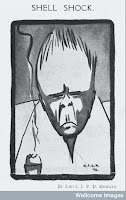
Lt J P D Hewatt, 'Shell Shock', 1917
Readers who consult the online Archives and Manuscripts sources guides may have noticed some recent changes to the guides on war, medicine and health. In order to streamline these somewhat, the content has been rearranged, into War, Medicine, and Health: general and guides relating specifically to World War I and World War II, and a significant amount of material relating to psychiatric and psychological issues to do with warfare pulled out to create a new guide, War, Psychiatry and Psychology.

We already held some important materials on these latter subjects, such as the observations by Charles McMoran Wilson, later Lord Moran, of the new phenomenon of 'shell shock' on the Western Front during the Great War, material in the Bowlby and Winnicott papers on the effects of wartime evacuation on children, records of S H Foulkes' work with the 'Northfield Experiment' during the Second World War. However, a number of more recent acquisitions, such as the papers of H V Dicks relating to his involvement in 'de-Nazification' of Germany after the war and his writings on the psychology of totalitarianism, and several collections of papers of individual psychologists received along with the records of the British Psychological Society have additionally developed our strengths in this area and this is reflected in the creation of  this new guide.

This turns out to be especially timely given the news of this forthcoming event, Psychoanalysis in the Age of Totalitarianism, bringing together historians, social theorists and psychoanalysts to explore the impact of the Second World War and totalitarianism on psychoanalysis, and of psychoanalysis on the understanding of the war and totalitarian systems. Organised under the auspices of the Institute of Psychoanalysis, the Pears Institute for the study of Antisemitism (Birkbeck, University of London), Birkbeck College, University of London, and the Centre for Psychoanalytic Studies of the University of Essex, it will take place in the Wellcome Collection Conference Centre, 21-22 September 2012.

Monday, October 17, 2011

'Stories of Psychology' Symposium report

Last Tuesday (11th October) the Wellcome Collection Conference Centre was the venue for the symposium ‘Stories of Psychology: Archives, Histories and What They Tell Us'. The event was held as part of the collaboration between the British Psychological Society (BPS) and the Wellcome Library, which has seen the Society’s extensive psychology archives transferred to the Library (and which we've flagged up in previous posts on this Blog).

The afternoon's proceedings begun with Professor Richard Bentall (University of Liverpool), talking on “How we have changed the way we think about madness”. His lecture offered a broad overview of developments in the field, touching upon such key developments as the classificatory work of Emile Kraepelin, Walter Freeman and psychosurgery and the rise of the treatment of mental illness through psychiatric drugs. Understandably, psychology featured strongly in this narrative, with Bentall discussing the behaviourist influence of B F Skinner, offering a personal recollection of "the token economy" at work in a mental hospital and also an interpretation of the work of Carl Rogers on the value of therapeutic relationships. There were some provocative comparisons to be drawn with other branches of medicine: during the years in which psychology has existed as a discipline, he pointed out, prognosis for diseases such as leukemia has improved beyond all measure in the developed West, whilst the prognosis for psychotic states remains much the same.

For his paper, Dr Peter Hegarty (University of Surrey) re-evaluated the work of sexologist Alfred Kinsey through the prism of Kinsey's early research on Gall Wasps. Hegarty's lecture was particularly interesting for how it interrogated the way that notions of the frontier in American society permeated Kinsey's work, both in how the values of insect society were interpreted, and in his account of the sexual behaviour of American men in rural areas (as a result Hegarty's audience may never watch be able to watch Pixar's A Bug's Life in the same way again).

Prof Michael Billig (Loughborough University) took a more personal approach: his paper, “Archival knowledge versus personal reminiscence: The case of social psychologist Henri Tajfel”, was based around Billig's personal memories of Tajfel (Billig was one of Tajfel's research students). It discussed how Tajfel's work on the social construction of groups was strongly influenced by his experiences in growing up in 1930s Europe, but also spoke of the construction of biography through personal and working papers, and how this differed from an individual's personal memories of a colleague. Particular pertinent views from the perspective of the Library, as with the transfer of the BPS archive we now hold Tajfel's papers.

In “Psychological knowledge and the making of the modern state”, Dr Rhodri Hayward (Queen Mary University) questioned the traditional narrative of understandings of psychiatry in the UK in the 20th century, arguing that in the proto-Welfare State of inter-war Britain there was an increased awareness of psychosomatic illness in discussion of states hitherto seen as “malingering”. His wide-ranging talk included analyses of the condition of "Busman's Stomach" in the 1920s and of how notions of stress and emotion became the basis for industrial negotiation as the century progressed. Pertinent issues, particularly with the importance recent Governments have placed on the "emotional wellbeing" of the British population.

Prof Sally Shuttleworth (University of Oxford) concluded the day with “Studying the child in the nineteenth century”. This paper examined the interplay of literature and research, and how the rich and evocative descriptions of childhood in the literature of the 1840s (e.g. Dombey and Son or Jane Eyre), influenced the growth of child psychiatry in the UK, so much so that by the 1890s, developments in the field were feeding back into literature (e.g. Edmund Gosse's Father & Son). Her talk also spoke of the important role played by women in the development of child studies in the nineteenth century and the present day difficulty in tracking down many of child development journals produced in the period.

This last point was indicative of a symposium which illustrated the variety of areas and issues which research into the history of psychology can explore. One hopes the papers of the BPS now held in the Wellcome Library will inspire and encourage further exploration.

Image: Henri Tajfel (from European Association for Social Psychology).

Thursday, March 17, 2011

The Birth of the Birth Control Clinic


As part of IHR@90, a celebration of the ninetieth anniversary of the foundation of the Institute of Historical Research, a conference was held last Friday at Senate House on ‘The Birth of the Birth Control Clinic’ (jointly organised with the University of Exeter), since it is also 90 years since Marie Stopes established the first birth control clinic in the UK, in Holloway – it subsequently moved to Whitfield Street in Fitzrovia, illustrated here.

This conference could hardly have taken place without the wealth of archival resources on birth control and allied matters held in the Wellcome Library providing a solid basis for research in this area.

It was a full day of fascinating papers and vigorous discussion, kicking off with Lesley Hall’s paper ‘Situating Stopes, or putting Marie in her proper place’. While suggesting that ideologically Stopes’s views were less pernicious than they have sometimes been depicted and that her involvement with contemporary ideas about eugenics was complex, it was also suggested that her difficult personality created many problems in her relationship with the birth control movement as a whole. This was perhaps prefigured by her secession from the Malthusian League to form her own Society for Constructive Birth Control in 1921.

Unfortunately one of the speakers for the first panel session on ‘Contexts’, Sarah Hodges, was unable to attend and we were thus deprived of an insight into the impact of birth control ideas in India, ‘Married Love among Madras's Neo-Malthusians’. However, Stephen Brooke demonstrated the significant impact more generally on gender issues in Labour politics of the introduction of birth control into the political sphere through the activities of Dora Russell and others in the Workers’ Birth Control Group. Another facet to issues around birth was revealed in Anne Bergin’s paper on the professionalisation of midwifery in nineteenth century Ireland, ‘From the Wop to the Bed: the modernisation of midwifery from handy woman to the professional midwife in Ireland, c.1800-1900’ (the ‘wop’ or ‘sop’ was the bed of straw upon which Irish women traditionally gave birth).

After lunch we had an insight into continuing work on reproductive health and contraception on a global scale from Victoria Elliott of Marie Stopes International. While this organisation is not a direct descendant of Stopes’s original Mothers’ Clinics, its headquarters are in the Whitfield Street building to which her London clinic moved in 1925, and its logo is its doorway.

Stopes’ own global, or rather, Imperial, concerns and ambitions were illuminated in Susanne Klausen’s discussion of Stopes’s interaction with the birth control movement in South Africa, ‘I ought to have a clinic in every country in the world’: Marie Stopes, imperial feminism and the South African birth-control movement, 1930-1945’.

In a further panel session ‘After Stopes’, Lara Marks gave a nuanced account of the multiple elements leading to the development of the contraceptive pill and the diverse nature of its impact, in ‘Panacea or Poisoned Chalice? A History of the Contraceptive Pill’ (and it is gratifying to hear that her major work Sexual Chemistry on this subject is now out in a new edition). Tania McIntosh paid attention to significant local differences in family size based on the nature of local economies in ‘Methods and beliefs: family planning in Sheffield and Nottingham, 1925-35’, as well as demonstrating the extent to which traditional cultures of abortion flourished. Amanda Raphael in ‘Birth by the book: Grantly Dick Read and the beginnings of the “natural childbirth” movement in England’, suggested that in spite of Dick Read’s appeal to ideals of the natural, his views only really gained purchase in a context inflected by the idea of family planning in which childbirth was no longer an inevitable ordeal over which the woman had no control. (Dick Read’s papers are also held in the Wellcome Library.)

Finally, Christina Hauck addressed a perhaps less well-known facet of Stopes’s diverse career, her ambitions as a dramatist, in ‘A baby of her own: maternal desire and English polity in the plays of Marie Stopes’. Hauck suggested that, even when not directly based on Stopes’s personal experience, as with Vectia, which rested very heavily on the debacle of her first marriage, the plays are autobiographically revealing of Stopes’s ideas about herself and the tensions between her public and private personae. Although the work of birth control propaganda Our Ostriches was produced at the Royal Court Theatre, and Stopes did have other plays staged, works such as Vectia and the unpublished The Vortex Dammed (based on Noel Coward’s first major success, The Vortex) sounded pretty much unproduceable, quite apart from the difficulties Stopes experienced with the theatrical censorship system.

This was a very full day and there was enthusiastic commentary and questioning on all papers.

Tuesday, November 2, 2010

Gimme some skin, man

Last week I attended as invited commentator a fascinating and thought-provoking conference, ‘Scratching the Surface: the history of skin, its diseases, and their treatment’, held at the University of Birmingham Medical School under the auspices of the History of Medicine Unit at Birmingham and Trent University (Ontario), with support from the Wellcome Trust and the Society for the Social History of Medicine. Many of the speakers were familiar faces from their researches in the Wellcome Library.

With twenty papers packed into the course of two days, this conference was both dense and wide-ranging. The periods and places under discussion ranged from eighteenth-century London, Italy and Quebec to 1980s San Francisco, via Mexico City in the 1790s, the nineteenth century Maghreb under French colonialism, Hong Kong and its New Territories under British rule before the Second World War, and mid-twentieth century Uganda. The conference was kicked off to an excellent start by Philip Wilson’s keynote, ‘Reading the Skin, Discerning the Landscape: Geohistorical Depictions of the Human Surface’.

Among the rich spread of topics discussed were the apparently new disease of pellagra in eighteenth century Italy (already associated with maize-eating, in the form of polenta, at that early date); Admiral Francis Beaufort (of wind-scale fame)’s skin disease and its diagnoses both contemporary and more recent; outbreaks of skin conditions believed to be specific to a particular area (St Paul’s Bay Disease in Quebec, ‘Radesygge’ in Norway, the lesions observed among the indigenous population of the Mahgreb); Percival Pott and his colleagues treating wounds at Barts in the eighteenth century; scrotal cancer in chimney-sweeps; vaccination, tattooing and ‘dermographia’; light therapy for lupus in the early twentieth century.

A theme that pervaded the conference was the important of visual depictions of skin diseases and the quest for accurate reproduction of various dermatological phenomena, through water-colour paintings, wax modelling and the preservation of specimens, and the important role these played both in teaching medical students and in health education. Another theme was the common perception that manifestations on the skin signified deeper problems within the bodily system. While many papers dealt with this question of what was false within appearing on the surface, others dealt with the penetration of the skin by outside forces, whether this was the wound treated by the surgeon, the surgeon’s own penetrating knife or scalpel wounding to heal, the soot ingrained in the skin of climbing boys, the lancet of the vaccinator, the needles of the tattooist, or the entry into the system of woolsorters of the anthrax bacillus.

The wider cultural concerns which, as it were, were perceived as writing themselves on the skin or explored through dermatological issues were strongly represented. To take just one example, the ‘Itch’ in early modern London was not merely associated generally with the more degraded social elements, it was particularly associated with the Scots who, following the Act of Union, were seen as that era’s flood of undesirable immigrants to the metropolis.

The presence of the particularly stigmatised ailments of leprosy and syphilis was prevalent: one redolent of Biblical horror and the other of God’s punishment for immorality. The attitudes they created towards sores and lesions on the skin seem to have become intricately imbricated in attitudes towards other diseases which manifested similarly.

As may be imagined, providing a few summary concluding remarks was a far from easy task with so many excellent papers and such a variety of topics, but some attempt was made to draw out common themes and resonances, including the need for caution in, so to speak, deciphering the messages written on the skin and not turning these into simplistic dramatic or moralistic narratives.

It is anticipated that a publication will ensue from this stimulating event.

Wednesday, September 22, 2010

Talking Nutrition


As previewed on this Blog, ‘Nutrition and History in the Twentieth Century’ was held last week (15 September) at the London School of Hygiene and Tropical Medicine (LSHTM). This one-day conference, organised by the School’s Centre for History in Public Health and their Archives department, was a great success, attended by over 50 people.

The LSHTM’s nutrition collections were recently catalogued through a grant from the Wellcome Trust. Browse their online catalogue here.

The archive collections of the LSHTM and the Wellcome Library both complement and overlap in many areas, particularly in the field of nutrition. This was illustrated in conference talks by the archive departments of both organisations which focused on the history of nutritional science, diseases of malnutrition, nutrition and war time and nutrition propaganda during the twentieth century.

This first session was followed by recollections and analysis by former staff and students of the School. Their experiences of working at the institution over the last few decades were recorded for the archive’s oral history collection. The two afternoon sessions were devoted to a variety of papers on historical aspects of nutrition, including a summary of UK food policy since the 1970s presented and discussed by Professor Tim Lang of City University.

Amongst some of the collections highlighted in the paper on ‘Nutrition Archives in the Wellcome Library’ were those of Harriette Chick, Edward Mellanby, Robert McCance and Elsie Widdowson, Robert McCarrison, Surgeon Captain ‘Peter’ T L Cleave, Cicely Williams, Frederick Le Gros Clark, the Society of Medical Officers of Health, the British Medical Association and Francis Avery Jones. Details of these and our other archive collections on nutrition can be browsed via our Sources Guide on Nutrition or through the links to our online Archives and Manuscripts catalogue given above.

The papers of the London Food Commission (LFC), founded by Tim Lang, were also discussed. This collection is held by the Wellcome Library and cataloguing is due to commence in October 2010, with the papers becoming available to researchers before Summer 2011. The LFC archive will undoubtedly provide valuable insights into food issues and policy in the 1980s and 1990s, including food labelling, safety, composition and standards, and the school meals campaigns.

As one of the Wellcome Trust’s five research challenges, ‘Connecting environment, nutrition and health’, nutrition is a hot topic on Wellcome Library’s outreach menu. Early in 2011 a new Insights session will be held, focusing on various aspects of the Library’s diverse and vivid primary and secondary source collections on food, diet, nourishment and health. Keep an eye on the Wellcome Collection website - and the Wellcome Library Blog - for details of this session.

A taster of the wealth of our resources can be instantly experienced by searching the Wellcome Images website. Amongst its holdings are a wide range of historical and contemporary images on nutritional matters, such as those which have illustrated this post.


Images:
1/ Health and Beauty in Wartime (Ministry of Food leaflet) (GC/198/B/2/1)
2/ Page from from McCance and Widdowson’s Food Analysis research notebooks (GC/97/A/7)
3/ Community health worker in rural Jamaica showing a mother a leaflet promoting good nutrition

Author: Amanda Engineer

Monday, July 12, 2010

A Weekend with Wells

The weekend 9th to 11th July saw a fascinating conference celebrating the 50th anniversary of the H. G. Wells Society, ‘H. G. Wells: From Kent to Cosmopolis’, held in the appropriate setting of the Darwin College Conference Suite at the University of Kent at Canterbury.

While the conference dealt predominantly with Wells as writer and social visionary, there were a number of papers and elements of interest to the medical historian. The planned opening speaker, the distinguished author Brian Aldiss, was unable to attend, but sent a brief note to be read to the conference referencing a group of novels written by Wells in the 1920s dealing with the topic of mental disturbance, and raising the question of how far these were rooted in personal experience.


A paper by Marc Arnold on ‘H. G. Wells: Tuberculosis, Class and the Fear of Racial Degeneration’ revealed contrasting attitudes - strongly based on social class - to sufferers from TB in the nineteenth century, either ethereally delicate and frail or brutish and animalistic. Although Wells had himself been diagnosed as tubercular as a young man (but had recovered), he lent his weight to the campaign in Sandgate mounted by respectable residents objecting to the presence of numerous pauper consumptives in the town brought there by a local sanatorium entrepreneur. Arnold also made the intriguing suggestion that the depiction of the Eloi and the Morlocks in The Time Machine (1895) owes something to these contrasting images of consumption.


Themes of notions of racial degeneration and Wells’ interest in eugenics cropped up in a number of other papers. John Partington, for example, explored Wells’ relationship to the developing birth control movement, indicating that his interests lay in the wider issues of racial improvement that he saw birth control as enabling. Although most of Wells’ correspondence with Marie Stopes is in the British Library Department of Manuscripts, there is one furious note to her among the Stopes correspondence here in the Wellcome, concerning his resignation from the Society for Constructive Birth Control in 1922, and carbon copies of her letters to him some years later trying to woo him back as a supporter (PP/MCS/A.242). Her endeavours failed, although he later became a Vice President of the rival National Birth Control Association, renamed the Family Planning Association in 1938, from its inception in 1930 until shortly before his death in 1945 (SA/FPA/A14/173)

There was a fascinating plenary lecture by the science fiction novelist and children’s author Gwyneth Jones (Ann Halam) about The Island of Dr Moreau (1896) and writing her own novel Dr Franklin’s Island (2001) influenced by it, deploying modern techniques of stem cells and genetic engineering rather than surgery as the means by which the sinister scientist creates human-animal hybrids. The discussion raised issues of the context for Wells’ depiction of vivisection. The Brown Dog furore about animal experimentation at University College took place from 1903 to 1910 (on which there is some documentation in Archives and Manuscripts) and had vivisection much in the news took place after the publication of the novel, but the topic had been a cause for concern and agitation throughout the later decades of the nineteenth century. The archives of the Lister Institute, formerly British Institute for Preventive Medicine, include material on the protests by local residents against its establishment on the Chelsea Embankment on the grounds of resistance to experimentation on animals.

This was an excellent conference, and I may also add that my own paper, ‘An Ambiguous Idol: H. G. Wells inspiring and infuriating women’, based on research in the Wells papers in the Rare Book and Manuscript Library of the University of Illinois at Urbana-Champaign, was well-received.
Monday, October 26, 2009

Researching Lives: Medicine, science and archives

The Wellcome Library and the British Records Association are organising a one day conference on the wealth of resources available in medical and scientific archives to build up pictures of individual lives.

Titled Researching Lives: Medicine, science and archives, the conference will be held on the 8th December at Wellcome Collection. The lectures will examine manuscripts and personal papers, films and photographs, forensic evidence and physical remains, covering a time frame from the 15th century to the present day. Speakers include Georgina Ferry (science writer), Julianne Simpson and Helen Wakely (Wellcome Library), Dr Simon Chaplin (Royal College of Surgeons), Dr Tim Boon (Science Museum), Dr Paul Carter and Natalie Whistance (the National Archives) and Professor Allan Jamieson (Forensic Institute).

The Maurice Bond Memorial Lecture, given by Dr Richard Horton, Editor, The Lancet, will take place at the end of the day followed by a reception in the Wellcome Library which will include the launch of Research Uses of Health Archives produced by the Health Archives and Records Group (HARG).

Further details and a booking form are available from the website of the British Records Association.

Wednesday, May 6, 2009

Wellcome Film at Learning on Screen

The Wellcome Film project was showcased at the 2009 Learning on Screen Conference, hosted by the Wellcome Library and run by the BUFVC on 7-8 April. Held in the Auditorium of the Wellcome Collection building on 183 Euston Road, London, the event focussed on digital video accessibility issues with a special session on new online video initiatives. The presentations showed that a range of new software applications have the potential to make video more and more accessible to people with disabilities. Of particular note was Sal Cook's introduction to the JISC's TechDis service, with information about software for developers that will maximise audio-visual accessibility.


The Wellcome Film project was presented by Christy Henshaw and Angela Saward on the second day, providing an overview of the project, its context in the Library's digitisation programme, choice of content, formats, metadata, and the various delivery methods utilised (open access via the Wellcome Library online catalogue, and HE/FE access via Film and Sound Online). A selection of clips was screened at the end of the presentation to illustrate the range of content chosen for inclusion in the project.

The Wellcome Film project has to date made over 200 titles accessible, including "Talk about Insulin", 1959 (below). This video shows an interview with Prof. Charles H. Best and Dr R.D. Lawrence. Prof. Best, along with Dr Frederick Banting, discovered the use of insulin in treating diabetes. Dr R.D. Lawrence was one of the first diabetics to receive insulin, and went on to carry out further research in this area.


Wednesday, November 26, 2008

Wellcome Library to host Learning on Screen 2009

The Wellcome Library will be hosting the Learning on Screen conference 2009 at The Wellcome Collection, 7-8 April 2009.

The BUFVC are organising this conference, and have put forward a call for papers, with a submission deadline of 15 January 2009. This annual conference was established by the Society for Screen-Based Learning and focuses on the delivery of learning and research with moving image and sound - be it broadcasting, web delivery or cinema.

During the conference there will be opportunities to visit the Wellcome Collection's spectacular permanent and temporary exhibitions.

Two key themes of the conference will be:
  • Disability and Access to Moving Image and Sound
  • Online Moving Image and Sound Services for Learning