Showing posts with label psychology. Show all posts

Friday, March 9, 2012

War and the psyche

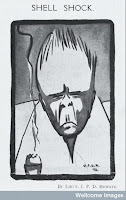
Lt J P D Hewatt, 'Shell Shock', 1917
Readers who consult the online Archives and Manuscripts sources guides may have noticed some recent changes to the guides on war, medicine and health. In order to streamline these somewhat, the content has been rearranged, into War, Medicine, and Health: general and guides relating specifically to World War I and World War II, and a significant amount of material relating to psychiatric and psychological issues to do with warfare pulled out to create a new guide, War, Psychiatry and Psychology.

We already held some important materials on these latter subjects, such as the observations by Charles McMoran Wilson, later Lord Moran, of the new phenomenon of 'shell shock' on the Western Front during the Great War, material in the Bowlby and Winnicott papers on the effects of wartime evacuation on children, records of S H Foulkes' work with the 'Northfield Experiment' during the Second World War. However, a number of more recent acquisitions, such as the papers of H V Dicks relating to his involvement in 'de-Nazification' of Germany after the war and his writings on the psychology of totalitarianism, and several collections of papers of individual psychologists received along with the records of the British Psychological Society have additionally developed our strengths in this area and this is reflected in the creation of  this new guide.

This turns out to be especially timely given the news of this forthcoming event, Psychoanalysis in the Age of Totalitarianism, bringing together historians, social theorists and psychoanalysts to explore the impact of the Second World War and totalitarianism on psychoanalysis, and of psychoanalysis on the understanding of the war and totalitarian systems. Organised under the auspices of the Institute of Psychoanalysis, the Pears Institute for the study of Antisemitism (Birkbeck, University of London), Birkbeck College, University of London, and the Centre for Psychoanalytic Studies of the University of Essex, it will take place in the Wellcome Collection Conference Centre, 21-22 September 2012.

Monday, September 5, 2011

As the new school year begins…


One might suppose that interest in child study must have been a twentieth century development, probably arising between the wars with the development of psychology as a discipline. In fact, a number of child study organisations, whose records are now among the archives of the British Psychological Society in the Wellcome Library, were set up during the 1890s arising out of concerns evoked in the wake of the introduction of universal free elementary education.


This spread of education to all children had revealed that many were ‘incapable of benefiting by the ordinary education’ and thus remained ‘practically untrained’ within a system designed for ‘average or normal children’. There was need of an investigation to establish the dimensions of the problem and propose actions. This led to the establishment of a Childhood Society for the Scientific Study of the Mental and Physical Conditions of Children, with the aim of promoting the study of educational methods and the school environment best suited to mental and physical development, both of the normal and ‘those whose conditions are abnormal, or who are feebly gifted mentally’.


They were not the only organisation interested in developing a systematic approach to the study of children and childhood. In 1894 a British Child-Study Association was established, by teachers, rather than doctors, a federation of a number of small local societies with similar aims:


[T]o interest parents, teachers and others in the systematic observation of children and young people, with a view to gaining greater insight into child-nature and securing more sympathetic and scientific methods of training the young


It may be noted that this body was more interested in the ‘normal’ child, rather than exercised about the ‘feeble-minded’ or otherwise disabled, and was primarily concerned about the implications for education of their findings, although a number of doctors joined the Association. By 1901 it had 8 branches, and was producing a journal, The Paidologist.


The degree of common interest between these two bodies led to their amalgamation in 1907 to form the Child Study Society, later Association. Their records reflect the fascinating intersection of educational and medical concerns about children at the turn of the nineteenth and twentieth centuries in Britain, a time of considerable anxiety about national fitness. They also reflect the development of child psychology: in 1948 the Child Study Society transferred its membership and its assets to the British Psychological Society Education Section.


Further collections on issues of health and welfare of children and adolescents in Archives and Manuscripts are the subject of a thematic sources guide: many of these bear on education and the school environment. A number of collections also deal with infant and child observation from a psychoanalytic perspective.


Monday, July 4, 2011

Dream a little dream…


In May 1940, Birmingham schoolteacher and army reservist, Kenneth Davies Hopkins, was captured by the Nazis in France, and sent to a succession of Prisoner of War camps in Germany. Whilst interned he had the idea of recording the dreams of his fellow POWs in order to later analyse them. His interest in psychology had been awakened in the 1930s when his MA Education dissertation had been supervised by C. W. Valentine, who, like Hopkins, was interested in the psychology of dreams

Over the next two years, Hopkins meticulously kept records of the dreams reported to him, using only a pencil and the rough paper he had available to him in the camps. This provides an exceptional record. As Valentine said to Hopkins in a letter dated 8th November 1940 "it would be a unique contribution, as far as I know, to have reports on dreams of prisoners of war while entirely separate from their normal environment", before going on to suggest that Hopkins look out for "wish-fullfilment dreams, fear dreams based upon war experiences, regression to childish memories, and symbolism in dreams" (PSY/VAL/4/6).

If it wasn’t for this letter, we would never have known of this important resource. In 1945, Major Hopkins’ dream research notebooks were found abandoned in a liberated camp. The letter to Valentine was with them, so the camp liberators forwarded the books to him in the hopes that he could reunite Hopkins with his notes. Unfortunately, Kenneth Hopkins had developed bronchial asthma and emphysema in 1942 whilst interned near Hildburghausen in central Germany, and had died there.

The notebooks remained in the possession of Professor Valentine until they were donated to St. Martin’s College Library, Lancaster, who deposited them on permanent loan with the British Psychological Society. In September 2008, Valentine’s papers were deposited with the Wellcome Library, along with other collections from the British Psychological Society History Centre.

In addition to the Hopkins material, the C. W Valentine archive held by the Wellcome Library includes notebooks created Valentine during observational studies of the infant psyche, drafts of his works Psychology and its Bearing on Education and The Psychology of Early Childhood, both of which are held by the Wellcome Library, along with notes from his university days.

Picture credit: The dream of a patient in Jungian analysis: left, a rocky wall; right a swirling wave; at the end, six people. Drawing by M.A.C.T., January 1971. Iconographic Collections, 658096i

Friday, June 3, 2011

Archives and manuscripts cataloguing, May 2011

May was, for the most part, a month of steady progress in the Archives and Manuscripts department, with several collections in train but the majority carrying on into June rather than being completed within the month. Nearly 400 records were added to the online database before the month's end. The majority remain invisible for the moment, awaiting the completion of the projects to which they belong, but May did see the release of several noteworthy sets of papers, now available for study in the Wellcome Library.

Our long-running project to repackage and make available material deposited here by the British Psychological Society passed another milestone, with the papers of Charles Wilfred Valentine (1879-1964) (PSY/VAL) being made visible in the database. Valentine was a specialist in educational psychology (and a life-long friend and colleague of Cyril Burt) and many of the papers relate to child development. In some tests, for example, he tracked the reactions of infants from birth to the age of three, monitoring such things as whether the sound of a ticking watch obtruded on their attention enough for them to stop feeding and whether this changed over time. He also wrote on the psychology of aesthetics, and on dreams. One particularly interesting section of the collection comprises notes kept by his one-time research student, Kenneth Davies Hopkins (d.1942). Hopkins, a Birmingham teacher, studied for an MA in Education under Valentine's supervision in the 1930s. A Territorial Army officer, he served in the Second World War and was captured in northern France in 1940. Whilst interned as a Prisoner of War, he embarked on a project to record his dreams and those of his fellow PoWs, with Valentine's encouragement. (Prisoners of war, with all too much time on their hands, undertook many scientific projects during the Second World War: much pioneering work on bird behaviour, for instance, dates from this time.) Sadly, Hopkins died of a lung condition in a PoW camp in 1942; his notebooks were found when the Allies took control of the vacated camp in 1945, and sent to Valentine. The Library is pleased to make them available now, as a small tribute to Major Hopkins' determination to continue scientific work under the most unpromising of circumstances.

War is a leitmotiv of this month's new material: another major tranche of papers relates to the Strangeways Research Laboratory's work during the Second World War. The papers form part of the existing SA/SRL collection of papers from the laboratory (SA/SRL), described as a new section M. The Laboratory spent the war researching substances that might be used in chemical warfare, and agents that might counteract them, in collaboration with the War Ministry's Porton Down Laboratory. An earlier blog post has described these papers in some detail.

On a lighter note, MS.8767 takes us travelling in nineteenth-century Italy. It comprises an account of a journey undertaken in 1855 by C.J.W. Bosanquet, whose identity remains unknown. Starting in Milan, Bosanquet takes us eastwards to Como and the Lakes, then into Switzerland and via Geneva to Lyon; he records sights seen, the weather, his experiences with officials when crossing borders, and religious reflections inspired by all of these. Drinkers of bottled water may be a little unsettled by his note that "We slept at a dirty little place called Evian." We can only applaud his taste, however, in how he opens the journal: its first words are "There are some very curious manuscripts in the Library." There are indeed; and several more are now available to be seen in the reading room.

Image: the travel journal of C.J.W. Bosanquet, 1855, showing geological formations near Geneva (MS.8767).

Tuesday, April 19, 2011

Stories of Psychology

Between 2008 and 2009 the British Psychological Society deposited in the Wellcome Library both its own institutional records and the archives of over 30 individual psychologists and small organisations. Since then, work has been proceeding to re-house these collections and to integrate them into our on-line catalogue. Followers of this blog will have noticed that papers relating to Charlotte Wolff (PSY/WOL), Henri Tajfel (PSY/TAJ), and E. C. Tolman (PSY/TOL) have already been opened to public access (and described in earlier blog posts: click here for information on Wolff, Tajfel and Tolman). Other material available includes papers relating to Albert Cherns (PSY/CHE), Grace Rawlings (PSY/RAW), L. S. Hernshaw (PSY/HEA) and C. S. Myers (PSY/MYE). More is scheduled to follow during the coming months.

To celebrate this collaboration between the British Psychological Society and the Wellcome Library, the Society is organising a half-day symposium on the afternoon of Tuesday 11 October 2011, to be held in Wellcome Collection Conference Centre. The theme will be Stories of Psychology: Archives, Histories and What They Tell Us. Speakers include Richard Bentall, Michael Billig, Rhodri Hayward, Graham Richards and Sally Shuttleworth. The symposium is free to attend, but registration is essential. For more information and to register, go to www.bps.org.uk/stories.

Thursday, January 20, 2011

New event: Was Jung a mystic?


We will be hosting another Medicine and Literature event on Wednesday 2 February, 19.00-20.15. Join us to hear author Gary Lachman investigate the life of psychologist Carl Jung.

Gary's talk will chart the development of Jung's ideas, look into the reasons behind his early reticence and later advocacy of the paranormal, and finally ask, was Jung a scientist or a mystic, or perhaps something else?

The event is free and tickets can be booked on the Wellcome Collection website.

Image: The dream of a patient in Jungian analysis: a railway tunnel, a train in the distance, and three people walking along next to the right-hand track. Drawing by M.A.C.T., 1971. (Library no. 658097i)

Friday, January 7, 2011

The Brain: A Secret History


Beginning last night on BBC4, The Brain: A Secret History, is a new three part documentary series which illustrates the history of attempts to understand and manipulate the brain.

In the first episode of the series, 'Mind Control', presenter Dr Michael Mosley discussed the famous experiments of Ivan Pavlov, B F Skinner and Stanley Millgram. The documentary mixed archive footage with interviews and also included Mosley visiting the Wellcome Library to look at the personal papers of controversial psychiatrist William Sargant.

The episode is available to viewers in the UK through the BBC iPlayer, where it will be joined by the other two episodes once they air, until the 27th January.

Image credit: BBC

Tuesday, September 7, 2010

The Red Book


It's not often books purchased by the Wellcome Library have guested on a prime time American crime show, but then again, Carl Jung's The Red Book is no ordinary work.

A facsimile of Carl Jung's Liber Novus (New Book), The Red Book was only published for the first time last year. It records in words and images the innermost feelings and thoughts of Jung, who started the work after undergoing an intense spiritual and mental crisis in the 1910s. According to the book's editor Prof Sonu Shamdasani, the publication of the work is an enormously important event in the history of psychology: the whole of Jung's career can now be reinterpreted through this intense work.

Both literally and metaphorically a weighty tome, the shelves of the Wellcome Library hold a number of copies of The Red Book and all are available to our readers. For an introduction to the work, BBC Radio 3 devoted the interval to last Saturday's Prom concert to a discussion of the work between presenter Bidisha, Prof Shamdasani and artist Bettina Reiber (and to sample the book's visual style, take a look at this BBC Slideshow).

The discussion will be available to listeners in the UK through the Radio 3 website until next Saturday: the Red Book feature begins 10 minutes into the programme.

Friday, January 22, 2010

Henri Tajfel Papers – Now Available to Consult!

The papers of Henri Tajfel (1919-1982), the Bristol University Professor of Social Psychology and eminent social psychologist, following the completion of the cataloguing process, have today become accessible at the Wellcome Library. An extensive obituary for Tajfel appeared in the Journal of Language and Social Psychology, Vol. 1, No. 1, 87-89 (1982). He also has an entry in the Oxford Dictionary of National Biography and an extensive Wikipedia biography where he is credited as the principal co-developer of Social Identity Theory. This theory, developed by Tajfel and Turner, suggests that people categorize themselves into groups which Tajfel and Turner called “in-groups”, and categorize everyone else into other groups, called “out-groups”. This categorization helps to promote a sense of identity but this leads to unfavourable comparisons between the in-group and the out-group and the enforcement of boundaries between the groups which can result in conflict in various guises.

The Tajfel papers at the Wellcome Library do not cover the development of Social Identity Theory to any great extent and anyone wishing to discover more about this and related theories would be better advised to read one of the following books:

• Tajfel, H. (Ed.). (1978). Differentiation Between Social Groups: Studies in the Social Psychology of Intergroup Relations. London: Academic Press.
• Tajfel, H. & Turner, J. C. (1979). "An Integrative Theory of Intergroup Conflict". In W. G. Austin & S. Worchel (Eds.), The Social Psychology of Intergroup Relations. Monterey, CA: Brooks-Cole .
• Tajfel, H. (1981). Human Groups and Social Categories. Cambridge University Press, Cambridge.
• Tajfel, H. & Turner, J. C. (1986). "The Social Identity Theory of Inter-group Behavior". In S. Worchel & L. W. Austin (Eds.), Psychology of Intergroup Relations. Chicago: Nelson-Hall

However, what the Henri Tajfel papers do cover is his extensive involvement with numerous social psychological societies, journals and books, particularly the Academic Press series of books which Tajfel edited, the European Monographs in Social Psychology. Tajfel’s files cover his lecture notes from the early 1960’s and are full of papers submitted for publication in various journals and books and presented at the many conferences/seminars which he attended in the 1960’s, 1970’s and 1980’s. There is also extensive correspondence concerning books, journal articles and letters both published and unpublished by other social psychologists of the time.

To date, Henri Tajfel has not benefited from a full biography covering his life and works. For those interested in his place in the history of social psychology theory, his legacy has been discussed in numerous books and journals in the almost 30 years since his death and one place to start is by referring to John C. Turner’s, “Henri Tajfel: An introduction”, which appears in W. P. Robinson (Ed.) Social groups and identities: Developing the legacy of Henri Tajfel. Oxford: Butterworth Heinemann (1996). Professor John Turner began as a research associate working for Tajfel at Bristol University and they worked together over many years.

Rather than repeat what has been said about Tajfel in these many sources, I thought it would be illuminating to see what Tajfel chose to write as his own biography in 1981, the year before his death. The following biography, written by Tajfel, is taken from the Cambridge University Press “Advance Information Sheet” produced in April 1981 for the book “Human Groups and Social Categories”.

“Professor of Social Psychology, University of Bristol. Born 22 June 1919 in Poland. Educated in several European countries. Prisoner-of-war in Germany June 1940 - May 1945. In the first few years after the war, working in various European countries for international organisations concerned with the rehabilitation of children and adults, victims of war. First degree and Ph.D. in Psychology, University of London. 1954-56, Assistant, University of Durham. 1956-67 in Oxford, University Lecturer in Social Psychology and Fellow of Linacre College. 1967, Professor of Social Psychology, University of Bristol. Longer-term visiting appointments at Harvard University; University of Western Ontario; Centre for Advanced Study in the Behavioural Sciences, Stanford, California; University of Leiden; Ecole des Hautes Etudes en Sciences Sociales, Paris; The Van Leer Foundation, Jerusalem; University of Bologna. Short visits to a number of universities in Europe and North America including Katz-Newcomb Lecturer, University of Michigan and Special Lecturer, University of Helsinki. Fellow of the British Psychological Society. Past President of the European Association of Social Psychology. Past Chairman of the Social Psychology Section of the British Psychological Society. First Annual Gordon Allport Intergroup Relations Prize, S.P.S.S.I.. Co-author and editor of several books in social psychology and publications in a variety of psychological journals in Britain, U.S.A., Canada, France, Italy, Germany, etc. Editor of the European Monographs in Social Psychology, Academic Press, London.”

What is clear from the 64 boxes of Tajfel papers, part of the deposit of the papers of the British Psychological Society at the Wellcome Library, is how hard Henri Tajfel worked, how many organisations he belonged to, how many books and journals he contributed to, how many conferences and symposia he attended, and how many people with whom he corresponded both agreeing and disagreeing with points made in private and in public. His prodigious output did not stop with issues of social psychology and where he felt newspapers or even the school curriculum was biased against matters dear to his heart such as the coverage of Israel, he would take up his pen and begin a lengthy correspondence. Henri Tajfel died at the relatively young age of 62, and given the amount of work that he had demonstrated that he could tackle and that he was still planning to get through in early 1982, it can only be imagined how much more he would have been able to contribute to the field of social psychology had he lived for just a few years longer.

The catalogue of the Tajfel papers can be consulted on the Wellcome Library's archives and manuscripts database, under the reference PSY/TAJ. The papers of the British Psychological Society will be released gradually as they are made ready for consultation. An earlier blog post has already described the papers of Charlotte Wolff, from the same source.

Author: Jon Cable