Showing posts with label Burroughs Wellcome and Co. Show all posts

Saturday, June 16, 2012

Easing the way for literature

16th June 1904: a young Dubliner goes on a first date with the woman who will become the mother of his children and (much later) his wife. Eighteen years later – that is, in 1922, ninety years ago – he will publish a book that, as well as encapsulating all literature, will capture Dublin as it was on the day of that first date, so that, as he was to say, if Dublin were destroyed it could be rebuilt from the information in that one volume. The young man is James Joyce, his date Nora Barnacle and the book Ulysses. Bloomsday, as 16th June is known to Joyce enthusiasts, is celebrated every year, but readers in Britain will be aware of extra coverage this year, as the BBC marks 90 years since the book’s publication with various events culminating in a dramatization of Ulysses spread across Radio 4 throughout Bloomsday, whilst in Ireland RTÉ's arts programme The Works will be devoted to Joyce.

A character resembling Joyce does feature strongly in the book – the rather humourless, priggish Stephen Dedalus, whom readers first met on a journey from childhood to young manhood in A Portrait of the Artist as a Young Man – but a quite different figure is at the centre of Ulysses, the middle-aged Jewish everyman Leopold Bloom. From the moment that he appears, at the start of the fourth chapter, Bloom is never far from the book’s action and it is his interior monologue that features most strongly as he navigates the city: hence, of course, the name Bloomsday.

Ulysses exists on multiple levels – as high conceptual art and meta-fiction, a discourse about literature via literature, picking up, pastiching and parodying various forms and tropes; but also on a more down-to-earth level as an experiment in rendering experience via language as completely as possible. This for Joyce means a focus upon the detail of basic, quotidian experience, observed closely and rendered faithfully and without judgement. Moments after Bloom’s first appearance, the brilliant ear Joyce brought to this project is summed up in one line from Bloom’s cat –
The cat walked stiffly round a leg of the table with tail on high.
-Mkgnao!
- which captures perfectly a particular sound to the extent that it is hard, having read it, not to hear all cats in future as saying “Mkgnao!” rather than the conventional Miaow. The focus on the quotidian however, also leads Joyce with some relish into areas often considered offensive or taboo. On the very first page Stephen Dedalus’s friend Buck Mulligan borrows Dedalus’s handkerchief and goes into flights of verbal fancy over the colour “snotgreen” – gazing out over Dublin Bay, he embarks on a verbal riff about “The snotgreen sea. The scrotumtightening sea.” Joyce’s characters, unlike many in literature, have bodily fluids and bodily waste: snot, urine, menstrual blood, farts, semen and excrement are all produced by one or other of them in the course of the eighteen hours tracked by the novel.

Human beings as part of the physical world, of course, are the stock in trade of the Wellcome Library, with Sir Henry Wellcome’s collecting vision of the history of medicine being (inter alia) a history of humankind’s physical side. It is, therefore, particularly appropriate that Wellcome, or rather one of his products, has a walk-on part at precisely one of those moments in the book. Bloom first appears early in the morning, frying breakfast and making tea (some of the meat is begged by the cat we met earlier, whilst a cup of tea is taken to his half-asleep wife). Like many of us, we suspect (but we won’t pry), he finds that after a short while up and about, his bowels kick into action and he has to go off to the privy at the end of the garden, where he muses on defecation during the act and provides a little endorsement for a Wellcome product:
..his last resistance yielding, he allowed his bowels to ease themselves quietly as he read, reading still patiently, that slight constipation of yesterday quite gone. Hope it’s not too big bring on piles again. No, just right. So. Ah! Costive one tabloid of cascara sagrada.
Cascara sagrada was a widely used natural laxative, derived from the dried bark of a species of Buckthorn - a routine element in the materia medica of the time. “Tabloid”, however, makes the mention more specific: this was (and is) a Wellcome trademarked word and at this time Wellcome was assertively litigious in defending his intellectual property, so there is no question that when Joyce has Bloom think of a product delivered in “tabloids” it is a Burroughs Wellcome item. (An image of Burroughs Wellcome Cascara Sagrada can be found in the Science Museum's Science and Society picture library.) Wellcome rarely missed a trick when it came to publicity and was keen to make sure his products were prominently placed in, for example, accounts of polar exploration. We suspect, however, that he was unaware of this bit of product placement in a notoriously “dirty” and long-banned book, and if he had known he might well have been rather too prudish to enjoy it.

It is a quirk of Joyce’s works, perhaps a function of the years each took to write, that by the end of each they tend to be turning into the next. A Portrait of the Artist as a Young Man brings Stephen Dedalus from infancy to the priggish young man who appears on the first page of Ulysses, whilst as the latter progresses its balance shifts from intense focus on everyday experience and interior monologue towards a more purely literary nature, working through various literary genres and parodies in an “unrealistic”, meta-fictional mode. This foreshadows Finnegans Wake and its attempt to bundle all of human experience and all human language into a tale of one archetypal family told in “night-language”, the slurred language of dreams in which concepts collide and coalesce in an endless series of puns, some serious and some joyfully smutty. We cannot, alas, say whether Wellcome or his products appear in the Wake, although its professed aim of encompassing all human experience means that they might well be in there somewhere. Perhaps Joyce missed a trick: in the first pages of Finnegans Wake we find ourselves inside the Wellington Monument in Phoenix Park, enlarged and transformed into a museum - “Now yiz are in the Willingdone Museyroom” – and he would surely have loved to include the Wellcome Museyroom, and to use the founder’s name as the opportunity for a smutty double entendre. Wellcome’s tense relationship with his more easy-going partner Silas Burroughs, too, is reminiscent of the Wake’s "Tales Told of Shem and Shaun", the stories of personality clash between two contrasting brothers (based on Joyce and his more strait-laced brother Stanislas) that include the fable of the Ondt and the Gracehoper. The beauty of Finnegans Wake is that, containing multitudes, it lends itself to application in all sorts of ways: if Wellcome, or indeed anyone one wishes, does not appear in it explicitly one can still find some sort of analogue. Another of its beauties is that having mentioned it one is immediately absolved from bringing a blog post to any sort of conclusion; like Finnegans Wake itself, one can start anywhere and just end in mid-

Illustration: James Joyce's grave in Fluntern Cemetery, Zürich. Copyright, Lars Haefner, made available under Creative Commons Attribution-Share Alike 3.0 Unported license via Wikimedia Commons. Fluntern Cemetery is high on the rounded top of the Zürichberg and backs onto Zürich Zoo: when she buried her husband there Nora Joyce commented that he would be able to hear the lions roaring and would like that.

Friday, October 28, 2011

The Statue of Liberty's sister and S M Burroughs

As well as our own small anniversary, today is also the 125th anniversary of one of the world's most famous cultural artefacts, as it was on this day in 1876 that the Statue of Liberty was dedicated.

Furthermore, there's a connection between the statue and the early days of our founder Henry Wellcome's pharmaceutical business - but it relates not to Henry Wellcome and nor to the statue in New York...


Just visible in the top right of this image is a copy of the Statue of Liberty. As indicated, the image is of Burroughs Wellcome & Co's then head office at Snow Hill in London. It references not only the nationality of the company's founders, but also hints at the activities of Wellcome's business partner, Silas Mainville Burroughs.

The statue that stands in New York was - as every good American schoolchild knows - a gift from the people of France in 1886. What's a lesser-known fact is that a smaller replica of the statue stands in Paris on the Île aux Cygnes - facing west in the general direction of her sibling.

The erection of the smaller statue in Paris was paid for by subscription by Americans resident in Europe to commemorate the centenary of the French Revolution and inagurated on 4th July 1889. Silas Mainville Burroughs was a subscriber to the fund. And here's the evidence - preserved in the Wellcome Library's collections - Burroughs's certificate of subscription (WF/E/02/03/05).

Whilst the certificate does not record how much money Burroughs donated, it does add another detail to the life of Wellcome's business partner: a politically motivated individual, who still stands very much in the shadow of Henry Wellcome.

Saturday, June 25, 2011

The lost world of Snow Hill


The image above captures the popular conception of London's reaction to the Blitz, which was arguably at its most fearsome during May and June 70 years ago. During the night-time bombings, lives were lost and buildings were destroyed. But come the morning... a cyclist trundles by, a roadsweeper brushes up: life goes on.

The remains of the building you see here are actually enormously important to the story of our founder Henry Wellcome, as this is the corner of Snow Hill and Holborn Viaduct in London, the site of the head office of the pharmaceutical company he co-founded, Burroughs Wellcome & Co.


Opened in 1883, three years after Silas Mainville Burroughs and Henry Wellcome entered into partnership, the scale of their head office matched the expectations Burroughs and Wellcome had for their nascent pharmaceutical company.

The imposing building was constructed of red brick, with granite pilars guarding the entrance. The tiled mosaic floor of the was illustrated with images of Commerce and Industry and the rich wood used for the walls was best American Walnut. [1]


Henry Wellcome was personally involved in designing and furnishing the interior of the building: no easy task given the building's curved shape. As the image above shows, Moorish curves were ideal for a building Wellcome himself described as having "not a single right-angle". The interior arrangements were executed under the direction of Christopher Dresser, now regarded as Britain's first industrial designer. Snow Hill was also one of the first business houses in London to be lit using electric light.

The interior alluded to Burroughs and Wellcome's country of birth with models of the Statue of Liberty and the American Eagle (visible towards the back of the image above) and the building captured something of the entrepreneurial get-up-and-go of these two salesmen.

The building also hinted at another aspect of Wellcome's personality: his growing interest in collecting. This is how Wellcome's office was described in a praiseworthy report on the building in Chemist and Druggist:

"It is furnished as a library, although hunting trophies, works of art from countries visited by the occupant...and a varied selection of general literature give it less the look of a commercial room and more the appearance of a bachelor's den". [1]

Fast forward to 1941 and it seems this example of late Victorian architecture was no longer fit for the purposes of twentieth century business: five years after Henry Wellcome's death, the Wellcome Foundation still retained Snow Hill as offices, but sought to build new premises elsewhere in London.

On the night of 10-11 May 1941, during one of the heaviest nights of the Blitz, the Snow Hill building was destroyed. Afterwards, staff were temporarily moved to other Wellcome owned sites - such as the main warehouse where Wellcome's collection was stored in Willesden and to the Wellcome Research Institution on Euston Road (which is now, of course, where the Library and the rest of Wellcome Collection is situated). Not ideal accommodation, but just as for the figures beside the bombed out Snow Hill offices shown above, life had to go on for the employees as well.

But with its carefully designed interior - and his collection-rich office - the lost world of Snow Hill captures something of Henry Wellcome's - often elusive - personality.

[1] Clues to the furnishings of the Snow Hill office remain through drawings which survive in the papers of the Wellcome Foundation Archive, WF/CA/P/01
[2] Chemist and Druggist, 28th January, 1888

Images:
- Burroughs Wellcome & Co Headquarters, Snow Hill, London, after being destroyed in the Blitz, 1941 (Wellcome Images, M0020173)
- Burroughs Wellcome & Co Head Office, Snow Hill, London (Wellcome Images, M0007868)
- Interior of the Burroughs Wellcome & Co building, Snow Hill, London (Chemist & Druggist, 28th January 1888)

Tuesday, April 19, 2011

Wellcome to the South Pole


Last Sunday, BBC2 broadcast The Secrets of Scott's Hut, a documentary which featured presenter Ben Fogle journeying to Antarctica, to observe the work of a team of conservators, attempting to preserve the hut of the explorer Captain Robert Falcon Scott. The hut acted as both accommodation and research centre during Scott's attempt in 1911 to reach the South Pole. It was then abandoned, leaving behind 10,000 items: the everyday and scientific materials of Scott and his men.

We've written before of the connection between Burroughs Wellcome & Co (BW&Co) - the pharmaceutical company co-founded by Henry Wellcome - and Scott's Antarctic Expedition, so it was nice to see within a few minutes of the documentary, Fogle and two conservators unpacking a surving medicine chest, which included Burroughs Wellcome & Co products.

More BW&Co chemicals were visible on screen when the documentary discussed the role of Herbert Ponting, the photographer on the Expedition. To illustrate the importance of Ponting's role, Scott's hut even had a dedicated dark room set outside for Ponting to develop his photographs. And there on the shelves of the dark room... developer supplied by Burroughs Wellcome & Co.

The Wellcome Foundation Archives held in the Wellcome Library include more details on the role Burroughs Wellcome & Co played in this and many other expeditions of the late nineteenth and early twentieth century.

The Secret of Scott's Hut is available on the BBC iPlayer to viewers in the UK until Sunday April 24th.

Images:
- Medicine bottles in Scott's hut. On the right is Burroughs Wellcome & Co 'Tabloid' Liquorice Compound Powder, to soothe upset stomachs. Taken from this BBC Slideshow.
- Advert for 'Tabloid' 'Rytol' showing Herbert Ponting, official photographer to the British Antarctic Expedition, 1910, developing a plate with 'Tabloid' 'Rytol' in his dark-room in the hut featured in the documentary (WF/M/PB/25/01/10)
.

Saturday, January 1, 2011

New family history sources for 2011

For anyone contemplating work on their family history, January the 1st is a significant day: not merely the day on which one resolves really to get down to it this year, but also the day on which, every year, a tranche of archive material previously closed under the Data Protection Act is opened up and made accessible. The January 1st openings affect all types of material, of course, but are particularly relevant to family historians since data relating to individuals is what the family historian needs but is also precisely the sort of material controlled most tightly by legislation. (Details of the way in which the Wellcome Library regulates access in the light of this legislation can be found on our website at http://library.wellcome.ac.uk/node159.html: see the first bullet point under Access.)

Several of the Wellcome Library items opened this January have particular relevance to family historians. The fullest information can be found in MS.5161, a casebook describing female patients admitted to the Holloway Sanatorium, Egham, in the early 1920s. As is usual with records of this type, there is a detailed description of the patient and her symptoms on admission and then a record of treatment in the hospital, sometimes over the course of many years.

From Ticehurst House Hospital in Sussex, whose archive is unparalleled as a record of a private mental hospital from the late eighteenth century to the mid-twentieth, comes MS.6277, a medical journal spanning the years 1905-1910. Unlike the previous item, this does not hold detailed treatment records for individual patients, but gives a day by day log of those patients to whom special circumstances applied at a given time – who was ill, who was being kept apart from the other patients for whatever reason, and so on.

Finally, of course, the Wellcome Library holds extensive records of the Wellcome Foundation, the pharmaceuticals firm through which Henry Wellcome made the money that was to endow the Library and the rest of the Wellcome Trust. Newly available this year is WF/CA/07, a series of staff index cards spanning the years from c.1898 to c.1933. These cards – formerly the contents of six wooden filing drawers – are arranged alphabetically by surname, making it easy to locate given individuals, and record name, staff number, age and date of birth, start and leave date, reasons for leaving, department and wages. They record staff overseas as well as in the UK and include staff at the Wellcome research laboratories. They are not, it appears, an absolutely complete record of all staff during those years – it seems that not all the index cards were retained – but they are an extensive and valuable resource for anyone whose family member(s) may have worked for Wellcome, whether at the London headquarters, the Beckenham research laboratories or as far afield as New South Wales.

Images, from top:
1/ Letters written to the King and Queen by a Holloway Sanatorium patient suffering from religious delusions, retained in MS.5161 next to her record.
2/ Wellcome Foundation staff cards, covering the name Burrows. Silas Burroughs, sadly, is not included.

Monday, October 18, 2010

Wellcome Library Insight: Henry Wellcome - His Life & Work

This week's free Wellcome Library Insight session - on Thursday 21st October - focuses on our founder, Henry Wellcome.

Who was Wellcome and what drove him to collect over a million objects during his lifetime? We will examine his personal life and business career through material preserved in the Wellcome Library.

Our Insight sessions offer visitors to the Wellcome Library an opportunity to explore the variety of our holdings. Sessions are thematic in style, last around an hour and offer a chance to learn about our collections.

This Thursday's session starts at 3pm, and tickets are available from the Wellcome Collection Information Desk from 1.30pm onwards. For more details, see the Wellcome Collection website.

Monday, September 27, 2010

Item of the Month, September 2010: Articles of Partnership

Today marks the anniversary - 130 years ago today - of the signing of this legal contract by two young American pharmaceutical salesmen: Henry Solomon Wellcome and Silas Mainville Burroughs.

The document described the business partnership that the two men entered into. The business formed - Burroughs Wellcome & Co (BW&Co) - would by 1900 establish itself as a multinational pharmaceutical company. Indeed, the monetary means for Henry Wellcome to acquire his collections - and the existence of the Wellcome Trust itself - can be traced back to the partnership described in this six page document.

We have previously - and will no doubt continue to in the future - write posts on different aspects of Wellcome's life, so it seems appropriate on this particular anniversary to say a little more about the man he entered into business with.

Born into relative prosperity in Medina, New York, Burroughs was the son of Silas Mainville Burroughs, Sr, an American Congressman. After working as a travelling pharmaceutical salesman Burroughs (Jnr) graduated from the Philadelphia College of Pharmacy in 1877.

Employed as a salesman for the American pharmaceutical business John Wyeth & Bros - leaders in the new field of compressed pills - in 1878 Burroughs travelled to London and founded Burroughs & Co. This deal gave Burroughs sole rights to sell Wyeth supplied products outside the USA and also allowed Burroughs leverage to market and a range of other products under his own name.

As Burroughs's sales exapnded, he sought help from a peer from the Philadelphia College of Pharmacy - Henry Wellcome. Wellcome at this time was working as a salesman for another pharmaceutical firm in the USA - McKesson & Robbins - and was building up a promising reputation amongst his peers. Through a series of letters from late 1879 to early 1880 - and now preserved in the Wellcome Library - Burroughs convinced Wellcome to move to London, perusading Wellcome that entering into partnership with him in England offered more prospects for success than continuing to work in the US.

No doubt due to the fact that he died in 1895, leaving Wellcome in sole charge of Burroughs Wellcome & Co - and perhaps also from the fractious business relationship the two men had by the time of Burroughs' death - Burroughs' role in the partnership has until recently been underrated.

Wellcome has traditionally been regarded as the marketing mastermind behind the company's success. However, Burroughs was no mean salesman himself. For instance, it was Burroughs who introduced to the pharmacy trade in this country the notion of 'detailing' - explaining face-to-face to doctors and chemists the company's products and passing on to them free samples.

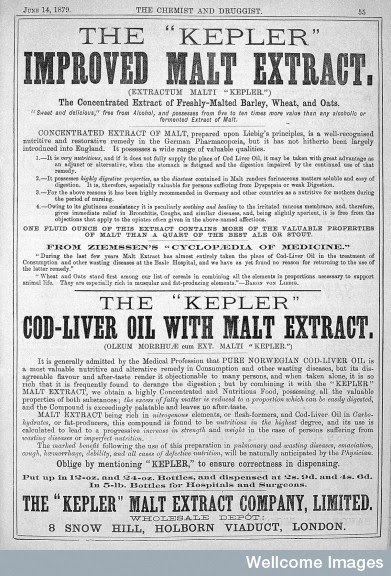
Also, before their partnership, Burroughs had added to the list of products he sold, two brands which would prove to be among the most successful for Burroughs Wellcome & Co: Hazeline (an extract of witch hazel, marketed as face cream) and Kepler malt extracts (to provide nutritional sustenance).

So, when the two men added their signatures to the document shown above, Burroughs was very much the senior partner: he had persuaded Wellcome to move across the Atlantic to London and had put up £1200 in relation to Wellcome's £800. Over the next fifteen years however, and as their business would flourish, their personal relationship would wither. So let's leave Burroughs and Wellcome in September 1880 with the ink still drying on their agreement and their futures ahead of them. The disintegration of their relationship can wait for another Blog post.

Images:
1/ Articles of Partnership between Silas Mainville Burroughs and Henry Solomon Wellcome, 27 September 1880 (WF/E/02/01/02/27)
2/ Silas Mainville Burroughs, photographed in 1885 (Wellcome Library no.
14368i)
3/ Advertisement for Kepler from 'Chemist and Druggist', June 14th, 1879


(For more on Burroughs the salesman, see the following article: Roy Church, 'The British Market for Medicine in the late Nineteenth Century: The Innovative Impact of S M Burroughs & Co', Medical History 2005 July 1; 49(3): 281–298 (available online through PubMedCentral) and the book Burroughs, Wellcome & Co.: Knowledge, Trust, Profit and the Transformation of the British Pharmaceutical Industry, 1880-1940 by Roy Church and E. M. Tansey (Crucible Books, 2007)).

Thursday, July 22, 2010

Pole to Pole with the Wellcome Library


The latest issue of Wellcome News - the Wellcome Trust's quarterly magazine rounding up its latest activities - contains an article based on material from the Wellcome Library, exploring the involvement of Henry Wellcome's pharmaceutical company with the last Antarctic expedition of Captain Robert Falcon Scott. The article is also available through the Wellcome Trust's website.

Such material is actually - to pardon the pun - the tip of the iceberg when it comes to our collections relating to the Polar regions, as this Sources Guide shows. This is just one of the many guides which exist to provde detailed thematic guidance to our archive collections. Readers with an interest in these regions are also advised to search on our catalogue for more items of interest, such as - perhaps - this illustration of the launching of the first balloon within the Arctic Circle (taken from Edward Daniel Clarke's Travels in various countries of Europe, Asia and Africa (1820-1823):

Saturday, July 25, 2009

25th July 1936


On this day in 1936, the death was announced of Sir Henry Wellcome.

Over his 82 years, Wellcome had overseen the growth of the pharmaceutical company he had co-founded into a multinational concern. Part of the fortune he made from this had been spent amassing a huge collection relating to the history of medicine, which formed the basis of the present day Wellcome Library.

Wellcome's death was widely reported in the newspapers of the day. His obituaries (which were collated, and now form a small part of our Wellcome Foundation Archive) illustrate how Henry Wellcome’s life and achievements were summarised in the aftermath of his death.

The obituaries range from those published in national titles to regional newspapers. They also include a statement read out on the 9.30pm news bulletin of the British Broadcasting Corporation on the 25th July.

These accounts of Wellcome’s life do their best to summarise his achievements. Some examined his business life, whilst others described Wellcome as a "Scientist and Explorer". Bazaar Exchange & Mart focused on Wellcome the collector, commenting that in his purchases from auctioneers:

"...he 'made the market' in the kinds of things he bought – medical relics, ethnological specimens and curious bygones of many kinds".

In this attempt to commemorate the anniversary of Wellcome’s death, the following lines from the The Times obituary seem apt:

“Wellcome insisted that his light should not be hidden and that the name of Wellcome should always be prominent”.

(Image above shows Sir Henry Wellcome lying in state in the Wellcome Research Institution, before his cremation at Golders Green Crematorium on the 29th July).

Monday, July 20, 2009

Wellcome in Space


Over the last few weeks, there have been many commemorations in the media of the 40th anniversary of the first manned mission to land on the moon. We thought we would add to this by flagging up an item from our collections. So – what’s the connection between the Wellcome and this lunar scene?

Shown here is the packaging for the Wellcome drug company’s product, ‘Marzine’, which was used as a precaution against travel sickness. Ships from the Apollo Space programme carried the product, and – as illustrated - the company later utilised this fact in the design of its packaging.

'Marzine' wasn’t the only Wellcome product used in the US space missions: 'Actifed' - for the relief of nasal congestion - was also widely used, as was 'Neosporin' (to clear up bacterial infections of the eye). Indeed, on one mission in the 1970s, Skylab carried a medical kit which included seven products provided by Burroughs Wellcome Co (USA).

It’s rather fitting that the exploration of space in the mid twentieth century utilised Wellcome products, given in the late nineteenth century, Burroughs Wellcome & Co medicine kits were essential components of many expeditions to the farthest flung corners of the Earth - Stanley, Scott and Shackleton all set forth with the company's products.

(The 'Marzine' packaging is a small part of the Wellcome Foundation Archive, which consists of material relating to the Wellcome drug business. As a result of flotations and mergers, the Wellcome drug business itself is no longer in existence. A summary of this is available).

Wednesday, April 29, 2009

One hundred years since the ‘Magic Bullet’

In 1909 Paul Ehrlich, working with his Japanese student Sahachiro Hata at the National Institute for Experimental Therapeutics in Frankfurt, discovered that the 606th substance tested in their attempts to discover a specific chemotherapeutic agent to cure syphilis, the arsphenamine compound named ‘Salvarsan’ did in fact destroy the spirochaete, treponema pallidum, which caused syphilis.

In the early years of the twentieth century this sexually-transmitted disease was a major public health problem: it had long-term lingering effects on the infected individual, and was also the cause of much disability in their offspring.

The discovery of Salvarsan was also an important breakthrough in the development of specifically targeted chemotherapeutic agents. It was rapidly taken up by the medical profession, replacing the previous much less efficacious treatment with mercury.

Its history is reflected in a number of archival collections in the Wellcome Library: the Paul Ehrlich transcripts include his work on arsphenamine, case-notes among the papers of Surgeon-General Knapp, RN (GC/85) show the early use of salvarsan trreatment in the Royal Navy, while Sir Bernard Spilsbury’s index cards of autopsies include some early deaths from toxic side-effects while dosage levels were still being worked out. These are also documented (with other material on Salvarsan) in the papers of Frederick Parkes Weber.

At the outbreak of the First World War in 1914 the supply of Salvarsan (and the later developed Neosalvarsan) was cut off since they were produced in Germany. Substitutes – Kharsivan and Neokharsivan - were developed and manufactured by Burroughs Wellcome and Co Ltd. Further information can be found in the company records.

Contemporaneously, the Royal Commission on Venereal Diseases (1913-1916) was hearing evidence on the best and most effective ways to bring this radical new treatment and sufferers together. Its reports and minutes of evidence are held in the Library.

Other items of relevance in the Wellcome Library, besides numerous printed works, include the 1974 BBC educational film The Search for the Magic Bullet as well as the famous Hollywood movie, starring Edward G Robinson (better known his gangster roles) as Ehrlich, Dr Ehrlich’s Magic Bullet (1940).

Although it was replaced in the 1940s by penicillin, a treatment which took much less time and had far fewer dangerous side-effects, Salvarsan and its clones played a major role in the reduction of syphilitic infection in the UK between the two world wars.