Showing posts with label literature. Show all posts

Saturday, June 16, 2012

Easing the way for literature

16th June 1904: a young Dubliner goes on a first date with the woman who will become the mother of his children and (much later) his wife. Eighteen years later – that is, in 1922, ninety years ago – he will publish a book that, as well as encapsulating all literature, will capture Dublin as it was on the day of that first date, so that, as he was to say, if Dublin were destroyed it could be rebuilt from the information in that one volume. The young man is James Joyce, his date Nora Barnacle and the book Ulysses. Bloomsday, as 16th June is known to Joyce enthusiasts, is celebrated every year, but readers in Britain will be aware of extra coverage this year, as the BBC marks 90 years since the book’s publication with various events culminating in a dramatization of Ulysses spread across Radio 4 throughout Bloomsday, whilst in Ireland RTÉ's arts programme The Works will be devoted to Joyce.

A character resembling Joyce does feature strongly in the book – the rather humourless, priggish Stephen Dedalus, whom readers first met on a journey from childhood to young manhood in A Portrait of the Artist as a Young Man – but a quite different figure is at the centre of Ulysses, the middle-aged Jewish everyman Leopold Bloom. From the moment that he appears, at the start of the fourth chapter, Bloom is never far from the book’s action and it is his interior monologue that features most strongly as he navigates the city: hence, of course, the name Bloomsday.

Ulysses exists on multiple levels – as high conceptual art and meta-fiction, a discourse about literature via literature, picking up, pastiching and parodying various forms and tropes; but also on a more down-to-earth level as an experiment in rendering experience via language as completely as possible. This for Joyce means a focus upon the detail of basic, quotidian experience, observed closely and rendered faithfully and without judgement. Moments after Bloom’s first appearance, the brilliant ear Joyce brought to this project is summed up in one line from Bloom’s cat –
The cat walked stiffly round a leg of the table with tail on high.
-Mkgnao!
- which captures perfectly a particular sound to the extent that it is hard, having read it, not to hear all cats in future as saying “Mkgnao!” rather than the conventional Miaow. The focus on the quotidian however, also leads Joyce with some relish into areas often considered offensive or taboo. On the very first page Stephen Dedalus’s friend Buck Mulligan borrows Dedalus’s handkerchief and goes into flights of verbal fancy over the colour “snotgreen” – gazing out over Dublin Bay, he embarks on a verbal riff about “The snotgreen sea. The scrotumtightening sea.” Joyce’s characters, unlike many in literature, have bodily fluids and bodily waste: snot, urine, menstrual blood, farts, semen and excrement are all produced by one or other of them in the course of the eighteen hours tracked by the novel.

Human beings as part of the physical world, of course, are the stock in trade of the Wellcome Library, with Sir Henry Wellcome’s collecting vision of the history of medicine being (inter alia) a history of humankind’s physical side. It is, therefore, particularly appropriate that Wellcome, or rather one of his products, has a walk-on part at precisely one of those moments in the book. Bloom first appears early in the morning, frying breakfast and making tea (some of the meat is begged by the cat we met earlier, whilst a cup of tea is taken to his half-asleep wife). Like many of us, we suspect (but we won’t pry), he finds that after a short while up and about, his bowels kick into action and he has to go off to the privy at the end of the garden, where he muses on defecation during the act and provides a little endorsement for a Wellcome product:
..his last resistance yielding, he allowed his bowels to ease themselves quietly as he read, reading still patiently, that slight constipation of yesterday quite gone. Hope it’s not too big bring on piles again. No, just right. So. Ah! Costive one tabloid of cascara sagrada.
Cascara sagrada was a widely used natural laxative, derived from the dried bark of a species of Buckthorn - a routine element in the materia medica of the time. “Tabloid”, however, makes the mention more specific: this was (and is) a Wellcome trademarked word and at this time Wellcome was assertively litigious in defending his intellectual property, so there is no question that when Joyce has Bloom think of a product delivered in “tabloids” it is a Burroughs Wellcome item. (An image of Burroughs Wellcome Cascara Sagrada can be found in the Science Museum's Science and Society picture library.) Wellcome rarely missed a trick when it came to publicity and was keen to make sure his products were prominently placed in, for example, accounts of polar exploration. We suspect, however, that he was unaware of this bit of product placement in a notoriously “dirty” and long-banned book, and if he had known he might well have been rather too prudish to enjoy it.

It is a quirk of Joyce’s works, perhaps a function of the years each took to write, that by the end of each they tend to be turning into the next. A Portrait of the Artist as a Young Man brings Stephen Dedalus from infancy to the priggish young man who appears on the first page of Ulysses, whilst as the latter progresses its balance shifts from intense focus on everyday experience and interior monologue towards a more purely literary nature, working through various literary genres and parodies in an “unrealistic”, meta-fictional mode. This foreshadows Finnegans Wake and its attempt to bundle all of human experience and all human language into a tale of one archetypal family told in “night-language”, the slurred language of dreams in which concepts collide and coalesce in an endless series of puns, some serious and some joyfully smutty. We cannot, alas, say whether Wellcome or his products appear in the Wake, although its professed aim of encompassing all human experience means that they might well be in there somewhere. Perhaps Joyce missed a trick: in the first pages of Finnegans Wake we find ourselves inside the Wellington Monument in Phoenix Park, enlarged and transformed into a museum - “Now yiz are in the Willingdone Museyroom” – and he would surely have loved to include the Wellcome Museyroom, and to use the founder’s name as the opportunity for a smutty double entendre. Wellcome’s tense relationship with his more easy-going partner Silas Burroughs, too, is reminiscent of the Wake’s "Tales Told of Shem and Shaun", the stories of personality clash between two contrasting brothers (based on Joyce and his more strait-laced brother Stanislas) that include the fable of the Ondt and the Gracehoper. The beauty of Finnegans Wake is that, containing multitudes, it lends itself to application in all sorts of ways: if Wellcome, or indeed anyone one wishes, does not appear in it explicitly one can still find some sort of analogue. Another of its beauties is that having mentioned it one is immediately absolved from bringing a blog post to any sort of conclusion; like Finnegans Wake itself, one can start anywhere and just end in mid-

Illustration: James Joyce's grave in Fluntern Cemetery, Zürich. Copyright, Lars Haefner, made available under Creative Commons Attribution-Share Alike 3.0 Unported license via Wikimedia Commons. Fluntern Cemetery is high on the rounded top of the Zürichberg and backs onto Zürich Zoo: when she buried her husband there Nora Joyce commented that he would be able to hear the lions roaring and would like that.

Monday, February 6, 2012

Happy Birthday, Charles Dickens

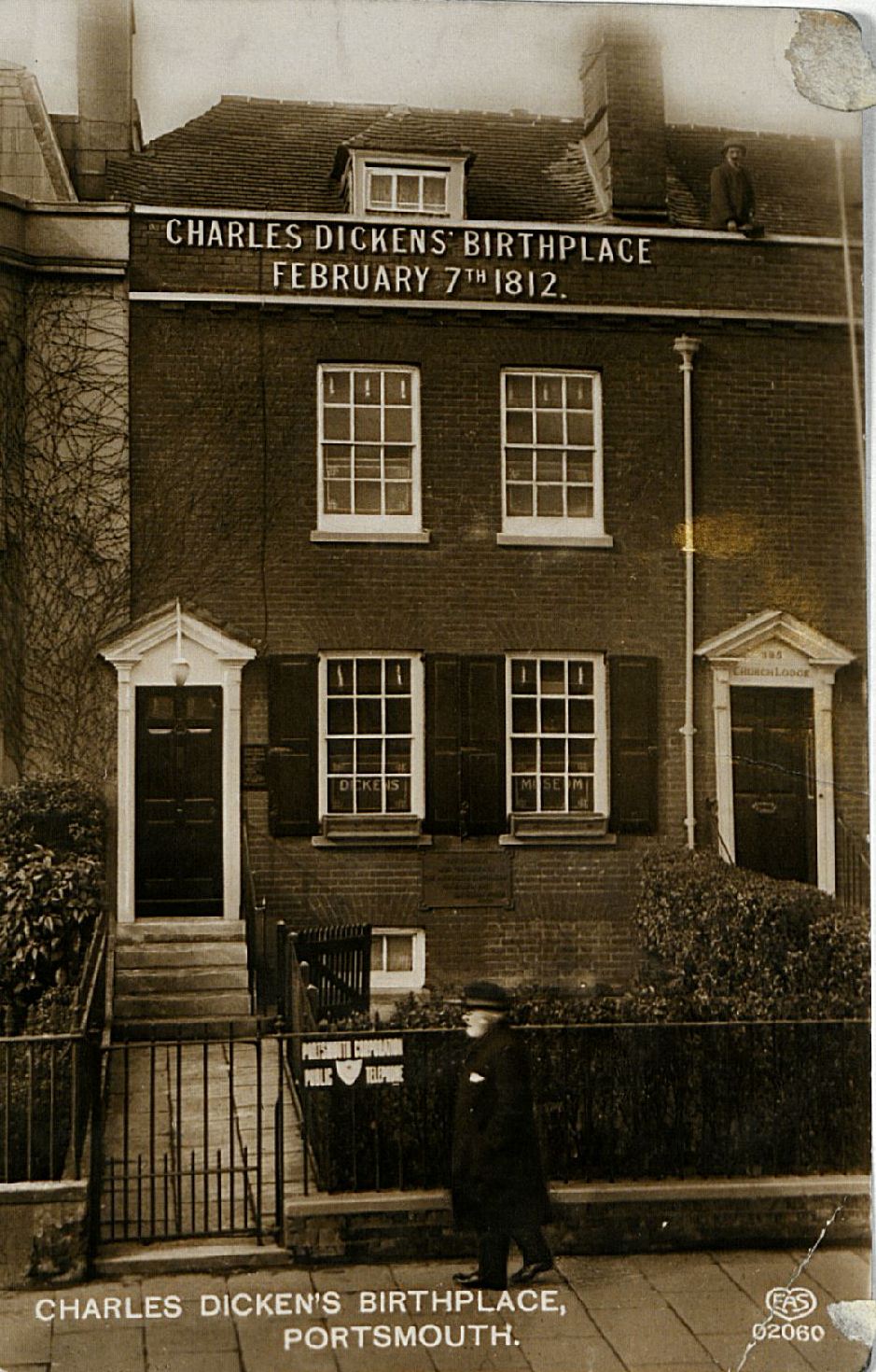
There can’t be many of our readers in the UK who are still unaware that this year is Charles Dickens’ bicentenary. 2012 sees exhibitions in Portsmouth, Dickens’ birthplace; in London, the city with which he is most closely associated; in Kent, where he lived at various times in his life and where he died, and, doubtless at any other place fortunate enough to claim kinship. 2012 was not even started when the Christmas season saw a flurry of Dickens adaptations on television. Throughout the year there will be events to mark this anniversary of one of our greatest writers; but today, February 7th, is the actual bicentenary, Dickens’ birthday, and it’s only right that today we look a little at Dickens and medical history.

It's fair to note that medicine is not the first profession one thinks of in connection with Dickens' fiction. Lawyers and their clerks, of course, march through his fiction in be-wigged crowds, trailing legal dust behind them. Merchants and shop-keepers and, again, their clerks (think of Bob Cratchit in A Christmas Carol), are not far behind. Dickens also has a particular eye for appalling customer service: his descriptions of horrible meals and surly staff in the Mugby Junction railway station will ring bells with many travellers (and have seldom been approached in fiction: W.G. Sebald's excruciating description of eating fish and chips in an out-of-season hotel in Lowestoft, in The Rings of Saturn, is their closest modern equivalent). The hard-core Dickens-fan will recall that Esther Summerson, in Bleak House, marries a doctor, Allan Woodcourt. Sarah Gamp, in Martin Chuzzlewit, summarises nicely the image of the drunken nurse before Florence Nightingale got to work on the profession. As regards patients, there are some penetrating descriptions of extreme mental states in his work (Miss Havisham in Great Expectations; Bradley Headstone in Our Mutual Friend), and some touching descriptions of characters with learning difficulties (Smike, in Nicholas Nickleby, or Mr. Dick in David Copperfield). However, medical personnel are generally few and far between in his work, and his description of the patients mentioned above is not clinical: one would struggle to identify particular syndromes from his descriptions, as they are used imaginatively, as symbols rather than detailed illustrations of actual conditions.

It would be a mistake, though, to think that Dickens and medical history have little connection. If the Wellcome Library's holdings teach us anything, it is that "medical history" goes far, far beyond what the official medical profession does, embracing the wider fields of public health, mortality, demography and so forth. If nothing else, the fact that Dickens' characters suffer the usual mortality-rates of the Victorian novel, with children dying young (Little Nell, Paul Dombey), young women wasting away (Dora Copperfield), and in general a lower chance of people making it through to their three-score and ten, would raise questions about the difference in health-care between his time and ours, the extent to which his fictional mortality rates mirror those of nineteenth-century society or are a matter of plot convenience, and so on.

But Dickens goes further than this, of course. He is a novelist as campaigner par excellence, using his fiction to drive debates about public health, the distribution of wealth and the interconnectedness of society: the agenda that drove the great nineteenth-century movements towards mass education, slum clearance, public ownership of utilities and, in the new century, unemployment benefit and eventually the National Health Service. Like much creative writing in the early nineteenth century (see, for example, other writers of "Condition of England" novels such as Elizabeth Gaskell), he is in revolt against Utilitarianism and the small-state Manchester School economics of the time, convinced of the value of social bonds, solidarity and empathy against a vision of society as atomized and competitive, in which the weakest go to the wall. The bleak calculus of Thomas Malthus had set out a demography in which food supply increases arithmetically but population increases geometrically until, outstripping food supply, it is reduced by famine or disease until the surplus population has gone. (Works on demography, including Malthus, can be found in the library at shelfmark EH and its subdivisions.) The long shadow of Malthus hangs over much fiction of the time: when Scrooge, before his reformation, snarls that the poor "had better [die], and decrease the surplus population", it is to this that he is alluding. Dickens, throughout his works, protests against this view of humanity in the mass, in which the poor in particular are seen only in the aggregate, as "surplus population", the death of a few thousand of which is of no great moment in the bigger scheme of things. Public health is a key element in this argument.

Visitors to our Dirt exhibition last year will remember the key role that concepts of cleanliness and dirt play in health and culture. With that in mind it is instructive to read the first paragraphs of Bleak House and to count up the references to dirt:

LONDON. Michaelmas term lately over, and the Lord Chancellor sitting in Lincoln’s Inn Hall. Implacable November weather. As much mud in the streets, as if the waters had but newly retired from the face of the earth, and it would not be wonderful to meet a Megalosaurus, forty feet long or so, waddling like an elephantine lizard up Holborn Hill. Smoke lowering down from chimney-pots, making a soft black drizzle with flakes of soot in it as big as full-grown snowflakes – gone into mourning, one might imagine, for the death of the sun. Dogs, undistinguishable in mire. Horses, scarcely better; splashed to their very blinkers. Foot passengers, jostling one another’s umbrellas, in a general infection of ill temper, and losing their foot-hold at street-corners, where tens of thousands of other foot passengers have been slipping and sliding since the day broke (if this day ever broke), adding new deposits to the crust upon crust of mud, sticking at those points tenaciously to the pavement, and accumulating at compound interest.


Fog everywhere. Fog up the river, where it flows among green airs and meadows; fog down the river, where it rolls defiled among the tiers of shipping, and the waterside pollutions of a great (and dirty) city.

At the very beginning of the novel, Dickens presents a world spiralling into entropy, all intellectual categories collapsing - Is it day or night? Is that a living animal or a mound of mud? Are we in the present or the time of the Dinosaurs? Dirt and decay are central to this vision, and as the novel progresses they concentrate in the slum, Tom-all-Alone's. In chapter 46, in his description of the slum, Dickens uses disease - and the prevalent miasma theory of infection, ascribing it to bad air rather than to microbes - as he argues against views of society as atomised and demands an acknowledgement of human interrelatedness:

But [Tom] has his revenge. Even the winds are his messengers, and they serve him in these hours of darkness. There is not a drop of Tom's corrupted blood but propagates infection and contagion somewhere. It shall pollute, this very night, the choice stream (in which chemists would find the genuine nobility) of a Norman house, and his Grace shall not be able to say Nay to the infamous alliance. There is not an atom of Tom's slime, not a cubic inch of any pestillential [sic] gas in which he lives, not one obscenity or degradation about him... but shall work its retribution, through every order of society, up to the proudest of the proud, and up to the highest of the high.

Read Dickens looking not for men with stethoscopes and bottles of medicine, but for the wider issues of medical history as understood by Henry Wellcome, embracing public health, hygiene, nutrition, poverty, all the factors that bind together a society in ways that go far beyond the purely economic: medical history issues understood thus recur over and over in his works, and are strongest in the greatest novels (Bleak House is the obvious example). It is no surprise, then, that some of Dickens' papers have found their way to the Wellcome Library. MS.7774 is a collection of various letters and other documents by Dickens or related to him, whilst MS.7775 is a group of papers related to Dickens' relationship with the maverick physician John Elliotson, pioneer of mesmerism. (Dickens, of course, operated metaphorically within a circle of stage fire all the time, and took particular delight in casting a spell over rapt audiences when doing readings of his works: he would have been fascinated by mesmerism.) To mark the bicentenary, do come and experience handling papers by Dickens himself. But you also mark his anniversary by taking a wider interest in medical history, by looking at what he would have seen as the ties of common humanity that straddle social classes: health, hygiene, poverty, nutrition, crime... all the headings you find in the Library's guide to its shelfmarks. The key themes of Dickens' great sprawling panoramas of Victorian society are often our stock in trade. Happy Birthday to him: in another two hundred years, people will still be reading.


Images:
Dickens near the end of his life, from Wikimedia Commons - click for copyright information.
Dickens as a young man, from Wikimedia Commons.
Postcard showing Dickens' birthplace, from MS.7774.
Dickens' signature, from MS.7774.

Saturday, November 26, 2011

The Giant Ape in the Library

Quick – what’s the connection between a hundred-foot rampaging gorilla and the Wellcome Library?

Well, it wouldn’t be a common sight in the reading room, and although stepping out onto the Euston Road has its hazards they usually relate to heavy traffic and air quality, not colossal primates. There’s a thread linking the two, however, and it runs through our manuscript 7797.

On the face of it, MS.7797 is an unremarkable little piece of correspondence. The letterhead indicates that was written on an ocean liner – it’s actually dateable from external evidence to the early 1930s, the great heyday of Transatlantic liner travel, the ship being the Empress of Britain belonging to the Canadian Pacific Line. The recipient is addressed only as “Dear Doctor” - one presumes this is the ship’s medical officer. The writer is clearly suffering from problems in the throat – he thanks the doctor for a gargle he has been given, and asks about a nose and throat spray that he has used in the past when suffering from catarrh. His valet, he explains, forgot to pack both his normal supply of the medication, and the atomiser used to administer it, and he is trying to work out what it is that he should ask for to replace this.

So far so good, but where do the giant apes come in? Well, turning the page we see the writer’s identity, and it takes us into the reliably fascinating world of Edwardian pulp fiction: this is the thriller-writer Edgar Wallace (1875-1932). Wallace was born the illegitimate son of actors and had to make his own way in the world: drifting through various jobs in his teens and early twenties, he found his metier when he enlisted in the Army at the time of the Boer War, at the age of 25. Not that he was cut out to be a soldier: he disliked the infantry (he was physically lazy and completely unsuited to a life of square-bashing) and arranged a transfer to the Royal Army Medical Corps, then moved on from here to the Press Corps, where he found his niche. (Our RAMC/1707 documents him at this time of his life, performing at a military entertainment by reciting a Kipling poem.) From here on his career was built around the Fleet Street core skill of producing large amounts of readable text quickly and to deadline: journalism for the Daily Mail and similar middle-brow outlets, and a series of thrillers beginning in 1905 with The Four Just Men. Various apocryphal tales are related about the speed and fluency with which he produced his works: one of these has him dictating an entire novel over the course of a weekend. By the early 1920s, one of his publishers estimated that a quarter of the books read in England that year were by Wallace.

The ability to produce text quickly and in a way that reflected the public’s taste reliably soon had Wallace receiving calls from the film industry, and it is here that our letter comes in. In late 1931 Wallace sailed for the United States, engaged by RKO to work as a “script doctor”. This letter was written on the voyage across the Atlantic (the name of the ship enables us to tie it to this journey) - although he doesn't give us the exact date, we're in November 1931 and thus pretty much exactly eighty years ago. In Hollywood, prolific as ever, Wallace cranked out various scripts to order, including – in a pulp-fiction summit meeting – one for The Hound of the Baskervilles. Most notable, however, was the project on which he worked from December 1931 to February 1932, collaborating on “a gorilla picture” with producer Merian C. Cooper. This was to be King Kong, which of course remains to this day one of the most famous products of the Golden Age of Hollywood.

It was also the culmination of Wallace’s career, although he never lived to see it: by the time the film was released in 1933 he was dead. A lifetime of too much food, several packs of cigarettes every day, lots of sugary tea and as a little exercise as possible (the classic Fleet Street lifestyle, although to do Wallace justice he was a virtual teetotaller, omitting one of the classic journalist’s vices at least) caught up with him in late January 1932, when a doctor identified that he had been suffering from severe diabetes, untreated, for years. As if in response to the diagnosis, Wallace fell into a coma almost immediately and died in Beverly Hills on February 7th.

We see him in MS.7797, then, in the very last months of his life, but at a high point in his career: about to embark on the project that would outlive him and the reputation of his books. Wallace’s novels are still in print (at least, some of them – he wrote over 170 books and many require a search of second-hand bookshops) but although Sanders of the River and The Four Just Men have an honourable and secure place in the history of pulp, they don't have the massive public profile that they did in Wallace’s heyday. King Kong, however, lives on, and has been paid the ultimate Hollywood compliments of remakes and spinoffs. In a sense, having produced the script Wallace’s work was done, his place in history secure. It’s unlikely that the next remake will feature the Wellcome Library, with a screaming Fay Wray held aloft above 183 Euston Road. Still, we like to feel proud of our little foothold in this landmark of popular culture.


Images
MS.7797, front.
MS.7797, back, including signature (and annotation by a previous owner of the letter).
R.M.S. Empress of Britain, passing through the Saint Lawrence River near Quebec. Taken on July 10th in 1937, on the "Ile d'Orléans" by Horace Bélinge, now deceased. Made available under Creative Commons (http://creativecommons.org/licenses/by-sa/3.0/ ) through Wikimedia.
Original poster for King Kong, 1933, from Wikimedia, now out of copyright in the USA, EU and many other domains (see Wikimedia page for details of copyright status).

Saturday, September 17, 2011

Death of a novelist

On this day in 1771 - exactly 240 years ago, in other words - the Scottish novelist Tobias Smollett (1721-1771) died in Italy. Like Henry Fielding, another of the eighteenth-century founders of the English novel, he had travelled to the Mediterranean in search of health: as a sufferer from tuberculosis, it was felt that he would benefit from the warmer, drier climate. Like Fielding, if he found any respite it was brief: the disease killed him there and he is buried in Livorno. Thus far, Smollett's is a familiar story of a disease well-documented in our holdings, but he is relevant to the Library not merely as a patient: he was also a medical man, serving when a young man as a naval surgeon's mate and taking part in the disastrous Cartegena expedition to the Caribbean in 1741. Although, from the 1750s onwards, he earned his living chiefly by his pen - and his universal reputation among his contemporaries for irascibility suggests that bedside manner would not have been one of his strengths - he remained in touch with the world of medicine and would have been well placed to note, with foreboding, the progress of his disease.

We have only one item by Smollett in our archives and manuscripts collection, a letter held as MS.7887/7, but it comes at an interesting point in his career. It dates from 1749, when Smollett had just published his first novel, Roderick Random, and begun to establish himself as a writer. Smollett's novels are unjustly neglected these days, despite the fact that he fully deserves his place in the quartet of great names that followed Defoe and set up modes of the novel in English that shaped it for the next century (the others in this quartet would be Fielding, Richardson and Sterne). His splenetic satires and grotesque characters are not to everyone's taste. The Victorians in particular regarded Smollett as very strong meat indeed - Dickens was a fan, but at the same time regarded his work as marred by the coarseness of an earlier, less polished era. All of which is, essentially, code for the fact that Smollett never met a chamber-pot joke that he didn't like; broad farce with brimming jordans is a staple of his comedy, something that became impossible in the mid-nineteenth-century novel (and renders his work problematic for Sunday afternoon costume-drama adaptations).

In the letter held in the Wellcome Library, Smollett writes to the great anatomist William Hunter (a fellow Scot) that he is shortly to visit Paris, and would appreciate being put in touch with anyone that Hunter knows there. We thus see a small light on the genesis of Smollett's next novel, Peregrine Pickle, which was to appear in 1751. Just as Roderick Random had drawn on Smollett's experience by sending its hero on the Cartagena expedition, so his next novel sent the hero and his entourage to Paris. It is to be hoped that not too much of it was drawn from the life. In Paris, Pickle sees the sights in conjunction with a vain, gullible, xenophobic English painter named Pallet, possibly based on Hogarth, whose linguistic skills stretch no further than "No parly Francy. Damn your chattering! Go about your business, can't ye?" In maybe the most characteristic scene of the novel, Pallet - who has been tricked into attending a ball in women's clothing, for complicated reasons! - finds himself in anguish with a full bladder and eventually, "compelled to yield to the urgent dictates of necessity", follows some male guests into the gentlemen's toilet and, hitching up his skirts, "discharge[s] the source of his vexation in the presence of them all, crying in his own excuse, 'By your leave, by your leave. Egad! necessity has no law.'"

Strong meat indeed for the Victorian palate, and unsuprisingly there has been no move towards a Merchant-Ivory adaptation of Smollett. On the anniversary of his death, though, think about this medical novelist and maybe make a resolution to read one of his works. Failing that, we have at least equipped you with a phrase to use in awkward social situations (for example, squeezing your way along a line of theatre seats after the perfomance has started): just adjust your wig like a true-born eighteenth century Briton and cry out "By your leave, by your leave. Egad! necessity has no law."

Images:
1/ Portrait of Tobias Smollett: engraving after Sir Joshua Reynolds. One of many pictures of Smollett to be found in Wellcome Images.
2/ MS.7887/7, letter from Smollett to William Hunter.

Wednesday, September 29, 2010

A novelist's bicentenary

Elizabeth Gaskell, the novelist, was born 200 years ago today, on 29th September 1810.

The huge success of the BBC’s version of Cranford (which added several of her other short stories to the adaptation) and, a few years before that, a high-quality version of North and South, have made her name a familiar one to a modern audience. For many years, however, she seemed destined to be treated as a footnote to other people’s stories. For much of the nineteenth and early twentieth centuries, she was known as a novelist basically for Cranford: for all its charm, this is perhaps one of her minor works and certainly made it possible to see her as a milder, more demure figure than the reality. In addition, as feminist critics rightly pointed out, the tendency during this time to refer to her as “Mrs Gaskell”, without a forename, tended to reduce her individuality (it also made it hard to distinguish her from similarly-named lesser writers such as Mrs Oliphant or Mrs Humphrey Ward). During her years of neglect, the other one of her works to enjoy continued currency was her biography of Charlotte Brontë: again, this gave her prominence but only as the friend and biographer of Brontë (whose biography, being first in the field, would often be attacked ritually by anyone seeking to justify the need for their own subsequent work).

From the 1950s onwards, her novels exploring the social consequences of the industrialisation she saw around her in Manchester – Mary Barton and North and South – were given more and more prominence, but again at the cost of lumping her into a literary-historical moment, treating these works as part of a collective whole called “The Condition of England novel”, in which Gaskell, Kingsley, Disraeli and others formed a rather undifferentiated supporting cast to Dickens’ Hard Times. It has taken the determined rediscovery and re-excavation of women’s writing from the 1970s and 1980s onwards to bring her to prominence on her own merits as an accomplished and varied writer: not as someone else’s wife or biographer, or a bit-part player in literary history, but as Elizabeth Cleghorn Gaskell (née Stephenson), novelist.

We might not think of her instantly as a writer who explores medical themes (although anyone who saw the TV adaptation of Cranford will have vivid memories, maybe too vivid, of Philip Glennister as Mr Carter having a leg amputated without anaesthetic). However – as any visitor to the Wellcome Library can vouch – what is “medical” can be defined very broadly, and many broad social or scientific issues turn out to be grist to the medical-historical mill. The industrial revolution involved huge social and scientific changes, very many of which had medical implications, and Gaskell’s works demonstrate a vivid eye for this changing world around her. Science and industry impinge on her novels frequently, even in those not explicitly to do with “the condition of England”: the rural idyll of Cranford, for example, is invaded by the newly-invented railway, and in her last novel Wives and Daughters the central male character, Roger Hamley, is a naturalist whose commitment to scientific rigour and clarity mirrors his personal qualities of honesty and uprightness. Most notably, of course, it is in those novels that explore the social consequences of industrialisation, and take the reader into the same Manchester slums that Engels described, that the public-health consequences of the Industrial Revolution are all around us, the ill-lit and ill-drained slums where the poor sleep surrounded by filth. The presentation of Gaskell as a meek, dove-like figure whose works were limited to a female world of charm and manners, which predominated in the early twentieth century, is a long way from the truth.

With that in mind, it should perhaps come as no surprise that Elizabeth Gaskell is represented in the archives collection of the Wellcome Library. Our MS.7141 comprises a letter from Gaskell to a friend named Ann Scott (the wife of the principal of Owens’ College, which would evolve into Manchester University), written around 1854, in which she discusses the medical case of a Mrs Glover of Bury. Mrs Glover is suffering from a uterine cancer and, it is clear, her prognosis is not good. Gaskell explains that there is a possibility of her being operated upon by Dr Protheroe Smith at the Women's Hospital in London; however, she makes it clear that she thinks that this is unlikely to heal her and that there might be no point in subjecting Mrs Glover to the pain and stress of unnecessary surgery. (Dr Smith, she indicates, has a track record of pressing ahead in such circumstances to an extent that she feels might amount to positive cruelty.) The alternative, she suggests, might be to experiment with reducing pain by using mesmerism: a concept that had been around since the start of the century, and which - despite the lack of an agreed model explaining it – had been used to perform pain-free operations in the place of anaesthetic. (Coincidentally, active in Manchester at the same time as Gaskell was the general practitioner James Braid, whose work on these phenomena was to explain them in terms of actions upon the mind of the subject rather than the nebulous physical explanations centring on a “magnetic fluid” that had been favoured by mesmerism’s inventor Franz Anton Mesmer: it was Braid who gave these phenomena their modern name, “hypnotism”.)

It is a suggestive vignette, pointing us in various directions: demonstrating Gaskell’s interest in medical issues and a willingness to think beyond the box of orthodoxy in looking at therapies, opening discussions on male practitioners’ treatment of the female body and of women’s illness, echoing modern concerns about medical invasiveness versus palliative care for the terminally ill. The letter is discussed in detail in an article in Medical History (Christopher Hilton, "Elizabeth Gaskell and Mesmerism: An Unpublished Letter", Medical History, 1995, 39: 219-235), published not long after the Library acquired it; the article - including a transcript of the letter - is freely available here. Although it is our only Elizabeth Gaskell item, it fully earns its place in our holdings: it links to all sorts of issues discussed elsewhere in the collection and demonstrates another way in which this intelligent, aware woman engaged with the changing world around her. Two hundred years on from her birth, we salute her: Elizabeth Gaskell, nobody’s footnote.

Images, from top:
1/ Elizabeth Gaskell, c.1851, from Wikimedia Commons.
2/ Manchester soup kitchen, mid-19th century, from Wellcome Images (image number L0004800).
3/ Manchester workers' dwellings, mid-19th century, from Wellcome Images (image number L0004801).
Images made available under Creative Commons licence.

Wednesday, August 25, 2010

Confrontation at Crystal Palace: The Adventure of the Bearded Colossus

One hundred and ten years ago, two doctors confronted one another in South London. One, in his fifties at the time, was the acknowledged leader in his field. The other, ten years younger, was a few years into a stellar career in a different area. In Upper Norwood’s Crystal Palace Park, a few yards from Benjamin Waterhouse Hawkins’ dinosaur sculptures, in a bowl of land that now houses the famous Crystal Palace athletics track, the two men met head on…

Their meeting – as the mysterious opening paragraph probably indicates – was not to do with any medical issue, and although both are instantly recognisable to this day, in neither case is it for their medical career. The older man is William Gilbert (“W.G.”) Grace, the brilliant cricketer (and general practitioner). The younger is Arthur Conan Doyle, author, general practitioner and one-time eye specialist.

Born in 1848, Grace had starred for Gloucestershire since he was a teenager, chiefly as a batsman but also as a bowler (initially medium-paced, but growing slower as his waistline increased with the years). In 1895, well into his forties, he had had a great “Indian Summer” season, compiling statistics that ranked with any season of his career – for example, he became the first player to score 1000 runs in May, something only two other people have achieved subsequently. In 1899, however, he quarrelled with the authorities at Gloucestershire and became the lynchpin of a new London County Cricket Club, based at Crystal Palace Park. Although he never had another truly great season, even in the twilight of his career he was a feared player: Grace in decline was as good as many players at their best.

Arthur Conan Doyle, by contrast, loved cricket but performed at a much lower level. At this stage in his career, he had already achieved huge success as the creator of Sherlock Holmes. The great detective had made his debut in two novels in the late 1880s but it was when Doyle began to write a series of short stories featuring Holmes for the Strand magazine, the first appearing in summer 1891, that public enthusiasm really went through the roof. The Strand rapidly made the Sherlock Holmes story its lead item, and circulation doubled. Notoriously, Doyle felt Sherlock Holmes was crowding out all his other literary projects and in December 1893 sent him and his arch-rival Professor Moriarty tumbling, apparently to their deaths, into the Reichenbach Falls; the remainder of the 1890s were spent in a variety of literary endeavours, including other mystery stories, historical fiction and tales on medical themes. When the two men met in 1900, in South Africa the Boer War was under way - something to which Doyle gave enthusiastic support – and he had just revived his medical skills to serve as a volunteer doctor at the Longman Hospital in Bloemfontein. In the late summer, he was back in England and back in the area of South London where he had lived with his wife and daughter earlier in his career (there is a blue plaque on Conan Doyle’s old house in Tenison Road, South Norwood, a mile or so to the south of the Park), on a collision course with W.G. Grace.

Doyle was a member of the Marylebone Cricket Club, and on 23rd-25th August 1900 the MCC took on Grace’s London club in a three-day game at the Crystal Palace. It will not surprise anyone familiar with the English summer to learn that the match was affected by rain – there was no play at all on the first day - and that the two clubs needed to negotiate ways in which the fixture could be brought to a conclusion despite time lost to the weather. Grace agreed to a proposal to extend the final day’s play into the evening to get a result. On the 25th of August, the LCC – who had batted first - were into their second innings. Neither side had scored heavily in the first innings and each had been all out for a very similar figure, so this final day would decide the game. No London batsman was particularly impressive, with the exception of Grace: he scored a century, with his nearest colleague scoring only 36 and all the others struggling to break double figures. Getting Grace out would be crucial for the MCC.

Conan Doyle, a slow-to-medium paced bowler for the MCC, had had a quiet game: taking no wickets in the first innings, and scoring only 4. Now, on the final day, he found himself wheeled in to bowl again. The two main MCC bowlers, Thompson and Cranfield, had taken all the wickets so far. Doyle later recalled the occasion in a long poem, “A Reminiscence of Cricket”:

“Before me he stands like a vision,
Bearded and burly and brown,
A smile of good humoured derision
As he waits for the first to come down…

And I - I had tricks for the rabbits,
The feeble of mind or eye,
I could see all the duffer's bad habits
And where his ruin might lie.

The capture of such might elate one,
But it seemed like one horrible jest
That I should serve tosh to the great one,
Who had broken the hearts of the best.”


And yet: Doyle’s very lack of threat as a bowler, his sheer amateurishness, may have served him well in the end. As he tells it, he sent down two deliveries that Grace treated with perhaps more respect than they deserved, killing them with the bat but not attempting to hit them beyond the crease. Then, on Doyle’s third delivery, when Grace had finally decided that there was no secret weapon and that Doyle was every bit as unpolished as he looked, the great man uncoiled a ferocious shot, and…

Still when my dreams are night-marish,
I picture that terrible smite,
It was meant for a neighboring parish,
Or any place out of sight.

But - yes, there's a but to the story…


But indeed: Grace’s bat swung a fraction too low and the ball, instead of sailing over the trees and landing in Penge, rocketed up vertically and dropped… safely into the gloves of the wicket-keeper.

The London club promptly declared and sent the MCC in to bat for their second innings. As mentioned above, the day’s play was extended to ensure that a result could be reached and, ten minutes after the game had been scheduled to end, the MCC reached their target and secured the victory. Doyle batted in the second innings but was out for a duck; however, his work was done. It was to be the only first-class wicket he ever took, but after W.G. Grace – even in his twilight years – anyone else would have been an anti-climax.

We remember neither man for his medical career: although Grace put in many years of general practice and Poor Law work in working-class areas of Bristol, he was no high-flyer, and Sherlock Holmes claimed Doyle before his medical career really gained any momentum. It is clear that if he had stuck to cricket we would not remember Doyle for that either. But the beauty of a sport wedded to statistics is that his feat – which clearly gave him enormous pleasure – is part of the official records to this day. Cricket fans wanting to see the full scorecard can do so here. And the Wellcome Library recognises both medical high-flyers and those whose main interests lay elsewhere: biographies of both Grace and Doyle can be found in the book collection, whilst Wellcome Images provides several illustrations of both men; there are also small collections of papers relating to both in the Archives and Manuscripts holdings. The main focus of their lives does lie outside medicine, but nonetheless the medical world can claim each as one of ours.

Images, from the top (all from Wellcome Images):
1/ W.G. Grace in middle age.
2/ Arthur Conan Doyle, undated.
3/ Crystal Palace Park, shortly after its opening in the mid-19th century. The cricket ground took over the area occupied by the large fountain to the left of the picture, beyond the dinosaurs.
4/ W.G. Grace in his prime.

Wednesday, July 7, 2010

Sir Arthur Conan Doyle: Clues in the Wellcome Library


We started 2010 with a post on material from our collections which had been opened under the Data Protection Act, on the case of Charles H.M. Kerr: from our records, patient of Manor House Asylum in Chiswick, but identified - after a little detective work of our own - as illustrator of some of Conan Doyle's Sherlock Holmes stories.

Now, on the day of the 80th anniversary of Sir Arthur Conan Doyle's death, we can announce the release of material with a more direct connection to Conan Doyle himself: letters written by Sir Arthur himself.

Whilst relatively minor pieces of correspondence, these letters have made us ponder the other material in the Wellcome Library's collections with a link to Conan Doyle: clues that when put together offer a portrait of the creator of the most famous of all fictional detectives.

Starting with the facts, a simple search on the Wellcome Library catalogue reveals a number of works on Conan Doyle. These range from biographical works to journal articles examining his career and the influences upon it.

Conan Doyle was a medical man, of course, training at Edinburgh University Medical School, seeing service as a ship's doctor on a Greenland whaler and later working as a general practitioner in both Plymouth and Southsea. His attempts to set up himself as a specialist in eye-surgery in London in the 1890s did not have great success, but by this stage in his life, his career as a writer - through the creation of Sherlock Holmes and Dr John Watson - was beginning to bear fruit.

Famously, the analytic deductive powers of Holmes appear to have (at least in part) been based on Dr Joseph Bell, professor of Clinical Surgery at Edinburgh University during Conan Doyle's days as a student. And for those who want to see if Bell's powers of reason come through in his publications, a number of Bell's works are held in the Wellcome Library.

Always rather in the shadow of Holmes is the stories narrator, Dr John Watson - again, another man of medicine. From the Holmes stories, we know that Watson picked up a war wound whilst serving as a Military Doctor in Afghanistan, and literary detectives have attempted to ascertain at which precisely which battle. In the Wellcome Library, the Royal Army Medical Corps Muniments Collection contains letters and diaries from fellow military doctors who served in the same campaigns, so offering up the voices of real-life Dr John Watsons.

One of the other threads of medicine running through the Holmes stories is drug use - often that of Holmes himself. The Sign of Four memorably starts with Holmes injecting himself with cocaine, and this image of a stage portrayal of Holmes and Watson's adventures, illustrates Holmes' far-away gaze and Watson's tense consternation at his friend's activities.

Towards the end of his life Conan Doyle became fascinated with Spiritualism, and for some fans of his work, this sits uneasily with his creation of the eternal rationalist Holmes. The Wellcome Library's collections do encompass a range of works on Spiritualism, helping to assess and understand why the movement was so successful in the late nineteenth century and early twentieth century.

And his interest in Spiritualism takes us back to Conan Doyle's death in 1930. As we wrote above, he died 80 years ago today. But, six days later, at a packed seance in the Royal Albert Hall, the medium Estelle Roberts declared the spirit of Conan Doyle had returned and was sitting in - to the eyes of unbelievers - an empty chair on stage. Whether such evidence bares out Holmes's famous dictum - "Once you eliminate the impossible, whatever remains, no matter how improbable, must be the truth" - we will leave for others to judge.

But in the spirit of the serialisation of Conan Doyle's Holmes' stories, we will leave you with an unfinished tale from our collections. It's of Conan Doyle, fellow novelist H Rider Haggard and a mysterious hallucinogenic plant. For the moment - to paraphrase Holmes and Watson's case of the Giant Rat of Sumatra - we will merely say this is a blog post for which the world is not yet prepared...

Tuesday, May 25, 2010

Behind the Scenes: Outreach and events

Our Behind the Scenes topic this month is cross-departmental, focusing on the outreach and events programme. Although many staff in the Library have duties that involve public-facing work, there are a handful who spend a large proportion of their time planning, managing and carrying out the organised outreach activities.

Tours, Insights talks, and Library Workshops are held on a regular basis at the Library, and these can be booked in advance. Ross Macfarlane (Research Officer) manages tours specifically centred around the Special Collections, and Danny Rees (Assistant Librarian) focuses on the library User Services tours. Strongly focused around our academic audiences, these tours are tailored to meet the interests of each tour group and to ensure that we are giving people a good sense of how the Library’s holdings and services are relevant to them.

Insights talks are managed by Eleanor Lanyon (Library Outreach Officer) currently on secondment to the Wellcome Trust Events Team. The Insights talks are held on a weekly basis (usually on a Thursday), focusing on specific topics relevant to the Library and its holdings such as “The Occult”, “Fascinating Faces” and “Madness”.

Workshops are held a couple times a week and provide a forum for our users to learn more about how to use the Library’s resources more efficiently, to highlight the services that we provide, and to provide more information on research topics. These are managed by Lalita Kaplish (Assistant Librarian) and draw on expertise across the Library staff. Examples include “Wellcome Images” and “Plants and Medicine” among others.

Library also runs one-off or annual events that are geared toward particular audiences and help to raise the profile of the Library in the History of Medicine world and beyond. Phoebe Harkins (Assistant Librarian) is involved in the planning of these including the Medicine in Literature series, where authors who have used the Library collections for their working talk about their research processes. Authors including Phillip Hoare and Mike Jay took part in the launch of the series last year, and Michelle Lovric will be presenting her latest work “The Book of Human Skin” (Bloomsbury 2010) in July.

In order to coordinate all these internal events, a committee including key staff as well as Tracy Tillotson (Library Administrator) meet on a weekly basis. This ensures that there is good cross-departmental communication on all aspects of the events, and assures a high level of quality and relevance for the Library’s users. Tracy is the hub of much of this activity, liaising with the Trust Events team to make sure that Library events are coordinated with the rest of Wellcome Collection and the wider Trust as appropriate.

The Library is not, however, limited to its own four walls – externally-located events are also part of its outreach agenda. Events such as the Midsummer Picnics, activities in schools around medical humanities, and others are planned and managed by Eleanor, targeting a more general audience and younger groups.

The Library’s holdings are also displayed for public consumption in exhibitions. Wellcome Collection exhibitions usually incorporate a number of items, and items are loaned to external museums, galleries and libraries. Rowan De Saulles (Library Exhibition Liaison), manages all aspects of these loans, and is currently working on material to be used in the “Skin” exhibition coming up in Wellcome Collection in June.

Although it is impossible in the space of a blog post to detail all the work that goes into the Library’s outreach activities, it can be seen that there is a dedicated programme, and staff with time dedicated to supporting, promoting and contributing to them. These events add great value to the service the Library provides to its users, allowing our holdings to be used and understood creatively, and leading to a broader and deeper understanding of the subject of the History of Medicine across a wide range of audiences.

Wednesday, April 28, 2010

Announcement of Wellcome Book Prize Judges

Announced today is the new panel of judges for the 2010 Wellcome Trust Book Prize.

Chaired by Clive Anderson, former barrister, comedy writer and presenter, the panel includes writer and former Man Booker judge Maggie Gee; writer, professor and former Man Booker judge AC Grayling; University College based medical historian Michael Neve; and anatomist, anthropologist, presenter and author Alice Roberts.

Launched in 2009, the Wellcome Trust Book Prize is open to outstanding works of fiction and non-fiction on the theme of health, illness and medicine. Last year's winner was Keeper by Andrea Gillies.

The shortlist for the 2010 Prize prize will be announced at the Cheltenham Literature Festival in October, with the winner announced at a ceremony in Wellcome Collection in November.

And just as with last year's inaugural prize, the Wellcome Library will have all the shortlisted books available on our shelves.

More details on the 2010 Wellcome Book Prize are available in a Wellcome Trust press release, and on the Prize's own website.

Tuesday, April 13, 2010

New Summer programme

The new Summer programme of free Wellcome Library workshops begins on 20th April. Further details can be found on the Library website at:
http://library.wellcome.ac.uk/workshops
The workshops provide training on research and resources in the Library, and are aimed at the general public.

The programme includes:
- thematic workshops such as Science in the News, Medicine and Literature and the History of medicine;
- training on specific resources such as PubMed Central, and Web of Science;
- and introductions to the Wellcome Archives, Wellcome Images and genealogical research resources at the library.
All workshops are free and available to library members (library membership is free and open to all).
To book a place, please use the online booking facility on the library website: http://library.wellcome.ac.uk/workshops

Monday, February 15, 2010

Wellcome Library Workshops

This week’s free Wellcome Library workshops are:

Making the most of my library:
the Wellcome Library catalogue and how to personalise it

Learn the most effective way of searching the Wellcome Library catalogue and the best strategies for finding the resources you need. Discover what you can do with your Library Account, and what it can do for you.
Tuesday 16th February, 2-3pm

Medicine and Literature
Whether you're interested in Love in the Time of Cholera or scaling The Magic Mountain, this workshop will help you explore the relationship between medicine and literature, through the resources of the Wellcome Library.
Thursday 18th February, 2-3pm

Our programme of free workshops offers short practical sessions to help you discover and make use of the wealth of information available at the Wellcome Library. Book a place from the library website.

Author: Lalita Kaplish

Tuesday, January 19, 2010

'Theories and Methods: Literature, Science and Medicine'

The Wellcome Library is a participant in an Arts & Humanities Research Council (AHRC) doctoral training programme 'Theories and Methods: Literature, Science and Medicine', which is running from 2009-2011.

The second event in this programme will take place from 25-27th March at the Wellcome Library, King's College, London, and the Royal College of Surgeons.

There will be 20 places for this event awarded to doctoral students, with also bursaries for accommodation and travel. Applications for this event must be submitted by Monday 1st February.

More details on the Literature, Science and Medicine programme are available from their website, including more detailed information on the Wellcome, Kings College and Royal College of Surgeons event.

Also of interest is LitSciMed’s flourishing social space, which includes details on the first event of the programme, held at St Deniol’s Library in January, along with discussion topics accompanying the training programme, plus blog postings, films of lectures, audio recordings and other learning resources for students working on topics that combine literature, science and medicine.

Friday, January 8, 2010

Addicted artists and the corridors of power: archive material opened January 2010

Sherlock Holmes took his bottle from the corner of the mantel-piece, and his hypodermic syringe from its neat morocco case. With his long, white, nervous fingers he adjusted the delicate needle, and rolled back his left shirt-cuff. For some little time his eyes rested thoughtfully upon the sinewy forearm and wrist, all dotted and scarred with innumerable puncture marks. Finally, he thrust the sharp point home, pressed down the tiny piston, and sank back…
(Sir Arthur Conan Doyle, The Sign of Four: opening words)


Every year, at the start of January, the Wellcome Library opens various archive items to the public that have been closed under the Data Protection Act until this point. As usual, this year’s collection of expired closures is widely varied, the subjects spanning madness, animal experimentation, the skin pigmentation disorder Argyria, and the discussions of Allied leaders during World War II. The items’ formats include patient records, personal diary notes, fellowship applications and organisational subject files. But what do any of these have to do with the opening words of The Sign of Four, possibly the best-known depiction of drug use in English literature until Trainspotting came along?

Among the items opened are several from the Manor House asylum, a private mental hospital located in Chiswick House, south-west London, some of whose papers are held at the Wellcome Library. MS.6224 comprises a volume of case notes for male patients in the years 1906-1925. The very first case provides our link. The patient, Charles Henry Malcolm Kerr, is an artist aged 48 who arrived at Chiswick in 1906. The doctor examining him on admission takes up the story:

"He is described as being normally rather reserved, and has done some good work painting, his portraits having been accepted by the Academy…. Broke down last spring and became irritable & excitable. Taken by Dr Lord to his "home" at Hampstead, then began to smash things, & threaten, and evidently in a condition of absolute insane excitement, was certified & sent to the Priory."

From the Priory Kerr was transferred to Chiswick. What his problems were may perhaps be indicated by the following undated note inserted between the pages of the newly-opened casebook:

"Dear Dr Tuke,
I wish I c[oul]d have some more brandy: it is like being in prison to be deprived like this of ordinary necessities.
C.K.
Also if you c[oul]d lend me a hypodermic syringe I s[houl]d be very much obliged."

Another note sheds light on the syringe:

"Dear Dr Tuke
Last night, the morphia bottle was not found in my room: so Mr [illegible] refused to give me a dose at all: this, I regard as the most monstrous piece of insolence in a paid [illegible] I have ever heard of: but not by any means the only bit of impertinence I have been subject to.
The morphia you have given me has had no effect at all. Mr Savage said definitely that I was to have it in doses strong enough to have some effect. I have told you over and over again that I have to take morphia in larger doses than people who are not accustomed to it: but you never attend to anything I say.
C.K"

Finally, another undated note suggests possible withdrawal symptoms:

"Sir
For heaven's sake send me some brandy or something, I never felt so ill in my life. If I had been at my own home I c[oul]d have put myself right hours ago.
C.K"

But the link to Sherlock Holmes? Although the doctor making notes on Kerr’s admission concentrates on his portrait work, Kerr was also a book illustrator of some note, providing pictures for works by Rider Haggard, Robert Louis Stevenson – and Conan Doyle. In fact, when The Sign of Four, with its vivid opening depicting intravenous drug use, was published in 1890, it was with illustrations by Charles H.M. Kerr.

Holmes’s drug of choice is said to be cocaine rather than the morphia Kerr uses, but Doyle does make a reference to “the drowsiness of the drug” when talking of cocaine use in a way that suggests this is one of his notorious errors of detail and that, at least sometimes, Holmes should be seen as taking morphia. Does art imitate life in this case, or life imitate art? Did the illustrator work on a text describing a dependency he knew only too well, or only later fall victim to the same addiction? The case-notes await work that would flesh this out.

What is only too clear is that the two addicts had different fates: Holmes, famously, is weaned off his drug-use by Watson, but Kerr has a less happy end. On September 8th 1906 he leaves the Manor House for his wife’s care, noted as "Discharged ‘Relieved’", but a note below this comments "Died at Burgess Hill, December 1907", a little over a year later.

Elsewhere in the papers newly open, we find a notebook by Winston Churchill’s physician Lord Moran, containing observations on many topics including Churchill’s character and oratory, and the meetings of Allied leaders. In February 1945 he accompanies Churchill to the meeting of Allied leaders at Yalta and comments on Franklin D. Roosevelt’s poor health:

There was a good deal of talk last night about the afternoon Conference at the President's house. Everyone thought he had gone to bits physically and there was much speculation ab[ou]t the cause. It was at [illegible] that I first realized there was something wrong and that he was losing weight. Now anyone can see that he is a very sick man. It is not only his physical deterioration that they notice. He intervened in the discussion very little, his mouth dropped and he seemed to have little grip on things. He has al[wa]ys been short of knowledge about the subject under discussion but his shrewdness as covered this up to the present. Now, they say, the shrewdness is gone and there is nothing left.
Stalin doesn't seem to be taking advantage of the new situation…
Cadogan [Sir Alexander George Montagu Cadogan (1884-1968), permanent under-secretary at the Foreign Office] told me he did not think Stalin liked the PM's theatrical style. He had noticed him looking at Winston when he was making gestures with tears in his eyes. I wonder if this only means Cadogan himself doesn't like this particular style of oratory…"
(PP/CMW/K.4/2)

This is one of only three items from the Moran papers to be opened this year, but these few are the prelude of a long series to come: January 2011 will see twenty-one items from that collection newly opened. Fascinating revelations can be expected.

From addicted artists to the corridors of power: the full varied list of items newly opened is given below. Readers are warmly invited to visit the Library and enjoy the sensation of being among the first people to read these papers for decades.

MS.6224 Manor House asylum: case notes, male patients (surnames A-K only), 1906-1925
MS.6226 Manor House asylum: case notes, female patients (surnames L-Z only), 1906-1925
MS.6334 Ticehurst House hospital: patient Certificates and Notices: Admission dates 1905-1909.
MSS.6347-6348 Ticehurst House hospital: Margaret Georgina Finch patient file (2 parts)
MS.6788 Ticehurst House hospital: Photograph Album
PP/CMW/D.6/1/1 Lord Moran papers: notes on London teaching hospitals and metropolitan regions
PP/CMW/D.6/1/3 Lord Moran papers: notes on teaching hospitals in the provinces
PP/CMW/K.4/2 Lord Moran papers: notebook containing miscellaneous observations on Winston Churchill character, oratory, meeting Stalin, Teheran, 1943
PP/HUN/C/1/7 Donald Hunter papers: Argyria
PP/RAS/D.41/3 Hugo Rast papers: patient file, Wladimir Wolkoff
SA/BMF/A.2/95-98, 100, 106 Beit Memorial Fellowship records. Files on: Eagles, George Hardy; Needham, Dorothy May; Chamberlain, Ernest Noble; Allott, Eric Newmarch; Denny-Brown, Derek Ernest; Irvine, James Tutin
SA/BRA/C.1/3/1 Brain Research Association papers: response to the 1979 Protection of Animals (Scientific Purposes) Bill and the 1979 Laboratory Animals Protection Bill (Includes papers from the Committee for the Reform of Animal Experimentation, The Physiological Society, the Research Defence Society, The Royal Society, and the Universities Federation for Animal Welfare)
SA/MAC/G.1/1 Mental Aftercare Association records: Registers
SA/MAC/G.2/5 Mental Aftercare Association records: Case Agenda Books
SA/RDS/J/12/3-9 Research Defence Society: files relating to the 1979 Protection of Animals (Scientific Purposes) Bill
SA/RDS/J/17 Research Defence Society: correspondence, 1980

All are described in the Archives and Manuscripts catalogue: simply search on the reference given at the start of each entry.

Illustrations: the upper illustration shows the first page of The Sign of Four. The lower shows Lord Moran aboard a ship.

Tuesday, January 5, 2010

Free Workshops at the Wellcome Library

The new Spring programme of free Wellcome Library workshops begins on 21st January.

The workshops provide training on research and resources in the Library, and are aimed at the general public.

In addition to many old favourites, we are presenting several new workshops this year:

Finding Visual Resources in the Wellcome Library
The Library Collections offer a wealth of visual resources: prints, paintings, photographs, film, exhibition catalogues and books. This workshop offers a practical introduction and some suggestions and tips on how to locate them.

Medicine and Literature
Whether you're interested in Love in the Time of Cholera or scaling The Magic Mountain, this workshop will help you explore the relationship between medicine and literature through the resources of the Wellcome Library.

Plants and Medicine
An introduction to contemporary and historical resources relating to plants and medicine in the Library Collections and electronic resources.

All workshops are free and available to library members (library membership is free and open to all).

To book a place, please use the online booking facility on the library website.

Author: Lalita Kaplish

Sunday, November 29, 2009

Wellcome Library Workshop

This week’s free Wellcome Library workshop is:

Medicine and Literature
Whether you're interested in Love in the Time of Cholera or scaling The Magic Mountain, this workshop will help you explore the relationship between medicine and literature, through the resources of the Wellcome Library.
Tuesday 1 December, 2-3pm

Our programme of free workshops offer short practical sessions to help you discover and make use of the wealth of information available at the Wellcome Library. Book a place from the library website.

Author: Lalita Kaplish

Monday, August 3, 2009

Death of a novelist


Eighty-five years ago today, on August 3rd 1924, the novelist Joseph Conrad died of a heart attack at his home in Kent.

Conrad’s narratives are slippery constructions, with lavish use of fractured timescales, unreliable narrators and indirect speech. Their indirection and refusal to commit to unambiguous statements is appropriate for their shape-shifting author: born Józef Teodor Konrad Korzeniowski in Russian Poland, he left Poland first for France and then for England, the Polish aristocrat remaking himself as a sailor and spending long years in the merchant marine before turning to fiction.

Conrad’s life was marked by illness from an early age as well as exile: his parents, Polish nationalists who were sent to Siberia with their infant son following a failed insurrection, were both dead from tuberculosis before Conrad was ten. His own life was characterised by periods of mental collapse: a suicide attempt at nineteen is still the centre of biographical debate, and later, in his fifties, he underwent a major breakdown after the completion of his novel Under Western Eyes in 1911. Novels such as Lord Jim analyse human behaviour when stressed to the limit and beyond. Physically, he was dogged by pain, suffering severely from gout for many years.


Some years after his death, in 1936, the German doctor Paul Wohlfarth wrote to two of his associates – his personal assistant Richard Curle and his French translator Gérard Jean-Aubry – to ask their opinion of how Conrad’s health had affected his writing. Both respond at some length to Wohlfarth’s query, and each is sure that Conrad’s medical history had a definite effect upon his fiction. Wohlfarth later donated these papers to the Wellcome Library: they can be consulted as MS.8512. Until recently they have been unknown to Conrad scholars but it is hoped that now they have been catalogued and made visible they will be published as part of a supplement to his collected correspondence.

The lower illustration is taken from The Malay Archipelago by Alfred Russel Wallace. Conrad travelled extensively in the Far East and Wallace's description of the area was one of his favorite books: his fiction is often set East of Suez, most notably Lord Jim.

Tuesday, April 28, 2009

The Atrocity Exhibition and the Wellcome Library

Obituaries of J.G. Ballard published in the last week have all mentioned the writer’s two years studying medicine at Cambridge, a period in which he dissected the physical body as prelude, he hoped, for a career in psychiatry. As it turned out his explorations of inner space took place in a different arena: his studies, however, were not lost and medical detail saturates his work. With this in mind it is perhaps no surprise that the Wellcome Library – or rather its predecessor, the Wellcome Museum – has a tiny part in one of his most notorious fictions.

The Atrocity Exhibition, published in 1970, can be seen either as a non-linear novel or as a collection of linked short stories (the bulk of it comprises changing versions of the same chapter). In it, a variously-named central character - Travis, Travers, Talbert: the name is different in each chapter - attempts to deal with a world that has ceased to cohere and make sense to him, assembling groups of objects in the hope of creating significance – elevations of a multi-storey car park, chemical analyses of human secretions, diagrams of wounds and so forth. In turn he is observed by other characters, some medical professionals, who try to make sense of his actions and of the objects he brings together. In chapter 8, “Tolerances of the Human Face”, we read:
“…Dr. Nathan pondered the list on his deskpad. (1) The catalogue of an exhibition of tropical diseases at the Wellcome museum; (2)…”

Although the Library's new 'Medicine and Literature' events aim to explore the relationship between these two themes, the example of The Atrocity Exhibition shows that Ballard was already linking the two - and in the context of the Wellcome - more than three decades ago.

Photograph: the tropical medicine section of the Wellcome Museum of Medical Science in the mid-20th century, as it was when The Atrocity Exhibition was written.

Monday, March 23, 2009

New evening events in the Wellcome Library


In April, the Library will launch a new strand of events, held in the Reading Room, to explore how authors have drawn on the resources of the Wellcome Library to inspire and inform their writing.

The Ghosts of Netley, Thursday 23 April, 18.30–20.00
Philip Hoare, author of Spike Island, will use archive images and film to re-imagine the history of Netley Victorian military hospital through its ruins, and the disparate men and women who worked or visited there.

The Atmosphere of Heaven, Thursday 21 May, 18.30-20.00
Author Mike Jay will discuss his new work The Atmosphere of Heaven: The Unnatural Experiments of Dr. Beddoes and his Sons of Genius, to be published by Yale University Press in April. Mike will discuss the chaotic rise and fall of the Pneumatic Institution in Bristol, and reveal for the first time its crucial influence - on modern drug culture, attitudes toward objective and subjective knowledge, the development of anaesthetic surgery, and the birth of the Romantic movement.

Tickets for both events are free but must be booked in advance. You can also telephone on 020 7611 2222.