Showing posts with label Wellcome Images. Show all posts

Tuesday, June 14, 2011

Wellcome Library workshops

This week’s free Wellcome Library workshops are:

Making the most of my library: the Wellcome Library catalogue and how to personalise it

Perplexed by the Library catalogue? Find what you're really looking for! In this workshop you will learn the most effective way of searching the Wellcome Library catalogue and the best strategies for finding the resources you need. You'll also discover what you can do with your Library Account, and what it can do for you.
Tuesday 14th June, 2-3pm

Wellcome Images
Do you need a picture? Find what you need from Wellcome Images: search 160 000 pictures online, covering the history of medicine and the history of human culture from the earliest periods of civilisation to the present day.
Thursday 16th June, 2-3pm

Our programme of free workshops offers short practical sessions to help you discover and make use of the wealth of information available at the Wellcome Library. Book a place from the library website.

Monday, May 9, 2011

Wellcome Library Workshops

This week’s free Wellcome Library workshops are:

Wellcome Images
Do you need a picture? Find what you need from Wellcome Images: search 160 000 pictures online, covering the history of medicine and the history of human culture from the earliest periods of civilisation to the present day.
Tuesday 10th May 2-3pm

Science in the news: keeping track of stories in the media
For anyone interested in following science in the media, this workshop will introduce you to online science news sources, and internet tools for keeping up to date.
Thursday 12th May, 2-3.15pm

Our programme of free workshops offers short practical sessions to help you discover and make use of the wealth of information available at the Wellcome Library. Book a place from the library website.

Tuesday, March 22, 2011

Wellcome Library Insight: Wellcome Image Awards


This Thursday at 6pm, join Dr Laura Pastorelli, Biomedical Images Coordinator, Wellcome Images, to find out more about the stories and techniques behind the winners of the 2011 Wellcome Image Awards.

The Insight will take on display in the Lightbox on the 1st floor of Wellcome Collection, where the Wellcome Image Award Winners are currently on display.

For details on attending this free event, see the Wellcome Collection website.

Image: False-coloured scanning electron micrograph of a honeybee (Credit: Annie Cavanagh, Wellcome Images)

Wednesday, February 9, 2011

Judging the Wellcome Image Awards

In exactly two weeks, the Wellcome Image Awards will be announced at Wellcome Collection. Louise Crane looks back to October, when the judging of the awards took place.

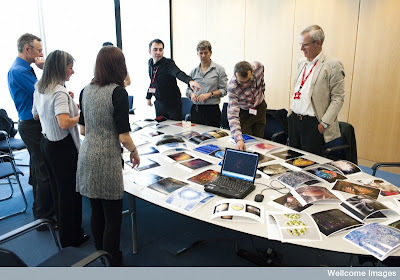
Last year, a team of picture editors, scientists, writers and broadcasters met in a room at the Wellcome Trust to select the winning pictures for the Wellcome Images Awards 2011. The judging panel was assembled and facilitated by Dr Laura Pastorelli, who acquires new biomedical images for Wellcome Images. She says, “Our eight judges represent the world of science and media. They all recognise the great value of scientific imaging – not only to research, but also for communicating this research to a wider audience. The judges were looking for recently acquired images that were visually stunning and conveyed scientific information in an interesting way. They also looked for skilful use of imaging techniques.”


Enter Dr Alice Roberts, who presented the awards in 2009 and was asked back as a judge for this year. Alice is not only a scientist and broadcaster (you may know her from BBC’s Coast and Don’t Die Young) but an artist too. Before the judging took place, she said "I love judging the Image Awards - there is always a great selection of beautiful, surprising and thought-provoking images to pore over. But that makes it very difficult as well!"

Over the next hour, the room buzzed with the deliberations, as Alice and seven other judges mulled over the 180 long-listed images laid in front of them. “What’s the story behind this image? Have I produced this myself, but better? If I was a teenager would I stick this up on my bedroom wall?!” were just some of the judges’ musings.

Also on the panel was another BBC presenter, Dr Adam Rutherford, who runs the podcast and video department at Nature. Adam explained that in the initial stages of judging, he was looking for images that gave him a strong reaction: something striking, or something that had never been seen before. Catherine Draycott, Head of Wellcome Images explained further: “To start, we eliminated anything where the image quality (focus, composition, etc.) wasn’t up to the standard we’d expect for the technique and the magnification. Then we started to home in on the images that stood out from the rest. We talked about what each one represented and how well this was conveyed by the picture.”
“Judges… ready! Images… ready! 3, 2, 1 – go!” From L-R: Fergus Walsh, Catherine Draycott, Laura Pastorelli, James Cutmore, Robin Lovell-Badge, Eric Hilaire and John Durant.

The long-list was narrowed down to a selection of around 50 images that the judges discussed in great detail. Aesthetics were admired, and detailed technical information unpacked. Laura’s expert knowledge of imaging techniques was complemented by Dr Robin Lovell-Badge, a scientist who is highly recognised in the field of developmental biology, not least for discovering SRY, the gene that determines if a developing embryo will become male. Sometimes the beauty of an image is almost a by-product of cutting edge imaging technique, but it is beautiful nonetheless. The Wellcome Image Awards are a great showcase for this. Robin explains, “anything that brings the beauty and the fascination of science to the general public is a good thing.”

The judges share their thoughts From L-R: John Durant, Catherine Draycott, Fergus Walsh, Alice Roberts, Adam Rutherford, Eric Hilaire

BBC medical correspondent Fergus Walsh was another of the judges. He commented on the impressive range of the images submitted and the variety of imaging techniques, and said that many images gave “a new insight into medicine and science.”

A few pictures polarized debate. One slightly blurry photograph caused a minor argument. “It’s not out of focus, it’s just got many focal planes!” exclaimed Adam.

“It’s not out of focus, it’s just got many focal planes!” Adam Rutherford scrutinises an image.

Some images totally absorbed our judges. I caught Eric Hilaire, Picture Editor at the Guardian, with a print in his hand staring intently at its patterns and colours. I could imagine a swirl of thoughts going round his head, which he elucidated later: “The first time I saw the print of this photomicrograph, I, for a second, wanted to look for a signature as if it was a painting. Later I tried to work out what it was that made me react this way: the subtle framing as well as an evocative choice of colours that recalls the brightness of dry pastel. Then, it was also the way I was reading this picture: a large red sun spreading its rays toward rows of shooting plants, maybe in a garden bed?”

Unfortunately for the readers of this blog, I can’t say which image he’s describing so evocatively until the awards are announced on February 23rd.

Eric enthuses about an image to the rest of the judging panel

Eventually, 21 winners were chosen by the panel. John Durant, Director of MIT Museum, who had flown from Boston to be on the panel, announced: “We have a great final list of images to be displayed.” The winning images will be on display at Wellcome Collection from February 24th until July.

What can you expect from the exhibition? Here’s a clue, from James Cutmore, Picture Editor at BBC Focus and second-time judge, about just one of the winners: “It's one of those pictures that truly intrigues people, because it shows an everyday occurrence in a completely unexpected way.” All the award-winning images provide a vision of science that you’ve not seen before, a close-up view of the beauty of nature. As James hints, expect the unexpected.

Monday, February 7, 2011

Wellcome Library Workshops

This week’s free Wellcome Library workshops are:

Making the most of my library: the Wellcome Library catalogue and how to personalise it
Perplexed by the Library catalogue? Find what you're really looking for! In this workshop you will learn the most effective way of searching the Wellcome Library catalogue and the best strategies for finding the resources you need. You'll also discover what you can do with your Library Account, and what it can do for you.
Tuesday 8th February, 2-3pm

Wellcome Images
Do you need a picture? Find what you need from the Wellcome Images catalogue: search 160 000 pictures online, covering the history of medicine and the history of human culture from the earliest periods of civilisation to the present day.
Thursday 10th February, 2-3pm

Our programme of free workshops offer short practical sessions to help you discover and make use of the wealth of information available at the Wellcome Library. Book a place from the library website.

Author: Lalita Kaplish

Friday, February 4, 2011

5 million manuscripts, films and texts…

…that’s what Europeana Libraries will be contributing to Europeana over the next two years.

The Europeana Libraries project kicked off last week and the Wellcome Library was there to be involved right from the start.

Europeana Libraries will add 5 million digital objects to the 15 million already available at Europeana. The Wellcome Library will be contributing images and films in the area of the history of science and medicine.

Europeana Libraries will make significant European cultural objects, such as letters from Immanuel Kant and the Wellcome Library’s own medical science films, more easily available to everyone from humanities and social science researchers to the general public.

You can read more in the Europeana Libraries press release.


Monday, January 17, 2011

Spring workshops

The new Spring programme of free Wellcome Library workshops begins on 8th February.

Further details can be found on the Library website at:
http://library.wellcome.ac.uk/workshops

The workshops provide training on research and resources in the Library, and are aimed at the general public.

The programme includes:
- thematic workshops on Science in the News, Medicine and Literature and the History of Medicine

- training on specific resources such as PubMed Central, and Nineteenth Century Newspapers Online

- and introductions to the Archives & Manuscripts Collection catalogue, and the Wellcome Images database.

All workshops are free and available to library members (library membership is free and open to all).

To book a place, please use the online booking facility on the library website.

Author: Lalita Kaplish

Friday, December 17, 2010

The Wellcome Library – A Picture Researcher’s Point of View

One of our Historical Picture Researchers, Rachael Johnson, is leaving the Wellcome Library for pastures new. Before she departs, she's offered us an insight into a typical day in Wellcome Images...

Wellcome Images researchers currently supply around 3,000 digital images every month to a wide client base, from academic scholars and lecturers to newspapers, book publishers, television and even design companies. No two days at Wellcome Images are ever the same, but here are some of the things we find ourselves researching.

I’m at my desk (with a cup of tea) by 9.30am and can begin by going through the email enquiries. On an average day, most are from academics requesting permission to use Wellcome Images pictures as part of their journal article, monograph or scholarly publication. I ascertain whether these clients are requesting contemporary biomedical material (which we hold as part of our contributor collections), or historical images, photographed in-house from items held in the Wellcome Library.

As well as the academic orders, we also receive numerous email requests from commercial companies, wanting to publish or broadcast our pictures. Although we are happy for academic clients to use many of our images free of charge, we do charge reproduction fees to commercial clients. A recent example is our collaboration with a Japanese TV company, who want to broadcast three of our images showing Jenner and his first vaccination. It’s enjoyable working with broadcasting companies, as we often get to see our images ‘in action’ in popular programmes including the BBC's Who Do You Think You Are?, The Great British Bake-Off and Victorian Pharmacy. We have recently been approached by two production teams working on upcoming feature films, wanting to use some of our images as set dressing: unfortunately the titles of both films are still a closely guarded secret, but do watch this space for more information once they hit the cinemas. One of the most unusual recent uses of our pictures was as part of the Grolsch beer website, illustrating a timeline of historical (non-beer related) events.

We always ask clients using our images in publications to send us a copy: we have recently featured on the cover of the Annals of Royal College of Surgeons, as well as History Today magazine.

We receive a steady stream of picture requests via the Wellcome Trust Press Office. As Wellcome Images hold pictures of all of the gallery exhibits in Wellcome Collection, we are frequently asked for images by publications such as What’s On and Time Out, so that they can entice their readers into our exhibitions with interesting pictures (including the image below, recently used in our recent Skin exhibition).
We receive a daily trolley delivery of items and requests from readers within the Wellcome Library. As we have an in-house studio and photographer, we can accommodate most requests for new photography, from miniature portraits to manuscripts and rare books. The most unusual item that I have ever asked to be photographed was an oil painting of the First World War, measuring almost 4 ½ metres square, which had to be photographed from above as it lay on the floor. As soon as any new photography has been completed, we catalogue the pictures and add them to our Wellcome Images website.

Although most of our clients have already seen the pictures they would like to order, we do also receive many speculative requests, where clients contact us in the hope that we can find them something rare, unusual or (in some cases) even impossible. I try to save these more involved requests for the afternoon, after I’ve been fortified with an excellent Wellcome Trust lunch.

A recent request came through for a selection of pictures showing the history of childbirth, for a publishing client. This involved searching through illustrations of birthing instruments, such as forceps, midwifery through the ages, foetal development and of course, labour itself. By the end of the day I have successfully found 53 great images for my birthing client and another 20 for a television documentary on the Plague.


The day normally ends at about 5.30pm, (unless I receive a telephone call from one of the national newspapers, who always seem to phone with an urgent request at 5.29) and I can head home, wondering what I’ll be searching for tomorrow.

Images:
1/'Wound Man', MS. 290
2/ Front cover of History Today (featuring image of William Price of Llantrisant (1800-1893) MRCS, LSA, medical practitioner, in druidic costume, with goats, Wellcome Library no. 45771i), May 2009.
3/ Rubber beauty masks, worn to remove wrinkles and blemishes (Wellcome Library no. 565924i)
4/ A birth-scene. Oil painting by a French (?) painter, Åbo, Sweden (later Turku, Finland), 1800 (Wellcome Library no. 4469i).

Author: Rachael Johnson

Friday, December 3, 2010

Follow On


As readers of the Wellcome Library Blog, you might be interested in other methods of keeping up-to-date with Library developments and events.

You can join the growing numbers who follow us on Twitter (@WellcomeLibrary) and on Facebook. There's also a new member of the Wellcome Library Facebook family, as Wellcome Images, our picture library, are now on Facebook too.

Wellcome Images have in the past produced an advent calendar and this year it will be exclusive to their Facebook page. All the more reason to follow them!

Image: The facial expression of extreme pain on the human face being induced by electrical currents. 'From Mécanisme de la physionomie humaine, ou, Analyse électro-physiologique de l'expression des passions' by Guillaume Benjamin Amand Duchenne (Paris, 1862)

Monday, November 29, 2010

Wellcome Library Workshops


This week’s free Wellcome Library workshops are:

Wellcome Images
Do you need a picture? Find what you need from Wellcome Images: search 160 000 pictures online, covering the history of medicine and the history of human culture from the earliest periods of civilisation to the present day.
Tuesday 30th November, 2-3pm

Pubmed and Pubmed Central: an introduction
Are you looking for the latest findings on diabetes or for historical research on radiology? Take a closer look at PubMed, one of the leading databases for locating research articles in the fields of health, medicine and dentistry. It contains over 15 million references back to the 1950s and is freely available to anyone with access to the internet. It is linked to PubMed Central, a free archive of life sciences journals.
Thursday 2nd December, 2-3pm

Our programme of free workshops offers short practical sessions to help you discover and make use of the wealth of information available at the Wellcome Library. Book a place from the library website.

Author: Lalita Kaplish

Wednesday, November 24, 2010

Hands

This Friday (26th November) sees an all-building evening event in Wellcome Collection: Hands. Through a series of activities, talks and installations, the event will focus on the myriad ways our hands can sense, communicate and create.

Hands will be examining items from the Wellcome Library's collections from a number of different angles. Activities in the Library Reading Room will focus on handwriting: a selection of handwritten letters from our archives and manuscripts will be on display, along with an analysis of each by graphologist David Bennett, who will also be on hand (no pun intended) during the evening to analyse visitors' handwriting.

There will also be an opportunity to try Arabic calligraphy with Soraya Syed, and European calligraphy with Patricia Lovett. Visitors will also be able to find more about the art of palaeography with Professor Michelle Brown from the School of Advanced Studies, University of London.

Meanwhile, the evening also sees the launch of a new temporary exhibition at Wellcome Collection, featuring pictures exclusively from Wellcome Images.

This exhibition, in the Lightbox on the first floor of Wellcome Collection, features seven themes exploring hands throughout history, each offering a different perspective on how hands are linked with identity, communication and medicine. These are illustrated with images from the Wellcome Library’s collections, traversing a wide range of materials, including books, manuscripts, oil paintings and letters.

Highlights of the exhibition include the story of Valentine Greatrakes (shown above), an Irish faith-healer who claimed to cure scrofula or ‘the kings evil’ just by laying his hands on the patient. There is also a section on palmistry and what the lines on your hands might foretell, and a section on graphology, examining the handwriting of Lord Nelson, David Livingstone and Anthony van Leeuwenhoek.

The Hands event takes place this Friday eveing at Wellcome Collection. The 'Hands' Lightbox exhibition will run from 26th November 2010 until mid-February 2011.

Authors: Eleanor Lanyon and Rachael Johnson

Image: Valentine Greatrakes. Oil painting. (Wellcome Library no. 45644i)

Monday, October 25, 2010

Wellcome Library workshops

Our Autumn programme of free workshops kicks off this week with two old favourites.

Making the most of My Library has been updated to include tips for using some of the Library catalogue’s new features such as My Lists, which was rolled out in August. Even if you’ve already attended this workshop, you’re likely to learn something extra to make your catalogue experience more productive.

Making the most of My Library: the Wellcome Library catalogue and how to personalise it
Perplexed by the Library catalogue? Find what you're really looking for! In this workshop you will learn the most effective way of searching the Wellcome Library catalogue and the best strategies for finding the resources you need. You'll also discover how to organise and streamline your research using the features of your Library Account.
Tuesday 26th October, 2-3pm

Wellcome Images
Do you need a picture? Find what you need from the Wellcome Images catalogue: search 160,000 pictures online, covering the history of medicine and the history of human culture from the earliest periods of civilisation to the present day.
Thursday 28th October, 2-3pm

These workshops offer short practical sessions to help you discover and make use of the wealth of information available at the Wellcome Library. Book a place from the library website.

Friday, October 8, 2010

Photography awards for Dave Sayer and Ben Gilbert

The Wellcome Library’s photographer, Dave Sayer, has won a Gold award at the Institute of Medical Illustrators (IMI) annual awards, for his photograph of George Nuku at Wellcome Collection’s Skin exhibition.

Dave captured George, an artist, with the Maori display case he created for the exhibition. The case is a representation of Rarohenga, the underworld and realm of the spirits in Māori mythology. Rarohenga is home to Niwareka, who, with her husband Mataora, is depicted on the sides of the case.

With this photograph, Dave has illustrated the creative process involved in the design and sculpting of one of Skin’s many exhibits. The portrait relates George, with his work and his ancestral facial tattoos, to the display of Maori imagery in the exhibition. The judges at IMI gave Dave a Gold award in recognition of his exceptional use of technique, understanding and interpretation of George and his work.

Another of our photographers, Ben Gilbert, was presented with a Bronze award for his striking photograph of a 19th century wax embryo, in recognition of his excellent application of technique. The wax model was created under the direction of anatomist Alexander Ecker and used as a teaching aid around 1850. Dave was also given a Bronze award for this chilling photograph of an engorged female sand fly, the vector for visceral leishmaniasis - a potentially fatal tropical disease.

The range of these images show the breadth of the work undertaken by the Wellcome Library’s photographers. Congratulations to them both.

Author: Louise Crane

Monday, October 4, 2010

Wellcome Library workshops: Autumn 2010

The new Autumn programme of free Wellcome Library workshops begins at the end of this month on 26th October. Further details can be found on the Library website.

The workshops provide training on research and resources in the Library, and are aimed at the general public.
The programme includes:
- thematic workshops on Science in the News, Medicine and Literature and the History of Medicine
- training on specific resources such as PubMed Central, and Nineteenth Century Newspapers Online
- and introductions to the Archives & Manuscripts collection, the Wellcome Images database, and genealogical research resources.

All workshops are free and available to library members (library membership is free and open to all). To book a place, please use the online booking facility on the library website

Author: Lalita Kaplish

Friday, September 10, 2010

Congratulations to Spike Walker


Last night, Spike Walker, one of Wellcome Images most prolific contributors - and over the years a multiple Wellcome Image Award winner - was awarded the Royal Photographic Society's Combined Royal Colleges Medal.

For more on Spike's work, see this post on the Wellcome Trust's Blog and also this gallery on the Guardian's website. A search for Spike's name on the Wellcome Images website will also bring up even more examples of his astonishing imagery, including the image shown above of a water flea giving birth.

Thursday, July 29, 2010

Congratulations to The Cell!

BBC Scotland’s The Cell, which features stills from Wellcome Images, won “Best scripted programme” at the ABSW Science Writers’ Awards on Friday. Last week we wrote about the recent multitude of appearances our images have made on television this year. We showed one of the physiologist Theodor Schwann’s microscopy drawings featured in the programme, and its usage can be seen in the YouTube clip here, at exactly 6:00 minutes.


The embedded link to YouTube above may not display in all browsers.


Congratulations to the team who produced The Cell: Nick Jordan, Adam Rutherford and Jaqueline Smith. We also like to think our images were, in part, behind their success…

Author: Louise Crane

Friday, July 23, 2010

Wellcome Images on screen

Photographs of books and manuscripts in Wellcome Library’s collections and images submitted directly to the photo library, Wellcome Images, are regularly featured on television programmes. Television viewers might have seen Wellcome Library material without even realising it.

Two of these programmes have been nominated for the Association of British Science Writers Awards in the “Best scripted or edited programme” category. The winners will be announced tonight. BBC Four’s Cell featured early imaginations of the cell and modern micrographs from Wellcome Images. The drawings shown here are taken from Theodor Schwann’s 1839 "Microscopic Investigations…" and were presented by Dr Adam Rutherford in the first episode of the three-part series.

The other nominated television programme, Darwin’s Dangerous Idea on BBC Two used engravings from the Library’s copy of Robert Fitzroy’s "Narratives…" of the Beagle’s voyage. Andrew Marr introduced a group of Tierra del Fuego natives with whom Darwin travelled on the Beagle, each illustrated by a portrait from the page shown here.

This year, photographs from Wellcome Images’ clinical collection were used on Channel 4’s Dispatches: Gun Crime to show the real effects of an injury caused by a bullet. Genius of Britain made use of Sir Christopher Wren’s plan of London as drawn by Gwynn. Back on BBC One, many of our images have been used in the Who Do You Think You Are? series. Most recently, two illustrations of 19th-century East London schools were used in an episode where actor Rupert Everett explored his family history.

Engravings of London slums were shown in BBC Two’s Victorian Pharmacy this month, which reconstructed life in a 19th-century pharmacy. Many more historical images have been used by the BBC this year in Children of the Revolution; The Story of Science; Victoria: A Royal Love Story; Mapping the World and Jenner’s Marvellous Medicine.

It’s not just the small screen where you’ll find our images. Creation, the 2009 film featuring Paul Bettany as Charles Darwin, used some phrenology images as part of the set. Clinical images were provided to the Harry Potter production team, who have used them to recreate wounds in the next instalment of the magical series. Finally, keep your eyes peeled for an eerie photograph from the historical collection appearing in The Awakening, a ghost story due in cinemas next year.

Author: Louise Crane

Monday, July 19, 2010

Library Year In Review 2009 goes live

Last week the Library launched its latest Year In Review. This year, we have opted for an electronic-only format, and the PDF of the Review is available for viewing and downloading from our website.

2009 was the Library's busiest year to date, with visitor numbers topping the 38,000 mark. The Review focuses on services for our in-person visitors, and also showcases a number of initiatives which are available via the web for our users worldwide.

We hope you enjoy the Review. As ever we are keen to hear from our users about their research and how they make use of the Library and its resources, so please feel free to get in touch.

Download the Year In Review 2009 [PDF 3.3 MB] (Right click to save)


Thursday, July 15, 2010

Portraits of Sir Paul Nurse


As announced today, Nobel laureate Sir Paul Nurse will be the first Director and Chief Executive of the UK Centre for Medical Research and Innovation (UKCMRI), which has been founded by the Medical Research Council, Cancer Research UK, the Wellcome Trust and University College London.

Wellcome Images has just acquired a series of portraits of Sir Paul, who will also take up the Presidency of the Royal Society later this year. These portraits were taken by Wellcome Image Award-winning photographer Anne-Katrin Purkiss, who has photographed many eminent scientists who also appear in our collections.

All images available free of charge to download in low-resolution for non-commercial purposes. Licence fees are charged for media and commercial usages – please contact images@wellcome.ac.uk for further information.

Author: Louise Crane

Monday, June 7, 2010

Wellcome Library Workshops

This week’s free Wellcome Library workshops are:

Using historical newspapers online
Discover the world of nineteenth century newspapers. In this workshop you can explore the Times Digital Archive, and learn how to search the text of newspapers from the British Library's newspaper archive online. A wealth of social history for all!
Tuesday 8th June, 2-3pm

Wellcome Images
Do you need a picture? Find what you need from the Wellcome Images catalogue: search 160 000 pictures online, covering the history of medicine and the history of human culture from the earliest periods of civilisation to the present day.
Thursday 10th June, 2-3pm

Our programme of free workshops offer short practical sessions to help you discover and make use of the wealth of information available at the Wellcome Library. Book a place from the library website.

Author: Lalita Kaplish