Showing posts with label Wellcome Image Awards. Show all posts

Tuesday, July 24, 2012

Capturing brains: grey matter turns pink

This striking and beautiful exposure of the surface of the human brain recently won the Wellcome Image Awards. Taken by Robert Ludlow as the patient awaited a treatment for epilepsy, this vibrant, colourful picture offers a stark contrast to the grey, inert look of a brain long separated from its body.

But how easily could you convey such a sight without the latest digital camera? What if the most accurate method available was the fine point of engraver’s stylus?

This image was not made by a doctor and not even by a professional illustrator but by a man more famous for creating one of London’s iconic buildings - St Paul’s Cathedral. In 1664 two years before the Great Fire of London created the opportunity for his architectural masterpiece, Sir Christopher Wren provided the pictures to accompany a book called Cerebri Anatome.

Written by an English physician named Thomas Willis this work was the first to give a complete account of how blood was supplied to the brain. The circulatory system that supports this most complex of organs is still known as the ‘Circle of Willis’ to this day. The Wellcome Library holds several editions of this seminal work complete with Wren’s original artwork.

In this idealised painting Willis is assisting Wren to introduce drugs through a vein. A founding Fellow of the Royal Society, Willis grew wealthy on his medical practice and part-financed a shared chemical laboratory at Wadham College, Oxford University. Willis cultivated relationships with notable scientists of the day; one of his assistants in these experiments was Robert Hooke who went on to produce Micrographia a book using the power of microscopes to reveal a wonderful, new world in amazing detail.

Willis was also the first to use the word ‘neurology’ to describe the study of nerves. In his writings, he helped to focus on the solid tissues of the brain rather than the cavities and fluids emphasized in the more traditional humoral model of the body. His progressive ideas included attributing the cause of epilepsy to a physical condition rather than some form of ‘supernatural possession’, helping to pave the way for the research carried out by Robert Ludlow some 350 years later.

Images: Intracranial recording for epilepsy. Surface of human brain in situ 2011 (Wellcome Image no. N0036750)
The brain engraving from Cerebi anatome by Thomas Willis, published by J. Flesher for J. Martyn & J. Allestry, London 1664 (Wellcome Image no. L0018951)
Christopher Wren making his first demonstration of a method of introducing drugs into a vein, before Dr Willis, 1667. Oil painting by Ernest Board. (Wellcome Library no. 45901i)

Tuesday, March 22, 2011

Wellcome Library Insight: Wellcome Image Awards


This Thursday at 6pm, join Dr Laura Pastorelli, Biomedical Images Coordinator, Wellcome Images, to find out more about the stories and techniques behind the winners of the 2011 Wellcome Image Awards.

The Insight will take on display in the Lightbox on the 1st floor of Wellcome Collection, where the Wellcome Image Award Winners are currently on display.

For details on attending this free event, see the Wellcome Collection website.

Image: False-coloured scanning electron micrograph of a honeybee (Credit: Annie Cavanagh, Wellcome Images)

Wednesday, February 9, 2011

Judging the Wellcome Image Awards

In exactly two weeks, the Wellcome Image Awards will be announced at Wellcome Collection. Louise Crane looks back to October, when the judging of the awards took place.

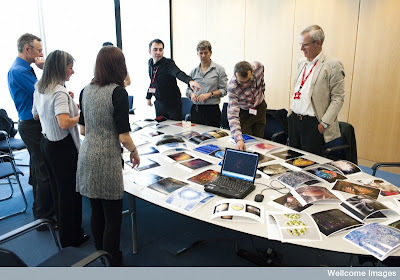
Last year, a team of picture editors, scientists, writers and broadcasters met in a room at the Wellcome Trust to select the winning pictures for the Wellcome Images Awards 2011. The judging panel was assembled and facilitated by Dr Laura Pastorelli, who acquires new biomedical images for Wellcome Images. She says, “Our eight judges represent the world of science and media. They all recognise the great value of scientific imaging – not only to research, but also for communicating this research to a wider audience. The judges were looking for recently acquired images that were visually stunning and conveyed scientific information in an interesting way. They also looked for skilful use of imaging techniques.”


Enter Dr Alice Roberts, who presented the awards in 2009 and was asked back as a judge for this year. Alice is not only a scientist and broadcaster (you may know her from BBC’s Coast and Don’t Die Young) but an artist too. Before the judging took place, she said "I love judging the Image Awards - there is always a great selection of beautiful, surprising and thought-provoking images to pore over. But that makes it very difficult as well!"

Over the next hour, the room buzzed with the deliberations, as Alice and seven other judges mulled over the 180 long-listed images laid in front of them. “What’s the story behind this image? Have I produced this myself, but better? If I was a teenager would I stick this up on my bedroom wall?!” were just some of the judges’ musings.

Also on the panel was another BBC presenter, Dr Adam Rutherford, who runs the podcast and video department at Nature. Adam explained that in the initial stages of judging, he was looking for images that gave him a strong reaction: something striking, or something that had never been seen before. Catherine Draycott, Head of Wellcome Images explained further: “To start, we eliminated anything where the image quality (focus, composition, etc.) wasn’t up to the standard we’d expect for the technique and the magnification. Then we started to home in on the images that stood out from the rest. We talked about what each one represented and how well this was conveyed by the picture.”
“Judges… ready! Images… ready! 3, 2, 1 – go!” From L-R: Fergus Walsh, Catherine Draycott, Laura Pastorelli, James Cutmore, Robin Lovell-Badge, Eric Hilaire and John Durant.

The long-list was narrowed down to a selection of around 50 images that the judges discussed in great detail. Aesthetics were admired, and detailed technical information unpacked. Laura’s expert knowledge of imaging techniques was complemented by Dr Robin Lovell-Badge, a scientist who is highly recognised in the field of developmental biology, not least for discovering SRY, the gene that determines if a developing embryo will become male. Sometimes the beauty of an image is almost a by-product of cutting edge imaging technique, but it is beautiful nonetheless. The Wellcome Image Awards are a great showcase for this. Robin explains, “anything that brings the beauty and the fascination of science to the general public is a good thing.”

The judges share their thoughts From L-R: John Durant, Catherine Draycott, Fergus Walsh, Alice Roberts, Adam Rutherford, Eric Hilaire

BBC medical correspondent Fergus Walsh was another of the judges. He commented on the impressive range of the images submitted and the variety of imaging techniques, and said that many images gave “a new insight into medicine and science.”

A few pictures polarized debate. One slightly blurry photograph caused a minor argument. “It’s not out of focus, it’s just got many focal planes!” exclaimed Adam.

“It’s not out of focus, it’s just got many focal planes!” Adam Rutherford scrutinises an image.

Some images totally absorbed our judges. I caught Eric Hilaire, Picture Editor at the Guardian, with a print in his hand staring intently at its patterns and colours. I could imagine a swirl of thoughts going round his head, which he elucidated later: “The first time I saw the print of this photomicrograph, I, for a second, wanted to look for a signature as if it was a painting. Later I tried to work out what it was that made me react this way: the subtle framing as well as an evocative choice of colours that recalls the brightness of dry pastel. Then, it was also the way I was reading this picture: a large red sun spreading its rays toward rows of shooting plants, maybe in a garden bed?”

Unfortunately for the readers of this blog, I can’t say which image he’s describing so evocatively until the awards are announced on February 23rd.

Eric enthuses about an image to the rest of the judging panel

Eventually, 21 winners were chosen by the panel. John Durant, Director of MIT Museum, who had flown from Boston to be on the panel, announced: “We have a great final list of images to be displayed.” The winning images will be on display at Wellcome Collection from February 24th until July.

What can you expect from the exhibition? Here’s a clue, from James Cutmore, Picture Editor at BBC Focus and second-time judge, about just one of the winners: “It's one of those pictures that truly intrigues people, because it shows an everyday occurrence in a completely unexpected way.” All the award-winning images provide a vision of science that you’ve not seen before, a close-up view of the beauty of nature. As James hints, expect the unexpected.

Monday, July 19, 2010

Library Year In Review 2009 goes live

Last week the Library launched its latest Year In Review. This year, we have opted for an electronic-only format, and the PDF of the Review is available for viewing and downloading from our website.

2009 was the Library's busiest year to date, with visitor numbers topping the 38,000 mark. The Review focuses on services for our in-person visitors, and also showcases a number of initiatives which are available via the web for our users worldwide.

We hope you enjoy the Review. As ever we are keen to hear from our users about their research and how they make use of the Library and its resources, so please feel free to get in touch.

Download the Year In Review 2009 [PDF 3.3 MB] (Right click to save)


Thursday, July 15, 2010

Portraits of Sir Paul Nurse


As announced today, Nobel laureate Sir Paul Nurse will be the first Director and Chief Executive of the UK Centre for Medical Research and Innovation (UKCMRI), which has been founded by the Medical Research Council, Cancer Research UK, the Wellcome Trust and University College London.

Wellcome Images has just acquired a series of portraits of Sir Paul, who will also take up the Presidency of the Royal Society later this year. These portraits were taken by Wellcome Image Award-winning photographer Anne-Katrin Purkiss, who has photographed many eminent scientists who also appear in our collections.

All images available free of charge to download in low-resolution for non-commercial purposes. Licence fees are charged for media and commercial usages – please contact images@wellcome.ac.uk for further information.

Author: Louise Crane

Thursday, October 15, 2009

10th Wellcome Image Awards


Dr Alice M Roberts, best known for her television appearances on BBC’s Don’t Die Young and The Incredible Human Journey, presented the winners of the 2009 Wellcome Image Awards with their trophies last night at Wellcome Collection. This year sees 19 images awarded in three categories: biomedical, illustration and photography.

The Wellcome Image Awards recognise the creators of the most informative, striking and technically excellent images among recent acquisitions to the Wellcome Images collection of medical and historical imagery.

Selected by a panel of expert judges, the winning images were created using a range of microscopic techniques, including combinations of light microscopy and innovative histological approaches, and electron microscopy; illustration, and photography.

The winning images are on display in Wellcome Collection from today until spring 2010. This space is shown in a BBC report, in which Sir Mark Walport, Director of the Wellcome Trust, talks about his favourite images in the exhibition.

Author: Louise Crane

Tuesday, January 27, 2009

Puzzling proteins

Put your visualisation skills to work for scientific research at Foldit, a computer game pitting humans against computers in the race to understand the function of proteins.

Why humans, when computers are so much faster? According to the people at Foldit: "We’re collecting data to find out if humans' pattern-recognition and puzzle-solving abilities make them more efficient than existing computer programs at pattern-folding tasks. If this turns out to be true, we can then teach human strategies to computers and fold proteins faster than ever!"

You can search our contemporary research images for some eye-catching folds like the one below. Wellcome Images also has a gallery of research images from the recent Wellcome Image Awards available to view online.