Showing posts with label Item of the Month. Show all posts

Friday, June 22, 2012

Item of the Month, June 2012: Charles Barbier, Petite typographie privée d'ambulance (Paris: Chez l'auteur, c. 1815)

At first glance, this image might look familiar. It’s a coded text that uses raised dots to be read by the fingertips. But one group of people who won’t find the code easy to understand are readers of Braille. That’s because this text isn’t written in Braille, but in a precursor to Braille devised by Charles Barbier, known as night-writing.

Nicholas Marie Charles Barbier de la Serre (1767-1841) was a captain in the Napoleonic army, who became obsessed with ways to improve communication with his troops and in particular with relaying orders in the dark without alerting the enemy. Barbier’s solution was a kind of phonetic code - he split the French language into 36 sounds which he laid out in a grid of numbered rows and columns. Though various methods, Barbier suggested, these grid positions could be communicated, and the sounds understood. One of these methods used the hands, rather like sign language – a number of fingers on the light hand were touched to a number on the left hand, representing the number of rows and columns on the grid. In another variation the code was cut into a piece of paper with a pocket knife; in yet another dots were impressed into the paper using a blunted stylus – the first line of dots represented rows, the second columns.

Barbier was confident that his invention was a good one – he just didn’t know what it could be used for. Rough-handed soldiers found it hard to read the impressions with their fingertips and the system was dismissed by the army as impractical and difficult to learn. Undeterred, Barbier considered various other uses. In a series of self-published pamphlets, of which Petite typographie privée d'ambulance is one, he proposed uses ranging from teaching the illiterate to read and write, to surreptitious note-taking, to creating multiple copies of the same article.

Finally Barbier realised that a system that had been designed to be used in the dark could be equally useful to the blind. In 1821 he presented his method to the blind children at the Institution Nationale des Jeunes Aveugle for testing. It was by no means the first type of embossed text the pupils had encountered - the founder of the school, Valentin Haüy, had produced tactile books for the blind since 1786. However, Haüy’s alphabetic script was not at all suited to reading by touch – rounded letters are easily distinguished from another by sight, but with the fingers they are slow to read, even with two hands. Barbier’s invention was received enthusiastically by the testers, but there were problems – the system was phonetic, so no good for boys who needed to master spelling and grammar to prepare them for work. Worse, there was no punctuation, meaning that the sounds ran into one another and became jumbled.

In the end it was a pupil at the school who made the adaptions necessary to put the code to use. Louis Braille heard the presentation when he was just 12 years old. His improvements - adapting the code from a phonetic to an alphabetic one and using 6 dots rather than 12 - meant that it could be read quickly with the fingers of just one hand. It was these changes that made the system practical and fast enough to give blind pupils a taste of the independence they craved. In 1837 Braille published his modified code, and in 1854, it was officially adopted in all French schools.

By all accounts a stubborn and condescending man, Barbier continued to proclaim his écriture nocturne to be the superior system, even as it was eclipsed by the success of Braille’s. Nevertheless, Braille acknowledged Barbier’s contribution in the second edition of his work, praising the ‘ingenious’ invention that had allowed him to construct his system of communication for the blind.

Author: Jo Maddocks

Further reading:

Charles Barbier, Petite Typographie Privée d'Ambulance (Paris: Chez l'auteur, c. 1815)
Lennard Bickel, Triumph Over Darkness: the Life of Louis Braille (London : Unwin Hyman, 1988)
Elizabeth M. Harris, In Touch: Printing and Writing for the Blind in the Nineteenth Century (Washington : Smithsonian, 1981)

Friday, May 18, 2012

Item of the Month, May 2012: 'De historia stirpium commentarii insignes'

To mark the first international Fascination of Plants Day, May's Item of the Month features one of the most important historical herbals from our collections

'De historia stirpium commentarii insignes' (or 'Notable commentaries on the history of plants') by Leonhart Fuchs was published in Basel in 1542.  Fuchs was professor of medicine at the University of Tübingen and this large folio volume is a landmark among the many herbals published in the 16th century.

Systematic botany has its origins in medical science, since the careful study of the qualities and species of plants was the foundation for pharmacy.  Herbals listed plants and their medicinal properties and were based upon the work of the Greek Physician Dioscorides. Fuchs's aim was to reproduce each plant from life, and he stated in his dedicatory epistle that 'a picture expresses things more surely and fixes them more deeply in the mind than the bare words of the text'. Each illustration was therefore based upon the appearance of the living plant.
 
The work includes descriptions for about 500 plants - arranged alphabetically by their Greek names - including many recently discovered in the New World. The book includes the first published European depiction of the red chilli, which was brought back by Columbus in 1492 (though Fuchs describes the plant as a native of India).

The Wellcome Library holds two copies of the 1542 edition.  One - catalogued as EPB 66181/D - was formerly part of the collection of the Medical Society of London, which was deposited for safekeeping in the Wellcome Library in 1964. It was eventually purchased by the Wellcome Trust in 1984, with assistance from the National Heritage Memorial Fund and other charities. 

The other - images from which illustrate this post - is catalogued as EPB 2438/D.  This edition does offer some clues to its earlier provenance: before entering our collection, this copy was owned by an Englishman and if you look closely, you can see the word 'poppy' has been written underneath the German and Latin names.
 
As well as the illustrations of plants, the work includes some other notable images. These are portraits of Heinrich Füllmaurer, Albrecht Meyer and Veit Rudolf Speckle, the three men responsible for illustrating 'De historia stirpium commentarii insignes'. 
It was common to include a portrait of the author in a work but never the illustrator. However, in recognition of the work of the artists, in this instance they are granted this honour. Meyer (upper right) is shown drawing the design from a live plant, Füllmauer (upper left) is shown transferring the drawing to the woodblock, and Speckle, the engraver or sculptor, is shown below.
With thanks to Julianne Simpson

Tuesday, April 24, 2012

Item of the Month, April 2012: 'On Indigenous Malaria'

As today is World Malaria Day, our Item of Month for April focuses on one of the thousands of works the Library holds on the disease. 
The term ‘Tropical Disease’ can be a misleading one. Take this image: in the book it comes from, the caption reads that it shows “a variety of tools used in anti-malarial work”. Given we think of malaria as the most familiar tropical disease, where in the world is the anti-malarial work taking place? Given the uniforms are of soldiers from the Royal Army Medical Corps, perhaps it’s a distant part of the British Empire? Surely somewhere south of the equator?
No – it’s from the English county of Kent.
The photograph is one of a number of images from a report entitled 'On Indigenous Malaria and on Malaria Work performed in connection with the troops in England during the year 1918' by Major Angus Macdonald, RAMC. It’s one of a number of reports collected together in a volume produced by the War Office, Observations on malaria by medical officers of the army and others, published in 1919 and edited by Sir Ronald Ross, then as now familiar for discovering the key role played by mosquitoes in the transmission of malaria.
Macdonald’s report acts as a reminder – perhaps a surprising one - that malaria was indigenous in the British Isles into the 20th century, particularly in the marsh land areas of Kent and Essex. Before the 19th century, terms such as “ague” and “marsh fever” would have been used to describe the malaria-like illnesses suffered by the local population.
Macdonald’s report consists of the response of the Army to outbreaks of malaria in 1917 in areas such as Romney Marsh, Sandwich and Sheppey – in particular, in in its effects on soldiers stationed in Army camps in these areas.
The report describes in detail the soldiers who caught malaria in England in this period, contrasting them with cases of malaria amongst civilian population in Essex and Kent, and proving that the cases of malaria were locally transmitted. Macdonald also includes testimonies from local residents on previous outbreaks, offering up perspectives on the diseases stretching back to the nineteenth century: the locals give different reasons for a decline in ague during their lifetimes, ranging from the cutting down of elm trees to the coming of the railways.
Macdonald goes into detail on the link between the structure of watercourses in these counties and why they were ideal breeding grounds for different species of mosquitoes, before recording the record of sanitary operations in Sandwich, Sheppey and Lydd - under Macdonald’s supervision - which aimed to disrupt the mosquitoes breeding grounds. 


These methods – including lime washing stables, the drainage and the maintenance of dykes and swampy areas – resulted (for Macdonald) in a measurable decrease in cases of malaria amongst soldiers stationed in Kent. However, outbreaks in the county would continue, up to the 1950s.


The contents of the War Office volume inadvertently point to an outbreak which would have a greater effect on health in 1919. The report which follows Macdonald’s in the volume is 'Observations on the Pathology and Treatment of Malaria' by R W Harold Row. It contains a prefatory note which hints at the pandemic the world was facing: “It is with deep regret that I have to report the death of Mr Harold Row from Influenza…”.

Images:
- 'Shows a variety of tolls used in anti-malaria work'
- 'A. maculipennis, photographed on a wall in a bedroom in Kent'
- 'Anti-malaria detachment setting out. Sandwich'
- 'Breeding-place of A. bifurcatus. Moat Farm, Iwade' (all from the report 'On Indigenous Malaria and on Malaria Work performed in connection with the troops in England')
-  Romney Marsh drainage scheme: gate at low tide (c.1960s, photograph by Leonard Bruce-Chwatt.  Wellcome Images, W0010475) 

Saturday, March 24, 2012

Item of the Month, March 2012: 'How the Department of Health of the city of New York is fighting tuberculosis'

To mark World TB Day 2012, we're travelling back to the United States at the turn of the 20th century to look at tuberculosis prevention in New York.

In 1882 Robert Koch announced his discovery of the tuberculosis bacillus, formally placing pulmonary tuberculosis (or consumption) among other communicable but preventable diseases. Responses to this varied. In New York the sanitary authorities didn’t make any major steps towards sanitary regulation and prevention using Koch’s work until 1894.
Hermann Michael Biggs (1859-1923), M.D. and from 1902, New York General Medical Officer, had initiated concerns and started a campaign to change the local approach to stopping the disease as early as 1887 when he was a consulting pathologist, urging notification, registration and surveillance of the disease as well as education of the public involving leaflets, press, exhibitions and lectures.  
These measures were all brought in eventually and disinfection was additionally suggested as a vital part of the campaign as well as free sputum analysis tests offered by the Dept. of Health’s bacteriological laboratory. Epidemiological cluster studies recorded on maps showed where local concentrations of the disease were, enabling targeting of available health resources.
This new approach caused angry controversy within the medical profession, but continued. In 1896 land for a tuberculosis sanatorium was bought at Otisville, 75 miles away in the Shawangunk mountains, offering free treatment for New York City residents. Special tuberculosis wards were set up in one of the New York Hospitals in 1903. Specialised clinics were opened with trained staff between 1904 and 1907. 
A scrapbook of 134 pages with 116 items of assorted stationery pasted into a continuous narrative about the city’s battle to prevent and control tuberculosis was compiled specially for the 1908 conference on tuberculosis in Washington, D.C. A footnote on the title page would appear to indicate that “250 sets” were produced. The Wellcome Library has one of these scrap books in its printed medical ephemera collection.

The scrapbook includes ‘A brief history of the campaign against tuberculosis in New York City’ by Biggs and preserves a very comprehensive range of campaign publications which includes simple forms, cards, envelopes, letterheads as well as samples of the pamphlets and leaflets that were distributed to people. The material is primarily in English, but with certain items translated into other languages reflecting the diverse ethnic population of New York City in 1908.
Four small maps also show detailed epidemiology of the disease, building by building in Lower New York in 1894-1898 and 1899-1908. Procedures for sanitary supervision and registration are given in detail with the relevant forms pasted in situ. Leaflets used in the campaign are here in a variety of languages explaining what the disease is, how it is spread (spitting is given as the chief cause), the importance of hygiene (disinfection and fumigation), what hospital and other health services were available to people and the need to report cases to the authorities. Information for health professionals is also included. The work of the bacteriological diagnosis laboratory is outlined as are the procedures for the collection of sputum samples.
The book documents a turning point in how tuberculosis was treated in New York and also the efforts of Hermann Biggs, fighting against the authorities to get them to change their approach in the light of Koch’s recent discoveries.
Tuberculosis features throughout the Wellcome Library’s collections. A general search in the online catalogue will yield much more in the way of books, journals, pictures and ephemera: this sources guide outlines our manuscripts and archive collections pertaining to the disease. [2] 

Images:
- Hemrnan Biggs, (From 'Plagues and People' website University of California, Irvine)
- Images from 'How the Department of Health of the city of New York is fighting tuberculosis' scrapbook
Author: Stephen Lowther

[1] It had previously been in the Medical Department Library of the British Local Government Board, responsible for overseeing administration, public health, sanitation etc. at a local level in England and Wales between 1871 and 1919 when it was abolished by the Ministry of Health Act.

[2] The Ephemera Collection in particular has numerous examples of colourful Christmas fund-raising stamps or seals from around the world which were sold every year to raise money for charities working with people suffering from TB. They had no postal value but made Christmas card envelopes look brighter and more cheerful. Many countries funded services and help for people with tuberculosis by placing a small surcharge on their actual postage stamps once a year. The money raised by this went specifically to help organisations and charities. We have many of these and they can be found within the Wellcome Library's stamp collections.

Tuesday, February 28, 2012

Portrait of a lady in Nizamabad: Isabel Kerr. Wellcome Library Item of the Month.

Photograph by G.M. Kerr, 1926. Wellcome Library no. 726380i.
This photographic print is one of the apparently few and elusive portraits of Isabel Kerr (1875-1932), a Methodist missionary who founded the Victoria Treatment Hospital for people with leprosy at Dichpali, near Nizamabad in the state of Andhra Pradesh in India.

Born Isabel Gunn, she had graduated MB ChB at Aberdeen in 1903, and arrived in India with her husband, the Rev. George McGlashan Kerr, in 1907. They noticed the frequency of leprosy and the unsatisfactory treatment of its victims, and having resolved to do something about it, received a donation of 10,000 rupees (£590) from a citizen of Nizamabad, Narsa Gowd, towards a leprosy hospital. In 1913 a gift of 60 acres of land at Dichpali (also called Dichpalli), a village ten miles down the railway line from Nizamabad to the city of Hyderabad, was received from the Nizam of Hyderabad. With further funds from Narsa Gowd and others, the hospital opened on 18 April 1915. [1]

The hospital expanded rapidly owing to demand, and by 1921 it consisted of 120 buildings. Further buildings were added in 1923 when the Minister of Finance of Hyderabad, A. Hydari (later Sir Akbar Hydari) opened more new buildings, again paid for by the Nizam. The running costs from 1910 to 1944 were subsidised by the Mission to Lepers, from 7 Bloomsbury Square, London (since 1965 known as The Leprosy Mission).

In 1920 Isabel Kerr adopted the treatment using oil of the chaulmoogra tree, which she learnt from Ernest Muir in Calcutta. It is presumably a chaulmoogra injection (excruciating for the patient) that is shown in the photograph. An Indian variation of the treatment used the related hydnocarpus plant, which was cultivated along with cinchona in the Nilgiri hills.

At Dichpali there was no shortage of patients, but in too many cases they were the wrong kind for treatment. The Rev. G.M. Kerr described how, in the early stage, when the disease was infectious and treatment would be most effective, patients would hide their symptoms. Only much later would they go for treatment, when the hydnocarpus oil could do nothing to undo the mutilations caused by the bacillus decades previously. Kerr compared the treatment-after-the-event at Dichpali to a clifftop where people were in danger of falling off: it would be better to install a rail at the top than a casualty station at the bottom. To encourage people to be treated in the early stages of leprosy, the Kerrs therefore opened an outpatient clinic in Hyderabad in 1928, with the desired effect: "Students from the colleges, clerks from their offices, and Government officials from their posts" all flocked to the clinic. [2]

A second photograph in the Wellcome Library (below) shows yet another foundation-stone laying ceremony, this time in 1935.
The foundation stone was laid this time by Amena, Lady Hydari. By this time Isabel Kerr had died: she died in 1932, aged 57. [3] The Rev. George McGlashan Kerr continued to run the hospital after her death, until his retirement to Scotland in 1938. His archive including three photographs is in Edinburgh University. He died in 1950.

Isabel Kerr was described as "modest, shy and diffident, and reluctant to speak in public". Hence no doubt the lack of photographs of her: the opposite of the much-portrayed Albert Schweitzer, renowned for his skilful use of publicity.

As a Methodist, Isabel Kerr was doubtless familiar with, and motivated by, the words of John Wesley (1703-1791), the founder of Methodism:

"Do all the good you can. By all the means you can. In all the ways you can. In all the places you can. At all the times you can. To all the people you can. As long as ever you can."


[1] Dermott Moynahan, The story of Dichpalli, London: The Cargate Press, 1949, is the source for most of what is written here. It is a revision of his earlier book The lepers of Dichpali, London: The Cargate Press, 1938. In the earlier edition but not in the later, the present photograph of Isabel Kerr is reproduced with legend "Dr Isabel Kerr giving an injection" (facing p. 28) 

[2] Rev. G.M. Kerr, 'Tackling a great social problem: the fight with leprosy', The foreign field (of the Wesleyan Methodist Church), April 1926, pp. 155-158 

[3] Her obituary in The Lancet reads as follows (in its entirety). "Isabel Kerr, M.B. Aberd. The death is reported from Dichpali, the Leper hospital settlement outside Nizamabad, of Dr. Isabel Kerr, the Scottish medical missionary, who has made this institution the outstanding centre in South India for the treatment of leprosy, and for training in diagnosis and treatment. Born at Fochabers-on-Spey in 1875, she graduated in medicine at Aberdeen in 1903, and went to India with her husband, the Rev. George M. Kerr, who is superintendent of the Wesleyan Mission Station at Nizamabad. She had charge for 12 years of the mission hospital there until the foundation of the Dichpali Home, where husband and wife have worked devotedly ever since. In 1923 she was awarded the Kaisar-i-Hind gold medal in recognition of her services." (The Lancet, 31 December 1932, pp. 1460-1461) 

Portrait of John Wesley: mezzotint by J. Faber after J. Williams, 1743. Wellcome Library no. 9621i.

Tuesday, November 29, 2011

Item of the Month, November 2011: Certificate of attendance at William Hunter's lectures


One of the pivotal figures in eighteenth century medicine, William Hunter (born on May 23rd 1718 at Long Calderwood, Kilbride, Scotland) was an eminent doctor, surgeon, obstetrician and teacher of anatomy. Educated in Glasgow and Edinburgh, he arrived in London in 1741 and by 1746 had begun to give lectures on anatomy and dissection in Covent Garden. By 1756, Hunter’s esteem had risen to the extent that he became a licentiate of the Royal College of Physicians.

Hunter regularly published essays and other works and became one of the outstanding physicians of the day, being appointed as physician extraordinary to Queen Charlotte in 1762. He had a school of anatomy built in 1770 in Great Windmill Street, London with an amphitheatre and what became an internationally famous collection. He died in March 1783 of a stroke following a long battle with that most recognisable of 18th Century diseases, gout. Whilst key to understanding the growth of the ‘man-midwife’ during this period, William Hunter’s career arguably now stands in the shadows of his younger brother, John.

The Wellcome Library acquired this certificate in May 2011. It dates from the Spring of 1755 when Hunter was still lecturing in Covent Garden and confirms that one Richard Colmer (surgeon) had satisfactorily completed anatomy and surgery courses under Hunter’s tutelage. The certificate, signed by Hunter, is headed by an engraved portrait of a bust of William Harvey, M.D., classical pillars to either side.

William Harvey was in born in Folkestone, Kent in 1578, educated at Canterbury, Cambridge University and Padua before joining the College of Physicians in 1604 and working at St. Bartholomew’s Hospital, being appointed as physician extraordinary to James I in 1618 then physician in ordinary to King Charles in 1631. As many readers of this blog will no doubt be aware, his 1628 publication, Exercitatio anatomica de motu cordis et sanguinis in animalibus presented his discovery of the workings of the heart and the circulation of the blood.

As suggested by the use of his image on this certificate, Hunter was a clear admirer of Harvey. We know that Hunter purchased and read keenly a number of works from Harvey's own Library. Hunter also authored a manuscript – now held in the collections of University of Glasgow – which illustrates this interest: Historical Anecdotes of Dr. William Harvey by Wm. Hunter, collected from family papers, etc., communicated to me by Councillor Eliab Harvey of Lincoln's Inn-fields, from the College book, from his own writings, from writers, from the Records in St. Bartholomew's etc [1].

This certificate now joins the other material held by the Wellcome Library on William Hunter, which includes his classic work of obstetrics, The Anatomy of the Human Gravid Uterus Exhibited in Figures to other certificates of attendance and student notes made at his lectures. Indeed, our MS.2965 – which consists of notes made by William Brougham Monkhouse (later surgeon to H.M.S. Endeavour, 1768-1770 on Captain Cook's First Voyage) - dates from the same period as Colmer’s certificate of attendance at Covent Garden.

Whilst establishing a connection between Colmer and Monkhouse is outwith the purposes of this blog, let’s instead consider the connections between Hunter and Harvey and one man of medicine paying homage to another.

[1] See K Bryn Thomas, 'William Hunter on William Harvey', Medical History, 1965 July; 9(3): 279–286

Author: Stephen Lowther

Monday, October 31, 2011

Item of the Month, October 2011: extract from Servetus’ Restoration of Christianity

This week marks the anniversary of the death of Michael Servetus (1511-1553): theologian, physician, heretic, and author of one of the rarest books in history.

Servetus was one of the most accomplished and controversial scholars of the sixteenth century. Born in Villanueva de Sijena, Spain, he studied law and - later -anatomy and medicine in Paris, where he was a near contemporary of Vesalius. In his own age Servetus was a renowned geographer and astronomer as well as a physician, but his fame among anatomists rests on his claim as the first westerner to describe the pulmonary circulation.

During his studies, Servetus had perceived that blood circulated from the right side of the heart to the left through the lungs, where it was mixed with ‘inspired air’ – a view contrary to the currently held opinion that blood passed through the partition that divides the two ventricles within the heart. Servetus published a description of his discovery in 1553, prefiguring William Harvey’s more complete and detailed explanation by 75 years. Had it been widely publicised, this account could have been one of the most significant breakthroughs in the history of anatomy. But Servetus published his findings not in a medical textbook, but in a religious tract. Not only that, but the medical breakthrough was overshadowed by theological content that was – quite literally - incendiary.

Servetus was a radical and uncompromising anti-trinitarian and this work, Christianismi Restitutio (‘The Restoration of Christianity’), described a religious philosophy that was unacceptable to both catholic and protestant church authorities. Although the work was anonymous, Servetus was denounced to the catholic inquisition in French Vienne - possibly by Calvin, with whom he was corresponding. Servetus was arrested, interrogated and imprisoned awaiting trial for heresy. After three days he managed to escape from jail and flee - just in time, for the court condemned the absent Servetus to death by a slow fire. Meanwhile, Servetus was making his way to protestant Geneva en-route to Italy, where he hoped to find safety. There, whilst attending mass, he was recognised and put on trial once more. This time there was no escape. On the 27th October 1553, with the last copy of the book chained to his body, Michael Servetus was burnt at the stake, reportedly calling out his heretical views to his final breath.

For over 150 years every copy of the Christianismi Restitutio was believed to have been destroyed. Then, in 1706, the German philosopher Gottfried Wilhelm Leibniz, browsing through the shelves of a friend’s library, recognised a copy of the lost work. This was none other than the same copy used by Germain Collardon, the prosecutor at Servitus’ trial, and containing manuscript notes by him. Leibniz realised at once that his friend, Karl von Hessen-Kassel, had in his possession one of the rarest books in history. There isn’t enough space here to do justice to the history of this copy since its discovery. Through theft, forgery, sale and barter it has passed through some of the most significant collections in the world, and now resides in the French Biblithèque Nationale.

In 1723 an illicit reprint was attempted in London. The exemplar was smuggled to England by a Dutchman, Gysbert Dummer, who delivered it to London printers Samuel Palmer and Issac Dalton. 252 pages had been completed when a schoolmaster named Patrick, who had been employed to correct the proofs, reported the scheme to the Bishop of London. On the 27th May the sheets were confiscated by the authorities and once again - 170 years after Servetus’ death - an attempt was made to eradicate his controversial work.

Servetus’ 1553 printing of Christianismi Restitutio is now known to have survived in two complete copies and one fragment. The 1723 reprint fared a little better – just four copies of the text and one of the proofs are known. Our object of the month, then, is a copy of the 1723 printing of Servitus’ Christianismi Restitutio, known as De Trinitate Divina. A banned copy of a banned work whose author was twice sentenced to death, and which now sits innocuously in the basement of the Wellcome Library.

Author: Jo Maddocks

Image: From William Stirling, Some Apostles of Physiology. London : Priv. print. by Waterlow and sons limited, 1902
Further reading: Lawrence and Nancy Goldstone,
Out of the Flames. London: Century, 2003.

Friday, September 30, 2011

Max Klinger at Dresden in 1911: Wellcome Library Item of the Month


1911 was a bumper year for exhibitions. In London there was the Festival of Empire and Imperial Exhibition at the Crystal Palace. In Turin there was the Esposizione Internazionale delle Industrie e del Lavoro. At the Hague in September there was the Drankweer tentoonstelling (Anti-alcohol exhibition) at the 13th International Congress against Alcoholism. There were many others. Far bigger than any of those mentioned, however, was the international hygiene exhibition in Dresden: the Internationale Hygiene-Ausstellung.

For those who are more familiar with the Wellcome library and museum collections, the best way of describing the Dresden exhibition is to say that the Dresden exhibition makes the exhibitions of those Wellcome collections look small. The catalogue of the historical section at Dresden alone (the equivalent of the handbook of the Wellcome Historical Medical Museum, 1913) has 600 pages and lists 20,394 exhibits. [1] The section on amulets alone contains 1,212 items (pp. 375-399). Qualitatively, on the other hand, there were many similarities and links between the two enterprises, which deserve fuller study. Wellcome-watchers will find many familiar names in the Dresden catalogue: to name but three, Eugen Holländer, Edward Lovett, and Ernest Wickersheimer are listed among the lenders to Dresden, and the photographs of the displays there show many resemblances to Wellcome’s first exhibitions in Wigmore Street, London. For instance the collections exhibited included such subjects as housing, bathing, clothing, and childcare: in both institutions, hygiene was defined as preventive medicine practised in the context of evolutionary anthropology. (Of course the Wellcome collections would later grow much larger, but as the holdings expanded, the exhibitions contracted.)

The committee of honour at Dresden included the Berlin museum director Wilhem von Bode; Hermann Diels, who gathered the fragments of the pre-Socratic philosophers and tracked down the manuscripts of Galen and Hippocrates; and the most famous Greek scholar of the day, Ulrich von Wilamowitz-Moellendorf. The president of the historical section was Karl Sudhoff, Director of the Institute for the History of Medicine at Leipzig.

Also contributing to the exhibition was the artist Max Klinger (1857-1920). He will perhaps be known to many through his sequence of etchings The Glove (1879-1881), which might be described as a fetishistic psychodrama (image above from the British Museum). At the Dresden exhibition Klinger exhibited a larger-than-life-sized bronze sculpture of an athlete, and was commissioned to make a large etching on the theme of hygiene to present to VIPs who had helped with the exhibition.

Here is Klinger’s etching (left: Wellcome Library no. 24236i), which he completed in 1912. How to interpret it? The giant can perhaps be seen as a symbol of the struggle for hygiene and sanitation. He has lifted a group of people up above the tumultuous world of nature: they dance and recline in an Italianate landscape, enjoying the delightful consequences of hygiene for all. The warring male figures below may symbolize the people and circumstances which work against hygiene. The three streams of water represent nature channelled into forms conducive to human life.

There is also a racial distinction. The beneficiaries of hygiene, who have learned to master the forces of nature, and are raised up into the sunshine of life, are conspicuously white. The savages in the river, who misguidedly attack the forces of hygiene, are prominently black. They are not dancing among the poplars, but rampaging with harpoons in an unruly river bordered by dark and threatening forests. Nor do they appreciate the three streams of pure clean water that flow from the Europeans’ water jars.

Nothing about this is particularly surprising. Germany had extensive colonies in Africa, the maintenance of which required training and research in many aspects of hygiene. The print may also be compared with the section on racial hygiene in the exhibition. The catalogue of that section, by Max von Gruber and Ernst Rüdin (both of Munich, the former a hygienist and the latter a psychiatrist) is a monograph on eugenics, with an impressive number of charts, graphs and family trees, and a bibliography on heredity, genetics, extinction, population trends, degeneration, and social aspects of hygiene. [2]

It is however remarkable that the Wellcome Library has two impressions of this large and apparently rare etching. One (shown above) was presented to Dr (later Sir) Frederick Walker Mott FRCP, FRS (1853-1926). Mott (portrait right: Wellcome Library no. 15290i) was a neuropathologist, working both in asylums and in academia (at Birmingham University), who is said to have established the syphilitic origins of "general paralysis of the insane". In Mott’s copy of Klinger’s etching, his name is inscribed at the bottom of the plate in the same colour ink as the etching itself, so that it appears to be part of the etching. The other impression (in the Wellcome Foundation archives in the Wellcome Library) was awarded to the "Wellcome Research Laboratories in London", and the name of the recipient is handwritten in grey ink (the rest of the etching is in black). Presumably the Wellcome laboratories had lent items to the exhibition.

Klinger's etchings up to 1909 were catalogued by Hans W. Singer, and those after 1909 by Carl Beyer, but Beyer's work does not appear to have been published. It is a typescript of which a copy is in the library of the Kupferstichkabinett, Staatliche Museen zu Berlin. [3] The hygiene allegory is no. 416 in Beyer's catalogue, and the Wellcome impressions are of the fourth and final state of which 100 impressions were made. A century later, how many survive from the other ninety-eight? And to whom were they awarded?

[1] Historische Abteilung mit ethnographischer Unterabteilung. I. Historische Abteilung. 2. verb. und illustrierte Aufl., Dresden: Internationalen Hygiene-Ausstellung, [1911]. Wellcome Library catalogue record here.

[2] Fortpflanzung, Vererbung, Rassenhygiene: Katalog der Gruppe Rassenhygiene der Internationalen Hygiene-Ausstellung 1911 in Dresden. Herausgegeben von Max von Gruber und Ernst Rüdin; ... Abbildungen von M. v. Gruber; nebst einem bibliographischen Anhang von Rudolf Allers, München: J. F. Lehmann, [1911]. Wellcome Library catalogue record
here.

[3] Carl Beyer,
Max Klingers graphisches Werk von 1909-1919: eine vorläufige Zusammenstellung im Anschluß an den Oeuvre-Katalog von Hans W. Singer. Many thanks to Dr Alexander Dückers for information about Beyer's work.

Thursday, August 11, 2011

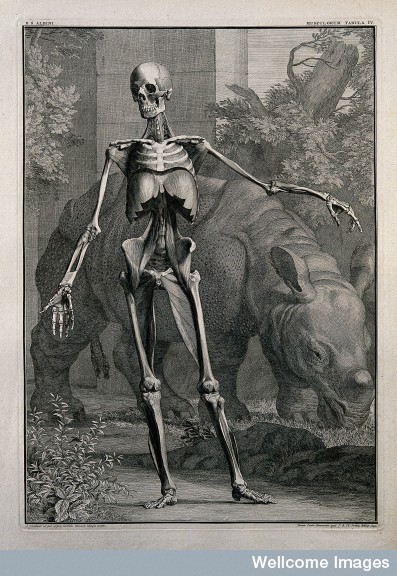
Object of the Month, August 2011 : Jan Wandelaar, Human Skeleton and young Rhinoceros


Of the many joys that accompany a stroll around the Wellcome Library’s stores, an unexpected encounter with a rhinoceros must rank as one of the more novel. The beast in question is Clara, an Indian Rhino who became in international superstar after arriving at the port of Rotterdam in 1741, at the tender age of two years old. Clara had been raised in the Bengal home of the director of the East India Company, who adopted her after her mother was killed by hunters. Evidently Clara was quite fond of human company as in Bengal she was allowed to meet visitors and even eat from the meal table ‘like a lap dog’. But on arrival in Rotterdam, to say that Clara was a novelty was an understatement. Her new owner, the ship's captain Douwe Mout van der Meer put Clara on public exhibition almost immediately and found the enterprise so profitable that he was soon able to give up his job and travel Europe with her full-time.


Over the course of the next seventeen years Clara was seen by many thousands of paying tourists, across the low countries, France, Germany, Austria, Italy and England. Rhinoceros fever hit Europe; medals were cast in her honour, poems addressed to her and during an especially triumphant stay in Paris in 1750 a hairstyle á la rhinoceros was named after her. Even Casanova wasn’t immune to Clara’s charms - although in his memoirs he reports that his mistress mistook the burly chap taking her entrance fee for the exhibit itself.


But Clara’s really lasting significance lay in zoological illustration. Until her arrival, artists and illustrators looking for an image of a rhinoceros were still slavishly copying Dürer’s famous woodcut of 1515, the manifest inaccuracy of which hadn’t detracted from the grip it held on the popular imagination. For artists and illustrators, therefore, Clara’s arrival was an opportunity not to be missed. One of the first to depict Clara was the artist and engraver Jan Wandelaar (1690-1759) who was at that time completing a commission to illustrate Bernard Siegfried Albinus’s magnificent Tabulae Sceleti et musculorum corporis humani, an anatomical atlas that promised to be the most accurate ever made. To enhance his figures, Wandelaar chose grandiose and whimsical naturalistic backgrounds which deepened the perspective and gave his figures a greater sense of volume. For his two plates illustrating the bones and the fourth order of muscles, he included Clara grazing in the background, her bulk and armour giving a pronounced contrast to the human form in front. The novelty of Clara’s appearance can’t have harmed Albinus’ enterprise either, as the London edition of the prints makes clear: “we thought the rarity of the beast would render these figures...more agreeable than any other ornament resulting in mere fancy.” Whatever the reason for her inclusion, these two prints are certainly amongst the earliest illustrations by a western artist to represent a rhinoceros with any degree of accuracy.


It wasn’t long before Clara was the darling of the art scene, having her portrait painted by some of the finest animal painters of the age. In 1748 the engraver Johann Elias Ridinger, (1658-1767), already famous for his sets of animal prints, made a series of six drawings of Clara in various poses, which he engraved as prints and used in the background of his other works. Clara appears to have aged considerably in the six years between the two engravings and makes quite a pathetic figure (although, interestingly, in the preliminary sketches she appears relaxed and rather less ‘droopy’). Early the next year the artist Jean-Baptiste Oudry (1686-1755) painted a life-size portrait of Clara at the fair of St Germain on a canvas 15 feet long and ten feet high, which was exhibited at the Paris Salon. And in 1751, while in Venice, Clara was the subject of two famous paintings by Pietro Longhi (1701?-1785), one of which is held in the National Gallery.


Clara died in London on 14th April 1758. In spite of her peripatetic existence, Clara’s life in Europe had been longer and considerably less brutal than her few forebears - Dürer’s rhinoceros, bound in a velvet collar and gilt chains, drowned in a shipwreck off the coast of Italy. Her successor, the so-called ‘Madrid’ rhinoceros of 1579, fared little better - after she overturned a chariot full of nobles the King of Spain ordered the removal of her eyes and her horn. Clara had led quite an extraordinary travelling life and enjoyed a diet that included “a good quantity of wine and spirituous liquors” as well as beer, oranges, and tobacco smoke blown up her nose. What’s more, it was her image which finally supplanted Dürer’s rhinoceros in the popular imagination and ensured that her likeness can be found in numerous natural histories from the eighteenth century to today.


The rhino is a homely beast,

For human eyes he's not a feast.

Farwell, farewell, you old rhinoceros,

I'll stare at something less prepoceros.

(Ogden Nash, The Rhinoceros)


Images : 1. An écorché figure, front view, with left arm extended, showing the bones and the fourth order of muscles, with a grazing rhinoceros in the background. Line engraving by J. Wandelaar, 1742 (Wellcome Library no. 565796i)

2. An écorché figure, back view, with left arm extended, showing the bones and the fourth order of muscles, with a rhinoceros seen in the background. Line engraving by J. Wandelaar, 1742 (Wellcome Library no. 565802i)

3. A rhinoceros. Woodcut after C. Gessner, 1551. (Wellcome Library no. 41009i)

4. A rhinoceros, also known as Miss Clara, shown with a lake and palm trees in the background. Etching by J. E. Ridinger, ca.1748 (Wellcome Library no. 39300i)


Author: Jo Maddocks

Monday, July 11, 2011

Item of the month, July 2011: On this day in Amsterdam ...

This print (left) sits in the Wellcome Library among a group of Dutch posters about the use of recreational drugs. It is exceptional for its casual production values: scraps of paper torn out of a notebook, containing incoherent verses which surround incompetently scrawled drawings, photographed on a ready made background and put together with whatever editing software was available for such purposes in 1995, the date on one of the drawings.

The scrawl can however be forgiven, as the author of these drawings was not a professional artist, and their incoherence is their whole point. As the signature "brood" indicates, they are the manic ramblings of Herman Brood (right), the charismatic Dutch rock-and-roll star whose well-publicised life was fuelled by drug-use: chiefly LSD, cannabis, heroin, amphetamines and alcohol. His heyday was the 1970s and 1980s. When the music industry became too strenuous, he turned to painting in the graffiti-influenced street styles which have since become more popular than they were then, and, though colour-blind, won some renown as a spraycan artist. This poster is an example of his drawing style, apparently published to dissuade drug users in Amsterdam from following his course in life.

As well they might (be dissuaded). For in Brood's case, years of drug-use had taken their due, and although he had made plans for a new recording with a full orchestra, the future must have looked unappetising to him. On 11 July 2001 he leapt to his death from the top of the Amsterdam Hilton hotel. To remember that moment, and the life that came to a sudden end at that time, a memorial event has been organized to take place there today, 11 July 2011, at 13.15 pm.

Image credits
Poster:
Wellcome Library no. 748920i; © DACS 2011

H. Brood in December 2000 with parrot: photograph by Sander Lamme in Wikimedia Commons: http://nl.wikipedia.org/wiki/Bestand:Herman_Brood_2000_Amsterdam_Sander_Lamme.jpg

Hilton Hotel, Apollolaan, Amsterdam: by PatrickDR on Flickr: http://www.flickr.com/photos/patrickdr/2469928582/

Wednesday, April 27, 2011

Wellcome Library Item of the Month: 'Nuremberg Chronicle'

Published in 1493 Liber chronicarum is a history chronicle following Biblical precedent, beginnning with the Creation of the World and ending with the Last Judgement. The largest section however, consists of scenes of contemporary life and contains many illustrations of European cities and countries. As the book was produced in Nuremberg – then the centre of the German book trade – it is not surprising that the city is afforded a double page spread (shown) and that the book is known in English as the 'Nuremberg Chronicle'.

It was written in Latin by Hartmann Schedel, a physician, though this medical connection is not purely why this copy came into our hands. This copy was purchased by Henry Wellcome in 1898 at Sotheby’s for £20 10s, at an auction of the Library of the artist and designer William Morris.

This copy has been 'rubricated' (chapter headings, paragraphs and important words have been highlighted in red) after it was printed. Also, some pictures have been hand coloured and an early owner made copious notes.

In the context of Wellcome’s collecting, this was a major early purchase but one made at a time when Wellcome was as much interested in books which could inspire designs for advertisements for his pharmaceutical business, than artefacts relating to the history of medicine.

Due to the variety of integration between its text and images, the Nuremberg Chronicle has been hailed as the most sophisticated printed book published before 1500. As such, it's also one of nearly 600 incanabulas held in the Wellcome Library, and one of our most treasured holdings.

A version of this post features in the latest issue of Wellcome News

Monday, February 28, 2011

Item of the Month February 2011: Notes on Yagé

Back in July last year, we wrote about some items from our collections relating to Arthur Conan Doyle. We deliberately left one item out from that post, as we wanted to write in more detail about it at a later date.

So, as our Item of the Month for February 2011, here's a post dedicated to this item: a manuscript that links Conan Doyle, fellow novelist H Rider Haggard and a hallucinogenic plant from South America (WMS/Amer.148).

It's a report from 1927 by Edward Morell Holmes, an English botanist, into the properties of Yagé, a South American drug, which - refering to a conversation initiated by Sir H. Rider Haggard, author of King Solomon's Mines - "causes clairvoyant and telepathic effects". The manuscript refers to a full account of the drug by A. Rouhier in Bulletin des Sciences Pharmacologiques, 1926, 33, 252-261 (which Holmes' notes summarise) and also to South American knowledge of Yagé.

But the Conan Doyle connection comes with the most fascinating aspect of this manuscript. The notes talk of a tincture of the drug prepared by the leading pharmacist W.H. Martindale (1875?-1933) and Holmes's attempts to pass it on to "some of our leading scientific Spiritualists to experiment with including Sir A. Conan Doyle, Professor (Sir) Oliver Lodge, and Sir (W.) F. Barrett".

These beliefs of these men in the ability to contact the spirit world is well recorded: Conan Doyle took his belief strongly enough to publish a History of Spiritualism in 1926; Lodge, a key figure in the development of the wireless, was like Conan Doyle a member of the Society for Psychical Research, and Barrett was a physicist and the author of such works as The Physical Phenomena of Spiritualism and On The Threshold Of A New World Of Thought.

But do we know if their interest in spiritualism was enough for these men to test out the "telepathic effects" of the tincture"? Did Holmes, indeed, ever contact them? So far, our research has drawn a blank...

Whilst we often feature as our Items of the Month, material from the Library that is well-researched, here's an instance of a manuscript we feel in need of more attention. Given its hoped for attraction to men of letters from the early 20th century, we even wonder if the notes may even shed light on the interest in Yagé of the beat author William Burroughs in the 1950s, in light of possible explanations as to how Burroughs developed an interest in the drug.

We wonder then, if Holmes's notes featured here may add something to this debate: even if not, they shed an intriguing light on scientific and literary circles in the early part of the twentieth century, and suggest a topic that we feel would have piqued the interest - and possibly the taste buds - of Holmes's namesake and Conan Doyle's most famous literary creation.

Images:
- Text of Holmes's Notes on Yagé
- Portrait of Edward Morell Holmes


With thanks to Mike Jay

Friday, January 28, 2011

A moment of pain and triumph. Item of the month, January 2011

Lithograph by C. Felixmüller, ca. 1922. Wellcome Library no. 727758i
This is a home birth in the 1920s. In other times or places, the two – subsequently three – people involved might have had moral support from women friends of the mother ("gossips") or technical support from a team of obstetrical consultants and neonatologists. Here however the midwife is solely responsible: no wonder she holds up the new arrival as if she were a Grand Prix winner holding up a trophy. Her moment of triumph is not so glorious for the mother, who attempts to overcome the pain of the delivery by clenching the mattress with one hand, pushing against the bedhead with the other, and pressing her heel against the bedclothes.

The print is the work of the German artist Conrad Felixmüller (1897-1977). It was spotted recently in an auction at Pforzheim in Baden-Württemberg, and is the second of his works to enter the Wellcome Library. The other work (Wellcome Library no. 46958i) is a World War I subject: it shows a soldier who has had a mental breakdown and is incarcerated in a military asylum. It draws on Felixmüller's never-forgotten four-week service as a hospital orderly in the Arnsdorf asylum which had been taken over as a military hospital.

The picture of childbirth is listed in Söhn's catalogue of Felixmüller's graphic works. [1] However the catalogue of the most comprehensive collection of his prints -– the gift of the Felixmüller family to the Kunstmuseum Düsseldorf –- omits it. It's obviously a rarity [3], but such a striking image deserves to be accessible to a wide public, hence its acquisition by the Wellcome Library is marked by its selection as the Library's Item of this Month.

The Wellcome Library impression is inscribed by Felixmüller to "Frau Jul. Rock, with the most cordial thanks and greetings", October 1922. Was she the midwife?

[1] Gerhart Söhn, Conrad Felixmüller: das graphische Werk 1912-1974, Düsseldorf 1987, no. 243

[2] Friedrich W. Heckmanns, Conrad Felixmüller: das druckgraphische Werk 1912 bis 1976 im Kunstmuseum Düsseldorf, Schenkung Titus Felixmüller und Luca Felixmüller, Düsseldorf: Kunstmuseum Düsseldorf, 1986

[3] Not reproduced in, for instance, Harold Speert, Obstetrics and gynecology: a history and iconography, New York and London: Parthenon Pub. Group, 2004 (rev. 3rd ed. of Iconographia gyniatrica)

Tuesday, December 14, 2010

Item of the Month, December 2010: The London Monster

On this day in 1790, this man, Rhynwick Williams, a young unemployed Welshman was convicted of three counts of assault and sentenced to six years in prison. This - seemingly - brought to an end a sequence of attacks on women in London over the previous two years. Images from the Wellcome Library's collections will help us tell this rather odd story.

There were over 50 reported, seemingly linked, attacks on women in London between 1788 and 1790. Whilst some women received deep wounds, it does not appear the aim of their assailant was to cause life threatening injuries - the attacker at times seemed as concerned with slashing the garments of the women as stabbing them. Often he would attempt to stab the women in the buttocks, sometimes those attacked reported they were offered a nosegay to sniff, out of which a sharp instrument would emerge and at least one report suggested the attacker approached a woman with sharp instruments attached to his knees. The description of the assailant also wildly differed.

Understandably, the attacks received a certain degree of late eighteenth century media hype: THE MONSTER! was how the newspapers of the day dubbed the attacker. There was also a certain degree of sensationalism in how artists and printmakers such as James Gillray responded to the attacks.

In an etching by Gillray, The Monster disappointed of his Afternoon Luncheon, or Porridge Potts preferable to Cork Rumps, the Monster is a true Ogre: about to feast on his victim whose only protection is a copper pan covering her posterior.


The Wellcome Library holds a copy of this related etching by Gillray, The Monster going to take his Afternoons luncheon which was issued in May 1790. Here, the victim has no protection, bare skin is revealed and there's a rather more salacious edge in how the victim is being portrayed.


There's a similar ribaldry in another of Gillray's prints of May 1790, Swearing to the Cutting Monster, or a Scene in Bow Street. Here, a victim shows her injuries - which the officials are making perhaps too close an examination of - to the Bow Street Magistrates. Note too the political connotations of the engraving: instead of our wild-haired ogre, here 'The Monster' in the Dock bears more than a passing resemblance to the politician Charles James Fox...

In June 1790, one victim claimed she recognised her attacker walk past her in the street - this was Rhynwick Williams. Williams was arrested and charged with the attacks. After his first trial collapsed on a technicality, Williams underwent a second trial leading to his conviction on 14th December 1790.

However, the story doesn't quite end there. In Jan Bondeson's The London Monster - the best account of these events - Bondeson talks of similar attacks to these in the centuries that have followed (for example, the 'Brooklyn Monster', depicted left); questions the reliability of Williams's conviction and explores the possibility that the explanation for the attacks may even lie in a massive case of Mass Hysteria (it's certainly the case that some 'victims' lied about the nature of their injuries).

Interestingly, Williams went back to his previous career as an artificial flowermaker after he left jail. His time spent behind bars did have one major transformative effect on him: by the time he left he was father to a child - which was conceived whilst Williams was behind bars (Williams would marry the mother of his child on release). As for the sensationalism of the 'Monster', it's almost tempting now to see this as prefiguring in some ways the newspaper reporting of the Whitechapel murders of 1888.

Image credits:
1/ Renwick Williams, a man convicted of wounding women. Reproduction of a stipple engraving (Wellcome Library no. 1970i)
2/ Renwick Williams, a man who attacked women; represented by a grotesque fiend wielding an exaggerated knife and fork and holding a young woman up by the skirt. Etching by J. Gillray, 1790. (Wellcome Library no. 11193i)
3/ The dismayed Charles Fox in handcuffs, implicated by a woman who is displaying her wounded posterior to three Bow Street Justices; satirizing Fox as being 'The 'monster'. Etching by J. Gillray, 1790. (Wellcome Library no. 12176i)
4/ A man who stabs women in the leg. Wood engraving. (Wellcome Library no. 3411i)

Friday, November 19, 2010

Item of the Month, November 2010: A Victorian Paper Trail

Among books, journal articles, pamphlets and bound volumes of patents about Victorian toilets (flushing or non-flushing), systems of varying complexity for the disposal (and recycling) of human sewage and many items about personal and household hygiene; we also have in the Wellcome Library’s Ephemera Collection what must be fairly scarce examples of late 19th century toilet paper.

Our main example comes from the 1870s, when one popular product was the Diamond Mills Paper Company’s ‘Bromo Paper’ which came in packs of about 500 individual sheets inside a solid card box (21 x 15 x 3 cm.), open at the top so that single sheets could be pulled out as required. Every sheet had a distinguishing watermark of ‘Bromo’ so that counterfeit versions could be easily spotted (the packaging states this was a problem in India). This toilet tissue had been awarded the highest prize at the Paris Exposition in 1878 and every pack proudly bore reproductions of both sides of the medal to prove it. The Wellcome Library holds one such pack, now catalogued as EPH471A.

The paper contained the "disinfectants and curatives" Bromo chloralum and carbolic acid, which the manufacturers' claimed would "...render its use not only a positive preventive of that most distressing and almost universal complaint, the Piles, but also a thorough deodorizer and disinfectant of the water closet". However common haemorrhoids were at the time, the flush toilet was certainly not standard in 1878 and the smells that would have developed in the non-flush version, particularly over a hot summer, would have needed all the help with deodorization that could be given.

The pack would have slotted neatly inside a wooden case which hung from a nail in the water closet wall, next to the toilet. A typical toilet paper polished wood case that would have held the box of individual sheets is illustrated on what is most likely a salesman's sample sheet of ‘Globus’ paper (EPH471:38) and was available from John Miller, Ltd., manufacturing stationers, 116 Renfield Street, Glasgow for one shilling. If you preferred your paper on a varnished wood and bronze finish toilet roll holder (illustrated on the ‘Excelsior’ paper sample, EPH471:37), that could be purchased from the same firm for one shilling and threepence. The samples would have been shown to prospective retail stockists by hopeful salesmen.

John Miller Ltd. also manufactured 'Purolette' (EPH471:39) and 'Silkine' (EPH471:40) brands of paper. They promised no stoppage of drains or injury to health (whatever injuries other brands of toilet paper may have been causing at the time...) and were advertised as being soft as silk, but also thin and tough. The samples we have feel more like greaseproof paper than silk - which makes us wonder what our Victorian ancestors would have made of today's luxury toilet paper brands.

As today is World Toilet Day - which raises awareness on sanitation in the present day - it seems the perfect occasion to ponder these examples of nineteenth century sanitation advancement. Furthermore, as all the thousands of items in the Library's Ephemera Collection share the fact they had a practical use before being discarded, can there be more apt examples of ephemera than our surviving material from John Miller Ltd and the Diamond Mills Papers Co. ?

Author: Stephen Lowther

Monday, October 25, 2010

George III's 250th anniversary. Wellcome Library Item of the month

On 25 October 1760, the British King George II died and his 22-year old grandson George William Frederick, previously Prince of Wales, became "His most Sacred Majesty George the IIId, King of Great Britain &c." (left). Looking back from today's vantage-point exactly 250 years later, George III's long reign, starting on that October day in 1760 and extending sixty years to his death in 1820, has left many marks on our everyday life. The defining events of his reign include American independence; long wars against France under the Ancien Régime, the Revolution and the Empire; and the decline of the power of the monarch. At home, he presided over turbulent political divisions between the Whigs personified by Charles James Fox and the Tories under William Pitt the younger; acrimonious divisions in his own family, in which his regent and successor the Prince of Wales pursued policies antagonistic to the king; and the complete transformation of the country's agriculture, sciences, industry and arts, exemplified by his founding of the Royal Academy of Arts in 1768. Policies which he declined to follow cast a long shadow: reform of the government of India, banning of the slave trade, and Catholic emancipation.

George III's accession is therefore being celebrated in a number of institutions, whether "Half Term Madness" at York Castle Museum or special lectures in the Historic Royal Palaces. In London we are constantly reminded of him through Buckingham Palace, the house which he acquired as the monarch's London residence, and through the magnificent King's Library built in 1828 to house his books, which is now the Enlightenment Gallery of the British Museum. The books themselves are displayed in a spectacular glass tower in the entrance hall of the nearby British Library, and a marble bust of him sculpted in 1812 stands in front of the tower. In South Kensington his instruments of experimental philosophy are shown in a dedicated gallery on the third floor of the Science Museum.

More parochially, his bouts of ill-health make him especially interesting to an institution such as the Wellcome Library which views the history of health as the central strand in its perspective on history. Alan Bennett's popular play (1991) and film (1994) The madness of George III was inspired in part by work at the Wellcome Institute by Roy Porter, Bill Bynum and Michael Neve (which, in George III 's case, in turn built on earlier research by Richard Hunter and Ida MacAlpine): Michael Neve suggested it would be a good subject for a play and lent Bennett some literature on the subject. [1]

There are many representations of the king in the Wellcome Library. Among several intimate portraits which focus on the king as a person, the mezzotint from a portrait by Thomas Frye shown above (top: Wellcome Library no. 25552i) portrays him in 1762, two years after his accession: squared up for transfer, it would be suitable as a model for an inn-sign of the King's Head. If we wish to test its accuracy against an independent control, we can compare it with this etching after a rapid sketch by Nathaniel Dance (1735-1811): the basic physiognomy is the same, though being drawn some thirty eventful years later, demonstrates the rejuvenation that tends to be involved in royal, but not only royal, portraiture.
Above right: soft-ground etching by William Daniell (1769-1837) after Dance. Wellcome Library no. 25553i
George's big eyes were blue, by the way.

Etching and stipple by Benjamin Smith after W. Beechey, 1 December 1804.
Wellcome Library no. 570646i
For those requiring a less intimate and more formal representation, Sir William Beechey shows him in later years as a general in military uniform, with a groom taking away his Vandyckian horse. This print shows on the right an ornate vase which is missing from the original painting of 1799-1800 in the Royal Collection: the vase associates the king with the elegance denoted in the United Kingdom by the word "Georgian".

Coloured aquatint, 1803. Wellcome Library no. 12196i
George's scientific pursuits are shown in this affectionate caricature from 1803 showing him as a chemical analyst examining the composition of Bonaparte in an alembic. Bonaparte is described as the "Corsican earthworm". Either the artist did not know that worms cannot be chemically analysed in a single vessel or he was merely using "earthworm" as a term of contempt: the OED gives one of its meanings as "a disparaging designation for a human being, esp. a mean or grovelling person". To read the king's analysis, click on the image.

King George III suffered several extended periods of illness involving mental breakdown, the first being in 1765 when he described himself as "a mind ulcer'd by the treatment it meets with from all around". Another lasted from the summer of 1788 to the spring of 1789. To celebrate his recovery in 1789 two prints shown here were published.

A mezzzotint attributed to James Parker (left: Wellcome Library no. 27217i) shows "The triumph of Hygiea [Hygieia]. From a transparency of the happy recovery of the KING, March the 10th 1789, exhibited at Lord Howard de Walden's". In a transparency, extra elements are revealed when the work is lit from behind: when lit by Lord Howard de Walden's lanterns, did the clouds disappear and a radiant sun take their place in the upper left part?

Line engraving by James Neagle after Edward Dayes, 1793.
Wellcome Library no. 42665i
Another engraving (for detail click on image above) records a royal procession in St. Paul's cathedral "on St. George's Day 1789, the day appointed for a general Thanksgiving for the king's happy recovery", led by the king himself. The future seemed to be bright.

Etching by James Gillray, 1792. Wellcome Library no. 12180i

However, George III had plenty to agitate his mind during his career. The King of France was guillotined in 1793, and in the previous year Gustaf III, King of Sweden, had been assassinated by his political opponents. In this caricature by James Gillray, the King and Queen Charlotte are disturbed at their toilet when William Pitt rushes in to bring "news from Sweeden": "Another monarch done over!". The horrified King stammers: "What? Shot? What? What? What? Shot! Shot! Shot!", showing the habit of repeating words in rapid succession which features memorably in Alan Bennett's play as a sign of the King's recovery of his personality.

Further episodes of mental disturbance occurred in 1801 and 1804. The king's fiftieth anniversary was celebrated on 25 October 1810 with a reception at Windsor, but it seems to have precipitated the insanity which persisted until the end of his life. After this date the king was in confinement: the portraits were presumably either speculative or based on existing portraits. Two from this period show him as a King Lear-like figure, blind, bearded and lost to the world: one by Charles Turner, the other possibly by John Jackson: the latter (right) was published as a mezzotint immediately after his death on 29 January 1820. It was "published by His Majesty's most gracious permission": that must mean George IV.
Right: mezzotint by S.W. Reynolds, 24 February 1820. Wellcome Library no. 569597i

Coloured aquatint by J.C. Stadler after Charles Rosenberg, 1812.
Wellcome Library no. 23324i
One of the last from-the-life portraits to be published must be this aquatint (above) by Charles Rosenberg, dated 1812 and showing the king standing in a pavilion at Cheltenham holding a glass of Cheltenham Spa water. It may have been drawn during an earlier visit to Cheltenham in 1788.

In the shadow to left lurks the young woman who hands out the beakers of water. The Union flag flies on the pavilion roof. The king is alert and looks vigorous. Alas, the Cheltenham water did not preserve his health, but from the nine portraits of the king shown above (selected from a much larger number in the Library), this happier portrait would be the writer's choice for the Wellcome Library's Item of the two hundred and fiftieth October since George III's accession. What what what's yours?

For a survey of the iconography of George III see John Ingamells, Mid-Georgian portraits, 1760-1790, London: National Portrait Gallery, 2004, pp. 195-203

[1] Alan Bennett, The madness of George III, London 1995, p. viii