Showing posts with label 16th century. Show all posts

Friday, May 18, 2012

Item of the Month, May 2012: 'De historia stirpium commentarii insignes'

To mark the first international Fascination of Plants Day, May's Item of the Month features one of the most important historical herbals from our collections

'De historia stirpium commentarii insignes' (or 'Notable commentaries on the history of plants') by Leonhart Fuchs was published in Basel in 1542.  Fuchs was professor of medicine at the University of Tübingen and this large folio volume is a landmark among the many herbals published in the 16th century.

Systematic botany has its origins in medical science, since the careful study of the qualities and species of plants was the foundation for pharmacy.  Herbals listed plants and their medicinal properties and were based upon the work of the Greek Physician Dioscorides. Fuchs's aim was to reproduce each plant from life, and he stated in his dedicatory epistle that 'a picture expresses things more surely and fixes them more deeply in the mind than the bare words of the text'. Each illustration was therefore based upon the appearance of the living plant.
 
The work includes descriptions for about 500 plants - arranged alphabetically by their Greek names - including many recently discovered in the New World. The book includes the first published European depiction of the red chilli, which was brought back by Columbus in 1492 (though Fuchs describes the plant as a native of India).

The Wellcome Library holds two copies of the 1542 edition.  One - catalogued as EPB 66181/D - was formerly part of the collection of the Medical Society of London, which was deposited for safekeeping in the Wellcome Library in 1964. It was eventually purchased by the Wellcome Trust in 1984, with assistance from the National Heritage Memorial Fund and other charities. 

The other - images from which illustrate this post - is catalogued as EPB 2438/D.  This edition does offer some clues to its earlier provenance: before entering our collection, this copy was owned by an Englishman and if you look closely, you can see the word 'poppy' has been written underneath the German and Latin names.
 
As well as the illustrations of plants, the work includes some other notable images. These are portraits of Heinrich Füllmaurer, Albrecht Meyer and Veit Rudolf Speckle, the three men responsible for illustrating 'De historia stirpium commentarii insignes'. 
It was common to include a portrait of the author in a work but never the illustrator. However, in recognition of the work of the artists, in this instance they are granted this honour. Meyer (upper right) is shown drawing the design from a live plant, Füllmauer (upper left) is shown transferring the drawing to the woodblock, and Speckle, the engraver or sculptor, is shown below.
With thanks to Julianne Simpson

Thursday, April 5, 2012

Easter 2012: "O death where is thy sting?"

Easter week celebrates the moment when, in Christian metaphysics, mortality is overcome by everlasting life. The crucifixion of Jesus Christ redeems mankind from the sinful state into which mankind fell through Adam's disobedience to the will of God in the garden of Eden. His resurrection liberates us from eternal perdition: in Saint Paul's famous words (I Corinthians, XV.54-55) "So when this corruptible shall have put on incorruption, and this mortal shall have put on immortality, then shall be brought to pass the saying that is written, 'Death is swallowed up in victory'. O death where is thy sting? O grave where is thy victory?".
These concepts were articulated with fresh force in the later sixteenth century through the Counter-Reformation, in media such as altarpieces, sermons, the educational work of the Jesuit Order, and through devotional prints which were widely disseminated. Here we present four such prints from the holdings of the Wellcome Library.
Engraving by B. van Bolswert after Rubens. Wellcome Library no. 24606i.
The print above publishes an altarpiece painted for a church in Antwerp in 1619-20. The lettering names Pieter Paul Rubens as the painter, and Boëce van Bolswert (in Latin, Boethius à Bolswert) as the engraver and printer. Bolswert (ca. 1580-1633) worked in Antwerp in collaboration with the Rubens studio. The lettering describes the scene in the words of Saint John's gospel (XIX.19-34), which is also closely followed in the depiction.

For instance, Saint John mentions that the mocking inscription on Christ's cross "was written in Hebrew and Greek and Latin" (XIX.20), as it is here. The print also illustrates an act of casual cruelty which is described by Saint John: the soldiers broke the legs of the two men crucified with Jesus, but when they got to Jesus himself, they saw that he was already dead so did not waste any effort in breaking his limbs. Thus the print emphasizes the sinfulness of mankind and its need for the "corruptible to put on incorruption".

The altarpiece was seen in Antwerp in 1781 by the painter Joshua Reynolds. He describes it as "famous", meaning that it was widely known from  Bolswert's print. He commented in his diary:
'The altar of the choir is the famous crucifixion of Christ between the two thieves, by Rubens. To give animation to this subject, he has chosen the point of time when an executioner is piercing the side of Christ, whilst another with a bar of iron is breaking the limbs of one of the malefactors, who in his convulsive agony, which his body admirably expresses, has torn one of his feet from the tree to which it was nailed. The expression in the action of this figure is wonderful: the attitude of the other is more composed; and he looks at the dying Christ with a countenance perfectly expressive of his penitence. This figure is likewise admirable.

'The Virgin, St. John, and Mary the wife of Cleophas are standing by with great expression of grief and resignation, whilst the Magdalen, who is at the feet of Christ, and may be supposed to have been kissing his feet, looks at the horseman with the spear, with a countenance of great horror: as the expression carries with it no grimace or contortion of the features, the beauty is not destroyed. This is by far the most beautiful profile I ever saw of Rubens, or, I think, of any other painter …

'The genius of Rubens nowhere appears to more advantage than here: it is the most carefully finished picture of all his works. The whole is conducted with the most consummate art; the composition is bold and uncommon, with circumstances which no other painter had ever before thought of; such as the breaking of the limbs, and the expression of the Magdalen, to which we may add the disposition of the three crosses, which are placed prospectively in an uncommon picturesque manner: the nearest bears the thief whose limbs are breaking; the next the Christ, whose figure is straighter than ordinary, as contrast to the others: and the furthermost, the penitent thief: this produces a most picturesque effect, but it is what few such a daring genius as Rubens would have attempted. . . . I have dwelt longer on this picture than any other, as it appears to me to deserve extraordinary attention: it is certainly one of the first pictures in the world, for composition, colouring, and, what was not to be expected from Rubens, correctness of drawing.'
Although Reynolds's appreciation is primarily technical, written from the point of view of a professional painter, his feeling for the subject matter is also strongly expressed. In the 19th century the composition continued to be well known under the name Le coup de lance given to it in 1876 by the French painter Eugène Fromentin. Even today some writers call it Le coup de lance, even though many other incidents are shown in addition to the centurion piercing Christ's side with the lance. Although the lettering on the print and other evidence state that the author was Pieter Paul Rubens, there are reasons for thinking that, while Rubens designed the composition, his pupil Antonie Van Dyck may have been responsible for some of the detailing. [1] The painting now belongs to the Koninklijk Museum voor Schone Kunsten, Antwerp.
At some stage Christ's body had to be taken down from the Cross. An episode after that, known in English by the Italian word Pietà, in which the Virgin Mary mourns her son, is recorded in many pictures and sculptures.

 Engraving by Lucas Kilian after Hans von Aachen, 1602. Wellcome Library no. 23231i.

This is one of the most finely worked prints of that subject. It is a truly international production. The designer was Hans von Aachen (1552-1615) who was born in Cologne, worked in Italy where he learnt a good deal about painting and design, and eventually became court painter to the Emperor Rudolf II in Prague, where he died. Our print is dated 1602, when Hans was in Prague. It bears a dedication from Dominicus Custos (the printer and/or publisher), dated to the day: "MDCII. VIII. Id. Maÿ", i.e. 8 May 1602. The dedicatee is Johann Philipp von Gebsattel (1555-1609),  Prince-Bishop of Bamberg from 1599 to 1609, not a man renowned for piety, which is perhaps why he was glad to be recognized as the patron of this magnificent print. He could hardly fail to be impressed by the engraver's work on the Virgin's halo. The engraver was the stepson of Dominicus Custos, Lucas Kilian, who was from Augsburg in Bavaria but carried out the work for this print in Venice.
The episode is not mentioned in the Gospels but became one of the standard Stations of the Cross in the Middle Ages. Evidently it was thought necessary to have a time for grieving between the killing of Christ and his burial. The Virgin's expression is one of bewilderment, while Mary Magdalene devotes herself to the wounded body of Christ. In the foreground are the causes of the sacred wounds, including the nails, a hammer, and the crown of thorns.

Engraving by Lucas Kilian after Tintoretto. Wellcome Library no.23236i.
The carrying of Christ's body to the tomb is shown in another print made by Lucas Kilian, again in collaboration with his stepfather Dominicus Custos as printer and/or publisher, but this time Lucas is engraving a design by a Venetian painter, Jacopo Robusti, called il Tintoretto. The patron to whom the print is dedicated is also Italian:  Anna Caterina Gonzaga (1566-1621), daughter of Guglielmo Gonzaga, Duke of Mantua, and at this time the consort of her uncle, Ferdinand II, Archduke of Austria. Unlike the Prince-Bishop of Bamberg, she was indeed renowned for her piety: as a child she had received visions of the Virgin, and after her husband's death she abandoned the trappings of wealth and devoted herself entirely to religion and good works.
It is clear why the archduchess would have been happy to be associated with an engraving in which the suffering Virgin Mary is literally so prominent: the three Maries are almost falling out of the front of the picture, with the Blessed Virgin in the centre, Mary Magdalene on the right and Mary the wife of Cleophas (John XIX: 25) on the left. Remarkably, what we might regard as the main subject, the carrying of the body of Christ, appears only in the background. The reaction of the Virgin to the sight of Jesus's body implies that a distinct earlier phase corresponding to the Lamentation or Pietà did not take place.
Engraving after Maerten de Vos, late 16th century. Wellcome Library no. 23283i.
Finally in this sequence, we have the powerful figure of Christ triumphing over death. The upper part combines two scenes: Christ is simultaneously resurrected from the tomb and ascends into heaven. In the lower left corner, Death itself is about to be swallowed up by a monster, while in the centre the snake that led Adam and Eve astray, and who is entwined around the secular world, is about to be trampled down by the wounded foot of Christ. On the right a tablet engraved with the Ten Commandments faces upwards, indicating that Christ is triumphing over righteousness of the law, replacing it with righteousness of faith.
The composition is by Maerten De Vos (1532-1603), and the engraving was produced by the publishing house of Hieronymus (Jeroen) Cock (c. 1510–1570) at the sign of the four winds ("Aux quatre vents") in Antwerp.

Thanks to Erika Delbecque for cataloguing the Wellcome Library's prints by Lucas Kilian.
[1] N. Van Hout, 'On the invention and execution of the Coup de Lance', in Rubens Bulletin Koninklijk Museum voor Schone Kunsten Antwerpen (KMSKA), 2011, 3: 2-39. Online at http://www.kmska.be/nl/Onderzoek/Rubens/Rubensbulletin_3.html

Tuesday, January 31, 2012

Item of the Month, January 2012: Everard Digby's De Arte Natandi

As the Olympic Games move ever nearer and as swimming is a sport for which Team GB has high hopes of medal success, we've dived into our collections and pulled from their depths one of the most influential works on swimming ever written.

Published in 1587, De Arte Natandi ("The Art of Swimming") is the first swimming treatise published by someone from these islands.


It was written by Everard Digby, a Cambridge Don more noted by his contemporaries for a number of theological works.

De Arte Natandi is a tremendously important book in the history of swimming.  Albeit a short work, the first half of the book covers the theory of swimming; the second half, techniques.  Aided by over 40 woodcuts, listed are over forty different strokes and manoeuvres described "more methodically than anyone else had ever done" [1]. 

The work is alive to the dangers of swimming outdoors: Digby makes careful note of the safest methods of entering rivers, warning against jumping in feet first (particularly if the water has a muddy bottom to which your feet would stick) and advocating a slow and patient entry.  Swimmers are also advised to have a companion with them, to help if they get into difficulties.  Digby also advises on the different kinds of water that can be swum in, advising against swimming in murky ponds (in which animals may have been washed).
 
Digby sees swimming as something natural to humans, arguing that man excels in the water over all the other beasts (and so fits with the prevailing view that man's place was at the head of the great chain of being).  Digby doesn't discuss group swimming nor racing and rather sees swimming as a rather solitary exercise.  With this focus - and particularly with its depiction of swimming in rivers - one can perhaps see Digby as a forerunner of the late writer and wild swimmer Roger Deakin (author of Waterlog: A Swimmer's Journey Through Britain).
 
Through highlighting the dangers of entering the water, Digby's book is particularly relevant in light of recent research into the large number of deaths from drowning in Tudor England (as explored in recent article in BBC History Magazine [2]).  In some ways, De Arte Natandi is as much safety manual as exercise guide.
 
It has been argued that Digby saw himself with De Arte Natandi writing a canonical work: perhaps seeing himself as the Hippocrates or Galen of swimming.  Digby's work greatly influenced what's seen as the two most important English and French titles on swimming in the 17th Century, so much so that the author of Digby's Dictionary of National Biography entry claims that he "may be said to have influenced the understanding and teaching of swimming for the next 200 years".
 
So, when July rolls around and we ready ourselves to cheer Rebecca Adlington and co diving into the uniform and clear waters of the Olympic Aquatics Centre, remember De Arte Natandi and spare a thought for Everard Digby carefully stepping into the rivers of Tudor England and performing some of the  manoeuvres illustrated in this book.


All the illustrations from De Arte Natandi are available on Wellcome Images.  Search for the work here or click on the thumbnails from its record in the Wellcome Library catalogue.

[1] Nicholas Orme, Early British swimming, 55 BC-AD 1719: with the first swimming treatise in English, 1595 (University of Exeter, 1983)

[2] Steven Gunn and Tomasz Gromelski, 'Drowning in Tudor England', BBC History Magazine, Christmas 2011, pp47-49

Friday, July 22, 2011

The matter of golden bedposts

Campo Santi Giovanni e Paolo, Venice: Scuola Grande and Hospital of San Marco, with the equestrian sculpture of Bartolomeo Colleoni in the foreground. Albumen print, 189-. Wellcome Library no. 665112i.

A set of three volumes on art-collecting in Venice was published between 2007 and 2009, and the first volume, ranging from earliest times to the 16th century, is among several books on Venetian history reviewed in the June 2011 issue of The Burlington Magazine (this volume reviewed by Dr Nicholas Penny). [1]

Together the books remind us of the extraordinary value of Venetian records as documents of early modern history. The series of volumes about "art" collections also reminds us that paintings, tapestries, sculptures etc. are physical items and may therefore be accounted for in terms of Material Culture (once known as Archaeology, which, in popular usage at any rate, now means something rather different). The many surviving documents in the form of wills and house-inventories listing works of art particularly lend themselves to such treatment.

Dr Penny comments that:
"Such documents, over the last thirty years, have been more systematically investigated and analysed by social historians concerned to trace the origins of consumerism in 'early modern' Europe, resolutely demonstrating their clinical prowess by classing even the most spectacular or glamorous works of art as specimens of 'material culture'."

He has in mind accounts which tabulate statistically the paintings, tapestries, books etc. recorded in inventories, but which pay no attention to the question as to what paintings, what tapestries, and what books they were, let alone what their authors (or even owners) thought about them. Such studies are compared to the statistical results of clinical trials. They may indeed have limitations: to caricature, one household might have only one painting and another might have fifteen, but if the painting in the first house was fifteen square feet in area and the fifteen paintings in the other measured one square foot each, what's the value of knowing merely the difference in the number of paintings?

To some extent these studies are simply reactions to, and complements of, earlier generations of art-historical studies which paid no attention to the size and purpose of collections in which particular treasures (or indeed any items) played a part. Both types of study are of value, as are those which combine both approaches. The last paper of many published by the late Professor J.M. Montias, for example, on 'Artists named in Amsterdam inventories, 1607-80', consisting mostly of statistical tables and commentary on them, reveals that the most collected drawings in his survey were those on parchment by Pieter Quast (1606-1647), such as this example in the Wellcome Library (above right: Wellcome Library no. 21093i). [2]

Exemplary treatments of inventories are to be found frequently in The Burlington Magazine itself, and the same June 2011 issue publishes for the first time an inventory of the pitiful belongings of the renowned and mysterious painter Giorgione after his wretched death of plague in one of the lazarettos of the Venetian state in 1510. [3] A variety of approaches to material culture is found in the recent volume Everyday objects, which has chapters devoted to such subjects as shoes, playing cards, bagpipes and portraits--seemingly the very stuff studied by the older generations of archaeologists. [4] However, the introduction to that book declares a broader subject in view than the material substance of things:
"This is a book about the things people owned and the way they used them. It explores how they were made, how they were acquired, how they were used and what people thought about them. Knowing about people's possessions is crucial to understanding their experience of daily life, the way they saw themselves in relation to their peers, and their responses to and interactions with the social, cultural, and economic structures and processes which made up the societies in which they lived."

The editors' awareness that a narrower approach can be taken to such objects is shown in their claim that "this is the first volume to offer multi-disciplinary analysis of a variety of material goods in pre-modern societies".

A nativity by Leandro Bassano (1557-1622). Wellcome Library no. 44696i.

The degree to which past material objects can and should be vivified with intellectual and spiritual culture is a question which surfaces frequently for custodians and users of the Wellcome Library and the dispersed parts of the other Wellcome collections. For it is noticeable that the material collections formed by Henry S. Wellcome were not generally formed for the study of the materials as an end in themselves. The purchases of books, pictures and technical instruments were carried out for what could be deduced from those material artefacts, and then communicated to the public, about the mentalities that produced and consumed them, about the personalities recorded within them, and about their place in the history of human activities.

The Wellcome Library and the other collections have not always succeeded in this: many of the Wellcome Library's catalogue records for paintings, for instance, are devoid of interpretation, but it is our intention and practice to add to those records new knowledge that arises elsewhere, and some of that new knowledge comes from those inventories.

An example of the way in which the inventories can shed light on items in other collections (including the Wellcome Library) is given in Dr Penny's review of the Venetian volume. He comments:
"Those of us who have wondered, when looking at Jacopo Tintoretto's Rape of Lucretia in the Art Institute of Chicago whether grand Venetian beds really did have large carved gilded figures in place of posts, or whether the painter invented such to increase the number of tumbling figures in his dynamic composition, will sit up when we meet (on p. 355) a 'lettiera de legname dorada con quattro figure' [bedstead of wood gilded with four figures] among the extraordinary possessions of Girolamo Superchi inventoried in March 1577, a few years before the probable date of Tintoretto's painting."

In the left foreground of Tintoretto's picture in Chicago, one of the four sculpted figures is broken off from Lucretia's bed and sent flying: the vandalism stresses the violence of the rapist, the out-of-control Prince Tarquin.

A nativity attributed to Lambert Sustris. Wellcome Library no. 44695i.

A similar bed is shown in a roughly contemporary painting in the Wellcome Library which is recorded in several versions (in the Louvre, in the Prince of Hanover's collection, and elsewhere), and which has sometimes been associated with Lambert Sustris (ca. 1515-ca. 1568?), a painter from Amsterdam who spent his later career in Venice. Its subject is a mystery: there are no halos or other implications of sanctity, so we cannot say that the owner of the bed is Saint Anne (mother of the Virgin) or Saint Elizabeth (mother of John the Baptist). It has even been suggested that the subject is one of secular history: Caterina Cornaro (1454-1510), Queen of Cyprus, giving birth to her short-lived son Prince Jacques III Lusignan (1474-1474), though that would be unusual given the lack of examples of similar works from the time; the suggestion may have come from someone who had sat through Fromental Halévy's grand opera on the subject, La reine de Chypre (1841).

Whoever the owner, the room is a lavish hall in a palace with marble floors, coffered ceilings, and a four-poster bed supported by carved and gilded caryatids. The scene might give us a hint of what the house of Girolamo Superchi looked like.

Scarcely less ornate is the magnificent carved bed shown in a painting by Leandro Bassano (1557-1622), another Venetian painter: here the descending Holy Ghost indicates the sacred subject of the scene, presumably the birth either of the Virgin or of the Baptist. The bedposts are adorned with putti playing amidst the scrollwork (detail right), though it is not clear whether they are gilded or of polished walnut.

We, like earlier people who viewed these three paintings, can enjoy the splendid furnishings vicariously even if we cannot own them ourselves. So one purpose of the Wellcome Library collections -- recipe books, sacred paintings, old photographs of Venetian squares, and so on -– is to enable us to experience and recreate in our own minds something of the material culture of the past, even though their contents may no longer be available for us to visit in person. Such an experience expands our own understanding of life, and applies as much to vanished moments from our own lifetimes as to previous centuries.

[1] Il collezionismo d'arte a Venezia, Venice: Fondazione di Venezia and Marsilio, 2007-2009. 1. Dalle origini al Cinquecento, by Michel Hochmann, Rosella Lauber & Stefania Mason, 2008 -- 2. Il Seicento, by Linda Borean & Stefania Mason, 2007 -- 3. Il Settecento, by Linda Borean & Stefania Mason, 2009. Vol. 1 reviewed by Nicholas Penny in The Burlington magazine, June 2011, 153: 410-411.

[2] John Michael Montias, 'Artists named in Amsterdam inventories, 1607-80', Simiolus: Netherlands quarterly for the history of art, 2004-2005, 31: 322-347.

[3] Renata Segre, 'A rare document on Giorgione', The Burlington magazine, June 2011, 153: 410-411.

[4] Tara Hamling, Catherine Richardson (editors), Everyday objects: medieval and early modern material culture and its meanings, Farnham, Surrey: Ashgate, 2010.

Tuesday, November 9, 2010

From Greeks to Geeks


A 16th century woodcut from Wellcome Images has been used as the inspiration for a 2011 calendar page. The page from the Geek Calendar features mathematicians Alex Bellos and Matt Parker in a 21st century interpretation of an image from German writer Gregor Reisch's Margarita Philosophica.

The Margarita Philosophica is a beautifully illustrated encyclopedia of knowledge created by Carthusian humanist Reisch (1467-1525). First published in 1503, it was used as a university textbook throughout the early sixteenth century. It contains twelve illustrated books on subjects including grammar, arithmetic, music, geometry, physics and physiology.

The image that inspired Geek Calendar’s mathematical photo shoot shows Arithmetica supervising a counting contest between the Christian philosopher Boethius, and Pythagoras, the Greek mathematician whose name will be forever associated with triangles. Boethius is using Hindu-Arabic numbers to calculate; Pythagoras a counting board. The image represents new versus old: Boethius is sometimes credited with introducing Hindu-Arabic numbers into Christian Europe.


For May 2011, the Geek Calendar’s mathematicians are calculating a restaurant bill tip, one using a 1970s Casio calculator, the other using a modern abacus. Argument ensues between the two hot-headed counters, unlike the much more dignified Boethius and Pythagoras.

The Margarita contains many more fascinating illustrations, including some famous depictions of the human body. The Wellcome Library holds a number of editions of the work, the illustration shown above being taken from an edition published in 1535.

More details on the The Geek Calendar are available from their website.

(Image of Geek Calendar from Flickr).

Author: Louise Crane

Friday, March 19, 2010

What's new in Paris--July 1539

In an article in the March 2010 issue of Print quarterly, Kate Heard publishes a rare early reference to a French anatomical fugitive sheet. [1] Even more unexpected: it comes from an Englishman. More about that later. But first, what on earth is an anatomical fugitive sheet?

Woodcut, 15--. Wellcome Library


It is a quaint term used by bibliographers since the 1920s to refer to prints (woodcuts or engravings) that circulated as single sheets from the 1530s to the mid-17th century, and which showed anatomical figures: the organs are cut to outline and pasted on the sheet in layers so that they can be lifted up one layer at a time. [2] It was a publisher's practice that was revived at various times in the 19th century: examples of books containing such sheets are E.W. Tuson's A supplement to myology, (London 1828), Gustave Joseph Witkowski's Anatomie iconoclastique (Paris 1874-1876) and Etienne Rabaud's Anatomie élémentaire du corps humain (Paris 1900). In the 20th century the same principle was used in Dr Jonathan Miller's best-selling pop-up book The human body (London 1983), as well as in books for medical and nursing students.


Lithograph of the thigh by Samuel G. Tovey and E.W. Tuson, 1828. Wellcome Library no. 561005i

Kate Heard's new discovery is a document in the British National Archives. It is a letter from Edmund Bonner, the British ambassador at the court of Francis I in Paris, to Arthur Plantagenet, Viscount Lisle (b. before 1472, d. 1542), the deputy of Calais. Bonner was a canon of St Paul's and a future bishop of London. Lisle was the illegitimate son of Edward IV (1442–1483) and therefore the uncle of Henry VIII. In Calais he was responsible for defending and governing the city, and for running spy-rings in north-east France and the Netherlands. His wife Honor accompanied him in Calais. [3]

Bonner wrote to Lisle in late July 1539 sending gifts to both Lisle and his wife. For Lady Lisle Bonner sent a turquoise (jewel), and for Lord Lisle "nothing of noveltie save this present which of late was here emprinting", i.e. a printed novelty of some kind. The subject is further described as follows, in Heard's transcription:

the anatomie of the man is iuged here to be doon exquisytlie, the anatomie of the woman pleaseth me not soo moche how be it mr bekynsall that is married & hath had but oon childe telleth me, that that is the figure of women in their travayl, to whos iugement, because I am ignorant, I leve the matter, thinking that he toke consultacion with some mydwife touchyng his sentence.

(i.e. The anatomy of the man is judged here [in Paris] to be done exquisitely, the anatomy of the woman pleases me not so much. Howbeit, Mr Beckinsall who is married and has had but one child tells me that that is the figure of women in labour; to his judgment, because I am ignorant, I leave the matter, thinking that he consulted some midwife about his opinion.)

What was this print? Given the date, mid-1539, it must surely have been one of the first anatomical fugitive sheets, a pair of woodcuts of a man and a woman which were published in Paris in the very same year of 1539 by Jean Ruelle (Carlino no. 6).

Above left, the man, and above right, the woman, in a pair of anatomical fugitive sheets, Paris 1539. Centre, detail from the woman's print showing the imprint.
Wellcome Library.

The imprint on each print states that it was for sale at the sign of the Fox's Brush in the Rue Saint-Jacques in Paris. Since only two anatomical fugitive sheets from before 1539 are recorded (one from Strasbourg and one from Augsburg), Bonner was well advised to describe his gift as a "noveltie". The full belly of the woman in Ruelle's print could be interpreted as a sign of pregnancy.

A possible alternative mentioned by Heard is a single sheet of a man and a woman which exists with French text pasted on it. It is reproduced above, at the top of this posting. However, no French edition of this print is known from as early as 1539. The paddle held by the woman contains text in Latin and English, and the version which has the French wording refers to "Maistre Andre Vesali" which implies a later date: Andreas Vesalius published his anatomical treatise De humani corporis fabrica in 1543. He had published Tabulae anatomicae sex in 1538, but those tables showed skeletons and viscera, unlike the Ruelle plates.

There has been much discussion of the purpose and audience of anatomical fugitive sheets, which is frustrated by the lack of independent contemporary comment on them. Here in Bonner's letter is a testament to their novelty, their esteem among Parisian connoisseurs, and their suitability as a gift from an ambassador in Paris, not to a medical student or a natural philosopher but to a noble courtier who would appreciate a novel work of art. There is also of course the interesting remark that Mr Beckinsall (John Beckinsall, another English functionary in France known to both Bonner and Lisle) must have consulted a midwife before giving his opinion that the woman would be pregnant. Bonner must be joking here, perhaps provoking his friend to lift the flaps and see whether a foetus is depicted in the womb (it is, as can be seen in the sequence of still images reproduced in the Wellcome Library catalogue).

For other implications of the letter, the reader is referred to the article in Print quarterly.

[1] Kate Heard, 'The gift of a print in 1539', Print quarterly, 2010, 27: 53-54

[2] Andrea Carlino, Paper bodies: a catalogue of anatomical fugitive sheets 1538-1687, London: Wellcome Institute for the History of Medicine, 1999 (Medical History, supplement no. 19)

[3] Oxford dictionary of national biography, Oxford University Press, 2004, articles on "Plantagenet, Arthur, Viscount Lisle" and "Bonner, Edmund"

Monday, March 1, 2010

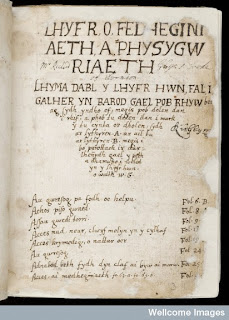
'A Welsh Leech Book'

Of the thousands of manuscripts in the Wellcome Library, only one is written in Welsh. And as it's St David’s Day today – the patron saint of Wales, of course – we thought we would offer a few words on the manuscript.

Purchased for Henry Wellcome’s collection of manuscripts and books in 1907, and now catalogued as MS.417, Lhyfr o fedheginiaeth a physygwriaeth ('Book of remedies and medicine'), was written around 1600.

The language may be different, but the contents are similar to the Wellcome Library’s other medical manuscripts of the period. It is compiled from a host of sources, both local and classical in tradition. Treatments offered in the manuscript include cures for coughs, colic, ague and failing eyesight. Prescriptions include the use of herbs and ointments, but there are also directions for incantations and magical formulas. Indeed, MS.417 shares features with our collection of later 17th century – English - domestic remedy manuscripts.

The main difference between MS.417 and our domestic remedy manuscripts is that this is an item of a medical 'professional', hence the title of a 1924 published transcript of another version of this manuscript as A Welsh Leech-Book (‘Leech’ being an Old English word for Physician).

As indicated on our catalogue entry, authorship of the manuscript is disputed (it may have been the work of Sir Thomas Williams [1550?-1620?]). What MS.417 does offer up is some of its previous owners, the names of which are listed in 18th and 19th century hands. Given the bardic traditions of Wales, the name on this list of ‘Dewi Fardd’ – the poet and antiquary David Jones (1708?-1785) – is an intriguing presence.

The manuscript is deserving of more attention. A recent article in the journal Social History of Medicine argued that Wales in the Early Modern period, was part of a wider medical network than previous historians have accounted for. It would be interesting assess whether MS.417 helps to back up or dispute this claim.

Tuesday, February 2, 2010

A new acquisition

The De Materia Medica of Dioscorides, written around 70 A.D., was the most important source of information on medicinal plants for 1500 years and today remains an important text in this field. The oldest known complete manuscript is the Juliana Anicia Codex (ca. 512 A.D.), housed in the Austrian National Library in Vienna. Listed as Codex Vindobonensis Medicus Graecus 1., it is better known as the Vienna Dioscorides, the oldest and most valuable work in the history of botany and pharmacology.

New plant discoveries in the 16th century led to a reappraisal of Dioscorides. The most important were the commentaries of Pietro Andreas Mattioli, a doctor and naturalist born in Siena in 1501. Pietro became so obsessed with Dioscorides that with each new edition his commentaries grew ever longer. He established an international reputation and was appointed personal physician to the Hapsburg Emperor Ferdinand I. In Prague he met Ogier Ghiselin de Busbecq who served as the Emperor’s ambassador to Constantinople from 1555 to 1562. Busbecq told him of the magnificent manuscript of Dioscorides he had seen at the Ottoman court, which he was later able to acquire for Ferdinand.

With the support of the Hapsburg princes Mattioli planned a new edition of Dioscorides on a grand scale. He employed two artists, Giorgio Liberale de Udine and Wolfgang Meyerpeck to design and illustrate over 600 wood blocks. These wood blocks were used to print translations in Czech and German in Prague in 1562 and 1563, then a Latin edition in Venice in 1565 and Italian in 1568.

The use of wood blocks to print illustrations was the most common technique in the 16th century. In the second half of the century publishers began to use engraved copper plates. This method could provide much finer detail and accuracy, but was more expensive as the plates had to be printed separately on a rolling press. Most wood blocks and copper plates from this time were used many times until they wore out, and sometimes recycled to create new images. However a few have survived. The most important collection is held at the Plantin-Moretus Museum in Antwerp.

The Mattioli wood blocks were rediscovered in Venice by the French botanist Henri Louis Duhamel du Monceau in the 18th century. He used some of them in his work Traité des Arbres et arbustes (Paris, 1755) and these were lost. However many remained in his family until the 20th century when they began to appear on the market. In 1989 110 blocks were offered for sale in a special catalogue from three bookdealers – Bernard Quaritch, Hazlitt, Gooden & Fox and Antiquariat Junk. In December 2009 the Wellcome Library purchased one of these blocks from W.P. Watson (previously of Quaritch). It is probably pearwood and measures about 22 cm by 15 cm. On the back of the block is a paper label “Ambrosia”.


A modern English translation of De Materia Medica identifies Ambrosia as Artemisia Maritima, or Sea Wormwood. Artemisia is a large, diverse genus of plants with between 200 to 400 species belonging to the daisy family Asteraceae. They grow in temperate climates of the Northern Hemisphere and Southern Hemisphere, usually in dry or semi-dry habitats. Wormwood has been used medicinally as a tonic, stomachic, febrifuge and anthelmintic. Artemisia Maritima (Sea Wormwood) has an extremely wide distribution in the northern hemisphere, occurring mostly in saltish soils and is found in the salt marshes of the British Isles, on the coasts of the Baltic, of France and the Mediterranean. It has similar properties to other wormwoods, but is less powerful. It was used as a replacement for "true" wormwood in remedies, as it was more readily available and often used in treatment of intermittent fevers. The most effective anti malarial drug is artemisinin, derived from Artemisia annua, also known as sweet wormwood, which had been used in Chinese medicine for centuries under the name 'Qinghaosu'. It was rediscovered in the 1970s, evaluated first in South-east Asia, and eventually accepted as an essential component of anti malarial treatment in the past few years.

The Mattioli woodblocks (Catalogue)

The Mattioli woodblocks (historical essay and portfolio of 9 plates printed from the original blocks)

Mattioli's herbal : a short account of its illustrations, with a print from an original woodblock (Morgan Library, New York)

Hand coloured copy of 1568 Italian edition in the Wellcome Library

Friday, August 7, 2009

16th century anatomical sheets - images and animations now online


The Library’s rare and important collection of printed anatomical sheets dating from the 16th century are now freely available online via Wellcome Images. These intriguing prints depict the human body through labelled illustrations, often using a three-dimensional 'pop-up' device of superimposed flaps, which can be raised in sequence to display the internal anatomy of the male or female figure. The fugitive sheet thus mimics the act of dissection.

They were a popular instructional aid in the 16th century and many were produced in vernacular languages which could be read by a lay audience interested in the workings of the human body. The earliest recorded sheets were printed in Strasbourg by Heinrich Vogtherr in 1538. They were probably produced in great numbers but only a very few survive today. There are 19 sheets in our collection, many in pairs of male and female figures and one set of three with a skeleton sheet. This is the largest single collection in any institution. The surviving examples represent only a fraction of a much larger number most of which are now lost for ever, but there is always the hope of fresh discoveries in unexpected places.

Images have been created showing each flap in sequence. Animated versions are also available from the catalogue records, showing the flaps raised and lowered in sequence.

Monday, June 1, 2009

The Birth of Mankind

The Birth of Mankind, otherwise named the Woman’s book was the most important English language work on midwifery in the 16th century. The text was a translation and adaptation of Der schwangern Frauwen und Hebammen Rosengarten, written by Eucharius Rösslin. The first English translation, by Richard Jonas, was published in 1540. A second translation, by Thomas Raynalde, was first published in 1545 and it is this version which was reprinted many times in the next 100 years. Not only did it provide information on fertility, pregnancy, birth, and infant care, but it also included up to date anatomical descriptions. Its illustrations were copied from Vesalius via Thomas Geminus’s Compendiosa totius anatomiae delineatio which was also first published in 1545.


The Wellcome Library has 11 editions of the Birth of Mankind, all of which you can find in the library catalogue. We purchased a copy of the 1545 edition at the sale of the Haskell Norman medical and scientific collection at Christie’s New York in 1998. In 2006 we added a later edition, with interesting annotations by two different readers, one from the 16th century and another in the 19th century. The title page is signed by Sir Edward Burrowes Sinclair (1824-1882) who was Professor of Midwifery at Trinity College Dublin from 1867. We have a copy of one of Sinclair’s publications entitled Practical midwifery : comprising an account of 13,748 deliveries which occurred in the Dublin lying-in hospital, during a period of seven years, commencing November, 1847 / by Edward B. Sinclair ... and George Johnston (London, 1858). He had obviously gained a lot of practical experience.

A modern annotated edition of The Birth of Mankind, based on the 1560 edition, has recently been published by Elaine Hobby.