Showing posts with label prints. Show all posts

Monday, June 18, 2012

Shackled in leg irony: black humour of the lower limb

Mezzotint by Jacob Gole (1660?-1737?) after Annibale Carracci.
Wellcome Library no. 24994i
It is a common experience to have enough feet but not enough shoes. The man shown here is, paradoxically, in the opposite situation: he has plenty of shoes but lacks a foot. The irony has a further twist: he is a shoe-seller whose single surviving foot is unshod, presumably because he cannot afford his own wares. No wonder he needs to keep up his spirits with a tobacco pipe.

Black humour (gallows humour, Galgenhumor) is a common feature of discourse about disability. However much we may deplore the fact, loss of mobility due to amputation of the lower limb -– at the thigh, leg or foot -- has been considered a particularly appropriate subject for such humour, perhaps owing to suppressed fear of losing such mobility as we may have. Irony is a way of playing down the horror of immobility while at the same time acknowledging it; and there can be intellectual pleasure (at least for functional bipeds) in the various paradoxes that can arise from limblessness, which are prominent in the drawings, photographs, prints and paintings in the Wellcome Library shown here.

Watercolour by C.W.D., 1866. Wellcome Library no. 12109i
Loss of a limb in a railway accident elicits no sympathy from this compensation board.
The victim (to Chairman) "Sir, in consequence of the carelessness of your servants. I have been compelled to have my leg amputated, besides suffering other injuries, and I consider myself entitled to compensation."
Facetious director. "Lost your leg have yer? Regular stumps etc? - Well! If yer any-think of a cricketer it must be an ill-convenience!"
Benevolent chairman. "Quite right sir - qu-i-te right, compensation by all means, loss of leg - eh? - an unfortunate accident that for all of us." (To secretary) "Here Mr Jones award this gentleman twelve shillings for a wooden one - and enter it on the minutes."'
Jones replies: "The usual discount sir I suppose for ready money? That'll make it eleven shillings." Another director adds: "One can't be too cautious but he don't look like a malingerer!".

Coloured etching, 19th century. Wellcome Library no. 44050i
To break one's natural leg is bad enough, but then to break its wooden replacement adds insult to injury. Two approximately contemporary prints show this subject. In the one above, the driver of the offending vehicle is asleep at the reins.

Coloured engraving published by Laurie and Whittle, 24 February 1800. Wellcome Library 44090i
But at least here the victim can smile as he sees the irony of his situation – and it's much less painful this time round for the young sailor who had lost his leg in the Far East. Fortunately a carpenter is passing with a saw and pot of glue in hand; "A broken leg, or the carpenter is the best surgeon. Haloo! Young Glewpot, de ye see Jack Junk has shivered his timbers, and we want a splice here." The surgeon coming out of his house on the left has no part to play on this occasion, and is pushed away.


There are even positive advantages to losing a leg!


Here another seadog has lost both his legs to the naval surgeon, but there's one compensation: no more suffering from corns ("Keine Hühneraugen mehr!").


Lithograph after Johann Bahr, 1909. Wellcome Library no. 577262i


Etching by Frederick Carter, 1928. Wellcome Library no. 44343i (Wellcome Library/©RG Clark)
"What, no legs? Lucky man!" are the words spoken by Ahasuerus (the Wandering Jew) to an immobile Spanish beggar in Frederick Carter's gloomy etching. It is the Jew's misfortune to be forever moving over the face of the earth without respite; the beggar's not to be able to move at all. You can see the world, or you can have a rest, but you can't do both.

Discarded crutches at Lourdes. Photograph, 1937. Wellcome Library no. 578619i
Once a leg has been lost, surely only a miracle could make it grow again. It was a friend of the writer Anatole France (1844-1924) who, contemplating the hundreds of discarded crutches at Lourdes, murmured "Une seule jambe de bois en dirait bien davantage" (Just one wooden leg would be much more significant). [1]

Coloured lithograph by C.J. Grant, 1834.
Wellcome Library no. 11854i
.
The regrowth of a natural leg from an amputation stump was considered absurd enough to be worthy of an advertisement for Morison’s pills – the heavily-advertised vegetable remedy for diseases attributed to iatrogenic blood poisoning. The man on the left went to bed with wooden legs, took a dose of Morison's Universal Pills, and "when I awakes in the morning to kick off the clothes, I'm blessed if I didn't find myself with these 'ere couple of jolly good legs and my old wooden ones right at the bottom of the bed!!!".

 Yet … looking towards a future age of stem-cell therapy, who would claim that regeneration of a limb could not occur?


Colour lithograph by H.G. Banks, ca. 1899.
Wellcome Library no. 556713i

It would need more than stem-cell therapy to put poor Callaghan together again. In the song What will poor Callaghan do? a disabled soldier has his wooden legs stolen by four drinking companions in a bar.

The song describes an evening out for four stage-Irishmen called Hogan, Casey, Murphy and "me"; originally "me" was Michael Nolan, a popular Irish music-hall performer. They had spent all their money drinking beer in a pub with an ex-Highland soldier called Patsy Callaghan, who had had his legs shot off from under his kilt when at war. To recover their funds, they got Callagahan drunk, removed his wooden legs and false teeth, pawned them, and left Callaghan literally legless on the pub bench. His plight, depicted on the front cover of the songsheet, is regarded by all as hilarious, though the speaker can't help wondering (in the words of the chorus) "What will poor Callaghan do?".

Michael Nolan asking "What will poor Callaghan do?"
Poor Callaghan was a precursor (or, from another point of view, a post-mediaeval successor) to The Black Knight in Monty Python and the Holy Grail (1975) who unwillingly makes comedy out of limb-deprivation. "'Tis but a scratch!" he says after losing one arm, "It's just a flesh-wound!" after losing the other, and "All right, we'll call it a draw" after finally losing both legs. Before the Black Knight, one-leggedness had been the subject of another piece of tasteless comedy: One leg too few, a sketch written by Peter Cook while a Cambridge undergraduate in 1960. For this sketch Cook appears to have coined the Latin-derived word "unidexter" to denote a person with one leg, although there was already a Greek-derived word in English, namely "monopod". Again there was an ironic twist of which some audiences were unaware: the actor playing the one-legged role (Dudley Moore) had had club-feet as a child and still had one ineffective leg. Irony and club-foot lead us on the well-intentioned but disastrous operation in Flaubert's Madame Bovary (1856), but we have enough space here merely to allude to it.

Oil painting attributed to the Master of Los Balbases, Burgos, ca. 1495.
Wellcome Library no. 46009i
Conversely, many people are shocked by the absence of irony in this Spanish altarpiece showing a verger's dream. The verger dreams that his bad leg is substituted by Saint Cosmas and Saint Damian with the leg of a black man, and on waking, finds it is true. Some viewers tend to resort to jocularity, showing that they are sophisticated enough to realize that transplants cannot routinely be performed by such means, but not knowledgeable enough to understand the episode as a miracle that could, for example, comfort diabetics. 
The dream of Saint John Damascene: the Virgin attaches his severed right hand.
Drawing, 16--. Wellcome Library no. 651341i
Similar pictures showing the reattachment of a hand do not seem to arouse the same facetiousness. But then in favourable circumstances, surgical reattachment of a hand (or for that matter a foot) to its original limb is not impossible today, according to this popular webpage about "fascinating reattachment surgeries". That really is something to be glad about.

The first examples discussed here have irony and humour, while the last two examples show that in religious contexts lack of a limb could be represented without humour and without irony. Let's end with an example that has irony but not (I suggest) humour.
Engraving by L. Gaultier, ca. 1613. Wellcome Library no. 571261i
This engraving by Léonard Gaultier (1561-1641) shows a man with a wooden leg carrying arms, legs and feet in a basket. At first sight it appears to have a similar subject to the Dutch mezzotint after Annibale Carracci (top).

However, it is a detail of a broadsheet designed by the Franciscan friar Martin Meurisse (1584-1644) to teach logic in Paris in 1613. If it is the nature of man to be a biped, is a "unidexter" a man? And if the function of a foot is locomotion, does a detached foot have the nature of a foot? The answer is that parts that naturally belong to an entity and are necessary for its completion, if removed from that entity, are reduced to predicates of it. Students whose minds have been befuddled by the many distinctions in Aristotle's writings on logic will have been glad to have had such a vivid and ironic image to remind them of how the contingencies relate to the substance of human life.

[1] Anatole France, Le jardin d’Epicure (1895), Paris 1923, p. 158

Wednesday, May 2, 2012

Interpreting caricatures

By their very nature, caricatures (in the sense of graphic works) distort the truth for humorous effect, but not quite enough to make their subjects unrecognizable. Quite how caricature artists have steered between the Scylla of distortion and the Charybdis of incomprehensibility was one of the questions explored in "Interpreting caricatures" at the Wellcome Library on 27 April 2012.

The event was the first in a series of "Masterclasses" intended to help with the interpretation of documents in the Wellcome Library, many (if not all) of which require a certain level of expertise for their understanding. Last week's Masterclass was given by Professor Ludmilla Jordanova of King's College London (above) and William Schupbach of the Wellcome Library, with participation from the fifteen people attending.

Wellcome Library no. 29318i
The meeting focused on caricatures in the Wellcome Library, and a number of points emerged. In the Wellcome Library the term "caricatures" is used to apply to distortions of events and situations as well as of persons. Some caricatures are satirical, others merely humorous without satirical intent. The Dutch caricatures of the financial crisis of 1720 (published in the compilation Het groote tafereel der dwaasheid) show the need to compare and contrast within a set of caricatures of the same subjects, and to link them with plays and poems. The print Modern moonshine, or the wonders of Great Britain (1774: above) shows that even with the aid of the internet and online reference sources, some caricatures still resist complete understanding. For British caricatures up to 1832, the catalogue records created by Mary Dorothy George are still fundamental.

Wellcome Library no. 12182i
 Much can be learned not only by analysis and comparison but also by studying the penumbra of radiating allusions, and by taking account of the artists' visual modes of expression (such as the dividing lines in A right hon.ble democrat dissected, 1793, right).

Some caricatures are valuable additions to an individual's portraiture, as in the case of William Hunter. In others, subsidiary figures such as the chimney-sweep in Thomas Rowlandson's A midwife going to a labour (1811) can be as important for social history and for telling the story as the principal figures (in this case the rumbustious midwife herself).

It is doubtful whether any of those attending failed to learn something new about caricatures, and new interpretations were put forward for several prints. Future Masterclasses will be announced on this blog.

Tuesday, April 17, 2012

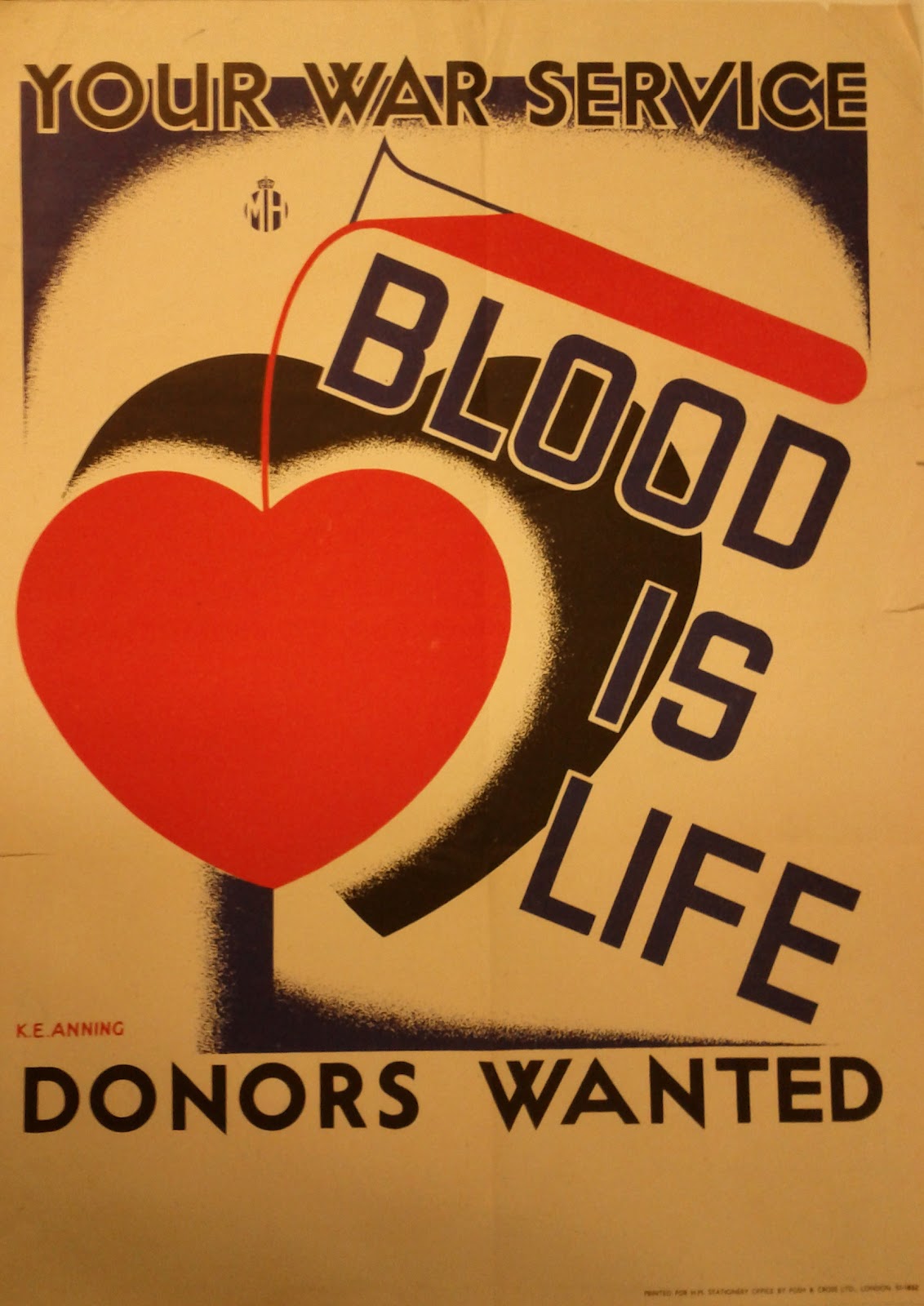
Health of the People -- British style

The Wellcome Library has acquired a collection of 600 British posters dating from the 1940s to the 1990s advertising the health-maintenance activities of the British state. Most were produced by the Central Office of Information for the U.K. Ministry of Health (subsequently Department of Health and Social Security, subsequently Department of Health).

The posters cover the following subjects: Blood donation (135); Children (44); Diseases (121: AIDS, asthma, colds and flu, diphtheria, epilepsy, meningitis, rabies, rubella, tetanus, tuberculosis); Drugs or narcotics (53); National Health Service services and charges (80: ambulance service, cervical screening, community care, emergency GPs, evaluation, fares to hospital, NHS 30th anniversary, prescription charges, spectacles); Nurses and midwives (87, including recruitment, Queen's Institute of District Nursing, etc.); Organ donation (44), Travel and health (8); and Miscellaneous (26: air-raids, disability, health and safety, health of the nation, hearing, incontinence, mental health, and teeth).

Proof pulls and storyboards are included as well as finished versions. Named designers include Reginald Mount, K.E. Anning (above), and Abram Games.

The posters are accompanied by a large collection of photographs, drawings, etc. which have not yet been explored, except for one item, a photograph album (Wellcome Library no. 811058i) recording an exhibition from 1948 called Health of the People. This exhibition was put on by the Central Office of Information in Oxford Street, London (but where in Oxford Street?) apparently to publicize the introduction of the National Health Service (NHS) in that year. On display from May to June 1948, the exhibition was an ambitious attempt to communicate the history of public health and the difference that the NHS would make between the past and the future. Much attention was given to new laboratory-based services.

The photographs makes it look like a halfway-house between Britain can make it at the V&A in 1946 and the Festival of Britain on the South Bank in 1951. No names of contributors (commissioners, writers, designers, manufacturers) are given, but surely they must be recorded somewhere; possibly in the unexplored parts of this same collection. The script which accompanies the album makes much reference to the Public Health Act of 1848, the centenary of which was being celebrated.

Did this period see the high-water mark of state involvement in health in the British Isles? If so, our successors will no doubt look on these documents with incredulity. Only time will tell. 
Displays in the Health of the People exhibition, 1948. Left, "the health team, consisting of the family doctor, dentist, nurse etc". Above, stands on protection of towns, water supply etc. Top, the staircase between floors.

Thursday, April 5, 2012

Easter 2012: "O death where is thy sting?"

Easter week celebrates the moment when, in Christian metaphysics, mortality is overcome by everlasting life. The crucifixion of Jesus Christ redeems mankind from the sinful state into which mankind fell through Adam's disobedience to the will of God in the garden of Eden. His resurrection liberates us from eternal perdition: in Saint Paul's famous words (I Corinthians, XV.54-55) "So when this corruptible shall have put on incorruption, and this mortal shall have put on immortality, then shall be brought to pass the saying that is written, 'Death is swallowed up in victory'. O death where is thy sting? O grave where is thy victory?".
These concepts were articulated with fresh force in the later sixteenth century through the Counter-Reformation, in media such as altarpieces, sermons, the educational work of the Jesuit Order, and through devotional prints which were widely disseminated. Here we present four such prints from the holdings of the Wellcome Library.
Engraving by B. van Bolswert after Rubens. Wellcome Library no. 24606i.
The print above publishes an altarpiece painted for a church in Antwerp in 1619-20. The lettering names Pieter Paul Rubens as the painter, and Boëce van Bolswert (in Latin, Boethius à Bolswert) as the engraver and printer. Bolswert (ca. 1580-1633) worked in Antwerp in collaboration with the Rubens studio. The lettering describes the scene in the words of Saint John's gospel (XIX.19-34), which is also closely followed in the depiction.

For instance, Saint John mentions that the mocking inscription on Christ's cross "was written in Hebrew and Greek and Latin" (XIX.20), as it is here. The print also illustrates an act of casual cruelty which is described by Saint John: the soldiers broke the legs of the two men crucified with Jesus, but when they got to Jesus himself, they saw that he was already dead so did not waste any effort in breaking his limbs. Thus the print emphasizes the sinfulness of mankind and its need for the "corruptible to put on incorruption".

The altarpiece was seen in Antwerp in 1781 by the painter Joshua Reynolds. He describes it as "famous", meaning that it was widely known from  Bolswert's print. He commented in his diary:
'The altar of the choir is the famous crucifixion of Christ between the two thieves, by Rubens. To give animation to this subject, he has chosen the point of time when an executioner is piercing the side of Christ, whilst another with a bar of iron is breaking the limbs of one of the malefactors, who in his convulsive agony, which his body admirably expresses, has torn one of his feet from the tree to which it was nailed. The expression in the action of this figure is wonderful: the attitude of the other is more composed; and he looks at the dying Christ with a countenance perfectly expressive of his penitence. This figure is likewise admirable.

'The Virgin, St. John, and Mary the wife of Cleophas are standing by with great expression of grief and resignation, whilst the Magdalen, who is at the feet of Christ, and may be supposed to have been kissing his feet, looks at the horseman with the spear, with a countenance of great horror: as the expression carries with it no grimace or contortion of the features, the beauty is not destroyed. This is by far the most beautiful profile I ever saw of Rubens, or, I think, of any other painter …

'The genius of Rubens nowhere appears to more advantage than here: it is the most carefully finished picture of all his works. The whole is conducted with the most consummate art; the composition is bold and uncommon, with circumstances which no other painter had ever before thought of; such as the breaking of the limbs, and the expression of the Magdalen, to which we may add the disposition of the three crosses, which are placed prospectively in an uncommon picturesque manner: the nearest bears the thief whose limbs are breaking; the next the Christ, whose figure is straighter than ordinary, as contrast to the others: and the furthermost, the penitent thief: this produces a most picturesque effect, but it is what few such a daring genius as Rubens would have attempted. . . . I have dwelt longer on this picture than any other, as it appears to me to deserve extraordinary attention: it is certainly one of the first pictures in the world, for composition, colouring, and, what was not to be expected from Rubens, correctness of drawing.'
Although Reynolds's appreciation is primarily technical, written from the point of view of a professional painter, his feeling for the subject matter is also strongly expressed. In the 19th century the composition continued to be well known under the name Le coup de lance given to it in 1876 by the French painter Eugène Fromentin. Even today some writers call it Le coup de lance, even though many other incidents are shown in addition to the centurion piercing Christ's side with the lance. Although the lettering on the print and other evidence state that the author was Pieter Paul Rubens, there are reasons for thinking that, while Rubens designed the composition, his pupil Antonie Van Dyck may have been responsible for some of the detailing. [1] The painting now belongs to the Koninklijk Museum voor Schone Kunsten, Antwerp.
At some stage Christ's body had to be taken down from the Cross. An episode after that, known in English by the Italian word Pietà, in which the Virgin Mary mourns her son, is recorded in many pictures and sculptures.

 Engraving by Lucas Kilian after Hans von Aachen, 1602. Wellcome Library no. 23231i.

This is one of the most finely worked prints of that subject. It is a truly international production. The designer was Hans von Aachen (1552-1615) who was born in Cologne, worked in Italy where he learnt a good deal about painting and design, and eventually became court painter to the Emperor Rudolf II in Prague, where he died. Our print is dated 1602, when Hans was in Prague. It bears a dedication from Dominicus Custos (the printer and/or publisher), dated to the day: "MDCII. VIII. Id. Maÿ", i.e. 8 May 1602. The dedicatee is Johann Philipp von Gebsattel (1555-1609),  Prince-Bishop of Bamberg from 1599 to 1609, not a man renowned for piety, which is perhaps why he was glad to be recognized as the patron of this magnificent print. He could hardly fail to be impressed by the engraver's work on the Virgin's halo. The engraver was the stepson of Dominicus Custos, Lucas Kilian, who was from Augsburg in Bavaria but carried out the work for this print in Venice.
The episode is not mentioned in the Gospels but became one of the standard Stations of the Cross in the Middle Ages. Evidently it was thought necessary to have a time for grieving between the killing of Christ and his burial. The Virgin's expression is one of bewilderment, while Mary Magdalene devotes herself to the wounded body of Christ. In the foreground are the causes of the sacred wounds, including the nails, a hammer, and the crown of thorns.

Engraving by Lucas Kilian after Tintoretto. Wellcome Library no.23236i.
The carrying of Christ's body to the tomb is shown in another print made by Lucas Kilian, again in collaboration with his stepfather Dominicus Custos as printer and/or publisher, but this time Lucas is engraving a design by a Venetian painter, Jacopo Robusti, called il Tintoretto. The patron to whom the print is dedicated is also Italian:  Anna Caterina Gonzaga (1566-1621), daughter of Guglielmo Gonzaga, Duke of Mantua, and at this time the consort of her uncle, Ferdinand II, Archduke of Austria. Unlike the Prince-Bishop of Bamberg, she was indeed renowned for her piety: as a child she had received visions of the Virgin, and after her husband's death she abandoned the trappings of wealth and devoted herself entirely to religion and good works.
It is clear why the archduchess would have been happy to be associated with an engraving in which the suffering Virgin Mary is literally so prominent: the three Maries are almost falling out of the front of the picture, with the Blessed Virgin in the centre, Mary Magdalene on the right and Mary the wife of Cleophas (John XIX: 25) on the left. Remarkably, what we might regard as the main subject, the carrying of the body of Christ, appears only in the background. The reaction of the Virgin to the sight of Jesus's body implies that a distinct earlier phase corresponding to the Lamentation or Pietà did not take place.
Engraving after Maerten de Vos, late 16th century. Wellcome Library no. 23283i.
Finally in this sequence, we have the powerful figure of Christ triumphing over death. The upper part combines two scenes: Christ is simultaneously resurrected from the tomb and ascends into heaven. In the lower left corner, Death itself is about to be swallowed up by a monster, while in the centre the snake that led Adam and Eve astray, and who is entwined around the secular world, is about to be trampled down by the wounded foot of Christ. On the right a tablet engraved with the Ten Commandments faces upwards, indicating that Christ is triumphing over righteousness of the law, replacing it with righteousness of faith.
The composition is by Maerten De Vos (1532-1603), and the engraving was produced by the publishing house of Hieronymus (Jeroen) Cock (c. 1510–1570) at the sign of the four winds ("Aux quatre vents") in Antwerp.

Thanks to Erika Delbecque for cataloguing the Wellcome Library's prints by Lucas Kilian.
[1] N. Van Hout, 'On the invention and execution of the Coup de Lance', in Rubens Bulletin Koninklijk Museum voor Schone Kunsten Antwerpen (KMSKA), 2011, 3: 2-39. Online at http://www.kmska.be/nl/Onderzoek/Rubens/Rubensbulletin_3.html

Tuesday, January 17, 2012

Mesmerism on show


Mesmeric therapy. Wellcome Library no. 44754i

Franz Anton Mesmer (1734-1815) was the promoter of a form of animal magnetism (named Mesmerism after him), at first in Vienna (1773-1777) and subsequently in France (1778-1784). His unique selling point was the supply of mesmeric fluid that served to rebalance the magnetic polarity of the animal body. His doctrine was one of many that sought to bring the animal body (the microcosm) into harmony with the larger world outside (the macrocosm). Such doctrines have a long history, from Hippocratic aphorisms about the effects of weather on certain temperaments to our contemporaries' warnings about asthma, allergies and air pollution.

As a therapist, Mesmer, like other innovators (James Graham, Edward Jenner, John Brown etc.) offered his therapy outside the established world of academia, the court, and the royal colleges. Indeed, they sometimes came into conflict, as Mesmer did in Paris. Both his popular appeal and the disdain of the establishment brought him publicity of commercial value.

Hence the many depictions of his therapeutic sessions. One of them is shown in an oil painting in the Wellcome Library (above). The patients are seated around Mesmer’s baquet, a large flat drum containing mesmeric fluid. Pipes, tubes and cords emerging from the drum could be applied to the affected parts: one man on the far left is winding a cord doused in mesmeric fluid around his head, while several others are applying the ends of the tubes to their eyes (detail left). A woman in Turkish dress in the centre foreground is treating the eye of a child to a dose of the mesmeric fluid.


While oil paintings were seen by few, prints were seen by many, if only in the shop windows of print-sellers and stationers in the high streets of towns and cities. Among several prints of mesmeric therapy in the Wellcome Library is this coloured engraving of Mesmer in Paris (above), with text below describing the scene (Wellcome Library no. 17918i). It shows one gentleman resting his right foot on the drum so that mesmerism can be applied to his shin. There is also a view through to a second baquet in a room off at the left.

Until today, the catalogue description of this print made no mention of any of the authors (artist, designer, engraver or publisher) of this print: it was by an unidentified hand.However, Sotheby's have in their forthcoming drawings sale in New York a pair of drawings attributed to the artist Claude-Louis Desrais (1746-1816), and one of them (Sotheby's Old master drawings, New York 25 January 2012, lot 123) is the original design for the Wellcome Library's coloured engraving. Indeed Sotheby's say in their catalogue record that this drawing and a similiar one by Desrais were "probably intended for prints or book illustrations as they are reddened on the reverse". However, as the Wellcome Library print is much cruder in execution than the drawing -– Sotheby's drawing has much finer detail -- there may have been an intermediary print or drawing from which the Wellcome Library's engraving was copied. An impression of the same engraving is also in the National Library of Medicine, Bethesda, Maryland, and no doubt there are others elsewhere.

The attribution to Desrais on stylistic grounds is satisfying because Desrais is known to have produced a portrait of Mesmer (right: Wellcome Library no. 23327i). If he was Mesmer's in-house image-maker, then, although he does not seem to be recorded as an oil-painter, could the Wellcome Library's painting also be by him? It does look like the work of someone unaccustomed to such a cumbersome medium.

The other drawing at Sotheby's (same sale, lot 124) shows a woman standing within a circular knee-high cage surrounded by three men in animated conversation. Another man (left) seems to be turning up a gas light, while on the right a demonstration is taking place of a closed vessel on a column. Perhaps someone familiar with public demonstrations of natural philosophy in Paris at this period can identify the event? It should be dated not later than 1816, the year of Desrais's death.

Tuesday, January 3, 2012

Hermitage and heritage: Augustinians in history

Austen (the surname of one of England's best-loved novelists and Austin (the capital city of Texas) are both abbreviations of the name Augustine. That name became popular from Saint Augustine of Hippo, Father and Doctor of the Church (354-430), philosopher and theologian (left: Wellcome Library no. 3493i).

In England the name Augustine later acquired added lustre from the Roman missionary Saint Augustine of Canterbury, who re-introduced Christianity to Britain in the 6th century. The earlier Augustine, Saint Augustine of Hippo, was a Roman citizen of the province occupied today by Algeria. At one time a professor of rhetoric in Rome and Milan, he returned to North Africa and died there after writing numerous works of theology and philosophy. His studies of such subjects as time, memory, mind, and magic are still much admired: today the School of Life in London recommends Saint Augustine's Confessions to its students, while a writer in a recent New York Review of Books boldly declared that he was "surely one of the mightiest intellects ever to walk this earth" [1].

The high intellectual standing of Saint Augustine of Hippo underlay the success of the Augustinian Order formed from various groups of hermits, and explains why he and members of his Order are so abundantly represented in the Wellcome Library. By Augustine himself the Library has an incunable edition of his De civitate Dei (Venice 1490), three incunable editions of his sermons, and many other works.

Of his followers, the Wellcome Library has nine editions of works by the Augustinian philosopher Giles of Rome (Aegidius Romanus, ca. 1243-1316), three of which (On the material of the heavens, On possible understanding against Averroes, and a Commentary on Aristotle's Physica) are edited by another Augustinian called Giles, namely Giles of Viterbo (Aegidius Viterbiensis, 1469-1532), also a cardinal and a student of Jewish mystical writings. The Wellcome Library's incunable edition of the work of the two Giles's has the inscription "Egidius in Phis." (Giles on the Physica) written on the bottom edge (above right): before the mid-17th century, books were generally stored with their edges facing towards the room (not their spines, as today), and the owner of this book in the sixteenth century evidently knew who "Giles" would be and what the "Phis" were. [2]

One of Giles of Viterbo's contemporaries north of the Alps was George Ripley (d. ca. 1490), a canon of the Augustinian priory at Bridlington, Yorkshire, whose scrolls of alchemical symbols have recently been discussed on this blog.
Another Augustinian of the same era was Saint Thomas of Villanova (1486-1555), Bishop of Valencia and a professor at the University of Alcalá, after whom many universities and schools are named. In the engraving on the left (Wellcome Library no. 11665i), a young woman finds her leg ulcers relieved after her cheek is brushed with a locket containing a portrait and a relic of Saint Thomas of Villanova.

The Wellcome Library has many writings by the Augustinian satirist and preacher Abraham à Sancta Clara (1644-1709), a famed communicator of his day both in Vienna and internationally.  The print below of a man literally dicing with death illustrates one of his popular books on death in the time of the bubonic plague.
 Nineteenth-century Augustinians include the experimental gardener Johann Mendel (1822–1884) -- or Brother Gregor, to use his name in religion -- after whom is named the Mendel University in Brno, Czech Republic (and, on a smaller scale, a meeting room in the headquarters of the Wellcome Trust in London). He was a member of the Augustinian Abbey of St Thomas in Brno, and from 1868 its abbot. In his horticultural work, Mendel grappled with botanical manifestations of the questions discussed by his predecessor Giles of Rome in the latter's De formatione corporis humani, written around the year 1270. An up-to-date introduction to the work of the Augustinian Order today can be found in the website Augnet.


The most monumental Augustinian work in the Wellcome Library is surely a gigantic etching (approx 145 x 160 cm.) produced on twelve plates in 1614 by the Italian engraver Oliviero Gatti of Bologna (1579-ca. 1648?). It bears the heading Mysticae Augustinensis Eremi sacrum gloriae decorisq. Theatrum ("Sacred display of the mystic glory and distinction of the Augustinian hermitage"); for brevity the work is also called Arbor augustiniana ("The Augustinian tree"). Gatti was commissioned to create this magnificent baroque print by two Augustinian friars, Marc Antonio Viani (from Bologna) and Paulus Vadovita (from Wadowice in Poland). Seven copies are known, not all of them now complete: the Wellcome Library's copy lacks two of the twelve plates. The print exists in two states: one from 1614 dedicated to Pope Paul V and King Philip III of Spain, the other dated 1678 and with updated dedications to their successors, Pope Innocent XI and King Charles II of Spain: the Wellcome Library's copy is of the first state. The print has been cleaned and conserved this year by Amy Junker Heslip in the Wellcome Library's Conservation department; during conservation, the superb quality of the paper and the vigour of the etching were revealed.

 Wellcome Library no. 32491i (plate 8 of the Arbor augustiniana

In the centre of Gatti’s composition, Saint of Augustine of Hippo sits holding the Rule of his Order (above), while around are representatives of the sacred and knightly orders associated with him, saints and martyrs, and eminent Augustinian friars and nuns, including his mother, Saint Monica. Giles of Rome appears no fewer than three times: once as a bishop, once as a cardinal-archbishop (left: Wellcome Library no. 32476i), and once among those who renounced a princely or royal title to become an Augustinian hermit: Giles of Rome was widely believed to be a member of the Roman noble family of Colonna, though the truth of this has been doubted. [3] A full analysis of the work is of course beyond the scope of this posting, but the prints themselves are available in the Wellcome Library to anyone wishes to study them, or indeed just to enjoy the brio of their draughtsmanship.

If we turn back from the Augustinian Order to Saint Augustine of Hippo himself, in addition to the many graphic representations of the saint the Wellcome Library has an oil painting, the subject of which has recently been identified by Mr Roberto Tollo in the course of his studies of Augustinian iconography. The painting is painted on a large sheet of copper (69 x 85.7 cm.) and was acquired by Sir Henry Wellcome in Granada in Spain in 1934.
The copper support, the Spanish provenance, and the costumes in the painting (similar to those in paintings by the Antwerp painter Frans Francken II) together suggest that this is a Flemish painting made in Antwerp in the mid-seventeenth century and painted on copper for export to Spain or Latin America. Paintings on copper travelled well, and once exported, could serve as models for larger paintings on wood or canvas for display in the churches, hospitals and convents of Spain and New Spain. [4]

Mr Tollo has now confirmed this by pinpointing the exact source of the composition as an engraving by the Antwerp artist Schelte Bolswert (1586-1659), apparently after his own design. That Schelte Bolswert's prints of Augustinian iconography were popular in the Hispanic world we know from the painted versions of them that have been found in Seville, Madrid, Quito, and Lima: the evidence is given in the Wellcome Library catalogue.

The subject derives from an episode in Carthage in the year 388, described by Saint Augustine himself [5]. The man in bed on the left is Innocentius of Carthage, who suffered from a rectal fistula, and was about to be treated for it by a painful surgical operation: in Augustine's words, "curabatur a medicis fistulas quas numerosas atque perplexas habuit in posteriore et ima corporis parte" (he was being treated by doctors for the many and difficult fistulas which he had on the posterior and lowest part of the body). However, for reasons of propriety, Schelte Bolswert shows the patient instead with a bandaged leg which a surgeon is expecting to amputate.

The surgeon, dressed in early 17th-century clothes, is sitting nearby with a brazier full of cautery irons – red-hot irons for sealing blood vessels -- and, on a table, an amputation knife for cutting the flesh around the bone: the surgeon's instruments are described in Augustine's account as "tremenda ferramenta". In the centre, blessing Innocentius, Saint Augustine is portrayed as a tonsured friar. Beyond him is a group of hermits of Saint Augustine, kneeling in prayer. Innocentius believes himself to be cured by a modern miracle without surgical innovation, and the surgeon almost lets go of his amputation-saw in surprise. On the right, a "marvellous Alexandrian surgeon" mentioned by Augustine as having been called in as a consultant raises his hand in an expression of astonishment, as well he might. He here represents those who assumed that miracles ceased in post-Biblical times, an assumption challenged by Saint Augustine from his own experiences. Augustine's message is that even eminent consultants cannot afford to take anything for granted.

[1] London review of books, 19 May 2011, p. 22. New York review of books, 27 October 2011, p. 54
[2] Questio Egidii Romani Eremite de materia celi. Padua: Hieronymus de Durantis, 1493, fol. B1v "F. Egidius Eremita Viterbiensis castigavit et dedit"
[3] M. Anthony Hewson, Giles of Rome and the medieval theory of conception: a study of the De formatione corporis humani in utero, London: Athlone Press, 1975, pp. 3-4 and 25 (find in the Wellcome Library here)
[4] Isaac van Oosten, Noah leading the animals to the ark, painting on copper 69.5 x 86.8 cm., Sotheby's, London, 6 July 2006, lot 101 (discussion in catalogue entry). Note that van Oosten's painting is very close in dimensions to the Wellcome Library painting. Pablo Escalante Gonzalbo and Martín Olmedo Muñoz, 'De invloed van de Zuid-Nederlandse gravure in Nieuw-Spanje', in Werner Thomas et al., Een wereld op papier: Zuid-nederlandse boeken, prenten en karten in het Spaanse en Portuguese wereldrijk (16de-18de eeuw), Louvain 2009, pp. 212-232
[5] De civitate dei, book XXII, chapter 8 (online at http://www.augustinus.it/latino/cdd/index2.htm)

Thursday, December 1, 2011

HIV/AIDS at 30: Spreading the Word

To mark World AIDS Day (1 December) this year, BHIVA (the British HIV Association) held a World AIDS Day Event in collaboration with the Wellcome Trust on the theme HIV/AIDS at 30: Back to the Future. 2011 is the thirtieth anniversary of the first description of AIDS -- a milestone in the continuing epidemic that has claimed the lives of millions of people worldwide. While reflecting on the experiences and work of the past 30 years, eminent speakers reviewed today's challenges, and looked ahead to consider how the knowledge of the past will inform future strategies.

One aspect of the epidemic that was considered was the way in which health authorities, activists and charities around the world have tried to prevent its spread by publicity, including posters. The Wellcome Library now has over 3,200 AIDS posters from many countries. The exhibition Spreading the Word: AIDS Posters from Around the World is a selection of 24 posters chosen and interpreted by Dr Sarah Graham of Leicester University, and shown earlier this year at the New Walk Museum in Leicester.


The posters emphasize the range of graphic techniques adopted and the variety of ethnic and social groups at which they were directed. Spreading the Word was also on display today at the BHIVA/Wellcome Trust meeting (left) and was much appreciated by those attending.

The latest AIDS poster to enter the Wellcome Library catalogue (right) must be one of the most allusive and discreet in the entire collection. It was published on World AIDS Day in 1994 by UNESCO in Paris, for Hispanic populations in which drug use was a source of transmission of the virus. Unlike the crashingly explicit posters (mostly from Germanic and Anglo-Saxon countries), it refers to open discussion within the family and use of counselling to help drug users, with no obvious indication to the casual passer-by that its end-purpose is to save them from contracting HIV through needle re-use.

Among the work publicised at the conference was a recent volume in the series Wellcome Witnesses to Twentieth Century Medicine, which was published in November 2011. It concerns the controversial National Survey of Sexual Attitudes and Lifestyles (NATSAL) which was launched in 1990. "A proposal that the UK Department of Health would fund it, after scientific scrutiny by the Economic and Social Research Council, was vetoed at government level – some say by Mrs Thatcher herself – on the grounds that this would be an unacceptable intrusion into private lives. This decision hit the headlines (first in The Sunday Times), as did the decision, some four weeks after the story broke, by the Wellcome Trust to step in and fund it instead. There is a similar story to be told of obstruction from the Bush White House,which forbade funding from the National Institutes for Health (NIH) for the American survey" (pp. xxi-xxii).

The phrase "some say by Mrs Thatcher herself" is backed up on p. 67 by a separate statement in the book (Appendix 3, pp. 66-68) by Dr Peter Williams, Director of the Wellcome Trust at the time, who received that account of events in a phone call from the Chief Medical Officer, Sir Donald Acheson. A note by Professor Virginia Berridge (p. 61) suggests that the reality behind the scenes may have been more complicated, but that at any rate Downing Street was happy to go along with the veto. More of the raw materials for this episode are set out in the volume, in the usual Witness Seminar manner: the spoken memories of people who were involved in the events at the time, provided with scholarly commentary and often with competing points of view. It makes compulsive reading. It is available in hard-copy from booksellers and Amazon, and available free of charge on the web as a PDF. [2]

[1] Overy C, Reynolds L A, Tansey E M. (eds) (2011) History of the National Survey of Sexual Attitudes and Lifestyles. Wellcome Witnesses to Twentieth Century Medicine, vol. 41. London: Queen Mary, University of London. ISBN 978 090223 874 9

[2] http://www.history.qmul.ac.uk/research/modbiomed/wellcome_witnesses/index.html

Monday, November 28, 2011

Music of the blind

Blind musicians in Paris. Detail of lithograph by Martin Sylvestre Baptiste, 1828. Wellcome Library no. 16519i
An article by Ingrid Sykes in the latest issue of Medical History considers the blind in Paris from an unusual angle: their sound. One might think that the blind would sound the same as the sighted, but no, not in Paris in the years before and after the French Revolution. [1]

There was in Paris a mediaeval institution called the Hospice des Quinze-Vingts, founded by King Louis IX in the thirteenth century. The Hospice was a self-governing community of 300 (quinze-vingts, or 15 x 20) blind and partially sighted men and women, their spouses and their children. The hospice's autonomy and antiquity, its often truculent and anarchic spirit, the fact that it was founded by a king and protected by a cardinal (the Grand Almoner, Cardinal de Rohan), all brought it into conflict with the new spirit of improvement and control in the French Enlightenment.

The character of the Hospice was expressed in its sound. The musicians of the Quinze-Vingts could be heard in Paris on the streets, at fairs, and at an all-night café. Fiddlers, woodwind performers and vocalists produced a raucous popular sound in which successive members would perform as soloists followed by a chorus in which all performers would join. The results were variously described as "depraved", "threatening", and even as "une scène si déshonorante pour l'espèce humaine" (a scene dishonourable to the human race). The politer sort would give them some small change in order to make them go away. The print above shows one of the Quinze-Vingts bands in their outlandish costume about to have a brawl on the street with a rival amputee musician.

Left, Valentin Haüy,with, far left, his brother, the crystallographer René-Just Haüy. Engraving by the brothers Boilly, Jules and Alphonse; Wellcome Library no. 545537i

A performance by a Quinze-Vingts band made a deep, though not favourable, impression on the reformer Valentin Haüy (1745-1822). It was after hearing a performance of the Quinze-Vingts, described by him as "cette atrocité", that Valentin Haüy decided to found a new institution for the blind, organized along more up-to-date lines. [2] This was the Institut des Jeunes Aveugles (Institute for Blind Youth), a typical Enlightenment institution. Secular, educational, managed by the sighted, run by the state and not by the church, the new organization's nature was signalled by its name: not a mediaeval Hospice but a structured Institut.

Aquatint with etching by Marlé, 1805. Wellcome Library no. 545557i

The character of the Institut was also signalled by its musical performances. Instead of the popular music of the Quinze-Vingts, the blind would be trained in the harmonic system of the composer Rameau: the new system was based on Cartesian mathematics and was published in a book ominously entitled Code de musique pratique (1761).

The Hospice had always existed and was there by Royal fiat. The Institut was an innovation and was there for a purpose. In the 1790s attempts were made by the revolutionaries to suppress the Hospice, invoking the inmates' licentious life-style and spirit of independence. Suppression was avoided, but, despite their disparate characters, the Hospice and the Institut were amalgamated in 1805, largely for financial reasons. The print above recording Pope Pius VII's visit in that year shows the more decorous appearance of the blind, their more harmonious means of music-making, and their more regimented organization under the Institut.


Sébastien Guillié (1780-1865). Left, as a young man: lithograph by C. Motte. Wellcome Library no. 3852i. His initial is given as J by mistake. Right, in later life: photograph by Giraudon, 1865. Wellcome Library no. 12835i

The merger did not last. In 1816 a new director, the despotic doctor Sébastien Guillié (above), determined to rid the Institut of its association with the Quinze-Vingts: he moved it away to a new site where, in the name of progress, he could carry out ophthalmological experiments on the blind children selected as his victims. [3] The Quinze-Vingts musicians continued their performances on the street for some years more, but could not defy change indefinitely: their building is now the site of a modern ophthalmological centre, the Centre Hospitalier National d'Ophtalmologie des Quinze-Vingts à Paris.

There is more to it than that, and more is provided in the article, which is available free online. One last point: the whole story would provide marvellous material for an opera. Richard Strauss and Clemens Krauss wrote Capriccio about different genres of drama and the relation between words and music. Bertolt Brecht and Kurt Weill included in The Threepenny Opera street songs and conflict with the police. Perhaps the authors of Les Misérables would like to produce a successor to those works, based on the struggles of the Quinze-Vingts? There would be a dramatic conflict between the two types of music, the protagonists on each side would provide plenty of character, and there would be scope for a variety of indoor and outdoor sets. And Victor Hugo himself could have a cameo role: according to the article, he was one of the champions of the Quinze-Vingts in their struggle against bureaucracy.

[1] Ingrid Sykes, 'Sounding the "Citizen–Patient": the politics of voice at the Hospice des Quinze-Vingts in post-Revolutionary Paris', Medical history, 2011 October; 55(4): 479–502. Available free online at http://www.ncbi.nlm.nih.gov/pmc/articles/PMC3199644/

[2] Pierre Henri, La vie et l'œuvre de Valentin Haüy, Paris: Presses universitaires de France, 1984, pp 37-43 (find in the Wellcome Library
here)

[3] Zina Weygand, The blind in French society from the Middle Ages to the century of Louis Braille, Stanford, Calif.: Stanford University Press, 2009, pp. 261-267 (find in the Wellcome Library
here)