Showing posts with label conservation. Show all posts

Thursday, May 31, 2012

Conservation In Action: Courier trip to USA with items from the Wellcome Library’s Asian Collection

Since 2011, as part of the Preservation and Conservation team, I have been focusing on the preparation of items from the Wellcome Library for internal exhibitions in the Wellcome Collection temporary exhibition space or for external loans, which have seen borrowers from the UK, Europe and overseas.
As an Exhibition Conservator, I work closely with the Library Exhibition Liaison Officer, discussing condition environmental parameters and display requirements for every single item going to be displayed. The Library receives numerous loan requests per year with peaks of workload during the two months before openings, which fall mostly during Spring and Autumn.

After the first approach from the borrowing institution and confirmation of the list of objects, I start with assessment of the physical condition of each item. Following verification that the items are stable enough to travel and to be exhibited, I continue with their documentation on the Conservation Database and if necessary, I proceed with conservation treatment in order to stabilise their physical condition and improve manual handling. I also arrange the framing and display mounting of items with the valuable help of some external art technicians.

Conservation of Islamic Call. 90, “A saying of the Prophet Muhammad”.

Tear repairing and flattening of object from the back.
Part of my role as Exhibits Conservator is also to accompany the items and install them at the borrowing venue. Last February, I accompanied nine items from our Asian Collection to the Brigham Young University Museum in Provo, Utah, USA.

Items documented and mounted at the Conservation studio before despatch
My journey started on a Tuesday morning, coincidentally on St. Valentine’s Day. Myself and the other two girls couriering from the British Museum and the Ashmolean, Oxford were hoping that as a consolation for the 3.45 am start that morning, we would be given a red rose... but that sadly did not happen. Exhausted, we were instead promptly driven down to a Heathrow Airport warehouse following the climate-controlled, AirRide vehicle that was transporting objects to Utah from four UK institutions (Wellcome Library, British Museum, V&A and Ashmolean).
Two empty crates arrived at the Wellcome Library. The Library material was individually soft- wrapped, carefully placed inside the crate and surrounded with layers of Polyurethane foam

The pallet containing the crates was loaded onto the cargo plane ready to travel to Los Angeles
Brigham Young Museum of Art (BYU) was hosting an exhibition of Islamic Art for the first time, following a long tradition of exhibitions relating to Christianity. The exhibition “Beauty and Belief: Crossing Bridges with the Arts of Islamic Culture” at BYU is the first venue of a touring show that will also exhibit at Indianapolis Museum of Art, the Newark Museum and the Portland Art Museum. It showcases more than 250 objects from various lenders in the United States, Europe and the Middle East. Curated by the art historian and artist Sabiha Al Khemir, the show spans the entire main floor of the Brigham Museum.

After an incredibly long journey of thirty hours, we finally arrived at Provo at 1 am. The next morning my day at the Museum was spent checking the condition of the items after all that travelling, noting any possible changes and working together with the local Museum art technician on the display, which had been discussed and agreed previously between the two institutions. Materials such as oil paintings, drawings and prints are often displayed framed and hung on wall using security fixings whereas archival flat items, manuscripts and books are usually placed carefully into showcases and either laid flat (sometimes on a barrier sheet of archival board or Mylar®/ Melinex® polyester film) or laid on custom made Perspex supports.

One of the highlights from the Wellcome Library was Arabic MS 1011, “Scroll of Prayers signed by Zayn al-'Abidin”, which was beautifully displayed on its own, exhibiting a meter and a half of its length.


Marking the base of the showcase with tape in preparation for the display of Arabic MS 1011, “Scroll of Prayers signed by Zayn al-'Abidin”.

Detail of the mounting system which prevents the item rolling back on itself.
Other Wellcome Library items were sharing cases with objects from other lending institutions. The curator and couriers were all working together to make sure that the objects were placed perfectly inside the case. When the final display was refined, the showcases were secured in place, locked and witnessed before our departure.

After returning to London, the Library Exhibition Liaison Officer and I received an email from the BYU Museum Registrar, thanking us for all of our helpful support during the preparation and build-up to the loan and for the work on the installation day. The opening day was a great success and the exhibition is still being well attended.

Marking the space on a showcase for the final display solution

Arabic MS 300, “Map of the World”, was placed on a tilted support to facilitate reading.

The Perspex lid of the showcase was carefully lowered before the final locking.

External view of Brigham Young University Museum of Fine Art

 Beauty and Belief: Crossing Bridges with the Arts of Islamic Culture, Brigham Young University Museum of Fine Art, Provo, Utah, 24th February to 29th September 2012
Author: Luana Franceschet

Thursday, March 8, 2012

Conservation In Action: Folios from the The Shahnama

Conservator Amy Junker Heslip talks us through the conservation treatment she undertook on the Wellcome Library’s folios of the Shahnama

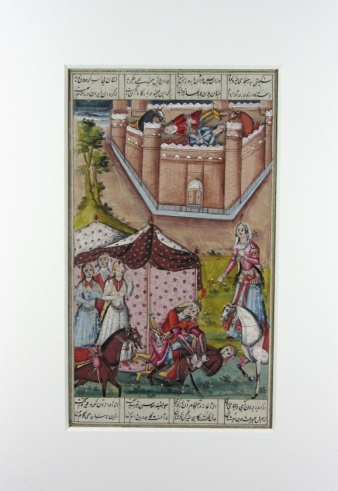
The Wellcome Library holds 20, highly illustrated, loose folios from The Shahnama or “Book of Kings”. The Shahnama is the longest poem ever written by a single author: Abu’l-Qasim Hasan Firdausi. His epic work narrates the history of Iran (Persia). One of the chief ways in which the text could be appropriated, was by commissioning illustrated manuscript copies of the poem, the earliest known illustrated texts dating from c. 1300. The copies held at the Wellcome have been dated from between 18th century and 19th century, with at least two different hands visible in the work.

Following the return of one folio from this series, from being on loan, a decision was made to treat the entire series. The added considerations were their historical significance, research value and the increased levels of interest in the items.

19 of the 20 folios are pasted down to a backboard with a window mount adhered directly onto the primary support.

All items had varying degrees of pigment loss, most prevalent in the white or containing pale pink/blues pigments.  This can be seen in the white of the horse in this image (Folio Qcc2664.13).


After documentation and photography, each item was surface cleaned lightly around areas without media.  It was then tested under magnification for flaking, lifting or powdery pigment and the details were recorded.
A variety of adhesives needed to be tested to determine the most effective consolidant to readhere the flaking media.  I carried out the testing of these adhesives for strenght, ease of application and degree of visual change after application (shown are some of some of the consolidants tested).
Based on current practice, through a literature search, the application methods that were chosen were two fold: by brush, under magnification, for treating small areas with lifting or unstable media, and with a nebulizer, for treating the large areas of cracking, lifting or unstable areas.  All areas consolidated, and materials used, were logged on the Wellcome's Conservation Database.

All but one of the folios were adhered to a heavy weight back board.  On the verso of these some have text.  After discussion with the curator it was agreed that the minature may have been attached to the backboard during its creation and should remain.  The window mounts, however, were agreed to be 20th century and certainly western.  The board was acidic and cracking and it was decided that these window mounts should be removed (this image of folio Qcc2640.4 shows where the mount board had cracked in the top left corner).
When completed all folios were mounted into a heavy weight deep conservation mount, cut to a standard size, with an over mount to protect the pigment from any further damage.  As researchers will need access to the verso of the mounts, where there is text, an additional window has been cut on the back board and folio protected from damage with a sheet of melinex.


Images: C2294.14 with over mount; Hinging of folio C2294.14 and back window of folio C2284.14


Author: Amy Junker Heslip

Tuesday, January 3, 2012

Hermitage and heritage: Augustinians in history

Austen (the surname of one of England's best-loved novelists and Austin (the capital city of Texas) are both abbreviations of the name Augustine. That name became popular from Saint Augustine of Hippo, Father and Doctor of the Church (354-430), philosopher and theologian (left: Wellcome Library no. 3493i).

In England the name Augustine later acquired added lustre from the Roman missionary Saint Augustine of Canterbury, who re-introduced Christianity to Britain in the 6th century. The earlier Augustine, Saint Augustine of Hippo, was a Roman citizen of the province occupied today by Algeria. At one time a professor of rhetoric in Rome and Milan, he returned to North Africa and died there after writing numerous works of theology and philosophy. His studies of such subjects as time, memory, mind, and magic are still much admired: today the School of Life in London recommends Saint Augustine's Confessions to its students, while a writer in a recent New York Review of Books boldly declared that he was "surely one of the mightiest intellects ever to walk this earth" [1].

The high intellectual standing of Saint Augustine of Hippo underlay the success of the Augustinian Order formed from various groups of hermits, and explains why he and members of his Order are so abundantly represented in the Wellcome Library. By Augustine himself the Library has an incunable edition of his De civitate Dei (Venice 1490), three incunable editions of his sermons, and many other works.

Of his followers, the Wellcome Library has nine editions of works by the Augustinian philosopher Giles of Rome (Aegidius Romanus, ca. 1243-1316), three of which (On the material of the heavens, On possible understanding against Averroes, and a Commentary on Aristotle's Physica) are edited by another Augustinian called Giles, namely Giles of Viterbo (Aegidius Viterbiensis, 1469-1532), also a cardinal and a student of Jewish mystical writings. The Wellcome Library's incunable edition of the work of the two Giles's has the inscription "Egidius in Phis." (Giles on the Physica) written on the bottom edge (above right): before the mid-17th century, books were generally stored with their edges facing towards the room (not their spines, as today), and the owner of this book in the sixteenth century evidently knew who "Giles" would be and what the "Phis" were. [2]

One of Giles of Viterbo's contemporaries north of the Alps was George Ripley (d. ca. 1490), a canon of the Augustinian priory at Bridlington, Yorkshire, whose scrolls of alchemical symbols have recently been discussed on this blog.
Another Augustinian of the same era was Saint Thomas of Villanova (1486-1555), Bishop of Valencia and a professor at the University of Alcalá, after whom many universities and schools are named. In the engraving on the left (Wellcome Library no. 11665i), a young woman finds her leg ulcers relieved after her cheek is brushed with a locket containing a portrait and a relic of Saint Thomas of Villanova.

The Wellcome Library has many writings by the Augustinian satirist and preacher Abraham à Sancta Clara (1644-1709), a famed communicator of his day both in Vienna and internationally.  The print below of a man literally dicing with death illustrates one of his popular books on death in the time of the bubonic plague.
 Nineteenth-century Augustinians include the experimental gardener Johann Mendel (1822–1884) -- or Brother Gregor, to use his name in religion -- after whom is named the Mendel University in Brno, Czech Republic (and, on a smaller scale, a meeting room in the headquarters of the Wellcome Trust in London). He was a member of the Augustinian Abbey of St Thomas in Brno, and from 1868 its abbot. In his horticultural work, Mendel grappled with botanical manifestations of the questions discussed by his predecessor Giles of Rome in the latter's De formatione corporis humani, written around the year 1270. An up-to-date introduction to the work of the Augustinian Order today can be found in the website Augnet.


The most monumental Augustinian work in the Wellcome Library is surely a gigantic etching (approx 145 x 160 cm.) produced on twelve plates in 1614 by the Italian engraver Oliviero Gatti of Bologna (1579-ca. 1648?). It bears the heading Mysticae Augustinensis Eremi sacrum gloriae decorisq. Theatrum ("Sacred display of the mystic glory and distinction of the Augustinian hermitage"); for brevity the work is also called Arbor augustiniana ("The Augustinian tree"). Gatti was commissioned to create this magnificent baroque print by two Augustinian friars, Marc Antonio Viani (from Bologna) and Paulus Vadovita (from Wadowice in Poland). Seven copies are known, not all of them now complete: the Wellcome Library's copy lacks two of the twelve plates. The print exists in two states: one from 1614 dedicated to Pope Paul V and King Philip III of Spain, the other dated 1678 and with updated dedications to their successors, Pope Innocent XI and King Charles II of Spain: the Wellcome Library's copy is of the first state. The print has been cleaned and conserved this year by Amy Junker Heslip in the Wellcome Library's Conservation department; during conservation, the superb quality of the paper and the vigour of the etching were revealed.

 Wellcome Library no. 32491i (plate 8 of the Arbor augustiniana) 

In the centre of Gatti’s composition, Saint of Augustine of Hippo sits holding the Rule of his Order (above), while around are representatives of the sacred and knightly orders associated with him, saints and martyrs, and eminent Augustinian friars and nuns, including his mother, Saint Monica. Giles of Rome appears no fewer than three times: once as a bishop, once as a cardinal-archbishop (left: Wellcome Library no. 32476i), and once among those who renounced a princely or royal title to become an Augustinian hermit: Giles of Rome was widely believed to be a member of the Roman noble family of Colonna, though the truth of this has been doubted. [3] A full analysis of the work is of course beyond the scope of this posting, but the prints themselves are available in the Wellcome Library to anyone wishes to study them, or indeed just to enjoy the brio of their draughtsmanship.

If we turn back from the Augustinian Order to Saint Augustine of Hippo himself, in addition to the many graphic representations of the saint the Wellcome Library has an oil painting, the subject of which has recently been identified by Mr Roberto Tollo in the course of his studies of Augustinian iconography. The painting is painted on a large sheet of copper (69 x 85.7 cm.) and was acquired by Sir Henry Wellcome in Granada in Spain in 1934.
The copper support, the Spanish provenance, and the costumes in the painting (similar to those in paintings by the Antwerp painter Frans Francken II) together suggest that this is a Flemish painting made in Antwerp in the mid-seventeenth century and painted on copper for export to Spain or Latin America. Paintings on copper travelled well, and once exported, could serve as models for larger paintings on wood or canvas for display in the churches, hospitals and convents of Spain and New Spain. [4]

Mr Tollo has now confirmed this by pinpointing the exact source of the composition as an engraving by the Antwerp artist Schelte Bolswert (1586-1659), apparently after his own design. That Schelte Bolswert's prints of Augustinian iconography were popular in the Hispanic world we know from the painted versions of them that have been found in Seville, Madrid, Quito, and Lima: the evidence is given in the Wellcome Library catalogue.

The subject derives from an episode in Carthage in the year 388, described by Saint Augustine himself [5]. The man in bed on the left is Innocentius of Carthage, who suffered from a rectal fistula, and was about to be treated for it by a painful surgical operation: in Augustine's words, "curabatur a medicis fistulas quas numerosas atque perplexas habuit in posteriore et ima corporis parte" (he was being treated by doctors for the many and difficult fistulas which he had on the posterior and lowest part of the body). However, for reasons of propriety, Schelte Bolswert shows the patient instead with a bandaged leg which a surgeon is expecting to amputate.

The surgeon, dressed in early 17th-century clothes, is sitting nearby with a brazier full of cautery irons – red-hot irons for sealing blood vessels -- and, on a table, an amputation knife for cutting the flesh around the bone: the surgeon's instruments are described in Augustine's account as "tremenda ferramenta". In the centre, blessing Innocentius, Saint Augustine is portrayed as a tonsured friar. Beyond him is a group of hermits of Saint Augustine, kneeling in prayer. Innocentius believes himself to be cured by a modern miracle without surgical innovation, and the surgeon almost lets go of his amputation-saw in surprise. On the right, a "marvellous Alexandrian surgeon" mentioned by Augustine as having been called in as a consultant raises his hand in an expression of astonishment, as well he might. He here represents those who assumed that miracles ceased in post-Biblical times, an assumption challenged by Saint Augustine from his own experiences. Augustine's message is that even eminent consultants cannot afford to take anything for granted.

[1] London review of books, 19 May 2011, p. 22. New York review of books, 27 October 2011, p. 54
[2] Questio Egidii Romani Eremite de materia celi. Padua: Hieronymus de Durantis, 1493, fol. B1v "F. Egidius Eremita Viterbiensis castigavit et dedit"
[3] M. Anthony Hewson, Giles of Rome and the medieval theory of conception: a study of the De formatione corporis humani in utero, London: Athlone Press, 1975, pp. 3-4 and 25 (find in the Wellcome Library here)
[4] Isaac van Oosten, Noah leading the animals to the ark, painting on copper 69.5 x 86.8 cm., Sotheby's, London, 6 July 2006, lot 101 (discussion in catalogue entry). Note that van Oosten's painting is very close in dimensions to the Wellcome Library painting. Pablo Escalante Gonzalbo and Martín Olmedo Muñoz, 'De invloed van de Zuid-Nederlandse gravure in Nieuw-Spanje', in Werner Thomas et al., Een wereld op papier: Zuid-nederlandse boeken, prenten en karten in het Spaanse en Portuguese wereldrijk (16de-18de eeuw), Louvain 2009, pp. 212-232
[5] De civitate dei, book XXII, chapter 8 (online at http://www.augustinus.it/latino/cdd/index2.htm)

Thursday, December 8, 2011

Conservation in Action: Ripley Scrolls

In the first of a new series, Conservator Amy Junker Heslip talks us through the conservation treatment she undertook on some of the Wellcome Library’s alchemical manuscripts.

The Ripley Scrolls are manuscripts which illustrate the pursuit of the Philosopher's Stone. George Ripley was a Augustine Monk from Yorkshire (c.1415-1490) but was additionally renowned as an alchemist. His name is associated with these scrolls as his allegorical poetry is included in many of the versions. There are approximately 21 scrolls worldwide, produced after Ripley’s death, dated from the 16th-17th centuries.

The Wellcome Library holds two of these scrolls, MS.692 and MS.693 and they are listed on the library catalogue as being on restricted access due to their fragile nature. They are dated from the 17th century, copy of a 15th century copy, and are water colour, wash and ink on heavy weight handmade wove paper. Both scrolls are mounted on linen and are stored rolled with wooden rollers at each ends, housed in wooden boxes. They are long with dimensions of 3280 x 400mm.


On closer inspection I was able to assess the physical condition of both objects. While the condition of MS.693 was stable and only required re housing (a new box), MS.692 was in a far worse state. The upper section had sustained a large amount of water damage, resulting in staining to the primary support and multiple losses to this upper section. The verso of this upper, lifting section had been lined with a heavy weight board in an attempt, one can only assume, to support these losses on the verso. Throughout the scroll, there are lifting areas of the primary support. The bottom of the scroll has been detached from the roller and re attached with tabs of paper.


The ink tested positive for iron gall ink and other colours proved very water sensitive upon testing. Although I was reasonably convinced that I could remove the linen backing dry, the relining would involve unnecessary exposure to moisture.

The board attached to the upper layer of the reverse of MS.692 was removed manually with a scalpel and immediately relived the tension added by this support so the upper section could lie flat again. The linen revealed below was heavily degraded and so was relined with a very strong but light weight silk crepeline. On the heavily water damaged areas on the front of the object the lifting areas were adhered using cold gelatin, to avoid unnecessary moisture contact with the iron gall ink, and in filled with a similar toned Japanese paper. The bottom roller of MS.692 was re-adhered more securely, with an extension of a medium weight repair paper added so the scroll could be comfortably opened up to its fullest extent.


Both items have now been rehoused into custom made boxes and are now stable. While they are both accessible again to Wellcome Library readers, it has been decided that their restricted status will be retained (due to the oversize nature of the material), so they can be viewed in an appropriate environment.


Images:
- MS.692 prior to conservation
- MS.692 during conservation (two photographs)
- MS.692 after conservation


Sources:
McCallum, Professor R I, The Ripley Scroll [online] Available at: http://www.rcpe.ac.uk/library/read/collection/ripley/ripley.php [Accessed 7th December 2011]

The Ripley Scroll [online] Available at: http://bibliodyssey.blogspot.com/2009/01/ripley-scroll.html [Accessed 7th December 2011]


Author: Amy Junker-Heslip

Friday, September 23, 2011

Conservation for digitisation: recent experiences at the Wellcome Library

Repairing torn pages with strips of Japanese tissue.
Beginning in July of this year, the Wellcome Library began to scan the first of some 15,000 early printed books in collaboration with the information provider ProQuest and the French data capture specialists Diadeis (a detailed outline of the project can be found here).

The reason that digitisation is being pursued at the Wellcome Library, and all over the world, is to enhance access to collections and provide new alternative research possibilities. Within reasonable limits, the conservation department is dedicated to ensuring that as many books as possible are digitised. The safety of the collection during these processes is paramount; it is critically important to establish safe working practices from the outset, particularly when using external contractors who are unfamiliar with the collection.

When conserving an object the intention is - as nearly as possible - to maintain for posterity the object’s original attributes. The suitability of each object for digitisation requires a pragmatic approach, taking the particular object’s condition into account.

Consider the following example: In the course of a survey of a batch of books (around 200 per month are surveyed) one was found to have loose covers hanging by a thread, and another a loose spine. Ordinarily both these books would be flagged for conservation and removed from circulation. However, even though it would be inappropriate for these books to reach a reader in their deteriorated condition, they were both included in the digitisation process, and sent on for careful scanning.

Why is this? Because even though the condition of a book may be degraded as a result of both physical (handling) and chemical (acidity) deterioration, paradoxically the deteriorated condition can in some cases actually facilitate the digitisation process. The opening of a book may be easier if the spine is detached; where covers once awkwardly hung by a thread and when handling in this state would cause further damage, the thread can be cut and the boards released to allow for easier imaging of the text block. Covers and spines can of course be repaired after imaging.


In summary, three key points may therefore be highlighted:
  1. Prioritising throughput. With good planning, large collections can be safely digitised. As noted above, a pragmatic approach to the condition of the object and stabilizing it in accord with good conservation practice means that most objects can be included in the project. In the end, the online results from digitisation projects at the Wellcome Library have done much to showcase the large volume of work that the conservation department undertakes.
  2. Withholding where necessary. While the emphasis has been on facilitating the scanning process where possible, some books may nevertheless need to be withheld. This is often for research reasons, when treatment or other preparation for digitisation will compromise the original attributes of the individual object and thus its research value.
  3. Paying attention to possible deterioration during the actual process of digitisation. The Wellcome conservation team maintains a daily dialogue with our scanning contractors to clarify our expectations on book handling, and to learn from them about their equipment and workflow. We have also included training in the use of basic conservation tools and straightforward tasks that save everyone’s time, such as unfolding the corners of pages. With good training and communication, the scanners too can raise conservation concerns and communicate them back to the conservator.

Images:
1/ Repairing torn pages with strips of Japanese tissue.
2/ A book before and after conservation.
3/ Imaging a book using an Atiz Bookdrive.

Tuesday, June 14, 2011

Behind the Scenes: Conservation and Collection Care


Behind the Scenes at the Wellcome Library resumes in 2011 with an expose of the Library's Conservation and Collection Care team. This team of six work in a spacious conservation studio that enables them to do on-site conservation and preservation of the Library's special collections, monitor the environments these collections are stored or displayed in, and to provide training in careful handling to all Trust staff.

Managed by Gillian Boal, a book conservator by background, the team can deal with a wide range of material types. But the focus is naturally on book and paper conservation. Gillian sums up the team's purpose, saying "Conservation is about ensuring these special collections are still around for future generations to access and consult. Everything we do is aimed at facilitating access by repairing and maintaining objects, as well as training staff and putting procedures in place to ensure that access remains a possibility." It is not about locking items away - although in some cases, this may be a necessity until stabilisation can be achieved.

The conservators do not just randomly repair and treat objects that happen to come to their attention (although this does happen on occasion). There is a strategy in place that prioritises objects for conservation, prompted by events such as exhibitions, daily use of Library materials, or by following a longer-term plan where entire collections, identified by the curators, are conserved in their turn.

Library materials are often lent for exhibition - both internally to Wellcome Collections, and externally to a range of locations in the UK and abroad. Luana Franceschet, the exhibitions conservator, works to repair and stabilise items for loan and ensure that the transport and exhibition environments are appropriate to the materials. She works closely with Rowan de Saulles - who, as the Library Exhibits Liason, manages the overall loans process. The venues to receive Wellcome Library items in 2011 include the Canadian War Museum, Tate Britain, Palais des Beaux Arts, Brigham Young University Museum of Art (USA), and Museum Boerhaave (Belgium), to name a few.

Stefania Signorello is the primary book conservator, who also manages outsourcing of work to specialist conservation experts. Stefania supports the librarians, archivists, and the photographers in handling and storing items during use. Objects requested for photography in particular are often popular, well-used special collection items; reviewing these requests provides a useful check on how objects are holding up under use. Stefania recently explained the benefits of her profession, and of working at the Wellcome Library in a Wellcome Trust video on the Jobs website.

Amy Junker-Heslip normally focuses on paper conservation, but is currently managing a project to rehouse - and then make available for access - the personal collection of Henry Wellcome including objects like his saddlebags, his cane, and many different types of textiles. This will require a combination of in-house management and organisation as well as outsourcing construction of new storage and display units.

Simon Jones is the environmental guru at the Library, keeping a careful eye on exhibition spaces in the building, storage areas, and any other locations where special collections will be stored or used. There are a range of parameters to be wary off, and to control as much as possible, including temperature, humidity, light and, of course, pests.

The conservation team have a strong agenda in improving education on careful handling and custodianship of the Library's collections, providing training to all new Wellcome Trust staff. They disseminate handling information to the Library's visitors using leaflets, posters and - a new addition - illustrated table mats for use in the Rare Materials Reading Room. They are on hand for consultation and support when readers need to use items that are difficult to handle - but the high quality of training they provide to Library staff means that this is rarely needed.

Monday, January 24, 2011

Wellcome Library Insight - Conservation in Action


This week's free Wellcome Library Insight session, on Thursday 27 January offers an opportunity to visit the Library’s Conservation studios.

There, you’ll have a chance to meet our Conservation team, see the material they’re currently working on and also visit one of our stores. The session will also be BSL interpreted.

This Thursday's session starts at 3.00pm, and tickets are available from the Wellcome Collection Information Desk from 1.30pm onwards. For more details, see the Wellcome Collection website.

Friday, December 3, 2010

Mellow memories of the drug market

The drug bazaar, Constantinople. Watercolour by J.F. Lewis.
Wellcome Library no. 45051i
Good to see Brian Sewell writing in a mellow mood (though not for long) in yesterday's London Evening Standard. [1] The usually acerbic art critic gave a half-page reproduction to one of the Wellcome Library's treasures that had pleased him, a watercolour by John Frederick Lewis RA (1805-1876) of the Egyptian bazaar in Constantinople.

Sewell commented:
To the art historian accustomed to the meticulous attention to detail affected by John Frederick Lewis, the refinement of his tiny brushstrokes, the ever-increasing intricacy, “the stern precision … (and) completeness of finish to the utmost corners of his canvas” — as John Ruskin put it, gathering him to the bosom of the Pre-Raphaelites in 1851 — his "Drug Bazaar, Constantinople" must be astonishing. Did Ruskin know of this big watercolour painted a year or perhaps a decade earlier (the Wellcome curators give conflicting dates)? It is so loose and free and broad-brush as to resemble more the approach of Delacroix, whose path Lewis had almost certainly crossed earlier in his travels; it gives the impression of a rapid and immediate under-drawing to which most refining work has still to be done, but this it cannot be, for his characteristic watercolours (sold in his day for as much as a thousand guineas) were always as clean and clear on the white paper as were the paintings of Holbein that he so much admired for their even finish. Could it have been so broadly painted because he worked on it under the influence of one of the drugs available in that very part of the Grand Bazaar?"

One does not have to endorse that last suggestion to agree that it certainly is something of a puzzle. The finished parts are brilliantly coloured -- mouth-watering reds, ochres and greens -- but as Sewell says, the rest of the painting would have had to be finished with similarly extravagant swathes and dollops of coloured pigments, rather than in Lewis's usual craftsmanly, not to say pedantic, manner. It's the old difference between the followers of Rubens and Poussin: normally Lewis, though a glorious colourist, was in the Poussin camp, but here he is a Rubéniste.

Yet there is no doubt about the attribution. It was bought by Henry S. Wellcome at the Lewis sale at Christie's on 24 May 1909 (lot 171, for 35 guineas), and as Major General Michael Lewis (author of the 1978 monograph J.F. Lewis R.A. on his ancestor) said in a letter to the Wellcome Institute in 1982, the painting "is full of JFL's characters – not least the tired donkey".

As far as the dates are concerned, Briony Llewellyn kindly carried out some research on the painting in 1998 and concluded: "It is possible that the Wellcome watercolour was executed while Lewis was in Constantinople in 1840/41, but its large size and complex arrangement of people and objects make it more likely that it was a composition that he began and worked up from sketches (such as lot 210 in the 1877 Lewis sale) later in England." There are several examples of Lewis returning to Turkish subjects even quite late in life, for instance he exhibited at the Royal Academy in 1870 a painting of "Arab horses and their seises [?], Constantinople", a painting which is not known to survive (though a study for it was sold at Christie's New York on 9 December 2004, lot 38).

The location depicted in the Wellcome Library watercolour was identified by Charles Newton of the Victoria and Albert Museum as the building constructed in 1660 and known as the Mısır Çarşısı or Egyptian bazaar, possibly so named because it was endowed by taxes levied by the Ottomans in Egypt. It is described in Godfrey Goodwin's book A history of Ottoman architecture, London 1971, p. 358. Lewis's position can be pinpointed on Goodwin's plan of the building (fig. 340) as very close to Goodwin's number "5", looking down the long corridor north-westwards. The market sold spices, herbs and drugs, and medicinal leeches were still sold in recent times at the southern end near the flower market. Another smaller sketch by Lewis, in the Huntington Library, Art Collections and Botanical Gardens (left, from the Huntington's online catalogue), shows the entrance to the same building as a picturesque muddle. Inside, its high-arched ceiling, long central axis and colourful market stalls made the building a favourite subject for painters: the Wellcome Library has at least two other depictions of it, and another, attributed to a French painter called Charles Pierron, was offered for sale at Christie's South Kensington on 21 June 2002 (lot 195).

A tip of the hat to the conservators who worked on the painting in 1997-1999, Keith Holmes and Sue Corfield. It's not clear whether, when Wellcome bought it, the painting was protected by a frame, but by May 1982 it was leaning up unframed on the concrete floor of the Wellcome Institute's warehouse on a trading estate in Enfield, Middlesex, having been moved there from previous warehouses in Willesden and Dartford. It was incredibly dirty, scuffed in places by other paintings leaning against it, and laid down on Lewis's blind stretcher (an acidic wooden board that was damaging the paper).

The conservators carefully removed the painting from the stretcher, and the latter was preserved separately, owing to its documentary inscriptions (shown above) including Lewis's initials JFL and the dates and stencil codes (439BN and 738F) of Christie's two Lewis sales in 1877 and 1909. (It was these stencils that enabled Christie's to identify it for us as the work sold in their 1909 sale.) The work was cleaned, the paper was deacidified, and the painting was laid down on a new support (a laminate of western and Japanese papers). Finally it was framed in a manner suitable for a Victorian exhibition picture, with a gold mount to match the gilded frame, instead of the jarring Modern-Movement-style cream mount so often used inappropriately for old master and Victorian works (left, from the BBC website).

It takes all that to get a picture fit for the admiration of Mr Sewell and his many readers.

[1] Brian Sewell, 'Confessions of a cannabis eater', London Evening Standard, 2 December 2010, pp. 39-41. Online here.

Monday, November 23, 2009

Courier duties to the Mori Art Museum, Tokyo

Leonardo di Vinci, Damien Hirst and Marc Quinn are just a few of the famous artists whose works will be displayed at the Mori Art Museum in Tokyo, as well as other contemporary and historical items from the collections of the Wellcome Library and Wellcome Collections. This exciting exhibition is based on the theme "Medicine and art: Imagining a future for life and love", and my colleague Stefania and I have been privileged - in our roles as conservators at the Wellcome Library - to be involved.

We travelled to Tokyo last week, arriving on 19 November when we settled into our apartments to recuperate from the long journey. Jet lag was quickly forgotten as we traveled around Tokyo, visiting the infamous fish market with Mami Hirose, the Project Manager at the Museum and two other couriers from the Science Museum (who are also loaning many items to this exhibition) - Emma Duggan and Lisa O'Sullivan among other sites.

The Mori Art Museum (located in the Mori Tower - see top image) has 6 galleries and 2 halls, and we started our first working day in Gallery 6 by unpacking the first X-ray machine and some of the iconographic items from the Wellcome Library. It was our duty to manage the unpacking and installation of items loaned by the Wellcome, and we were pleased that the objects arrived safely. Only one crate suffered minor damage; as a result, a Warhol print had dropped down in its frame and had to be rehinged and reframed. Stephania installed the largest books as well as a metal mannequin artifact that had been used as an anatomical teaching tool. This wrapped up our first busy day at work in the Mori.


Author: Gillian Boal

Tuesday, October 13, 2009

Wellcome Library Insight - Conservation in Action


This week's free Wellcome Library Insight session, 'Conservation in Action' - on Thursday 15th October, 3pm – offers an opportunity to visit the Library’s Conservation studios.

There, you’ll have a chance to meet our Conservation team, see the material they’re currently working on and also visit one of our paintings stores.

Friday, September 11, 2009

Frederick Cayley Robinson in 'Country Life'


An article by Peyton Skipwith in the current issue of Country Life discusses the four large paintings by Frederick Cayley Robinson which are displayed at the entrance to the Wellcome Library. [1]

The author calls Cayley Robinson "that rare phenomenon—an English Symbolist painter". He identifies features of the Wellcome Library paintings which are handled with variations in other paintings by the artist, such as the L-shaped compositions, or subjects of innocence and experience, and sums it up as "a four-part pictorial-Theosophical cycle concerned with sympathy and compassion". Theosophical? In the group shown above, the figures wear costumes from several different eras, and given that the seated old man also appears in one of Cayley Robinson's ancient Egyptian scenes, one can certainly see him as a continually reincarnated figure appearing, like the Wandering Jew or the Flying Dutchman, as an eternally recurrent presence in the doctor's waiting-room of earthly existence.

Mr Skipwith also suggests that the girl being presented to the doctor in the second pair of paintings is to be understood as one of the orphans shown in the first pair. This has also been suggested verbally by another observer, the artist James Broomfield, and it would satisfactorily link the two pairs.


During the summer of 2009 the four paintings were cleaned, and a large amount of surface dirt was removed that had inevitably accumulated during the seventy years in which the paintings had been displayed at the entrance to the Middlesex Hospital (even though they had been protected there by glass). The difference between the cleaned area above and the uncleaned area below is shown on the left.


After cleaning the purple outlines around the figures make them seem more unearthly, the artist's meticulously drawn squaring-up is more visible, and the greens, violets and whites (suffragette livery!) shine out more strongly against the drab surroundings. And look at those blues below!


[1] Peyton Skipwith, 'Exhibition: Frederick Cayley Robinson at the Wellcome Library. Acts of mercy sold but safe', Country life, 9 September 2009, p. 116

Friday, July 10, 2009

Closed Week by the numbers

Each year the Library closes for a week to allow staff to work on projects that could be disruptive to our readers during normal open hours. This year our stocktaking activities included a full tidying of all open access collections and a search of every nook and cranny for missing books. Though we do try to keep the Library tidy throughout the year, Closed Week allows the entire staff to work collectively to ensure your research materials are available where and when you need them.

Improvements to the physical environment included French polishing of the woodwork in the Reading Room and Gallery, cleaning of the air vents, fitting of magnetic door holdbacks for fire safety, and a reorganisation of the Gallery Annexe to make books easier to find on the shelves. The recently acquired quartet of paintings by Frederick Cayley Robinson were also expertly cleaned and repaired.

A final tally of Closed Week 2009:

7500 staples removed from Archives
6000 open access shelves tidied
1000 books relabelled
813 books searched for across four floors
810 books reclassified
720 shelves of Rare Books checked
600 archive collections checked
405 Archive boxes file checked
380 Rare Books tied
250 Drawings foldered
240 drawers of prints and drawings content listed
200 Rare Books assigned shelf numbers
160 Shelves of Rare Books flagged
150 files of Archives repackaged
107 Rare Books put back in sequence
90 books first aided
54 lost books found
50 fire marshals refreshed
6 missing Rare Books found
5.6 miles of open access books moved
4 Cayley Robinsons repaired