Showing posts with label paintings. Show all posts

Monday, June 18, 2012

Shackled in leg irony: black humour of the lower limb

Mezzotint by Jacob Gole (1660?-1737?) after Annibale Carracci.
Wellcome Library no. 24994i
It is a common experience to have enough feet but not enough shoes. The man shown here is, paradoxically, in the opposite situation: he has plenty of shoes but lacks a foot. The irony has a further twist: he is a shoe-seller whose single surviving foot is unshod, presumably because he cannot afford his own wares. No wonder he needs to keep up his spirits with a tobacco pipe.

Black humour (gallows humour, Galgenhumor) is a common feature of discourse about disability. However much we may deplore the fact, loss of mobility due to amputation of the lower limb -– at the thigh, leg or foot -- has been considered a particularly appropriate subject for such humour, perhaps owing to suppressed fear of losing such mobility as we may have. Irony is a way of playing down the horror of immobility while at the same time acknowledging it; and there can be intellectual pleasure (at least for functional bipeds) in the various paradoxes that can arise from limblessness, which are prominent in the drawings, photographs, prints and paintings in the Wellcome Library shown here.

Watercolour by C.W.D., 1866. Wellcome Library no. 12109i
Loss of a limb in a railway accident elicits no sympathy from this compensation board.
The victim (to Chairman) "Sir, in consequence of the carelessness of your servants. I have been compelled to have my leg amputated, besides suffering other injuries, and I consider myself entitled to compensation."
Facetious director. "Lost your leg have yer? Regular stumps etc? - Well! If yer any-think of a cricketer it must be an ill-convenience!"
Benevolent chairman. "Quite right sir - qu-i-te right, compensation by all means, loss of leg - eh? - an unfortunate accident that for all of us." (To secretary) "Here Mr Jones award this gentleman twelve shillings for a wooden one - and enter it on the minutes."'
Jones replies: "The usual discount sir I suppose for ready money? That'll make it eleven shillings." Another director adds: "One can't be too cautious but he don't look like a malingerer!".

Coloured etching, 19th century. Wellcome Library no. 44050i
To break one's natural leg is bad enough, but then to break its wooden replacement adds insult to injury. Two approximately contemporary prints show this subject. In the one above, the driver of the offending vehicle is asleep at the reins.

Coloured engraving published by Laurie and Whittle, 24 February 1800. Wellcome Library 44090i
But at least here the victim can smile as he sees the irony of his situation – and it's much less painful this time round for the young sailor who had lost his leg in the Far East. Fortunately a carpenter is passing with a saw and pot of glue in hand; "A broken leg, or the carpenter is the best surgeon. Haloo! Young Glewpot, de ye see Jack Junk has shivered his timbers, and we want a splice here." The surgeon coming out of his house on the left has no part to play on this occasion, and is pushed away.


There are even positive advantages to losing a leg!


Here another seadog has lost both his legs to the naval surgeon, but there's one compensation: no more suffering from corns ("Keine Hühneraugen mehr!").


Lithograph after Johann Bahr, 1909. Wellcome Library no. 577262i


Etching by Frederick Carter, 1928. Wellcome Library no. 44343i (Wellcome Library/©RG Clark)
"What, no legs? Lucky man!" are the words spoken by Ahasuerus (the Wandering Jew) to an immobile Spanish beggar in Frederick Carter's gloomy etching. It is the Jew's misfortune to be forever moving over the face of the earth without respite; the beggar's not to be able to move at all. You can see the world, or you can have a rest, but you can't do both.

Discarded crutches at Lourdes. Photograph, 1937. Wellcome Library no. 578619i
Once a leg has been lost, surely only a miracle could make it grow again. It was a friend of the writer Anatole France (1844-1924) who, contemplating the hundreds of discarded crutches at Lourdes, murmured "Une seule jambe de bois en dirait bien davantage" (Just one wooden leg would be much more significant). [1]

Coloured lithograph by C.J. Grant, 1834.
Wellcome Library no. 11854i
.
The regrowth of a natural leg from an amputation stump was considered absurd enough to be worthy of an advertisement for Morison’s pills – the heavily-advertised vegetable remedy for diseases attributed to iatrogenic blood poisoning. The man on the left went to bed with wooden legs, took a dose of Morison's Universal Pills, and "when I awakes in the morning to kick off the clothes, I'm blessed if I didn't find myself with these 'ere couple of jolly good legs and my old wooden ones right at the bottom of the bed!!!".

 Yet … looking towards a future age of stem-cell therapy, who would claim that regeneration of a limb could not occur?


Colour lithograph by H.G. Banks, ca. 1899.
Wellcome Library no. 556713i

It would need more than stem-cell therapy to put poor Callaghan together again. In the song What will poor Callaghan do? a disabled soldier has his wooden legs stolen by four drinking companions in a bar.

The song describes an evening out for four stage-Irishmen called Hogan, Casey, Murphy and "me"; originally "me" was Michael Nolan, a popular Irish music-hall performer. They had spent all their money drinking beer in a pub with an ex-Highland soldier called Patsy Callaghan, who had had his legs shot off from under his kilt when at war. To recover their funds, they got Callagahan drunk, removed his wooden legs and false teeth, pawned them, and left Callaghan literally legless on the pub bench. His plight, depicted on the front cover of the songsheet, is regarded by all as hilarious, though the speaker can't help wondering (in the words of the chorus) "What will poor Callaghan do?".

Michael Nolan asking "What will poor Callaghan do?"
Poor Callaghan was a precursor (or, from another point of view, a post-mediaeval successor) to The Black Knight in Monty Python and the Holy Grail (1975) who unwillingly makes comedy out of limb-deprivation. "'Tis but a scratch!" he says after losing one arm, "It's just a flesh-wound!" after losing the other, and "All right, we'll call it a draw" after finally losing both legs. Before the Black Knight, one-leggedness had been the subject of another piece of tasteless comedy: One leg too few, a sketch written by Peter Cook while a Cambridge undergraduate in 1960. For this sketch Cook appears to have coined the Latin-derived word "unidexter" to denote a person with one leg, although there was already a Greek-derived word in English, namely "monopod". Again there was an ironic twist of which some audiences were unaware: the actor playing the one-legged role (Dudley Moore) had had club-feet as a child and still had one ineffective leg. Irony and club-foot lead us on the well-intentioned but disastrous operation in Flaubert's Madame Bovary (1856), but we have enough space here merely to allude to it.

Oil painting attributed to the Master of Los Balbases, Burgos, ca. 1495.
Wellcome Library no. 46009i
Conversely, many people are shocked by the absence of irony in this Spanish altarpiece showing a verger's dream. The verger dreams that his bad leg is substituted by Saint Cosmas and Saint Damian with the leg of a black man, and on waking, finds it is true. Some viewers tend to resort to jocularity, showing that they are sophisticated enough to realize that transplants cannot routinely be performed by such means, but not knowledgeable enough to understand the episode as a miracle that could, for example, comfort diabetics. 
The dream of Saint John Damascene: the Virgin attaches his severed right hand.
Drawing, 16--. Wellcome Library no. 651341i
Similar pictures showing the reattachment of a hand do not seem to arouse the same facetiousness. But then in favourable circumstances, surgical reattachment of a hand (or for that matter a foot) to its original limb is not impossible today, according to this popular webpage about "fascinating reattachment surgeries". That really is something to be glad about.

The first examples discussed here have irony and humour, while the last two examples show that in religious contexts lack of a limb could be represented without humour and without irony. Let's end with an example that has irony but not (I suggest) humour.
Engraving by L. Gaultier, ca. 1613. Wellcome Library no. 571261i
This engraving by Léonard Gaultier (1561-1641) shows a man with a wooden leg carrying arms, legs and feet in a basket. At first sight it appears to have a similar subject to the Dutch mezzotint after Annibale Carracci (top).

However, it is a detail of a broadsheet designed by the Franciscan friar Martin Meurisse (1584-1644) to teach logic in Paris in 1613. If it is the nature of man to be a biped, is a "unidexter" a man? And if the function of a foot is locomotion, does a detached foot have the nature of a foot? The answer is that parts that naturally belong to an entity and are necessary for its completion, if removed from that entity, are reduced to predicates of it. Students whose minds have been befuddled by the many distinctions in Aristotle's writings on logic will have been glad to have had such a vivid and ironic image to remind them of how the contingencies relate to the substance of human life.

[1] Anatole France, Le jardin d’Epicure (1895), Paris 1923, p. 158

Saturday, February 18, 2012

New online resources: Your Wellcome Library Paintings, and National Trust Collections

The free online database Your Paintings was launched last year. [1] It makes available information on more than 100,000 paintings in public and private collections in the United Kingdom that are accessible to the public.

The collections include not only art institutions but also for example local government offices, schools, almshouses, libraries and police stations. It is an online counterpart to the printed catalogues of paintings being produced by the charity The Public Catalogue Foundation. Indeed the data for Your Paintings are produced by staff of The Public Catalogue Foundation in collaboration with the contributing institutions, while the website is hosted as a public service by the BBC.

The database is expanding towards its estimated target of 200,000 paintings. This week saw the addition of around 7,000 paintings including 1,291 items from the Wellcome Library. The others added this week include paintings from four other collections in the London Borough of Camden (Royal Free Hospital, Central Saint Martins College of Arts and Design (no longer in the City of Westminster but now in its spectacular new home at 1 Granary Square, Kings Cross); the London Borough of Camden collection; and Sir John Soane's Museum) and from seven Liverpool collections forming the National Museums Liverpool.

Five other Camden institutions (British Library, British Museum, Royal College of Physicians, the Foundling Museum, and the Zoological Society of London) will be added shortly, while others such as SOAS, the London School of Hygiene and Tropical Medicine, UCL, and UCL Hospitals Arts, are already there.

Although the Wellcome Library has contributed catalogue data to many other online union catalogues (COPAC, the Karlsruhe Virtual Catalogue (KVK), the National Inventory of Continental European Paintings, OCLC WorldCat, etc.), the Your Paintings database is at present probably the best source from which to display online images of paintings in the Wellcome Library. The cut-off date for inclusion was April 2011: new acquisitions after that date (eight paintings so far) are excluded, as are new attributions and identifications of subjects; it may be possible to add them later. They are of course included in the Wellcome Library catalogue.


Above left, the UCLH "Vesalius" portrait. Above right, the Wellcome Library version (Wellcome Library no. 45840i)
For most people looking at the database there will be surprises. From the Wellcome Library's point of view, the great revelation of the database is the ability to find related paintings in other, hitherto unfamiliar, collections. For instance our neighbour UCL Hospitals have a version of the same Venetian portrait (long regarded as a portrait of Andreas Vesalius) as the Wellcome Library (above left and right).

Finding other works by relatively obscure artists could not be easier. The Wellcome Library has a portrait (right: no. 47408i) of William Russell, a Worcestershire worthy, painted by one Stephen Hewson (fl. 1775-1812): Your Paintings reveals Hewson's itinerant life by showing ten portraits by him from Canterbury, Deal, and Dover, and one of the actor Tate Wilkinson (1739–1803) painted in York. Negative evidence is also useful: we discover that the only two paintings in the database by the still-life painter Gian Domenico Valentino (fl. 1661-1681) are (so far) the two in the Wellcome Library.
Many of the paintings shown here have never been photographed before, while others are the first online reproductions in colour. A notable example is the painting in the Royal Free Hospital of Dame Mary Scharlieb – Memsahib, gynaecologist, surgeon and Christian apologist—by Hugh Goldwin Riviere. The online image (left) portrays passionate commitment shining in her eyes and energy in her body-language. Her costume is also significant: she wears her MD gown while holding what looks like a pair of obstetric forceps.


Another new free online database, National Trust Collections [2], currently has around 750,000 records, about the same as the Wellcome Library catalogue, but of course the items described are much more diverse and are housed in buildings all over England, Wales and Northern Ireland (Scotland has its own separate organization, The National Trust for Scotland).

Like the Wellcome Library catalogue, National Trust Collections interfiles records for books (around 190,000 records), prints, photographs, and paintings, but also for scientific instruments, ethnographic objects and other things. Like Your Paintings, it is well worth a bookmark on the computer of any historical researcher.

[1] Your Paintings: http://www.bbc.co.uk/arts/yourpaintings

[2] National Trust Collections: http://www.nationaltrustcollections.org.uk

Tuesday, January 31, 2012

The Boilly exhibition in Lille

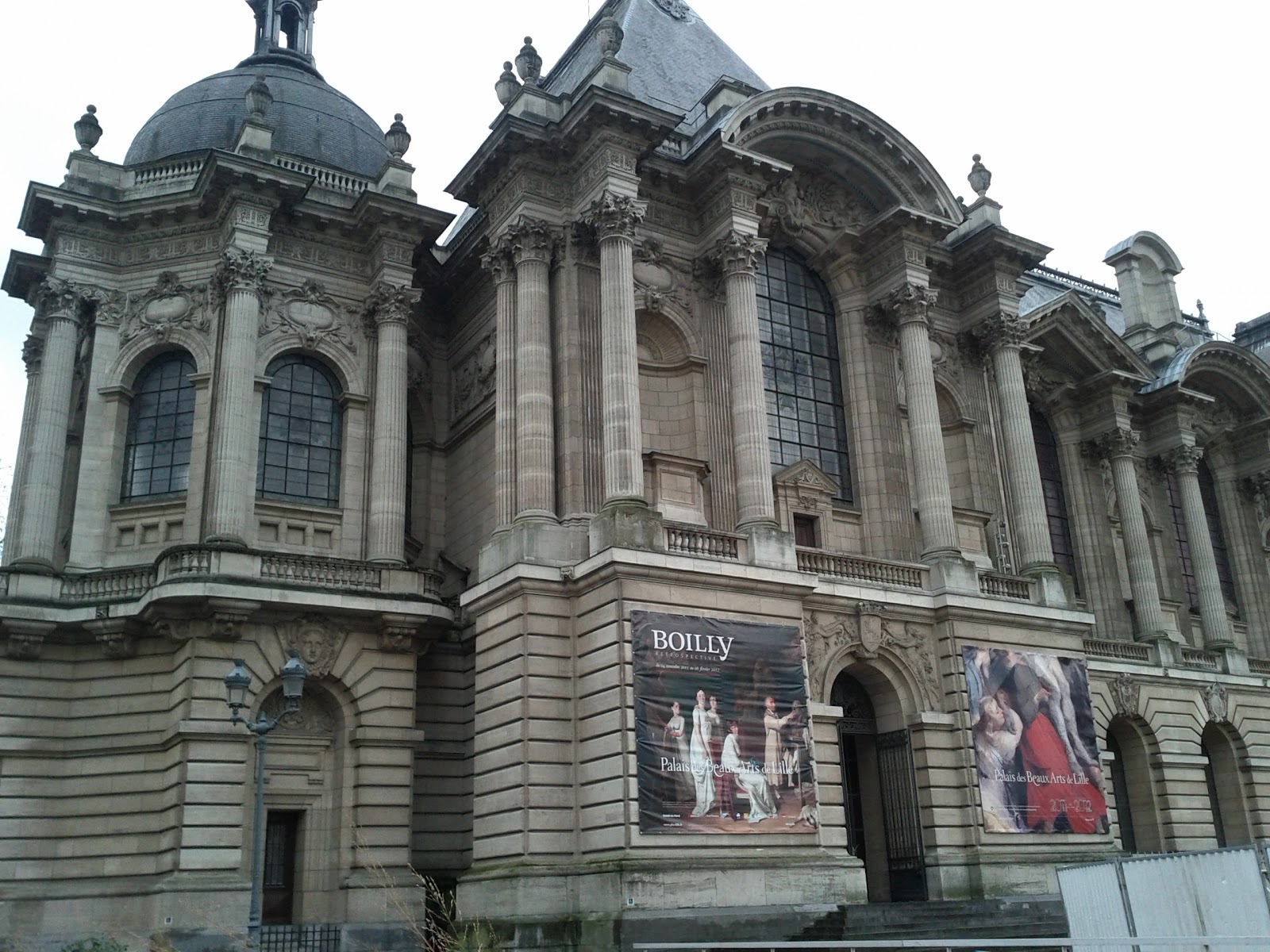
For anyone with easy access to Lille – and that includes anyone in London, which is 90 minutes from Lille by direct Eurostar train, at a price – the exhibition of works by the painter Louis-Léopold Boilly (1761-1845) is well worth visiting. It is on display at the aptly named Palais des Beaux-Arts: the photograph (left) shows the north-east corner of this truly palatial building. Boilly was a local artist: he came from La Bassée (about 20km from Lille), practised painting at Arras (about 30km from La Bassée) and moved away to Paris in 1785.

Boilly's work is admired for its precision and virtuosity, treasured for its value as a historical witness, and loved for its humour and sympathy. These qualities are well-displayed in the exhibition, and indeed in this fittingly mounted and framed self-portrait drawing (right: no. 34) on loan from the Museum of Fine Arts at Boston, Massachusetts.

Boilly's early pictures from the Ancien Regime are gallant scenes in the manner of Beaumarchais's plays. Most of those exhibited are from a series painted for a nobleman called Calvet in Avignon and are on loan from Saint-Omer. (Other paintings from the same series in the Wallace Collection in London may not be lent.)

We discover that the stories shown in these paintings were given to Boilly by Calvet himself. As with a series of prints from the same period (Estampes pour servire à l’histoire des moeurs et du costume des françois dans le dix-huitième siècle, 1773-1784), the "authors" of the picture include not only the painter or engraver, but also the person who devised it (in this case Calvet), even if he never lifted a paintbrush or an engraving tool.

To help earn his family's bread and butter, Boilly painted many small portraits, all in the same format but nevertheless distinctive. He may have painted over 4,000 of them; they certainly appear regularly in the auction rooms. In the exhibition their character and number are suggested by a wall containing twenty of them hung together at the beginning of the exhibition (left).

Boilly's virtuosity is shown in his amazing trompe l'oeil paintings. One (no. 169) bought by Lille in 1974 is available in the museum shop in the form of trays, mouse-mats and fridge magnets. The catalogue reveals (p. 63) that the term trompe l'oeil was coined in 1800 to describe Boilly's paintings, though the genre itself had existed at least since the 17th century. Another superb example not in the exhibition was sold at Christie's New York last week (The Art of France, New York, 25 January 2012, lot 144: image, right, from Christie's catalogue). It shows the back of a torn canvas, with a cat looking though the hole at a pair of mackerel hanging from the back of the stretcher: all painted in oils! For this marvel a European private individual paid $842,500 (£541,649, €650,981) including buyer's premium.  In the exhibition, Boilly's genius is demonstrated in his trompe l'oeil oil paintings in grisaille imitating non-existent engravings after his own paintings: one such grisaille painting is lent by the National Gallery, London (reproduced further below).

Caught up in the French Revolution, Citoyen Boilly could not but be overwhelmed by daily life in Paris, which thereafter dominated his paintings, giving  them great historical value. In portraiture, his masterpiece is the Atelier of Isabey from the Louvre (no. 68), showing 31 men, mostly fellow artists, in the studio of the painter J.B. Isabey. They include the rising stars of the day such as the flower painter Pierre-Joseph Redouté, the Romantic mythologist Anne-Louis Girodet, the brilliant pair of neoclassical architects Percier and Fontaine, and Boilly himself. Equally significant are those omitted: the big guns of the establishment, such as Gros, David, and Ingres. A sensation when first exhibited in An VI (1798), at Lille it is shown with a number of painted sketches for the figures, showing the great amount of work that Boilly put into both the individual portraits and the mellifluous composition. One of the studies was stolen in 1964: its reproduction in the catalogue (p. 156) may lead to its identification.

Paris as a city of pleasure is brilliantly portrayed in the Entrance to the Turkish gardens (1812, no. 136) which was bought by the Getty Museum at Christie’s New York on 27 January 2010. Boilly normally works on a very small scale by the standards of his time, but this picture is large for him (73.3 x 91.1 cm.) and contains a very rich cast of characters amusing themselves in the square outside a Turkish restaurant and ice-cream parlour. One can see why the Getty was prepared to put aside $4.5 million for it. Also exhibited is one of Boilly's preliminary drawings for the painting, which was identified in Antwerp as a result of the publicity surrounding the Getty's purchase of the oil painting: the Getty Museum subsequently bought the drawing too (no. 137).
 
It is one of several paintings which excel at showing contemporary moeurs: others are paintings of women playing billiards (no. 126, from the Hermitage, St Petersburg), a father giving his daughter a geography lesson (no. 138, from the Kimbell, Fort Worth), and conscripts from 1807 passing through the Porte Saint-Denis (no. 130 from the Musée Carnavalet, Paris): a tiny detail in the lower right corner of the last painting shows a veteran who has lost his sight (right).


Wellcome Library no. 40474i
One of these contemporary scenes (here dated to 1807) is a painting lent by the Wellcome Library (above: no. 131). It shows vaccination being carried out, within the first decade of its introduction into France: the procedure is said to have been first carried out by Pinel at the Salpêtrière in 1800. It was shown next to no. 128, on loan from St Louis, Missouri, which is from the same year and about the same size, and shows a less affluent family following the progress of Bonaparte's army through Prussia on a map.


Above and right, the installation of the Wellcome Library and St Louis paintings, supervised by Gillian Boal (Wellcome Library), Thierry Germe (Architect) and Annie Scottez de Wambrechies (Conservateur en Chef).

Also on display was one of Boilly's drawings for the Wellcome Library painting (below: no. 132), suggesting that he had previously thought of it as a more compact and intimate scene, but later enlarged it to emphasize the gravity of the occasion.

The catalogue includes an essay by Humphrey Wine (of the National Gallery, London) on Boilly and Great Britain. It was a subject well worth investigating, but unfortunately it reveals that the British have been little interested in Boilly. Perhaps this is not surprising considering the amounts paid by British collectors for the home team: painters such as Devis, Zoffany, Edward Bird, Wheatley, Rowlandson, David Wilkie, and many other artists whose work overlaps with some aspect of Boilly's. Boilly was of course collected by the 4th Marquis of Hertford (the creator of the Wallace Collection, so named after his illegitimate son), but then Hertford was specializing in French art of the period. As a notable exception to the general British indifference, the author is kind enough to mention the Wellcome Library painting, which was acquired in 1994.

Provenances in the catalogue show who really did value Boilly. Williamstown, Massachusetts (pop. 7,754) in the Berkshires provides no fewer than three paintings. One (left: no. 65) had belonged to the Singer Sewing Machine heir Robert Sterling Clark, and passed to the Sterling and Francine Clark Art Institute in Williamstown. Following his example, the Clark Institute has bought another two pictures by Boilly, including a trompe l'oeil piece (no. 163). Lille itself, other institutions in the Nord such as Saint-Omer and Tourcoing, Versailles, the Musée du Louvre, the Musée Marmottan (where the present writer was privileged to see a smaller Boilly exhibition in 1984), the Musée Carnavalet and other Paris institutions, have also acquired valuable works which are on show here. 

In Boilly's own lifetime, Prince Nikolai Borisovich Youssoupoff  (1751-1831) owned four of the paintings now on display in Lille, one of which was bought before 1812: two are from the Pushkin Museum, Moscow (nos. 43 and 66), one from the Hermitage, St Petersburg (no. 126), and one was sold by the Soviet Union and is now on loan to Dallas Museum of Art (no. 44). Prominent dealers who have committed themselves to his work in recent times include Agnew's (nos. 128, 129, 131), Hazlitt Gooden and Fox (nos. 113, 138, 163, all now in America), Didier Aaron (191), and Etienne Breton (nos. 105, 189).

It is striking that three of the four paintings on loan from British collections have belonged to women. The National Gallery's grisaille (left: no. 186) was presented in 1937 by Emily Iznaga Clement, of a Cuban sugar-refining family, and had belonged to her sister Doña María Consuelo Iznaga y Clement, sometime Duchess of Manchester (1858-1909). The extraordinary trompe l'oeil table from Wimpole Hall, Cambridgeshire (below: no. 164, National Trust) had been bought by Rudyard Kipling's daughter Elsie, Mrs George Bambridge (1896-1976).
The Wellcome Library painting came from the sumptuous residence of Graziella Patiño de Ortiz-Linares, in the Avenue Foch, Paris. Another painting, the one owned by Robert Sterling Clark, had previously been bequeathed by Alfred De Rothschild to Almina, Countess of Carnarvon, who in 1895 had married the 5th Earl (d. 1923): she sold the painting from Highclere in 1925, and died as recently as 1969.
A further point that could be observed only by visiting the exhibition is that the ornate neoclassical frame of the Wellcome Library painting (above) has strong similarities to frames on two other works in the exhibition: no. 114, from the Louvre, and no. 184, from Saint-Omer. All three works passed through Galerie Charpentier: the Saint-Omer and Wellcome paintings both on 11 December 1934, the Louvre painting in 1959. Could the Galerie Charpentier have commmissioned these carved and gilt frames?
Congratulations to Lille for a fitting tribute to its brilliant native son on his 250th anniversary. The exhibition is considered to be of national importance and has therefore received funds from the French Republic. It is also sponsored by the Wellcome Library's Euston Square neighbours Grant Thornton. Unfortunately the exhibition is due to close on Monday 6 February, but for anyone who has a free day before that date, here is the Eurostar timetable from St Pancras to Lille. If you can't make it, both Louis-Léopold and his son Julien Léopold (called Jules, 1796-1874) are abundantly represented in the Wellcome Library by their graphic work, which is not treated very thoroughly in the exhibition. For students of the reception of literary works by women, the collection of portraits of women writers by Jules is particularly noteworthy (Wellcome Library no. 40182i).

The Lille exhibition catalogue is also available in the Wellcome Library: click here  for details. Other reviews of the exhibition available online include those of The Art Newspaper  and La Tribune de l'Art .

Thursday, January 26, 2012

Early Modern Horror

Students from the Art History department at University College London visit the Wellcome Library for an MA course on "Early Modern Horror". It is taught by Dr Maria H. Loh (far left), and looks with critical attention at sixteenth- and seventeenth-century representations of horror: works specifically designed to elicit fright, confusion, terror, pity, and/or pain from the spectator.

As well as considering anatomical prints using vanitas motifs, and anatomical figures in the form of the Farnese Hercules and Laocoon, the students had a chance to consider and comment on this recently conserved painting of a head composed of writhing écorché figures, composed in the manner of Giuseppe Arcimboldo (right: Wellcome Library no. 44576i).

Classes, seminars and tours with expert interpretation can be provided at the Wellcome Library for undergraduate and graduate courses, extramural and diploma courses, and special interest groups. Recent visiting groups have come from King's College London, University of Kent at Canterbury, Institute of Historical Research, University of Wisconsin-Stout, University of Aberystwyth, Christie's Education, and Birkbeck University of London. To arrange a visit, please email: librarygroupvisits@wellcome.ac.uk.

Tuesday, January 17, 2012

Mesmerism on show


Mesmeric therapy. Wellcome Library no. 44754i

Franz Anton Mesmer (1734-1815) was the promoter of a form of animal magnetism (named Mesmerism after him), at first in Vienna (1773-1777) and subsequently in France (1778-1784). His unique selling point was the supply of mesmeric fluid that served to rebalance the magnetic polarity of the animal body. His doctrine was one of many that sought to bring the animal body (the microcosm) into harmony with the larger world outside (the macrocosm). Such doctrines have a long history, from Hippocratic aphorisms about the effects of weather on certain temperaments to our contemporaries' warnings about asthma, allergies and air pollution.

As a therapist, Mesmer, like other innovators (James Graham, Edward Jenner, John Brown etc.) offered his therapy outside the established world of academia, the court, and the royal colleges. Indeed, they sometimes came into conflict, as Mesmer did in Paris. Both his popular appeal and the disdain of the establishment brought him publicity of commercial value.

Hence the many depictions of his therapeutic sessions. One of them is shown in an oil painting in the Wellcome Library (above). The patients are seated around Mesmer’s baquet, a large flat drum containing mesmeric fluid. Pipes, tubes and cords emerging from the drum could be applied to the affected parts: one man on the far left is winding a cord doused in mesmeric fluid around his head, while several others are applying the ends of the tubes to their eyes (detail left). A woman in Turkish dress in the centre foreground is treating the eye of a child to a dose of the mesmeric fluid.


While oil paintings were seen by few, prints were seen by many, if only in the shop windows of print-sellers and stationers in the high streets of towns and cities. Among several prints of mesmeric therapy in the Wellcome Library is this coloured engraving of Mesmer in Paris (above), with text below describing the scene (Wellcome Library no. 17918i). It shows one gentleman resting his right foot on the drum so that mesmerism can be applied to his shin. There is also a view through to a second baquet in a room off at the left.

Until today, the catalogue description of this print made no mention of any of the authors (artist, designer, engraver or publisher) of this print: it was by an unidentified hand.However, Sotheby's have in their forthcoming drawings sale in New York a pair of drawings attributed to the artist Claude-Louis Desrais (1746-1816), and one of them (Sotheby's Old master drawings, New York 25 January 2012, lot 123) is the original design for the Wellcome Library's coloured engraving. Indeed Sotheby's say in their catalogue record that this drawing and a similiar one by Desrais were "probably intended for prints or book illustrations as they are reddened on the reverse". However, as the Wellcome Library print is much cruder in execution than the drawing -– Sotheby's drawing has much finer detail -- there may have been an intermediary print or drawing from which the Wellcome Library's engraving was copied. An impression of the same engraving is also in the National Library of Medicine, Bethesda, Maryland, and no doubt there are others elsewhere.

The attribution to Desrais on stylistic grounds is satisfying because Desrais is known to have produced a portrait of Mesmer (right: Wellcome Library no. 23327i). If he was Mesmer's in-house image-maker, then, although he does not seem to be recorded as an oil-painter, could the Wellcome Library's painting also be by him? It does look like the work of someone unaccustomed to such a cumbersome medium.

The other drawing at Sotheby's (same sale, lot 124) shows a woman standing within a circular knee-high cage surrounded by three men in animated conversation. Another man (left) seems to be turning up a gas light, while on the right a demonstration is taking place of a closed vessel on a column. Perhaps someone familiar with public demonstrations of natural philosophy in Paris at this period can identify the event? It should be dated not later than 1816, the year of Desrais's death.

Tuesday, January 3, 2012

Hermitage and heritage: Augustinians in history

Austen (the surname of one of England's best-loved novelists and Austin (the capital city of Texas) are both abbreviations of the name Augustine. That name became popular from Saint Augustine of Hippo, Father and Doctor of the Church (354-430), philosopher and theologian (left: Wellcome Library no. 3493i).

In England the name Augustine later acquired added lustre from the Roman missionary Saint Augustine of Canterbury, who re-introduced Christianity to Britain in the 6th century. The earlier Augustine, Saint Augustine of Hippo, was a Roman citizen of the province occupied today by Algeria. At one time a professor of rhetoric in Rome and Milan, he returned to North Africa and died there after writing numerous works of theology and philosophy. His studies of such subjects as time, memory, mind, and magic are still much admired: today the School of Life in London recommends Saint Augustine's Confessions to its students, while a writer in a recent New York Review of Books boldly declared that he was "surely one of the mightiest intellects ever to walk this earth" [1].

The high intellectual standing of Saint Augustine of Hippo underlay the success of the Augustinian Order formed from various groups of hermits, and explains why he and members of his Order are so abundantly represented in the Wellcome Library. By Augustine himself the Library has an incunable edition of his De civitate Dei (Venice 1490), three incunable editions of his sermons, and many other works.

Of his followers, the Wellcome Library has nine editions of works by the Augustinian philosopher Giles of Rome (Aegidius Romanus, ca. 1243-1316), three of which (On the material of the heavens, On possible understanding against Averroes, and a Commentary on Aristotle's Physica) are edited by another Augustinian called Giles, namely Giles of Viterbo (Aegidius Viterbiensis, 1469-1532), also a cardinal and a student of Jewish mystical writings. The Wellcome Library's incunable edition of the work of the two Giles's has the inscription "Egidius in Phis." (Giles on the Physica) written on the bottom edge (above right): before the mid-17th century, books were generally stored with their edges facing towards the room (not their spines, as today), and the owner of this book in the sixteenth century evidently knew who "Giles" would be and what the "Phis" were. [2]

One of Giles of Viterbo's contemporaries north of the Alps was George Ripley (d. ca. 1490), a canon of the Augustinian priory at Bridlington, Yorkshire, whose scrolls of alchemical symbols have recently been discussed on this blog.
Another Augustinian of the same era was Saint Thomas of Villanova (1486-1555), Bishop of Valencia and a professor at the University of Alcalá, after whom many universities and schools are named. In the engraving on the left (Wellcome Library no. 11665i), a young woman finds her leg ulcers relieved after her cheek is brushed with a locket containing a portrait and a relic of Saint Thomas of Villanova.

The Wellcome Library has many writings by the Augustinian satirist and preacher Abraham à Sancta Clara (1644-1709), a famed communicator of his day both in Vienna and internationally.  The print below of a man literally dicing with death illustrates one of his popular books on death in the time of the bubonic plague.
 Nineteenth-century Augustinians include the experimental gardener Johann Mendel (1822–1884) -- or Brother Gregor, to use his name in religion -- after whom is named the Mendel University in Brno, Czech Republic (and, on a smaller scale, a meeting room in the headquarters of the Wellcome Trust in London). He was a member of the Augustinian Abbey of St Thomas in Brno, and from 1868 its abbot. In his horticultural work, Mendel grappled with botanical manifestations of the questions discussed by his predecessor Giles of Rome in the latter's De formatione corporis humani, written around the year 1270. An up-to-date introduction to the work of the Augustinian Order today can be found in the website Augnet.


The most monumental Augustinian work in the Wellcome Library is surely a gigantic etching (approx 145 x 160 cm.) produced on twelve plates in 1614 by the Italian engraver Oliviero Gatti of Bologna (1579-ca. 1648?). It bears the heading Mysticae Augustinensis Eremi sacrum gloriae decorisq. Theatrum ("Sacred display of the mystic glory and distinction of the Augustinian hermitage"); for brevity the work is also called Arbor augustiniana ("The Augustinian tree"). Gatti was commissioned to create this magnificent baroque print by two Augustinian friars, Marc Antonio Viani (from Bologna) and Paulus Vadovita (from Wadowice in Poland). Seven copies are known, not all of them now complete: the Wellcome Library's copy lacks two of the twelve plates. The print exists in two states: one from 1614 dedicated to Pope Paul V and King Philip III of Spain, the other dated 1678 and with updated dedications to their successors, Pope Innocent XI and King Charles II of Spain: the Wellcome Library's copy is of the first state. The print has been cleaned and conserved this year by Amy Junker Heslip in the Wellcome Library's Conservation department; during conservation, the superb quality of the paper and the vigour of the etching were revealed.

 Wellcome Library no. 32491i (plate 8 of the Arbor augustiniana) 

In the centre of Gatti’s composition, Saint of Augustine of Hippo sits holding the Rule of his Order (above), while around are representatives of the sacred and knightly orders associated with him, saints and martyrs, and eminent Augustinian friars and nuns, including his mother, Saint Monica. Giles of Rome appears no fewer than three times: once as a bishop, once as a cardinal-archbishop (left: Wellcome Library no. 32476i), and once among those who renounced a princely or royal title to become an Augustinian hermit: Giles of Rome was widely believed to be a member of the Roman noble family of Colonna, though the truth of this has been doubted. [3] A full analysis of the work is of course beyond the scope of this posting, but the prints themselves are available in the Wellcome Library to anyone wishes to study them, or indeed just to enjoy the brio of their draughtsmanship.

If we turn back from the Augustinian Order to Saint Augustine of Hippo himself, in addition to the many graphic representations of the saint the Wellcome Library has an oil painting, the subject of which has recently been identified by Mr Roberto Tollo in the course of his studies of Augustinian iconography. The painting is painted on a large sheet of copper (69 x 85.7 cm.) and was acquired by Sir Henry Wellcome in Granada in Spain in 1934.
The copper support, the Spanish provenance, and the costumes in the painting (similar to those in paintings by the Antwerp painter Frans Francken II) together suggest that this is a Flemish painting made in Antwerp in the mid-seventeenth century and painted on copper for export to Spain or Latin America. Paintings on copper travelled well, and once exported, could serve as models for larger paintings on wood or canvas for display in the churches, hospitals and convents of Spain and New Spain. [4]

Mr Tollo has now confirmed this by pinpointing the exact source of the composition as an engraving by the Antwerp artist Schelte Bolswert (1586-1659), apparently after his own design. That Schelte Bolswert's prints of Augustinian iconography were popular in the Hispanic world we know from the painted versions of them that have been found in Seville, Madrid, Quito, and Lima: the evidence is given in the Wellcome Library catalogue.

The subject derives from an episode in Carthage in the year 388, described by Saint Augustine himself [5]. The man in bed on the left is Innocentius of Carthage, who suffered from a rectal fistula, and was about to be treated for it by a painful surgical operation: in Augustine's words, "curabatur a medicis fistulas quas numerosas atque perplexas habuit in posteriore et ima corporis parte" (he was being treated by doctors for the many and difficult fistulas which he had on the posterior and lowest part of the body). However, for reasons of propriety, Schelte Bolswert shows the patient instead with a bandaged leg which a surgeon is expecting to amputate.

The surgeon, dressed in early 17th-century clothes, is sitting nearby with a brazier full of cautery irons – red-hot irons for sealing blood vessels -- and, on a table, an amputation knife for cutting the flesh around the bone: the surgeon's instruments are described in Augustine's account as "tremenda ferramenta". In the centre, blessing Innocentius, Saint Augustine is portrayed as a tonsured friar. Beyond him is a group of hermits of Saint Augustine, kneeling in prayer. Innocentius believes himself to be cured by a modern miracle without surgical innovation, and the surgeon almost lets go of his amputation-saw in surprise. On the right, a "marvellous Alexandrian surgeon" mentioned by Augustine as having been called in as a consultant raises his hand in an expression of astonishment, as well he might. He here represents those who assumed that miracles ceased in post-Biblical times, an assumption challenged by Saint Augustine from his own experiences. Augustine's message is that even eminent consultants cannot afford to take anything for granted.

[1] London review of books, 19 May 2011, p. 22. New York review of books, 27 October 2011, p. 54
[2] Questio Egidii Romani Eremite de materia celi. Padua: Hieronymus de Durantis, 1493, fol. B1v "F. Egidius Eremita Viterbiensis castigavit et dedit"
[3] M. Anthony Hewson, Giles of Rome and the medieval theory of conception: a study of the De formatione corporis humani in utero, London: Athlone Press, 1975, pp. 3-4 and 25 (find in the Wellcome Library here)
[4] Isaac van Oosten, Noah leading the animals to the ark, painting on copper 69.5 x 86.8 cm., Sotheby's, London, 6 July 2006, lot 101 (discussion in catalogue entry). Note that van Oosten's painting is very close in dimensions to the Wellcome Library painting. Pablo Escalante Gonzalbo and Martín Olmedo Muñoz, 'De invloed van de Zuid-Nederlandse gravure in Nieuw-Spanje', in Werner Thomas et al., Een wereld op papier: Zuid-nederlandse boeken, prenten en karten in het Spaanse en Portuguese wereldrijk (16de-18de eeuw), Louvain 2009, pp. 212-232
[5] De civitate dei, book XXII, chapter 8 (online at http://www.augustinus.it/latino/cdd/index2.htm)

Tuesday, November 8, 2011

Approaching Sikandra

Everyone who visits Agra in Uttar Pradesh visits the Taj Mahal, the monument which was built from 1632 onwards by the sorrowful Shah Jahan (1592-1666), fifth Mughal emperor, in memory of his wife, Mumtaz Mahal, after her death in childbirth.

Not everyone visits nearby Sikandra. Here, those who do will find the magnificent earlier mausoleum of Akbar (1542-1605), the mighty third Mughal emperor, conqueror of northern India, patron of arts and sciences, and grandfather of Shah Jahan. [1] The mausoleum (above) was planned by Akbar himself and built by his son Jahangir (1569-1627) between 1605 and 1613. At Sikandra, the future builder of the Taj Mahal could therefore contemplate the mausoleum of his grandfather, built by his father. One might suppose that the earlier mausoleum would have influenced the later.

The historically-aware visitor would therefore want to view the Taj Mahal in the perspective of Sikandra, inter alia and vice versa. And many people have done so. The views of some of them on the Taj will be the subject of another posting on this blog. The present posting, however, concerns some of the many paintings, drawings, prints, photographs and written accounts of Sikandra that have found their way into historic British collections such as the India Office Library in the British Library, the British Museum, the Wellcome Library and no doubt others. This posting reviews some of the drawings and prints of Sikandra in the Wellcome Library, a repository of (among other things) records of sepulchralia of all kinds, and of Indian history.
Coloured soft-ground etching with watercolour by William Hodges, 1788.
Wellcome Library no. 26689i

We start on the approach road, in the company of William Hodges (1744-1797). Under the patronage of Warren Hastings, Hodges had sketched Sikandra on the spot in the early 1780s, and produced this print in 1788 --a year in which India was in the news in England because Burke, Fox and Sheridan were railing against Hastings at the opening of the latter’s trial in Westminster. The road at Sikandra as seen by Hodges is a broad dirt-track with a couple of donkeys on it, surrounded on either side with dilapidated minor tombs scattered in a park. More inviting than the immediate surroundings is the prospect of fine buildings glimpsed through the trees on the far right.

Coloured etching and aquatint by Thomas Daniell, 1795.
Wellcome Library no. 27432i

We next find ourselves tranported not only to the end of the road but also forwards seven years to the year 1795, when this aquatint by Thomas Daniell was published (above). It shows the leftmost of those buildings glimpsed through the trees: it is one of the gateways leading to the the mausoleum of Akbar. Though only a gateway, it is a grand building of sandstone topped with four white marble minarets. Not so long previously, vandalistic snipers have had some sport shooting the tops clean off those minarets. In the clearing in front of the gateway, a military camp is still in residence: it is a British one, to which the artist Thomas Daniell is attached.

In the early nineteenth century Indian artists also produced views of the building, presumably for purchase in the main by western visitors. These are commonly called Company drawings (after the East India Company), and those in the Wellcome Library are characteristic examples. One watercolour (left: Wellcome Library no. 25209i is small and relatively simplified, though attractive enough to its previous owner to be put into a gold frame.

However, the painter of a larger one (39 x 56.3 cm., below Wellcome Library no. 579856i), spares no effort to do justice to the elaborate flower and leaf motifs realized in pietra dura around the central doorway.


A photograph taken in 2008 (right) shows that the tops of the minarets have been restored. By comparison with the painting above, the photograph vindicates the great care taken by the watercolour artist. The minarets themselves may be called the grandfathers of those which stand at the four corners of the Taj Mahal.

Soft-ground etching by William Hodges. Wellcome Library no. 26823i

The gateway at Sikandra leads to a long walkway at the end of which is the mausoleum of Akbar the Great. Starting again with Hodges in 1788 (above), he shows the building as being obscured by vegetation. There seems to be no picture of the mausoleum by Daniell, but there are plenty of Company drawings by Indian artists, made slightly later and showing the building (actually or ideally) cleared of trees and bushes, perhaps in order to show it as they imagined it to be at the time of Akbar's interment.
This view (above), like three others in the Wellcome Library, shows an interplay between a white marble colonnade on the ground floor and three sandstone terraces above adorned at the corners with domes of the Rajasthan type (chhatris).

In current photographs of the building, that interplay no longer exists: the ground floor arcade seems to be painted red. All however show the topmost terrace as of crisply carved white marble, marking by its filigree craftsmanship and costly materials the cenotaph of Akbar, high above his actual tomb directly below in the crypt.

The Company paintings (such as, left: Wellcome Library no 25226i) differ among themselves in showing the setting of the building in varying perspectives in relation to its surrounding char bagh or Persian pleasure garden: the setting provides cooling channels for running water, gardens and pools.

The effect of the setting is to emphasize that even the humblest of the living can here enjoy the created world more than Akbar, for all his power, now that he is dead. One small but highly detailed watercolour (right: Wellcome Library no. 578936i) is taken from a viewpoint so close to the central runnel that the base of the first story is no longer visible, apparently as a gesture to western artistic conventions.

Finally, there is a complete outlier (left: Wellcome Library 575709i) in which the building is condensed so that the long first-storey terrace becomes the same width as the second storey. An inadvertent slighting of His Imperial Majesty! As we do not need to rely on this watercolour alone, we can afford to sympathize with the artist's mistake. The noble resting place of the mighty Akbar, author of this and other admirable buildings, remains for the recreation and inspiration of those lucky enough to visit it.

[1] Irfan Habib (ed.), Akbar and his India, Delhi: Oxford University Press, 1997 (find in the Wellcome Library here)

Further reading
Catherine B. Asher, Architecture of Mughal India, Cambridge 1992 (The New Cambridge history of India, part I, vol. 4), pp. 105-111 (find in the Wellcome Library
here )

Mildred Archer, Early views of India: the picturesque journeys of Thomas and William Daniell, 1786-1794, London: Thames and Hudson, 1980 (find in the Wellcome Library
here)

Ernest Binfield Havell, A handbook to Agra and the Taj, Sikandra, Fatehpur-Sikri and the neighbourhood, London 1912

Thanks to the following for making their photographs available on Flickr.
Top: by Takehiko Ono at http://www.flickr.com/photos/onopko/529915275
Gateway: by Koshyk at http://www.flickr.com/photos/kkoshy/2252005330.
Detail of mausoleum by Saad.Akhtar at http://www.flickr.com/photos/saad/47375523.
Other images: Wellcome Library.