Showing posts with label new acquisitions. Show all posts

Tuesday, April 17, 2012

Health of the People -- British style

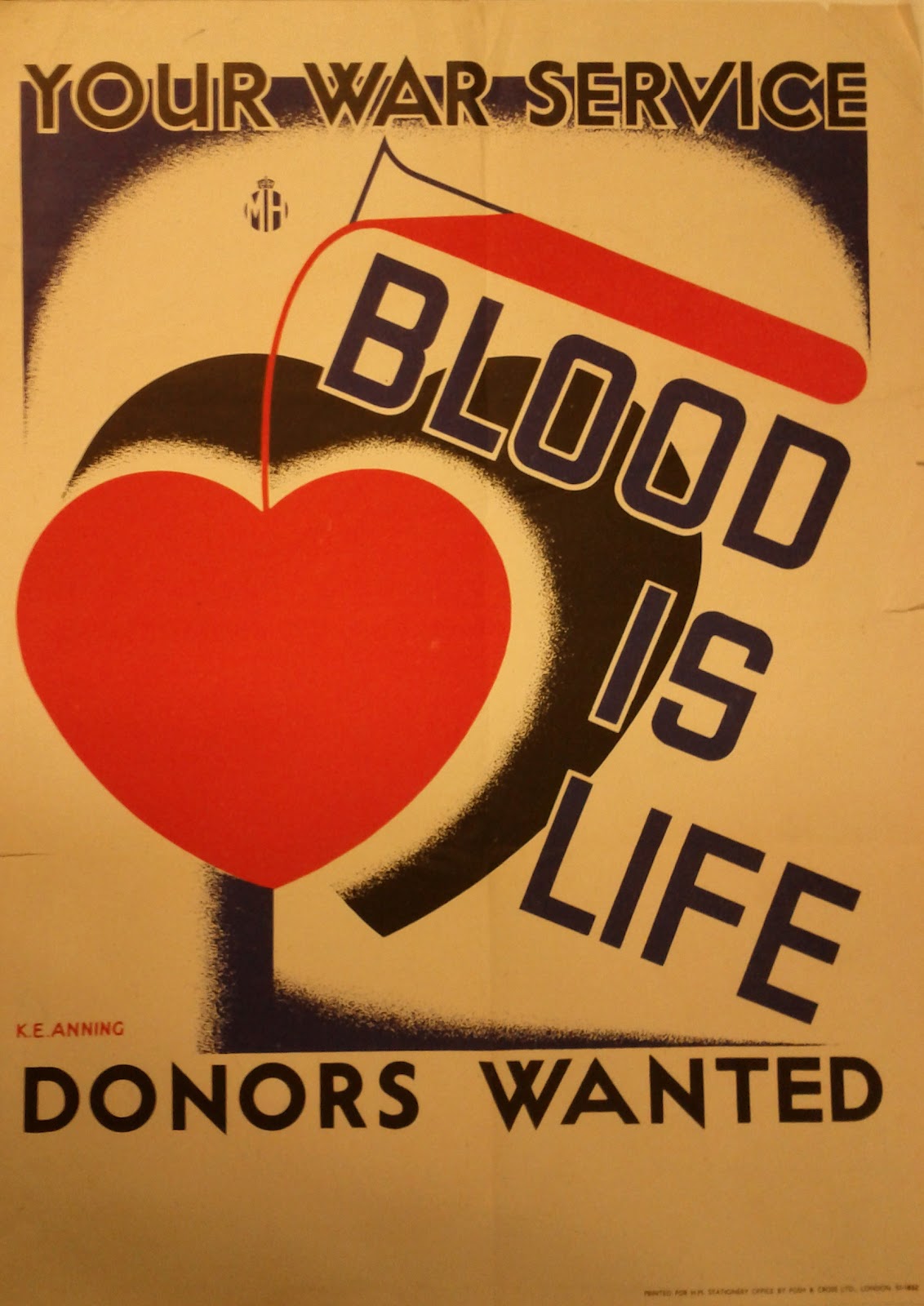
The Wellcome Library has acquired a collection of 600 British posters dating from the 1940s to the 1990s advertising the health-maintenance activities of the British state. Most were produced by the Central Office of Information for the U.K. Ministry of Health (subsequently Department of Health and Social Security, subsequently Department of Health).

The posters cover the following subjects: Blood donation (135); Children (44); Diseases (121: AIDS, asthma, colds and flu, diphtheria, epilepsy, meningitis, rabies, rubella, tetanus, tuberculosis); Drugs or narcotics (53); National Health Service services and charges (80: ambulance service, cervical screening, community care, emergency GPs, evaluation, fares to hospital, NHS 30th anniversary, prescription charges, spectacles); Nurses and midwives (87, including recruitment, Queen's Institute of District Nursing, etc.); Organ donation (44), Travel and health (8); and Miscellaneous (26: air-raids, disability, health and safety, health of the nation, hearing, incontinence, mental health, and teeth).

Proof pulls and storyboards are included as well as finished versions. Named designers include Reginald Mount, K.E. Anning (above), and Abram Games.

The posters are accompanied by a large collection of photographs, drawings, etc. which have not yet been explored, except for one item, a photograph album (Wellcome Library no. 811058i) recording an exhibition from 1948 called Health of the People. This exhibition was put on by the Central Office of Information in Oxford Street, London (but where in Oxford Street?) apparently to publicize the introduction of the National Health Service (NHS) in that year. On display from May to June 1948, the exhibition was an ambitious attempt to communicate the history of public health and the difference that the NHS would make between the past and the future. Much attention was given to new laboratory-based services.

The photographs makes it look like a halfway-house between Britain can make it at the V&A in 1946 and the Festival of Britain on the South Bank in 1951. No names of contributors (commissioners, writers, designers, manufacturers) are given, but surely they must be recorded somewhere; possibly in the unexplored parts of this same collection. The script which accompanies the album makes much reference to the Public Health Act of 1848, the centenary of which was being celebrated.

Did this period see the high-water mark of state involvement in health in the British Isles? If so, our successors will no doubt look on these documents with incredulity. Only time will tell. 
Displays in the Health of the People exhibition, 1948. Left, "the health team, consisting of the family doctor, dentist, nurse etc". Above, stands on protection of towns, water supply etc. Top, the staircase between floors.

Wednesday, April 11, 2012

New article on a portrait of record

Drawing by Pierre Chasselat.
 Wellcome Library no. 729420i
An exceptional neoclassical portrait drawing that was acquired by the Wellcome Library in 2010 is the subject of an article in the current (April 2012) issue of The Burlington magazine. [1] The drawing, by Pierre Chasselat (1753-1814), is a portrait of the French surgeon A.-B. Imbert-Delonnes who, in the same year as the creation of the drawing (1800), served under Napoleon at the battle of Marengo. He was also involved in a number of controversial episodes, some of which are commemorated in the drawing.

 Following Marc Fecker's identification of the previously unidentified sitter as Imbert-Delonnes, the article, by Marc Fecker and William Schupbach, places  the drawing in the context of other works by Chasselat and by Jacques-Louis David (they were both pupils of Joseph-Marie Vien), and identifies the various works of furniture, painting, and sculpture shown in the portrait, among them (in the lower left corner) an oval portrait of the mayor of Angoulême, Perier de Gurat. Perier de Gurat suffered from appalling facial tumours which Imbert-Delonnes removed through a long and painful surgical operation. The engravings below, published by Imbert-Delonnes, show Perier de Gurat before and after that operation.


Above, Perier de Gurat before and after surgical removal of his tumours by Imbert-Delonnes in 1798/1799. 
Plates to Ange-Bernard Imbert-Delonnes, Nouvelles considérations sur le cautère actuel, Avignon 1812.

Here (right) is the detail from the lower left corner of Chasselat's drawing, showing the painting by Joseph Bose from which the first engraving of Perier de Gurat was made. The open book in front of it is a volume of the works of one of Imbert-Delonnes's professional role-models, Ambroise Paré (1510?-1590).

 Other details of the drawing are elucidated in the article. The drawing was purchased by the Wellcome Library with the aid of the MLA/V&A Purchase Grant Fund and The Art Fund, to whom go the renewed thanks of the Library.

 [1] Marc Fecker and William Schupbach, 'A recently discovered portrait of the surgeon Ange-Bernard Imbert-Delonnes (1747-1818) by Pierre Chasselat', The Burlington magazine, April 2012, 154: 236-240.

Friday, January 6, 2012

Let's talk about the weather...

Patient: What do you think of a warmer climate for me doctor?
Doctor: Good heavens Sir, That’s just what I am trying to save you from!


Climate and health have been connected since the days of humoural medicine and probably before that, but the spectre of global climate change gives this cartoon from Punch (1901, Vol. 121 p.315) a whole new dimension.

A report produced by the UCL-Lancet Commission in 2009, described climate change as “the biggest global health threat of the 21st Century”. Environment, nutrition and health are also key areas of research interest for the Wellcome Trust: it’s website states that “climate change has major implications for global health and nutrition – with impacts on food security, access to clean water and sanitation, population migration and the threat of an increased number of natural disasters.”

A number of recent additions to the Library collections reflect some of the interesting research that is being done in field of health and climate change. A report by the Institute of Medicine in the USA looked at the effects of climate change on indoor air and public health. Many climate change ‘hot spots’ lie in rural communities, and another new book considers the health of rural children, one of the most vulnerable groups. A book on climate change and human well-being considers the “psychological responses and mental health impacts that accompany gradual environmental change and extreme weather events, and explains how climate change exacerbates existing inequities.” What is striking about much of this research is the multidisciplinary nature of the work being done, which often includes education, policy, and development as well as scientific analyses of medical and health concerns.

Perhaps the multidisciplinary nature of the health related research reflects the wider context of the climate change debate. Some fifteen years after the Kyoto Protocol, certain new publications indicate that people are beginning to look back at the history of climate change. Several scientists have recently published personal accounts of being in ‘the thick of it’ in the climate change debates. Raymond Bradley really was at the centre of the controversy as he, along with Michael Mann and others, published the so-called ‘hockey stick’ graph in the journal Nature in 1998. His book about Global warming and political intimidation relates how he felt politicians and policymakers in the USA sought to discredit him and his colleagues, and shut down their work.

James Powell was a scientist on the ‘inside’ when it came to science policy. He was appointed to the US National Science Board by both Presidents Reagan and George W Bush and remained there for 12 years. His book – The inquisition of climate science addresses the question “why, when the scientific evidence for global warming is unequivocal, does only half the public accept that evidence?”

Inevitably the media had its part to play: Climate change and the media examines the changing nature of media coverage around the world from the USA, UK and Europe to China, Australasia and the developing world.

Several recent contributions to the climate change debate take a more pragmatic approach, and consider how progress on some of the concerns around climate change might be facilitated. A book on social science research looks at the issues around Engaging the public with climate change. This collection of papers make the case for why scientists and policymakers should engage the public on debates and decisions about climate change. Julie Doyle’s book: Mediating climate change looks at “practices of mediation and visualisation” in relation to the visual arts and climate change, and related issues such as meat and dairy consumption, and environmental activism.

Finally, in A perfect moral storm philosopher Stephen Gardiner considers the reluctant response to the challenge of climate change to be a result of various moral failings such as the temptation to ‘pass the buck’ onto future generations, and transfer costs onto the world’s poor. Inaction is facilitated by ignorance about science and international justice.


“When two Englishmen meet, their first talk is of the weather”

Samuel Johnson quipped. Judging by this range of books, it seems that these days, in health, science policy, social sciences, arts and philosophy, everyone is talking about the weather, or more accurately the climate.

Wellcome Image No. L0028080 from Punch magazine, published London 1901

Thursday, May 19, 2011

New acquisition: a portrait of Ange-Bernard Imbert-Delonnes

The great aspirations, dramatic events, heroic deeds and terrible crimes against persons that occurred in France between the first stirrings of the Revolution in 1789 and the end of the First Empire in 1815 remain stamped in the public memory even after two centuries. The Scarlet Pimpernel, A tale of two cities and La Chartreuse de Parme are some of the literary works inspired by this unprecedented episode, and there are innumerable works of history and iconography. Everything that happened in France at that time seems to have a heightened presence -– especially its fine arts, as many brilliant French painters, sculptors, craftsmen and draftsmen lived and died in those turbulent years.

Drawing by Pierre Chasselat, 1799-1800. Wellcome Library no. 729420i
It is therefore a pleasure for the Wellcome Library to be able to acquire a magnificent drawing from that period which has remained unknown until very recently (above). It is a portrait of the French surgeon Ange-Bernard Imbert-Delonnes (1747-1818) by Pierre Chasselat, signed by him and dated in the revolutionary calendar "L'an 8" (1799-1800).

The drawing, without identification of its subject, was discovered by Marc Fecker of the firm of Didier Aaron Ltd. (right), who also carried out independent research in the Wellcome Library in order to re-identify the sitter. The identity was clinched by the discovery of a rare engraving (Bibliothèque Nationale de France) of the head and shoulders of our sitter, which was copied from the Wellcome Library's drawing and was published as a portrait of Ange-Bernard Imbert-Delonnes in his lifetime.

Imbert-Delonnes was born at Vacqueyras near Avignon (then in the Papal States) and spent much of his career as a military surgeon, serving under Napoleon at the battle of Marengo (1800). At one time a member of the new French Republic's Conseil de Santé, he later became the director of the veterans' hospital in Avignon – now in a different country, France. He died in Paris in 1818. His life and works formed the subject of a doctoral thesis by J. Robert in 1976, but, though Robert's thesis was well researched, he did not know of this drawing.[1] Robert did however reproduce the engraving in the Bibliothèque Nationale de France which led to the identification of the subject of the drawing.

The drawing shows the lordly figure of Imbert-Delonnes sitting in his study surrounded by mementos of his professional life. In the left background is his scholarly library presided over by a statue of Aesculapius (left). Above right is a portrait of his surgical role-model Ambroise Paré (1510-1590), while a volume of Paré's works is seen in the lower left corner. That volume leans against another portrait, of a man disfigured by tumours: he was a star patient of Imbert-Delonnes, Périer de Gurat, portrayed for Imbert-Delonnes by Joseph Boze the evening before the operation in which Imbert-Delonnes removed the tumours. On the far right, in a belljar, is a colossal tumour removed controversially from another prominent patient, Charles Delacroix (1741-1805); and neoclassical furniture, about which more is still being discovered. The highlights of white gouache applied to the rendering of the chair represent the hardness and smartness of these magnificent ebony or mahogany surfaces.

Despite the many disparate and in two cases unattractive objects which the patron wished to include in the drawing, the artist managed to provide a coherent portrait of the sitter and his attributes in a lifelike and welcoming setting. Its plethora of detail, secure documentation, and high-quality draftsmanship together make this one of the most remarkable French drawings to have emerged from obscurity in recent years. It has been acquired by the Wellcome Library with the aid of grants from the MLA/V&A Purchase Grant Fund and The Art Fund.

For further details please see the description in the Wellcome Library on-line catalogue and this press release issued by the Wellcome Trust. A further publication by Marc Fecker and William Schupbach will present a fuller analysis of the drawing, its subject, and the episodes which individual details in the drawing refer to.

The drawing is available for viewing in the Wellcome Library, where it joins a collection of some 15,000 portraits of public figures from Greek philosophers and Roman emperors to our own contemporaries.

[1] Jacques Robert, La vie et l'oeuvre du chirurgien Imbert-Delonnes (1747-1818), thesis, Université Claude-Bernard, Lyons, 1976