Showing posts with label Henry Wellcome. Show all posts

Thursday, May 24, 2012

Guest Post: Little Ilford School ‘Science Club’

In the second post from our Year 9 friends at Little Ilford School, here are Edward and Farzana reflecting on their visit and the four humours: 
'During the 17th century medicine was still handicapped by wrong ideas about the human body. Most doctors thought that there were four fluids or 'humours' in the body, blood, phlegm, yellow bile and black bile, which had to stay in balance for a person to stay healthy or become healed from their illness. 
These four humours all had a different meaning that relates to illness.  For example, blood was created in the liver, and was warm and moist, but black bile (from the gall bladder) was cold and dry. Blood could be extracted to try to balance the four fluids.
Each humour was also like a different emotion: sanguine (blood) means pleasure-seeking, sociable, amorous; choleric (yellow bile) means ambitious, leader-like, bad-tempered; melancholic (black bile) means introverted, thoughtful, sleepless; and lastly phlegmatic (phlegm) means relaxed, quiet, unemotional.
Our reaction to learning about the four humours was shock - since technology and our knowledge of the human body has developed over the centuries, we have learnt about how illnesses are caused.  We found it shocking but fascinating because we didn’t think that in the olden times people thought illnesses were caused by their bodies’ fluids not being in balance.  We thought that people in the past thought God was punishing them for their sins and evil they had committed.
We also learnt about how the Wellcome Trust was founded and how it came to be. There was a man called Henry Wellcome who loved to collect artefacts, so he went around the world to find as many artefacts as he could and he ended finding so many and building massive collections.  He then set up a museum for his artefacts.
But not only was it a museum, it also funded people to learn about the body, and people who were funded by the Wellcome Trust made massive breakthroughs in research on the human body.  It has helped people around the world.'
Posted on behalf of Edward and Farzana
Images: Drawing of Sir Henry Solomon Wellcome by F. Reynolds, 1901 (Wellcome Library no. 95891)
An ill man being bled by his doctor, 1804 (Wellcome Library no. 12046i)

Thursday, February 23, 2012

Pills and Potions at Royal Holloway


This Saturday (25th February) Wellcome Library Research Officer Ross MacFarlane will be speaking at Pills and Potions, Royal Holloway University’s 2012 Science Open Day.

The title of Ross’s talk is Henry Wellcome: Invisible Ink to Pills and Potions and in it he will explore Wellcome’s career as a pharmaceutical entrepreneur, from boyhood dabblings in his Uncle’s pharmacy store to the pioneering work of the drug business he co-founded.


Royal Holloway’s Science Open Day showcases the extensive research and outreach of the College’s science departments. Events include talks, demonstrations, visits, and hands-on workshops. So, if you fancy learning about the chemistry of ice cream, making a model of your own DNA or even discovering the healing power of tomatoes, come along.

More details on the Royal Holloway Science Open Day (25th February, 10am-4pm) – including a full programme- are available on the University’s website.

Tuesday, December 13, 2011

Merman resurfaces in Regent's Park

After a recent sighting in Bromley, a merman once owned by Henry Wellcome, and now in the collection of the Horniman Museum, is making an appearance north of the Thames at the headquarters of the Royal College of Physicians, beside Regent's Park in London.

As part of this loan, next Tuesday 20th December sees a free lunchtime event at the Royal College of Physicians, Fakes, Forgeries and Quacks. The event will consist of two talks: Ross MacFarlane, Wellcome Library, will place the merman in the context of Henry Wellcome's wider collections and Paolo Vascardi, Horniman Museum, will trace the history of mermaids and reveal a tale of fraud, bankruptcy and shipwrecks.

The event starts at 12.30pm and will last just over an hour. No booking is required and directions to the Royal College of Physicians are available from their website.

Image: A grotesque mermaid, amidst luxurious cushions and drapes, and framed by two shells. Coloured lithograph by E. Purcell, 1822 (Wellcome Libary no. 3332i).

Wednesday, December 7, 2011

Henry's Cats

In 1936, readers of the Liverpool Echo were intrigued to read of the death of a London millionaire who apparently chose to live in a Portland Place hotel while maintaining a palatial Regents park residence for the sole occupancy of his three beloved cats. This individual was none other than Sir Henry Wellcome.

Over the past year, whilst celebrating the 75th anniversary of Wellcome Trust's foundation, we have learned much about the life, work and achievements of Henry Wellcome. We have been reminded of Wellcome the collector, entrepreneur, philanthropist and even inventor, but this report hints at another side of his character - Henry Wellcome was an archetypal cat owner, with the eccentricities to match.

The claim may seem surprising, implausible even, but a search around in the Wellcome Library's archives quickly unearths more evidence for the great man’s devotion to his feline friends...

With the winter holidays approaching, many of the cat owners amongst us will be contemplating time away from our pets and find ourselves writing novella-length notes for those brave souls entrusted with their care.

Henry Wellcome, it seems, was no different. Nestling in the recesses of his personal papers are page after page of instructions for successive pet-sitters; those whose task it was to keep the little darlings happy had no small job on their hands. One memo notes that the cats were "accustomed to eating cooked beef, ox & lamb liver & kidney, boiled hake and cod, salmon & sardines", and, occasionally, "a little raw beef, if it is finely cut up" (from WA/HSW/PE/A.30).

Fresh meat and fish was delivered to No. 6 Gloucester Gate daily by Wellcome’s butcher and fishmonger (‘NOT from a ‘cats meat’ butcher”) and were cooked there and then by Wellcome’s staff to be enjoyed with fresh milk and water. On Sundays, by which time the patience of the cook was presumably wearing thin, the cats were treated to a tin of salmon. “Under NO circumstances must they be given pork or pork liver or kidney”, demand the instructions. Potatoes were also strictly, if inexplicably, forbidden.

Neither were their sartorial needs neglected: when the cats travelled they took their brushes and beds with them and it was Wellcome’s "special desire" that the cats should be "well cared for and not teased or abused in any way".

As the 75th anniversary comes to a close it’s interesting to discover a heretofore overlooked aspect of Henry Wellcome’s personality and one that helps us relate to the great man on a more personal level. And, whilst you cat owners out there buying Hill’s Science Diet food can take note of Henry’s cat care legacy, the cat-sitters amongst us can gain some comfort from not having to face the terrible responsibility of minding Henry Wellcome’s pampered pets!

Images:
- Cutting from the Liverpool Echo, 1st August 1936 (from WF/M/GB/29/32/02)
- An example of HW’s holiday care instructions
- 'Pip' with one of her kittens


Authors: Jo Maddocks and Sharon Messenger

Tuesday, November 15, 2011

Flo-Motion: Nightingale in Wellcome Sound and Vision

Next Thursday (24th November), Wellcome Library Research Officer Ross MacFarlane will be giving a talk at the Florence Nightingale Museum. Flo-Motion: Nightingale in Wellcome Sound and Vision will explore audio visual material from the Library's collections which have a connection to the life and legacy of Florence Nightingale.

From the starting point of a recording of Nightingale's voice, the talk will examine the fascinating origins of this historic audio recording and reveal the curious connection between Nightingale, Henry Wellcome and the dawn of television. The talk will also feature films showing the treatment of injured soldiers from both World Wars and Public Health films from the 1940s.

The talk will be followed by a free glass of wine and an opportunity to view the museum. More details, including booking information, is available from the Florence Nightingale Museum.

Wednesday, November 2, 2011

The first antiques roadshow?

Today has seen the BBC celebrate 75 years since the launch of the world's first regular television service.

Given their current popularity, it's no surprise that the daytime schedules of both BBC1 and BBC2 have today (as on most other days) included a number of antiques shows - Bargain Hunt, Flog It! and Celebrity Antiques Roadtrip.

However, the origin of such BBC antiques shows - and let's not forget the long-running Antiques Roadshow, nor it's forerunner Going for a Song - may have an intriguing Wellcome connection...

The Wellcome Library holds a series of newspaper cuttings, collated by the Wellcome pharmaceutical business after its co-founder Sir Henry Wellcome's death in 1936. These cuttings not only include an array of obituaries from across the globe, but newspaper reports from the next few years on the establishment of the Wellcome Trust and the early sales of objects no longer deemed appropriate to be part of Wellcome's collection.

One such cutting dates from the 13th February and is from the Sunday Observer. "Television Pre-View of Auction - Model Ship Collection", is its title and the article is worth quoting in full:

"For the first time an important auction sale has had a television pre-view.

All three television programmes from Alexander Palace on Thursday included a selection of the 200 ship models collected by the late Sir Henry Wellcome. Tomorrow they will be offered for sale by auction at Alford House, Princes Gate, Knightsbridge.

While Mr M. B. Roberts explained their oddities, models of ships floated down the centuries and across the television screen. There was an Egyptian barge wanting but a thumb-sized Anthony and Cleopatra for perfection. Under the sun-smitten canopy of a Burmese state barge smooth-bronzed royalty sat.

A Chinese houseboat had the carved elaboration that rich merchants seek, but a galleon in silver had less of the spicy East about her. Her longest voyage had been from table-end to table-end, her hull a port decanter.

More curious was the paper filigree boat of no recognisable design, but of most fragile build. An ostrich egg-shell made her hull, hens' eggs her row-boats. Strange me and stranger fishes tramped her decks and frolicked in her little pot of ocean.

Lastly, there were the wooden walls of England reduced to a foreman's length - a stout original dockyard model of a 64-gun late eighteenth century man-o'-war. She had a dignity that made Mr Roberts wish for her a home in some national museum.


Whilst considering when a day's schedule on the BBC could feature only three programmes, let's also ponder whether this was the start of the BBC's auction and antiques broadcasting.

It should also be said that this isn't the only connection between the early days of television and Sir Henry Wellcome - there's a more direct link but it's one we'll save for a future date. Keep watching this space...

Image: Alexandra Palace (Credit: BBC)

Tuesday, November 1, 2011

A Merman comes ashore in Bromley


This Saturday (5th November), Wellcome Library Research Officer Ross MacFarlane will join Paolo Viscardi, one of the Horniman Museum's Natural History Curators, at the Bromley Musuem, Orpington, Kent, on "a voyage of discovery across oceans, through time and into the realm of the merman".

The free event, which begins at 11.30am, ties in with the temporary loan of the merman to the Bromley Museum from the Horniman. Before entering the Horniman's collections, the Merman was previously owned by the Wellcome, being purchased for Henry Wellcome in 1912.

For those wishing to join Paolo and Ross on their journey into the cultures and contexts of mermen and mermaids, more details on the event are available from the website of the Horniman Museum.

Image: Merman, Horniman Museum. Photograph by Heini Scneebelli.

Wednesday, July 13, 2011

New issue of Wellcome News

Published four times a year, Wellcome News contains up-to-date articles highlighting the Wellcome Trust's wide-reaching science and public engagement activities, grant schemes, policies and more.

The latest issue's 'From the Archive' feature, highlights one of our digitised recipe manuscripts (MS.7113), compiled by Lady Ann Fanshawe in the 17th century.

The issue also contains an extra supplement, Wellcome News 1936, to tie in with the Trust's 75th anniversary. The supplement imagines how Wellcome News might have looked in the year of the Trust's founding, and is inspired by material from the Library's collections.

Both Wellcome News - and its 1936 supplement - are available to download from the Wellcome Trust's website.

Saturday, June 25, 2011

The lost world of Snow Hill


The image above captures the popular conception of London's reaction to the Blitz, which was arguably at its most fearsome during May and June 70 years ago. During the night-time bombings, lives were lost and buildings were destroyed. But come the morning... a cyclist trundles by, a roadsweeper brushes up: life goes on.

The remains of the building you see here are actually enormously important to the story of our founder Henry Wellcome, as this is the corner of Snow Hill and Holborn Viaduct in London, the site of the head office of the pharmaceutical company he co-founded, Burroughs Wellcome & Co.


Opened in 1883, three years after Silas Mainville Burroughs and Henry Wellcome entered into partnership, the scale of their head office matched the expectations Burroughs and Wellcome had for their nascent pharmaceutical company.

The imposing building was constructed of red brick, with granite pilars guarding the entrance. The tiled mosaic floor of the was illustrated with images of Commerce and Industry and the rich wood used for the walls was best American Walnut. [1]


Henry Wellcome was personally involved in designing and furnishing the interior of the building: no easy task given the building's curved shape. As the image above shows, Moorish curves were ideal for a building Wellcome himself described as having "not a single right-angle". The interior arrangements were executed under the direction of Christopher Dresser, now regarded as Britain's first industrial designer. Snow Hill was also one of the first business houses in London to be lit using electric light.

The interior alluded to Burroughs and Wellcome's country of birth with models of the Statue of Liberty and the American Eagle (visible towards the back of the image above) and the building captured something of the entrepreneurial get-up-and-go of these two salesmen.

The building also hinted at another aspect of Wellcome's personality: his growing interest in collecting. This is how Wellcome's office was described in a praiseworthy report on the building in Chemist and Druggist:

"It is furnished as a library, although hunting trophies, works of art from countries visited by the occupant...and a varied selection of general literature give it less the look of a commercial room and more the appearance of a bachelor's den". [1]

Fast forward to 1941 and it seems this example of late Victorian architecture was no longer fit for the purposes of twentieth century business: five years after Henry Wellcome's death, the Wellcome Foundation still retained Snow Hill as offices, but sought to build new premises elsewhere in London.

On the night of 10-11 May 1941, during one of the heaviest nights of the Blitz, the Snow Hill building was destroyed. Afterwards, staff were temporarily moved to other Wellcome owned sites - such as the main warehouse where Wellcome's collection was stored in Willesden and to the Wellcome Research Institution on Euston Road (which is now, of course, where the Library and the rest of Wellcome Collection is situated). Not ideal accommodation, but just as for the figures beside the bombed out Snow Hill offices shown above, life had to go on for the employees as well.

But with its carefully designed interior - and his collection-rich office - the lost world of Snow Hill captures something of Henry Wellcome's - often elusive - personality.

[1] Clues to the furnishings of the Snow Hill office remain through drawings which survive in the papers of the Wellcome Foundation Archive, WF/CA/P/01
[2] Chemist and Druggist, 28th January, 1888

Images:
- Burroughs Wellcome & Co Headquarters, Snow Hill, London, after being destroyed in the Blitz, 1941 (Wellcome Images, M0020173)
- Burroughs Wellcome & Co Head Office, Snow Hill, London (Wellcome Images, M0007868)
- Interior of the Burroughs Wellcome & Co building, Snow Hill, London (Chemist & Druggist, 28th January 1888)

Friday, May 27, 2011

Wellcome Library Insights: June - July


Our popular Insight sessions offer visitors to the Wellcome Library an opportunity to explore the variety of our holdings. These free sessions are thematic in style, last around an hour and offer a chance to learn about our collections.

Details of June and July's Insights have just been released. They are:

Fascinating Faces - 16th June, 3pm-4pm
(Learn about the provocative idea that our faces can be 'read' - is it an art or a science?)

Women, Health and Healing - 23rd June, 3pm-4pm
(Explore the changing attitudes of women in medicine and attitudes to female healers through the centuries)

Henry Wellcome: His Life and Work - 28th July, 6pm-7pm
(Find out more about our founder as an individual, a businessman and as a collector).

For more details on how to attend the sessions, please follow the links above to the appropriate pages on the Wellcome Collection website.

Image: Seven portraits of women, compared for their beauty and prudence. Drawing, c. 1789 (Wellcome Library no. 28698i)

Monday, March 28, 2011

A grim day in Minnesota

This colour lithograph (click on image to enlarge) was recently found in a drawer in the Wellcome Library containing personalia of Henry S. Wellcome, the founder of the Library. It shows the hanging of 38 Sioux or Dakota leaders in Mankato, Minnesota, in 1862. There is an impression of it in the Library of Congress (as one would expect, for deposit in that Library was a necessary condition for registration of copyright in the USA), and a few other impressions are also documented, but the significance of the Wellcome Library impression is that it had belonged to someone who was actually caught up in the massacre by the Sioux for which their leaders were hanged –- the event portrayed in in the lithograph.

Henry S. Wellcome was only nine years old at the time. The state of Minnesota had been created in 1846-1858 out of lands that were an enclave within unceded Sioux territory. It passed to the United States under compensation promises that were never fulfilled owing to some conditions in the small print that overruled them in favour of competing compensation promises in favour of white interests. The non-payment of the compensation became a runnning grievance for the Sioux, who regarded the white settlers in the Minnesota Valley in much the same way as Hamas today regards the Israeli settlements on the West Bank of the River Jordan.
Settlers fleeing the Dakota, Minnesota 1862. Published by Whitney's Gallery, St. Paul, Minn.
As in the Middle East, a series of barbarous tit-for-tat murders and massacres ensued. In August 1862, anticipating an all-out attack by the settlers, the Sioux started a general uprising, attacking ferociously some outlying settlements and even townships such as the one in which the Wellcome family lived, Garden City, Minn. The boy Wellcome assisted his uncle Jacob, the town surgeon-apothecary, in treating the wounded. Casualties among the settlers would have been greater but for the protection of another Native American tribe, the Winnebago.

The United States did indeed respond in kind, defeated the Sioux in battle, and tried the prisoners. Three hundred and three were found guilty of savage crimes of whom all but 38 were pardoned by President Lincoln. The 38 walked to the scaffold in Mankato on 26 December 1862 in warpaint and feathered headdresses, to be hanged simultaneously on one massive set of gallows.

Henry S. Wellcome did not attend the hanging but he kept this print of it, and later described the Sioux uprising (rather undramatically) as "the most interesting event of my life". Though he might have been expected to have lost his respect for the Native Americans, in fact he reacted in the opposite way. He recognized the historical reasons for their hostility to the settlers, appreciated their culture from the anthropologist's point of view, and -- from a room in the Arlington Hotel in Washington, D.C. -- worked tirelessly in later life to prevent further injustices.

Left: Wellcome Library no. 45889i

The series of pastel portraits which he commissioned from the artist W. Langdon Kihn in the 1920s demonstrate his interest in preserving their vanishing culture. The example shown here retains its original frame: a Jazz Age record of Native American decoration.

Acknowledgment: Robert Rhodes James, Henry Wellcome, London 1994, pp. 23-29

Saturday, December 25, 2010

Wellcome's Christmas Gifts

Every Christmas from the 1890s until 1914, Henry Wellcome gave a book to the employees of his pharmaceutical business, Burroughs Wellcome and Co. As some of these titles remain in the Library's collections, we wondered if they would shed some light on Henry and his feelings towards his staff, as well as attitudes of employers in Victorian and Edwardian times more generally.

Among the titles, there's some fiction, a little poetry, numerous biographical works and at least one compendium. Most of the titles were popular at the time, but not all of them are remembered in the 21st century. A clear theme from the titles is that of self-improvement and utility. Through examples of self-made men promoting the virtues of hard work, Wellcome was not only giving role models to his staff, but also commenting on his own journey from impoverished childhood in rural America to wealth and success in London. A journey made through sheer hard work.

For example, in 1907 Wellcome gave as his Christmas book Samuel Smiles's Life and Labour (1887). One of the bestselling authors of the late Victorian period, Smiles advocated social advancement through the virtuous acts of hard work, thrift and sobriety. He can even be seen as the forerunner of the various self-help guides you find today. Even in Wellcome's gift of 1911 – Cassell's Book of Sports and Pastimes - there is a sense of practicality. This title was full of advice on making, mending and healthy pursuits, which suggested to the staff as they unwrapped their gifts that even their spare time should be spent in a useful, practical manner.

Another clear theme in Wellcome's choices is his growing interest in Africa. By 1914, he had not only opened the groundbreaking Wellcome Tropical Research Laboratory in Khartoum but also carried out extensive archaeological excavations in Sudan (both activities he felt had practical philanthropic benefits to the local populations).

This interest in Africa comes through in his 1914 gift, The Autobiography of Sir Henry Stanley, edited by Dorothy Stanley (Henry Stanley the journalist and explorer - another self-made man - was a close friend of Wellcome's). It's also evident in two other choices from the 1890s: Fire & Sword in the Sudan and With Kitchener to Khartoum - two titles on the British Army's derring-do in Sudan in the late 19th century.

Of the more famous works of literature Wellcome gave, Henry Longfellow's romanticised poem of Native American life, The Song of Haiwatha, is suggestive of Wellcome's childhood in rural Minnesota, growing up close to the Sioux. His choice of Gulliver's Travels is more intriguing: perhaps Wellcome saw in Gulliver's adventures a lone individual pulling himself through against difficult odds?

So, Henry Wellcome's choice of gift does offer a degree of insight into his interests and attitudes, and also how he wished to be perceived. His selections are very much of their time - as are, however, his thoughts on his staff. In 1910, Wellcome chose Charles Darwin’s The Voyage of the Beagle. But he chose it for male employees. Women received copies of the Encyclopaedia of Needlework.

(A version of this post also appeared in the most recent edition of Wellcome News).

Saturday, December 11, 2010

Vital Mental Medicine


A BBC Radio 4 documentary which aired today, Vital Mental Medicine: Shackleton's Banjo, offers an indirect insight into an aspect of Henry Wellcome's life.

The documentary tells the story of the instrument shown above: a banjo belonging to Leonard Hussey, a meteorologist who was part of Ernest Shackleton's Imperial Trans-Antarctic Expedition expedition party which set out on board the Endurance in 1914. Famously, the Endurance became stuck in pack ice forcing Shackleton and five crew members to sail the 1,300 km to South Georgia in a small boat in an attempt to get help. He left behind twenty-two men: one of whom was Hussey.

As the Endurance was sinking, Shackleton allowed each crew member to take 2 lbs of possessions with them. The only exception to this was Hussey's banjo - which Shackleton himself retrieved. "We must have that banjo", Shackleton was reported to have said, "It's vital mental medicine".

Miraculously, Shackleton made it to South Georgia and all the stranded men were eventually rescued. Their signatures adorn Hussey's banjo (now owned by the National Maritime Museum and currently on display in the National Maritime Museum Cornwall) which he played to the other twenty-one men he was stranded with.

As for the Wellcome connection... we move from the ice of Antarctica to the sun of the Sudan, as it was there that Hussey first saw the newspaper advertisement calling for volunteers for Shackleton's expedition. And the reason Hussey was in the Sudan? He was working on Henry Wellcome's archaeological excavations at Gebel Moya in the north of that country, during the winter of 1913-1914.

Between 1911 and 1914, Henry Wellcome funded excavations at Gebel Moya, south of Khartoum. Both a continuation of Henry Wellcome's charitable work in the Sudan and a practical example of his interest in archaeology, the excavations were a major contribution to the knowledge of the early history of Eastern Africa. They also featured an ingenious use of aerial photography - a development which these excavations have seldom been credited with. (Life at Gebel Moya during the 1912-1913 season was captured on a film now digitised as part of our Wellcome Film project).

It appears that Hussey's time with Wellcome at Gebel Moya was a major formative influence. Amongst the personal papers we hold of Wellcome's, we have correspondence between him and Hussey. Hussey, in a letter dated 21st August 1918, writes that:

"I don't think that we all quite realised the immense value of the training in discipline and especially in loyalty, which we had at Gebel Moya. Sir Ernest Shackleton - and I say this with all diffidence - always refers to me as "one of the most cheerful and loyal ones", and I wish for no finer epigraph". [1]

For more on Hussey's cheerfulness - and how his banjo kept spirits up amongst his fellow strandees - have a listen to the documentary, which is available through the BBC iPlayer to listeners in the UK until next Saturday (18th December).

Image credit: National Maritime Museum

[1] From file WA/HMM/CO/Ear/316. The letter also makes brief mention of Hussey and Shackleton about to embark on a "wartime mission in Northern Russia".

Monday, November 22, 2010

Public events

News of a pair of forthcoming free public events, which draw on the expertise and knowledge of two members of Wellcome Library staff.

On Tuesday 30th November, Ross MacFarlane, Research Officer, will be speaking at Brent Archives on 'Henry Wellcome: His Life and Work', examining Wellcome's career and his collection and the important part played in the latter by an ex-wireless factory in Willesden. The talk starts at 7pm.

On Tuesday 7th December, Helen Wakely, Archivist, is giving a seminar at the Institute of Historical Research (IHR) in their Archives and Society series titled: 'Francis Crick: so last century?'. The session begins at 5.30pm.

Both events are free and for those wishing to attend, more details are available through the websites of Brent Archives and the IHR respectively.

Monday, October 18, 2010

Wellcome Library Insight: Henry Wellcome - His Life & Work

This week's free Wellcome Library Insight session - on Thursday 21st October - focuses on our founder, Henry Wellcome.

Who was Wellcome and what drove him to collect over a million objects during his lifetime? We will examine his personal life and business career through material preserved in the Wellcome Library.

Our Insight sessions offer visitors to the Wellcome Library an opportunity to explore the variety of our holdings. Sessions are thematic in style, last around an hour and offer a chance to learn about our collections.

This Thursday's session starts at 3pm, and tickets are available from the Wellcome Collection Information Desk from 1.30pm onwards. For more details, see the Wellcome Collection website.

Friday, October 8, 2010

'London's Lost Collector: Searching for Edward Lovett and His Magical Collection'


The Wellcome Library's Ross MacFarlane will be giving a talk at the Cuming Museum, London, on Saturday 16th October, titled 'London's Lost Collector: Searching for Edward Lovett and His Magical Collection'.

Lovett was a folklore collector in the early 20th century, with a particular interest in lucky charms and healing objects. A great deal of these objects were collected by Henry Wellcome and his staff for Wellcome's collections: the Wellcome Library still holds detailed correspondence on their acquisition and some of them - such as the amuletic necklace shown above - are on show in Wellcome Collection's 'Medicine Man' exhibition.

The talk is part of a series of events to tie in with the new exhibition on the artist and occultist Austin Osman Spare at the Cuming Museum (which also holds a large array of Lovett-collected objects).

More details on the exhibition and the series of talks are available from the Cuming Museum's website.

Image: An amuletic necklace worn to cure bronchitis. Collected in Woolwich, London, by Edward Lovett, c.1914.

Monday, September 27, 2010

Item of the Month, September 2010: Articles of Partnership

Today marks the anniversary - 130 years ago today - of the signing of this legal contract by two young American pharmaceutical salesmen: Henry Solomon Wellcome and Silas Mainville Burroughs.

The document described the business partnership that the two men entered into. The business formed - Burroughs Wellcome & Co (BW&Co) - would by 1900 establish itself as a multinational pharmaceutical company. Indeed, the monetary means for Henry Wellcome to acquire his collections - and the existence of the Wellcome Trust itself - can be traced back to the partnership described in this six page document.

We have previously - and will no doubt continue to in the future - write posts on different aspects of Wellcome's life, so it seems appropriate on this particular anniversary to say a little more about the man he entered into business with.

Born into relative prosperity in Medina, New York, Burroughs was the son of Silas Mainville Burroughs, Sr, an American Congressman. After working as a travelling pharmaceutical salesman Burroughs (Jnr) graduated from the Philadelphia College of Pharmacy in 1877.

Employed as a salesman for the American pharmaceutical business John Wyeth & Bros - leaders in the new field of compressed pills - in 1878 Burroughs travelled to London and founded Burroughs & Co. This deal gave Burroughs sole rights to sell Wyeth supplied products outside the USA and also allowed Burroughs leverage to market and a range of other products under his own name.

As Burroughs's sales exapnded, he sought help from a peer from the Philadelphia College of Pharmacy - Henry Wellcome. Wellcome at this time was working as a salesman for another pharmaceutical firm in the USA - McKesson & Robbins - and was building up a promising reputation amongst his peers. Through a series of letters from late 1879 to early 1880 - and now preserved in the Wellcome Library - Burroughs convinced Wellcome to move to London, perusading Wellcome that entering into partnership with him in England offered more prospects for success than continuing to work in the US.

No doubt due to the fact that he died in 1895, leaving Wellcome in sole charge of Burroughs Wellcome & Co - and perhaps also from the fractious business relationship the two men had by the time of Burroughs' death - Burroughs' role in the partnership has until recently been underrated.

Wellcome has traditionally been regarded as the marketing mastermind behind the company's success. However, Burroughs was no mean salesman himself. For instance, it was Burroughs who introduced to the pharmacy trade in this country the notion of 'detailing' - explaining face-to-face to doctors and chemists the company's products and passing on to them free samples.

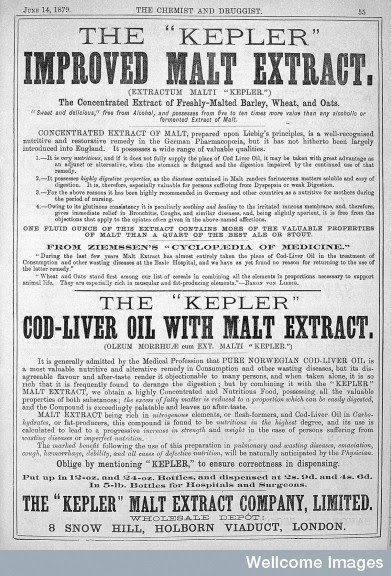
Also, before their partnership, Burroughs had added to the list of products he sold, two brands which would prove to be among the most successful for Burroughs Wellcome & Co: Hazeline (an extract of witch hazel, marketed as face cream) and Kepler malt extracts (to provide nutritional sustenance).

So, when the two men added their signatures to the document shown above, Burroughs was very much the senior partner: he had persuaded Wellcome to move across the Atlantic to London and had put up £1200 in relation to Wellcome's £800. Over the next fifteen years however, and as their business would flourish, their personal relationship would wither. So let's leave Burroughs and Wellcome in September 1880 with the ink still drying on their agreement and their futures ahead of them. The disintegration of their relationship can wait for another Blog post.

Images:
1/ Articles of Partnership between Silas Mainville Burroughs and Henry Solomon Wellcome, 27 September 1880 (WF/E/02/01/02/27)
2/ Silas Mainville Burroughs, photographed in 1885 (Wellcome Library no.
14368i)
3/ Advertisement for Kepler from 'Chemist and Druggist', June 14th, 1879


(For more on Burroughs the salesman, see the following article: Roy Church, 'The British Market for Medicine in the late Nineteenth Century: The Innovative Impact of S M Burroughs & Co', Medical History 2005 July 1; 49(3): 281–298 (available online through PubMedCentral) and the book Burroughs, Wellcome & Co.: Knowledge, Trust, Profit and the Transformation of the British Pharmaceutical Industry, 1880-1940 by Roy Church and E. M. Tansey (Crucible Books, 2007)).

Tuesday, August 31, 2010

Wellcome Library Insights - September and October


Our popular Insight sessions offer visitors to the Wellcome Library an opportunity to explore the variety of our holdings. These free sessions are thematic in style, last around an hour and offer a chance to learn about our collections.

The next series of Insights begins this Thursday afternoon (2nd September) at 3pm, with a session exploring the manuscripts and early printed books once owned by William Morris that are now part of the Wellcome Library's collections.

You can pick up your free ticket for this event from the Wellcome Collection Information Desk from 13.30 on the day. Tickets are issued on a first-come, first-served basis: for more details, see the Wellcome Collection website.

Our other Insights sessions for September and October are:

The Quest for Perfect Skin - Thursday 9th September, 3-4pm

Mind and Body, Heart and Soul – Thursday 23rd September, 6-7pm

London Faces - Saturday 2nd October, 2.30-3.30pm

Anatomies of London - Thursday 7th October, 6-7pm and Saturday 9th October, 2.30-3.30pm

Henry Wellcome: His Life and Work - 21st October, 3-4pm

For more details on attending the sessions, please follow the links above to the appropriate pages on the Wellcome Collection website.

For a preview of other Wellcome Collection events over the next few months, have a look at this post on the Wellcome Collection Blog.

Image: Liber chronicarum, previously owned by William Morris.

Thursday, July 22, 2010

Any new acquisitions?

The online journal Museum practice often publishes useful case-studies for curators on such subjects as exhibitions, lighting, conservation, and cultural politics, but it was a surprise to read in an article from 15 July 2010 that "the Henry Wellcome collection has not been added to for around 75 years". 75 years would take us back to 1935, presumably meaning around the time of Sir Henry Wellcome's death in 1936. If the author means that Henry S. Wellcome's personal collection has not been added to since his death, how could anyone add to that except the man himself? But if it refers to those collections which Wellcome created and left to posterity, and which are named after him today -- of which the Wellcome Library is one -- then, well … we must not believe everything we read in the press, even the quality professional press.

There are in fact dedicated web-pages on the Wellcome Library's website devoted to "Newly available items", of which all but the section headed "Retrospective cataloguing" actually consists of new additions to this part of "the Henry Wellcome collection". They record the steady stream of carefully selected items arriving in packages and cardboard boxes and tubes in Wellcome Library offices. The page devoted to iconographic documents such as prints, paintings, photographs and drawings lists the last three months' additions: at the time of writing there are fifty items on that page alone, and that's certainly not from the most prolific department. On that page the items acquired range in date from around 1700 to 2010, and come from Italy, Germany, Austria, France, Bangladesh and the UK.

Two items acquired in the last decade deserve special attention just now, because at the beginning of July 2010 they were put on permanent public display in the Wellcome Library for the first time -- not perpetual display, but continuous display for a few years. One (left) has already been mentioned in a posting on this blog: the portrait of Benjamin Jesty, the first vaccinator, which the Wellcome Library repatriated from South Africa where it had been preserved for many years by Jesty's descendants.

The other (above) is notable on several accounts. It is an eighteenth-century Dutch painting, which is a rarety in itself, since eighteenth-century paintings from the Netherlands are as rare in British collections as British portraits by artists of Dutch descent are common. This picture was painted, probably in Rotterdam, by the Prague-born painter Johannes Zacharias Simon Prey (1749-1822). It was found offered for sale, unframed and with no earlier provenance, in Antwerp by the dealer Rafael Valls who bought it there for the Wellcome Library.

The painting is an allegory, and like many allegories it is complex, but rewardingly so. There are three scenes, which are linked to each other. They start on the left, with the three people in ancient garb. They have the attributes of Apollo (the bow with which he, as the inventor of medicine, killed the Pythia), Aesculapius (his rod entwined by a single snake), and apparently hybrid features of Hippocrates, Galen and Celsus (a skull and syringe, and the Greek proverb "know thyself", the catchphrase for anatomy). This venerable group represents Traditional Western Medicine as it was preserved in the writings attributed to Hippocrates and Galen, was rediscovered in the fifteenth and sixteenth centuries, and then formed the foundation of western academic medicine from the sixteenth to the end of the eighteenth century.

In the second scene, in the foreground (illustration above), putti lay before these ancient sages a box of exotic riches and materia medica of the kind brought back from South Africa and the East Indies to Europe by the VOC (Vereenigde Oostindische Compagnie, or Dutch East-India Company), as well as imports from the colonies in Brazil: coral, elephant's tusk, exotic minerals and plants, and precious stones. The subject is similar to the one shown in this 18th-century print (image right): the Dutch fleet is shown below, while above are the putti presenting its cargo of materia medica to Apollo, Mercury and tutelary pagan deities. The effect of these discoveries on natural history, medicine and pharmacy is brilliantly illuminated in Harold J. Cook's award-winning book Matters of exchange: commerce, medicine, and science in the Dutch Golden Age (Yale 2007)

The third scene, on the right (image top), shows materia medica being turned into medicines in a chemical-pharmaceutical laboratory. On the left of this scene stands a man working a mortar and pestle. He looks out at the viewer, and his mortar is inscribed with the artist's name "Is. Prey": these are heavy hints that this is a self-portrait of Johannes Prey. The mortar bears the date 16 July 1791 ("17 - 7/16 - 91"), when Prey would have been aged 42 (click on image at top to enlarge). The laboratory scene shows "today", i.e. the summer of 1791; it is depicted in grey, almost grisaille, contrasting in colour with the Rubensian splendour of the ancient Greeks on the left.

One of the items on the steps in the foreground is a book containing two colour illustrations. The one on the left shows the head of the femur and the one on the right shows black and white squares. These have been identified by Dr Monique Kornell as two works by the printmaker Jan L' Admiral which were published in books by well-known Dutch authors in the 1730s (i.e. nearly sixty years previously). The black and white squares show the different skin colours of North Africans ("Ethiopians"): this is a plate to Bernhard Siegfried Albinus's De sede et causa coloris aethiopum et caeterorum hominum (Leiden 1737), and it is the sole plate to that book. The two squares show skin from the breast of a black woman and the lower image shows a "nail removed from her thumb", part of a discussion of the physical characteristics of racial types. The other illustration, showing the hip bone and top of the femur, was published in Frederik Ruysch's Icon membranae vasculosae (Leiden 1738). Both are colour mezzotints made by L' Admiral, the inventor of intaglio printing in colour, for two of the most illustrious scholars of the time in Holland, Albinus and Ruysch. The painter seems to have been remarkably well-informed about Dutch innovations in print-making techniques. He includes them as modern contributions to medical knowledge on a par with the discoveries in zoology and botany which the VOC had enabled through its arduous voyages of discovery.

So on the left of the painting we have what Prey depicts as the glorious tradition of western medicine (obviously differing from Professor David Wootton's view of it as thoroughly inglorious). In the foreground we have the results of the Dutch trading empire which has brought into Europe new materia medica that enriches and transforms that ancient learning, together with the new medical and anatomical knowledge created by such moderns such as Albinus (image left), Ruysch and L' Admiral. In the middle we have Prey recording this event in mid-July 1791. And on the right we have the drab world of "today" (1791 and after) in which the ingredients are transferred to a chemical laboratory and turned efficiently into medicines. The medicines are shown in jars on the back wall of the laboratory.

And as if that's not matter enough, there's the Rotterdam connection. And the significance of the marble steps on which the putti recline. And the patron or institution for which this painting might have been commissioned. And other points for which there is no time or space in this posting, and will have to await discussion elsewhere. The nuances are arguable, and there may be a significant source for the representation of the laboratory, but the above seems to give the gist of the work. The painting can now be seen in the Reading Room of the Wellcome Library if anyone wants to check any details for themselves. And if anyone has any other ideas about the interpretation of the picture, please add them as a Comment to this posting or send them to the Wellcome Library.

The date 1791 is literally at the centre of the painting and historically central to its significance: the midst of the French revolution in which so many old traditions were swept away in the intellectual world as much as in the political or architectural. Galen's vocabulary was found wanting and was replaced by new coinages such as Bichat's tissues; the work of Lavoisier on gases undermined the humours; and the Ancien Régime's dominance of physicians over surgeons could no longer be taken for granted. The painting is a retrospect on a great intellectual and practical tradition at a turning point in its transformation into something recognizable to some extent today.

No new additions to the Henry Wellcome collection? On the contrary, to discover works like the above, keep watching those rolling web pages (also available as RSS feeds) which record them as they come in! In fact it would be something of a scandal had there really been no new additions, as Sir Henry Wellcome (right) directed in his will that his estate should be used "for the purchase and acquisition of books, manuscripts, documents, pictures, and other works of art and other objects and things for [his] Research Museums or Libraries". The two paintings that have now been added to his collection and put on public display fulfil the terms of his bequest and would surely have delighted him.


Top and details: Oil painting by Johannes Zacharias Simon Prey, 16 July 1791. Wellcome Library no. 466059i
Apollo and the VOC fleet: Coloured engraving, 17--. Wellcome Library no. 93i
Black and white skin: Colour mezzotint to Dissertatio secunda de sede et caussa coloris Aethiopum et caeterorum hominum, Leiden 1737, Wellcome Library no. 5761091
Bernhard Siegfried Albinus: Mezzotint by J. J. Haid after C. de Moor. Wellcome Library no. 461i
Post-revolutionary doctors: Coloured lithograph by F-S. Delpech after Louis Boilly, 1823. Wellcome Library no. 16325i
Henry S. Wellcome: Bronze by G.F. Edgardo Simone, 1930. Wellcome Library no. 47277i

Pole to Pole with the Wellcome Library


The latest issue of Wellcome News - the Wellcome Trust's quarterly magazine rounding up its latest activities - contains an article based on material from the Wellcome Library, exploring the involvement of Henry Wellcome's pharmaceutical company with the last Antarctic expedition of Captain Robert Falcon Scott. The article is also available through the Wellcome Trust's website.

Such material is actually - to pardon the pun - the tip of the iceberg when it comes to our collections relating to the Polar regions, as this Sources Guide shows. This is just one of the many guides which exist to provde detailed thematic guidance to our archive collections. Readers with an interest in these regions are also advised to search on our catalogue for more items of interest, such as - perhaps - this illustration of the launching of the first balloon within the Arctic Circle (taken from Edward Daniel Clarke's Travels in various countries of Europe, Asia and Africa (1820-1823):