Showing posts with label psychiatry. Show all posts

Friday, March 9, 2012

War and the psyche

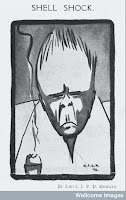
Lt J P D Hewatt, 'Shell Shock', 1917
Readers who consult the online Archives and Manuscripts sources guides may have noticed some recent changes to the guides on war, medicine and health. In order to streamline these somewhat, the content has been rearranged, into War, Medicine, and Health: general and guides relating specifically to World War I and World War II, and a significant amount of material relating to psychiatric and psychological issues to do with warfare pulled out to create a new guide, War, Psychiatry and Psychology.

We already held some important materials on these latter subjects, such as the observations by Charles McMoran Wilson, later Lord Moran, of the new phenomenon of 'shell shock' on the Western Front during the Great War, material in the Bowlby and Winnicott papers on the effects of wartime evacuation on children, records of S H Foulkes' work with the 'Northfield Experiment' during the Second World War. However, a number of more recent acquisitions, such as the papers of H V Dicks relating to his involvement in 'de-Nazification' of Germany after the war and his writings on the psychology of totalitarianism, and several collections of papers of individual psychologists received along with the records of the British Psychological Society have additionally developed our strengths in this area and this is reflected in the creation of  this new guide.

This turns out to be especially timely given the news of this forthcoming event, Psychoanalysis in the Age of Totalitarianism, bringing together historians, social theorists and psychoanalysts to explore the impact of the Second World War and totalitarianism on psychoanalysis, and of psychoanalysis on the understanding of the war and totalitarian systems. Organised under the auspices of the Institute of Psychoanalysis, the Pears Institute for the study of Antisemitism (Birkbeck, University of London), Birkbeck College, University of London, and the Centre for Psychoanalytic Studies of the University of Essex, it will take place in the Wellcome Collection Conference Centre, 21-22 September 2012.

Wednesday, February 8, 2012

Turn on, tune, in...investigate your subconscious?


On 19th April 1943, Swiss chemist Albert Hofmann accidentally got some of the chemical he was synthesising onto his fingers, resulting in what he described as a dreamlike intoxication that lasted for two hours. His employers, Sandoz pharmaceuticals were quick to recognise that this new drug, lysergic acid diethylamide, or LSD, had a lot of potential. It was soon being marketed as a psychiatric drug under the trade name Delysid.

Meanwhile in Worcestershire, Ronald Sandison had taken up his first consultancy post at Powick Hospital. Originally built in 1847 to house 200 inmates, the former Worcester County Pauper and Lunatic Asylum was home to around 1000 patients by the 1950s. In his autobiography, A century of psychiatry, psychotherapy and group analysis, Sandison described the hospital as “bleak in the extreme…I discovered that the heating was defunct, many of the internal telephones did not work, and the hospital was deeply impoverished in every department.” As part of attempts to transform the hospital by Sandison and his colleagues, in 1952 he embarked on a study tour of Swiss psychiatric hospitals. It was during this visit that he met Albert Hofmann and became aware of the therapeutic potential of LSD.

Returning to England with a supply of the drug, Sandison developed what he referred to as “psycholytic therapy”, using small amounts of LSD to assist patients in exploring their subconscious. By 1958, Powick Hospital had a dedicated LSD treatment unit, where Sandison worked until he left the hospital in 1964. LSD therapy continued at Powick for a further two years after Sandison’s departure. The increasing publicity around recreational use of LSD by figures such as Timothy Leary and Aldous Huxley, along with tighter regulation of its use, led to Sandoz withdrawing the drug from the market.

After leaving Powick Hospital, Sandison never again used LSD therapy. However, he continued to believe in its value as a treatment when used in a clinical setting.

Although Ronald Sandison is primarily remembered for his pioneering work in LSD therapy, this was far from his only area of expertise. His personal papers, now available at the Wellcome Library as PP/SAN, show Sandison as a medical renaissance man, who was successful in a number of different fields during his career. Besides his work with LSD and other psychedelic drugs like mescaline and psilocybin, the collection covers his work with the Group Analytic Society, (whose archives are also held by the library, as SA/GAS, and the Pastoral Development Group, as well as his work in in family planning, and with alcoholics in Shetland. Also included are a series of dream diaries kept by Sandison between 1948 and 2009.

Image:
Pink elephants on parade LSD blotter, from Wikimedia Commons - click for copyright information.

Wednesday, October 19, 2011

Louis Wain in Willesden

Amidst the much-publicised closing-down and boarding-up of some of the public libraries in the London Borough of Brent, there has been a cheering event from Brent Archives and Museum at Willesden Green Library Centre: their exhibition of works by the painter of cats, and sometime psychiatric patient, Louis Wain (1860-1939), who resided on Brondesbury Road in Kilburn (now in the borough of Brent) before his confinement in a series of asylums. The exhibition Communicating through cats: the art and mind of Louis Wain ends on Saturday 29 October 2011 (open Mon.-Sat. 10-4). It contains a good cross-section of Wain's anthropomorphic pictures of cats –- bicycling, cricketing, tea-drinking and so on.
Among the rare and remarkable works on display are two large mirrors painted by Wain for his fellow-patients at Bethlem Hospital at Christmas times (one shown above left), lent by the Bethlem Art and History Collections Trust.

No less surprising are examples of ceramic cats designed by Wain as Cubist pastiches. Their rarity may be explained by the unconfirmed story that the stock of them was sunk by a German torpedo on a cross-Atlantic crossing. Marine archaeologists of the future who are not familiar with Wain will have great difficulty in identifying these works, with their unusual combination of Cubist, Egyptian and Art Deco associations. These two examples are on loan from Chris Beetles Gallery.

Wain also knowingly applied historical and fanciful styles to his paintings, a fact which led a psychiatrist writing in a national newspaper to misinterpret them as evidence of psychosis: the story is well set out in the exhibition. That interpretation is however still accepted by some. [1]

Two drawings from the archives of a psychiatrist, Noel Gordon Harris (1897-1963), are lent by the Wellcome Library.
They are impressively displayed in a showcase to reveal a typically mysterious inscription on the verso of one of them, spoken by a smiling cat: "I have more mouth than I want to open, but don't look, it is very dark inside. But I will send you a pretty message from it." That sums up the title of the exhibition, as interpreted in Wain's idiosyncratic manner. Communicating through cats is simultaneously humorous and sinister. An approachable and rewarding exhibition.


[1] Terry Castle, 'Do I like it?', London review of books, 28 July 2011, pp. 19-23

Wednesday, May 11, 2011

Archives and manuscripts cataloguing, April 2011

It’s (almost) all in the mind: the focus of this month’s completed cataloguing is largely on the mind, on psychology and psychiatry. As has been mentioned in previous blog posts, the archives of the British Psychological Society have been deposited at the Library and there is a long-running project making these available: the material is being repackaged in acid-free folders, and the catalogue records updated to take account of its new format. Last month we highlighted several collections from this source that had been released and this month another became available: papers relating to the behavioural psychologist Edward Chace Tolman (1886-1959) (PSY/TOL). Tolman’s papers are described in detail in their own blog posting; of particular interest are the items relating to his work on rats learning in mazes and, in complete contrast, those on his political stance during the McCarthyite period in the USA, when in the interests of academic freedom he took legal action against the imposition of a Loyalty Oath.

Remote on the spectrum from Tolman’s behaviourism is the work of Roger Money-Kyrle (PP/RMK), a leading Kleinian psychoanalyst with personal links to many other figures already documented in our holdings (for example, Melanie Klein herself, and Henry Dicks whose papers were recently released and described in another blog post). Money-Kyrle’s papers have been described here; the bulk of them consist of case histories and his development of these into writings.

Turning from the mind to the brute physical facts of war, this month the archives and manuscripts department acquired and catalogued a fascinating memoir of service by a woman doctor in the Second World War. Dr Muriel "Molly" Newhouse is primarily remembered for her work in occupational health and in particular establishing the connection between asbestos and mesothelioma: however, like many other medical men and women she found herself in 1942 (having qualified in 1936) called up into the Royal Army Medical Corps. Her unit followed the D-Day forces into Normandy and, as is described in a blog post, she found herself called upon to treat the sick, carry out surgery and on at least one occasion plunge into midwifery, delivering the baby of a local farmer’s wife. In her time in Normandy she never went more than seven miles inland: subsequent postings took her further afield, to India and to Singapore, where she cared for prisoners recently released from the horrific conditions of Japanese PoW camps. A blog post has described her memoir, and the item itself can be viewed in the catalogue as MS.8766.

Image: Fowler's phrenological head, from Wellcome Images (image number L0057592).

Wednesday, January 12, 2011

"Mental: a history of the madhouse" available again (briefly)

Mental: a history of the madhouse is "a documentary which tells the fascinating and poignant story of the closure of Britain's mental asylums". It was originally broadcast on 17 May 2010 and in July 2010 was discussed in a posting on the Wellcome Library blog.

The film is now once again available for UK viewers free of charge on the BBC iPlayer for a limited period (11-21 January 2011). The Wellcome Library offers free internet access, so anybody who does not have easy access to the internet and can visit the Wellcome Library may watch the film in the Library free of charge.

Friday, January 7, 2011

The Brain: A Secret History


Beginning last night on BBC4, The Brain: A Secret History, is a new three part documentary series which illustrates the history of attempts to understand and manipulate the brain.

In the first episode of the series, 'Mind Control', presenter Dr Michael Mosley discussed the famous experiments of Ivan Pavlov, B F Skinner and Stanley Millgram. The documentary mixed archive footage with interviews and also included Mosley visiting the Wellcome Library to look at the personal papers of controversial psychiatrist William Sargant.

The episode is available to viewers in the UK through the BBC iPlayer, where it will be joined by the other two episodes once they air, until the 27th January.

Image credit: BBC

Thursday, December 16, 2010

Archives and Manuscripts cataloguing statistics: November 2010

This month's cataloguing statistics for archives and manuscripts, like last month's, are dominated by two major groups of archive records. (New cataloguing accounts for all the records added to the database, although behind the scenes retroconversion work continues on the catalogue of the Chartered Society of Physiotherapists (SA/CSP).)

The first of our new cataloguing highlights is the archive of Henry V. Dicks (1900-1977), psychiatrist (PP/HVD). Dicks’s papers cover two highly contentious topics: sex and fascism. In the aftermath of the Second World War Dicks interviewed many former Nazis as part of research into questions about authoritarian psychology and collective psychopathology. Later, his work at the Tavistock Institute centred on marital dysfunction and the couple as a unit of therapy. His papers comprise 14 boxes and are described in more detail in a recent blog posting.

Our second highlight relates to the archive of Action on Smoking and Health (SA/ASH), or ASH, which has been held at the Wellcome Library since the early 1990s. The organisation is still an active one and thus, of course, generates new material for the archive: recent transfers have now been catalogued and the result is a doubling in size of the collection, now comprising 167 boxes and including material up to the early 21st century. The new material documents a period when the tobacco industry was very much on the defensive, striking back against attempts to restrict its advertising and sponsorship activities. Again, a recent blog posting describes the additions in more detail.

A third highlight relates not so much to new content for the archives database, as to what one can do with that content. Library users will be aware that archive and manuscript material is ordered online using the same system (the same reader's ticket, the same password, and the same interface) as one uses to order books from the stacks. In order to make this happen, periodic movements of data between the two databases have to happen: item-level records - those records that relate to an actual file or volume that can be consulted in the reading room as opposed to records from higher in the hierarchy that represent bigger intellectual groupings - have to be harvested from the archive database, converted to the appropriate printed-matter standard and loaded to the main catalogue. Our last harvest took place on either side of the final weekend in November, and moved over 14,000 new records into the main catalogue, making it possible to order much recently-catalogued or recently-retroconverted material. Collections affected include the papers of Sir Ernest Chain (PP/EBC), Alice Stewart (PP/AMS), the MRC Blood Group Unit (SA/BGU) and many others set out in recent cataloguing bulletins (see October, September and August for some recent examples).

Image: a montage of items from the archives of Action on Smoking and Health (ASH), supplied by Wellcome Images.

Wednesday, November 24, 2010

Psychology, authoritarian regimes and modern marriage

The papers of the influential psychiatrist Henry Dicks (1900-1977) are now available in the Wellcome Library (Ref. PP/HVD). Having been born in Estonia to an English father and German mother, Dicks spoke English, Russian, German and French. This linguistic flexibility bestowed upon him the facility to examine, compare and comment upon different European cultures. He brought his professional psychiatric training to bear on an analysis of what underlay the great tides of human affairs that swept across the continent during his lifetime, writing in 1972 that "...currents of group and mass action remain enigmatic if we exclude from their study the influence of the strivings and roles of individual actors – leaders and led". [1]

Dicks is well known for his work during World War II when he served in the British army as a psychiatrist. He interviewed and conducted psychological evaluation of German prisoners of war and assessed the prevalence of national socialist ideology. He made reports on the state of morale of German forces, recommended how to conduct psychological warfare and target propaganda for maximum effect and, for a period in 1941, was physician in charge of Rudolf Hess. During the latter stages of the War, and in the immediate post-War period, Dicks provided similar expert opinion to the Supreme Headquarters Allied Expeditionary Force and the Allied Control Commission for Germany, including on the ‘de-Nazification’ of German army personnel. All this activity is represented in his papers, which include many of the official reports and memoranda that he produced and his notes on interviews with individual prisoners of war. Having collaborated with the sociologist Edward Shils during this period, Dicks went on to work with him on a RAND Corporation-financed study of Soviet soldiers who fetched up in the West.

Dicks was to draw on this first-hand experience in his repeated return to questions about authoritarian psychology and collective psychopathology. His first work on this topic, a "psychopathological study of European culture patterns", written in the late 1940s, remained unpublished (a draft is contained in the collection: ref. PP/HVD/B/3/2). During the next 3 decades, however, he published and lectured widely on topics such as 'the Bolshevik personality' and 'the Nazi character'. His papers bear witness to the interdisciplinary nature of his preoccupations which ranged across the behavioural sciences, sociology, social philosophy, and history. Between 1967 and 1968 he conducted face-to-face interviews with those in prison in Germany for war crimes and in 1972 published a monograph on Licensed Mass Murder: A Socio-psychological Study of Some SS Killers, which is still much-quoted today.

In addition to the attention he gave these interests, the bulk of Dicks's career was spent in clinical practice, teaching and research at the Tavistock Clinic in London where, apart from the interruption of the war years and a brief spell in Leeds, he worked from the early 1930s until the mid 1960s. Only a few papers relating to his pre-War career survive, but the collection does include material reflecting his wide-ranging professional interests from the 1940s onwards, including his work in the field of marital therapy. During the 1950s and 1960s Dicks and his colleagues at the Tavistock pioneered new and influential approaches to the couple as a unit of therapy, extending the theory of object relations, as developed by Klein, Fairbairn and others, to the analysis of marital dysfunction.

The 14 boxes of Dicks’s papers now available in the Library bear testament to the way in which he moved his critical focus back and forth between the macro-social currents of European society and the micro-social unit of the modern marriage. We hope that, as a result, those working in many and varied fields of study will visit the Library to consult the collection.

[1] Henry V. Dicks, Licensed Mass Murder: A Socio-psychological Study of Some SS Killers (Sussex University Press, 1972), p.17.

Image: Cover of Dicks's Marital Tensions (credit: Google Books)

Author: Jennifer Haynes

Thursday, September 30, 2010

Graphic Medicine

I’m not a great aficionado of comics or graphic novels. I know who Alan Moore and Stan Lee are; various (male) friends and family have raised my awareness of Marvel and DC Comics; I’ve read the odd issue of Swamp Thing, but the term graphic medicine was new to me. I came across it when a list of recommendations for the Library’s Medicine & Society Collection landed on my desk. They all came from the Graphic Medicine website created by Dr Ian Williams. This excellent website identifies and reviews graphic novels relating to all aspects of health and medical culture. Since the Medicine & Society Collection is all about exploring key medical and health themes in contemporary society, graphic medicine seemed like a perfect fit.

Definitions
A quick aside here: The distinction between graphic novels and comic books is imprecise, but graphic novels tend to come in bound book format and are usually a single continuous narrative, they can be fiction, biography or non-fiction. The term ‘comic books’ is generally used for single unbound pamphlets that serialise a story in weekly issues traditionally bought from newsagents. The Wellcome Library also has a selection of comic books, most of which are public health information pamphlets.

Variety
Having had a chance to examine some of the graphic novels in more detail, I’ve been impressed by the range of topics covered and by the diversity of authors working in this relatively small field:

There are patient accounts of illness and treatment, such as Cancer made me a shallower person by Miriam Engelberg and Spiral Cage, Al Davison’s autobiographical account of living with spina bifida.


There are views from inside the health care system such as Psychiatric Tales by Darryl Cunningham who worked as a health care assistant in an acute psychiatric ward, and Couch Fiction, an account of a therapy session from the points of view of both the patient and the therapist.


Perhaps surprisingly, there were quite a few accounts of carers and family members’ experiences of living with a sick person, such as Epileptic, a memoir of growing up with a brother who has epilepsy, and Blue Pills, a love story about a man’s relationship with a woman and her son, both of whom have HIV.


There are also more traditional comic formats such as the manga style Monster, a thriller about a hospital doctor tracking down a serial killer. The manga novels offer an extra challenge to readers in English because, although they are translated from the original Japanese, they still read from right to left, which can take some getting used to.


The authors are a mix of ages and sexes, and come from Japan, the United States, France and the UK, and there are almost as many different and styles and techniques as there are authors.

Medical education
Along with the development of medical humanities, literature and arts are proving to be useful tools in medical education and patient care. Patient narratives can give health care professionals a valuable insight into the patient’s point of view, but a recent BMJ article on graphic medicine suggested that by using techniques such manipulation of scale, text and image, graphic novels have “the ability to convey visceral understanding in ways that conventional texts cannot” [i]. Their ‘unreal’ quality can also make it easier for trainee health practitioners to discuss difficult or complex issues of ethics or interpersonal communication. In the increasingly global field of public health, they can be particularly useful for reaching young people or non-native speakers.

Pay attention here’s the library bit...
All the titles can be found at the same location in the Library, a specially created classification for graphic novels in the Medicine & Society Collection: HHLC. This allows readers to see the variety of themes amongst the graphic novels and directly compare their different styles. Library catalogue users can also search by genre for ‘graphic novels’ to see what is available across the collections.

As an emerging genre, graphic medicine offers a vivid representation of how illness, disability and health issues can touch people in so many different ways: personally, professionally, directly and indirectly. They are an exciting addition to the Library collections, and one that I look forward to expanding in the future.

[i] Green, Michael J. and Myers, Kimberly R.; Graphic medicine: use of comics in medical education and patient care in BMJ Vol. 340 Iss. 7746, 13 March 2010

Author: Lalita Kaplish
Thursday, July 8, 2010

Asylum portraits

"Mental: a history of the madhouse" was a 60-minute television documentary in the BBC Four/Open University "Out of Mind" Season, broadcast in the UK in May 2010. [1] It told the story of the closure of Britain's mental asylums. To quote the press release, "In the post-war period, 150,000 people were hidden away in 120 of these vast Victorian institutions all across the country. Today, most mental patients, or service users as they are now called, live out in the community and the asylums have all but disappeared. Through powerful testimonies from patients, nurses and doctors, the film explores this seismic revolution and what it tells us about society's changing attitudes to mental illness over the last sixty years." Powerful? Overwhelming.

Among the interviewees were patients, members of medical and nursing staffs, the historian Dr Peter Barham, and Dr Henry Rollin FRCP FRCPsych, emeritus consultant psychiatrist at Horton Hospital, Epsom, and former Librarian of the Royal College of Psychiatrists. Dr Rollin described the grimly low levels of medical care in many of those asylums, and of care in general. Historic film footage of crude brain surgery was shown. Of prefrontal leucotomy Dr Rollin confessed "I had the misfortune to recommend sixteen patients [for the operation] ... it was of no benefit whatsoever, and some of them had the tragedy of personality change." It seemed at times that the only escape from the tyranny of routine lay in the menace of maltreatment. A former psychiatric nurse in Newcastle told of a difficult patient being dragged away and having a bucket of cold water being poured over him by a staff member who then jammed the bucket on the patient's head. A young woman who suffered panic attacks went to one asylum and ended up staying inside for thirty-three years.

As an illustration of a classic old-style asylum, the programme focused on High Royds near Leeds (illustration top), which had all the right qualifications: a Psycho-type silhouette at twilight, miles of corridors, once fine but now decayed Victorian decoration, the indispensable looming water-tower, and of course a proposal to turn it into luxury residences when it closed in 2003.

High Royds. Drawing by Paul Digby, 2003-4. Wellcome Library no. 643245i

The Wellcome Library has a large drawing made by an artist in High Royds in 2003-2004 as part of the ritual commemorations that were felt to be required at the time of its decommissioning. It looks like drawings done by patients to describe their gloomy life in the asylum. In fact, as film of the High Royds corridors showed, the drawing is merely an atmospheric representation of the actual interior in which patients spent their "empty and repetitive asylum life". There was a "quasi-prison atmosphere" (Dr Rollin again). The film-makers found articulate people who were able and willing to describe their experiences at High Royds and other asylums, whether as patients or as staff. These interviews are priceless.

The film-makers were careful not to make High Royds seem like a scapegoat: after describing episodes of brutality towards patients, the commentary stated that there was "no evidence of this kind of treatment at High Royds" which on the contrary was "in the forefront of the drugs revolution" in therapy. Some of the reminiscences on the High Royds website are quite complimentary, though others, it must be said, recall much unpleasantness. Other asylums in Newcastle, Sussex and Buckinghamshire also featured in the narrative, often with superb historic film footage.

The film showed the long process leading to the closure of the asylums. The first real "breaking point with the Victorian period" (Barham) was the 1959 Mental Health Act. Dame Pat Hornsby Smith MP called for "sympathy and understanding" to be the principles underlying treatment of the mentally ill. In 1961 Enoch Powell as Minister of Health 1960-1963 started a war on the asylums with a remarkable speech seizing on the image of the "looming water-tower and chimney combined" as the emblem of the asylum. Powell urged "the elimination of by far the greater part of this country's mental hospitals as they are today". He lost battles but won the war when Care in the Community was introduced. But Dr Rollin was no happier about the new arrangements than about the bad old days of the asylum. "The whole concept of Community Care is a disaster: I don't think the community cares" (NIMBYism was one of the problems he had in mind).

Mental illness is always with us, but individuals and institutions can be better than the film's account of what was offered in the asylum regime that Powell and others deplored. Last month I visited Bethlem Hospital to see an exhibition of a suite of portrait prints of patients and doctors at the Bethlem and Maudsley Hospitals in south London. Bethlem Royal Hospital is now in the London Borough of Bromley, and is approached by Monks Orchard Road, a leafy avenue with fine large houses down one side and the hospital's extensive grounds on the other, shielded by attractive woods and shrubberies. Inside the hospital grounds, as open as any ordinary hospital, one almost seems to be arriving at a National Trust country house: there's the chapel, there's the main house, where's the old stable block for cream teas?

On the other side of a meadow of wild flowers is a low building marked as The Bethlem Gallery, where the exhibition had been installed. (Note, behind the gallery, even here is the inevitable "looming" water-tower.) Most of the other people there are staff, and talking to them, it is striking how many of them are aware of the hospital's infamous history in formidable and less therapeutic buildings, first in Robert Hooke's palazzo in Finsbury (1676-1815: below left) and later in the building that now, shorn of its wings, houses the Imperial War Museum (1815-1930: below right). They appreciate the present environment of the hospital, and it is hard to believe the patients do not do so too, at least those in convalescent mode.

Two views of Bethlem: above left, drawing by Thomas Rowlandson, 1789; above right, coloured aquatint, 1817. Wellcome Library nos. 536228i and 39200i.

Access to the Gallery and to occupational art-activities is provided. The portraits on show in the Gallery are colour etchings by Gemma Anderson, a talented artist from Northern Ireland who trained in printmaking in London at the Royal College of Art. The artist is present (right), and it is touching to see her talking to a former patient, "Frederick", who sat to her for his portrait (below). In the clear light of the white-walled gallery, the etchings are beautifully exhibited in frames, each one a finely wrought tribute to an individual person.


So striking are the portraits, and so unusual, that the Wellcome Library has bought the sixteen prints that form the complete set Portraits: patients and psychiatrists. They mark a new step in psychiatric portraiture that mirrors the transition from the closed asylums of the past to the hope for a better present and future. They deserve a notice of their own, if not more than one: watch this space.

[1] Director: Chris Boulding. Producer: Adam Jessel. Executive Producer: Denys Blakeway. Archive Researcher: Peter Scott, for Blakeway Productions. No longer available on television but the Wellcome Library has a DVD of it.

Tuesday, March 23, 2010

Sterilization and murder of psychiatric patients 1934-1945

The Prinzhorn Collection in Heidelberg has opened a small exhibition of "Pictures of a forced sterilization" which were acquired in 2008. They are a series of pictures by Wilhelm Werner (1898-1940) who lived from 1919 in the asylum at Werneck in Bavaria.

The Nazi eugenic regulations came into force on 1 January 1934, and Werner was one of those forcibly sterilized as a result. From then until 1938 he made drawings of his experience, including one of a "Sterilization bus" flying the swastika flag. In the words of the Prinzhorn's publicity, "He transformed the experience of the degrading intervention into a series of imaginative and original pictures." In 1940 he was put to death as part of the Nazi "euthanasia" programme.

In addition, other works are on show by psychiatric patients who were also put to death between 1940 and 1945 because they were considered to be "lebensunwert" (unworthy of life).

Kabinettausstellung: Bilder einer Zwangssterilisierung. Wilhelm Werner (1898-1940) is at the Sammlung Prinzhorn, Heidelberg, 18 March-6 June 2010.

http://www.prinzhorn.uni-hd.de/aktuelles/index.shtml

Wednesday, April 1, 2009

William Sargant documentary


BBC Radio 4 today aired a documentary called Revealing the Mind Bender General.

Details:

James Maw on the controversial psychiatrist Dr William Sargant, who tested drugs on his patients with, some say, catastrophic results.

In the 1960s and 1970s he developed his controversial Deep Sleep Treatment in the Sleep Room of St Thomas's Hospital in London. James talks to some of those who worked under Sargant in the late-1960s and to some of his former patients, who all say that they are still suffering from his treatment to this day.


The documentary also investigates allegations that Sargant was involved in secret military experiments with hallucinogenic drugs.

Sargant's papers are held by the Wellcome Library, and the documentary quotes from Sargant's notes on patients undergoing Deep Sleep Treatment and also his correspondence with the writer Robert Graves (in particular, on Graves taking the drug psilocybin - "magic mushrooms").

The documentary is available through the BBC’s iPlayer for the next 7 days.

Tuesday, March 3, 2009

Donald Winnicott papers - expanded catalogue now online

Early in February a substantial additional tranche of papers of Donald Winnicott was received from the Winnicott Trust to add to the significant transfer they made last summer of the papers of this important figure in child psychiatry and the British school of psychoanalysis. The new material has just been added to the online catalogue.

Besides vastly expanding the number of Winnicott's unpublished papers in the collection, this new accession includes his appointment diaries, additional case-material (most of which is, however, currently closed for reasons of Data Protection), files on his interaction with child psychiatrists and the psychoanalytic community in Finland, and an assortment of documentation relating to his work with the Oxfordshire Evacuee Hostels Scheme during World War II. It was in connection with this scheme, which dealt with evacuees who were too disturbed to be billetted in ordinary households, that Winnicott met Clare Britton, who became his second wife, in her capacity as the project psychiatric social worker.

The catalogue can be viewed online by putting PP/DWW into the reference field of the search interface for the Archives and Manuscripts online catalogue. Clicking on the blue numerals in the lefthand column of the resulting hitlist will provide access to detailed descriptions, and the 'See in Context' link for a hierarchical 'tree' view of the catalogue.

Readers requiring access to the collection must obtain prior permission from the Winnicott Trust: further information available from Archives and Manuscripts

Monday, December 15, 2008

Melanie Klein Play on Radio 4

This Saturday (20th December) Radio 4 will be broadcasting a play based on the life of the influential child psychoanalyst Melanie Klein (1882-1960).

Mrs Klein by Nicholas Wright dramatises Klein's relationship with her own children.

Melanie Klein, a disciple of the teachings of Sigmund Freud, came to London in 1926 and was a key figure in the 'British School' of psychoanalysis. The therapeutic techniques she devised for children also had a lasting impact on methods of child care and rearing.

The Wellcome Library holds Klein's papers – a rich collection of material and part of our significant archival holdings on psychiatry and psychoanalysis.