Showing posts with label World War I. Show all posts

Friday, March 9, 2012

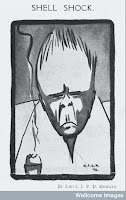
War and the psyche

Lt J P D Hewatt, 'Shell Shock', 1917
Readers who consult the online Archives and Manuscripts sources guides may have noticed some recent changes to the guides on war, medicine and health. In order to streamline these somewhat, the content has been rearranged, into War, Medicine, and Health: general and guides relating specifically to World War I and World War II, and a significant amount of material relating to psychiatric and psychological issues to do with warfare pulled out to create a new guide, War, Psychiatry and Psychology.

We already held some important materials on these latter subjects, such as the observations by Charles McMoran Wilson, later Lord Moran, of the new phenomenon of 'shell shock' on the Western Front during the Great War, material in the Bowlby and Winnicott papers on the effects of wartime evacuation on children, records of S H Foulkes' work with the 'Northfield Experiment' during the Second World War. However, a number of more recent acquisitions, such as the papers of H V Dicks relating to his involvement in 'de-Nazification' of Germany after the war and his writings on the psychology of totalitarianism, and several collections of papers of individual psychologists received along with the records of the British Psychological Society have additionally developed our strengths in this area and this is reflected in the creation of  this new guide.

This turns out to be especially timely given the news of this forthcoming event, Psychoanalysis in the Age of Totalitarianism, bringing together historians, social theorists and psychoanalysts to explore the impact of the Second World War and totalitarianism on psychoanalysis, and of psychoanalysis on the understanding of the war and totalitarian systems. Organised under the auspices of the Institute of Psychoanalysis, the Pears Institute for the study of Antisemitism (Birkbeck, University of London), Birkbeck College, University of London, and the Centre for Psychoanalytic Studies of the University of Essex, it will take place in the Wellcome Collection Conference Centre, 21-22 September 2012.

Monday, February 27, 2012

Extreme traveller of the early C20th

John Fulton Barr as a young man
A small collection of papers of John Fulton Barr (1868-1954) has just been catalogued and is now available for reader use. Barr qualified in medicine at the University of Glasgow in 1891. According to the donor of the papers, after the relatively tame postgraduate enterprise of going to Paris to study ophthalmology, Barr then joined in the Klondike Gold Rush, an episode in his career sadly not covered by the diaries and other items we hold.

Early in 1900, like so many of his compatriots, he sailed from England to serve in the Boer War. This period of his life is covered by three diaries (PP/JFB/A.1/1-3) and nearly 100 black and white photographs showing a very wide variety of aspects of the life he encountered in South Africa. There are also a couple of postcards from him to a Miss Isabelle Carmichael of Kilmalcolm, Renfrewshire. These materials form a welcome addition to our already significant holdings relating to the war in South Africa, 1899-1902, a topic of continuing interest to researchers.

Following this episode, Barr went to Japan, and was involved in a business venture - a salmon cannery - on the Kamchatka Peninsula in Siberia. Over the years he made several expeditions into this wild volcanic region. Even these days this area presents huge challenges for the traveller because of its inaccessibility and rugged terrain, although a tourism industry is developing. His surviving diary 1907-1909 describes his travels in Japan, China, and Russia and his expeditions into Kamchatka

There are frustratingly no diaries for the period from 1909 until 1917. Thus, although Barr was commissioned as a Lieutenant in the RAMC in August 1914, we only have an account of his war service from November 1917, along with a little, mostly official, correspondence. He was discharged from service in 1919, taking a position as surgeon on one of the ships repatriating chinese labourers after the War, in order to return to Asia.

After further travels in the Far East, and also trips to North America, the Baltic and Australia, Barr returned to the UK.  According to the Medical Directory he held a few hospital medical officer posts in Scotland, before establishing himself in Unstone, Derbyshire (near Sheffield), where he continued to reside after his retirement from practice c. 1940, and to keep up his diaries. He continued to take extended periods of travel: apart from fairly frequent trips to Scotland (mainly Gelston) and a couple to Ireland, he went to South America in 1924 and South Africa in 1932, revisited Japan in 1939, and visited Sri Lanka in 1940, as well as going to Wengen, Switzerland, on  several occasions during the 1930s.

John Fulton Barr in the 1940s
There is a complete run of his diaries covering his career and travels from 1917 until 1948, although according to the British Medical Journal Barr did not die until 1954.

This collection, though small, offers considerable riches to the researcher, adding to our existing treasure-trove of unpublished travel writings as well to our extensive holdings on War, Medicine and Health, and illuminates an unusual and enterprising medical life-course.


Saturday, December 24, 2011

Abbey Christmas

Clammy hands? Trouble sleeping? Counting down the hours until Christmas day? Like many of the library staff, you might be suffering withdrawal from medical history docu-drama and all-round national treasure Downton Abbey. That’s right, folks, medical history. Those of you who’ve managed to tear themselves away from Cousin Matthew’s puppy-dog eyes will surely have noticed the show’s preoccupation with all things sickly. The first series saw Lady Crawley’s miscarriage, Mrs Patmore’s cataract surgery, Bates’ ill-corrected limp and Isobel pressurising Dr Clarkson into performing pericardiocentesis on a dropsy patient. (Editor's note: we're drawing a veil over Mr Pamuk and his untimely ending at the erm, hands, of Lady Mary). But it was in the second series, set during the great war, that the medical storylines really started stacking up, with everything from gas-blindness to the poisons register getting a mention. With nine whole months to survive between Sunday’s Christmas special and the promised third series, Downton addicts will be casting around for something to feed their habit. And what better place to start than the Wellcome library?

Downton’s transformation into a convalescent home is evocatively suggested in two albums of photographs. In the series Lady Sybil trains as a VAD (voluntary aid detachment) nurse to tend to injured servicemen. Our albums come from slightly less privileged stock: Grace Mitchell was the daughter of tenant farmers in Theydon bois, Essex, and worked as a nurse during and after the war, in England and France and at casualty clearing stations in Cologne. Dorothy Waller was from a medical family - her brother Wathen was serving as a Surgeon-Captain in the Royal Army Medical Corps. Both Grace and Dorothy took photographs during their time at the 3rd southern general hospital, which included Oxford town hall and the Oxford examination schools. Pictured is Grace with patients in Oxford.


Downton’s shell-shocked Valet Mr Lang’s condition is brought to life in a 1917 film War Neuroses: Netley Hospital
which has been digitized and is available on the Wellcome Film youtube channel. The library also holds a collection of reprints of articles by Charles Samuel Myers, who coined the term “shell-shock” as well as diaries and notes made by Charles McMoran Wilson, when he was a medical officer on the Western front, which led to the publication of his The Anatomy of Courage in 1945.

The series climaxed with a perilous outbreak of Spanish flu, with Lady Grantham, faithful butler Carson, and Lavinia Swire all struck down.
The 1918 medical officer of health report for Kingsclere, close to Highclere castle where Downton is filmed, reveals how closely art imitates life - the influenza outbreak there ‘increased with the cold damp September till in October and November it was of alarming frequency causing 31 deaths.’ A further 5 deaths were attributed to the resulting pneumonia, against a total of 122 for the year. A public service film and a documentary with archival footage also record the outbreak.

If all of that’s piqued your interest but you’re still too lethargic to leave the house, why spend some of your Christmas book tokens on one of these:

Dismembering the male: men's bodies, Britain, and the Great War by Joanna Bourke

War, disability and rehabilitation in Britain: "soul of a nation" by Julie Anderson

A war of nerves by Ben Shephard

Spike Island: the memory of a military hospital by Philip Hoare

Women in the war zone by Anne Powell

As for “Patrick Crawley”’s amnesia and Matthew’s miraculously cured paralysis? We’re as stumped on those as you are…

Images:

A neo-Gothic building used as a hospital, with an ambulance in the drive. Watercolour by Walter E. Spradbery, Wellcome Library 47357i

Photograph from the album of Grace Mitchell, Wellcome Library 675224i

Compiled by Wellcome library staff and written by Jo Maddocks

Monday, November 14, 2011

The Mystery Correspondents

Arthur Balfour, politician; Robert Bridges, Poet Laureate; Sir James Crichton Browne, physician and psychologist…

In 2002, the Wellcome Library’s online catalogue of archives and manuscripts went live, replacing various large printed manuscript catalogues and several hundred typed lists of archives. Putting all this data online involved a campaign of retroconversion, the majority as part of a dedicated project and the remainder, as has been noted here before, undertaken over succeeding years by the archives department in odd snatches of time (typically, something to be done on a quiet Saturday morning). Almost all catalogues are now converted, with the Chartered Society of Physiotherapists (SA/CSP) the only major collection still to appear on line in full (this one is on the stocks and approximately two-thirds converted).
Andrew Carnegie, manufacturer and philanthropist; Austen Chamberlain and Neville Chamberlain, politicians; Randall Davidson, Archbishop of Canterbury…

Converting a catalogue is (relatively) simple, although the archivist faced with a 1980s word-processed document whose page-layout is generated entirely through the use of tab-stops might snort derisively at that claim! A more difficult issue is how to capture the information that was often held in indices, some many pages long, at the end of the catalogue. Turning a line in a catalogue that tells one that file PP/BAR/C/234 is a file of correspondence from people with surnames A-H, covering the following dates, into a database record, is fairly quick. But how to capture and store usefully the information held in an index of correspondents made up of lines like this one:

Bridges (Robert Seymour), poet. Letters, 1900-29 and n.d. C/234, 316, 367, 391, 502, 1089
Browne (George Buckston),
surgeon; Kt (1932). Letters, 1901, 1925. C/396; M/3, f. 17v.


Well, you could simply cut and paste the index into the Notes field at the collection’s top-level record, and get the desired result instantly. For some small collections with short indices this is what we have done. For the very long index, however – forty, fifty, one hundred pages long – this is obviously unsuitable: no-one is prepared to hold the scroll-down button for minutes at a time to reach the desired name. (Indeed, much thinking on web-design suggests that asking readers to scroll down at all loses up to a third of one’s audience.)

In an ideal world, Robert Bridges’ and George Buckston Browne’s names would of course appear on the catalogue records for each of the eight files listed in the sample line. To undertake this, however, would mean embarking on a lengthy process of handcrafting, picking each line apart entry by entry: just think of the two lines above, which would require one to visit and edit eight separate database records, and multiply that by hundreds. Readers would wait years for the information to be made available on that basis. What is needed is something that breaks up the index in at least a partly granular fashion, whilst being relatively quick and, ideally, something that can be done through routine, mechanical processes.

In recent years we have experimented with various processes that take word-processed indices and break them up using search-and-replace commands, splitting data in a way that enables them to be put in a spread-sheet and sorted before returning to word-processed form. We will spare you the details! – the upshot, however, is that with the expenditure of only a little time, many pages of index can at least be broken up into the data that relates to individual sections of the catalogue, thus enabling readers to make a better judgement of which letters relating to an individual are relevant, and which are not. In collections of family papers, in which each section may correspond to a family member, this is particularly useful, as it may be a particular family member, and him/her alone, whose correspondence is of interest. With some thought about the way the data in the original catalogue is shaped, this process can be done in hours or days rather than the months required to handcraft records for individual files: the work of the proverbial quiet Saturday, rather than a long-running process.

This process has been applied to various collections in the past, most notably the Hodgkin family papers (PP/HO). The latest collection to receive this treatment is the papers of Sir Thomas Barlow (PP/BAR), Royal physician, and his family. The Barlow papers span almost a century (Barlow lived a long life, from 1845 to 1945, and the collection continues with the papers of his children), and a large proportion is correspondence, covering a wide range of activities: not merely medicine, but also the arts, philanthropy and personal family letters – the last including letters from his son Basil from hospital after being wounded on the Western Front, wounds from which eventually he died. The range of correspondents, then, is a wide one. All the very varied names set at intervals into this article, in italics, are drawn from the Barlow catalogue’s index. The Barlow catalogue has been available on the online catalogue for some years now, but it is probably safe to say that the inclusion now of the original cataloguer’s hard work indexing the papers virtually doubles the value of the collection to the researcher. The reader is invited to look at the section-level records for the collection (go to the “tree” of the collection here and click the letter next to any of the entries to get into detailed section-level records) or simply to search for a name of their choice to see if it is in there (go to http://archives.wellcome.ac.uk, put the surname into the Any Text box and put PP/BAR into the Reference box). There will be the names listed above in italics and many, many more, including
King Edward VII, Field-Marshal Douglas Haig, Myra Hess DBE, pianist famous for morale-boosting free concerts during World War II…and more…


Image: Sir Thomas Barlow, undated caricature by Spy from Vanity Fair (in Wellcome Library Iconographic Collections, visible at Wellcome Images as image L0008407)

Wednesday, January 5, 2011

Archives and Manuscripts cataloguing statistics: December 2010

In the weeks before Christmas work proceeded on various long-running projects within and outside the online database. As mentioned last month, behind the scenes retroconversion work continues on the catalogue of the Chartered Society of Physiotherapists (SA/CSP), completion of which will bring all our archive catalogues onto the database after ten years' work. We are also coming close to the end of a project to fine-tune the catalogue of the Royal Army Medical Corps collection (one of our most heavily-used) and make it suitable for online ordering: we hope to say more about this next month. The highlights of new cataloguing for this month, however - that is to say, cataloguing completed and made available to the public, as opposed to work proceeding on longer-term projects - all come from the manuscript collection.

The image at the head of this posting (from Wellcome Images) is of James Braid (1795-1860), the Manchester surgeon and general practitioner to whom we owe our modern understanding of hypnosis (and indeed the very word). Franz Anton Mesmer had described the phenomenon in the late 18th and early 19th century, but had ascribed it to disturbances in a “magnetic fluid” that surrounds us all, created by the mesmeric operator waving their hands, having a physical impact on the subject. Braid re-examined the phenomenon and described it in terms of a neurological state brought on by concentration, placing it in the field of psychology rather than physics. Newly visible in the database is a letter by Braid (previously part of the old Wellcome Library Autograph Letters Sequence, and thus only accessible using a card index in the reading room), in which he discusses another late 18th century concept by this stage relegated to the fringes of crankdom, namely phrenology. (MS.8756)

Turning to fiction, we made available two unpublished works of fiction (or lightly fictionalised autobiography) by Colonel Frederick Smith, CB, CMG, DSO (1858-1933) of the Royal Army Medical Corps. There are versions of a novel set in Sierra Leone - "The White Man's Grave"- in 1898 (the year of the Sierra Leone Rising against the imposition of a hut tax following declaration of British Protectorate status), and an account of service as a medical officer in France in the early months of World War I. The papers are described in more detail in a recent blog posting. (MS.8701)

Finally, we also made available some papers relating Professor Cyril Keele, FRCP (1905-1987), pharmacologist, and his research on pain. (MS.8755)

Tuesday, December 21, 2010

A remarkable man


We recently received, from his granddaughter's executor, a couple of manuscripts of Colonel Frederick Smith (1858-1933) of the Royal Army Medical Corps. When cataloguing these, and turning to the usual sources of reference for information on his career, I discovered that Col. Smith had had a most remarkable career. He had enlisted in the ranks of the Medical Service Corps at a time when it was not expected that this would lead eventually to an officer's commission. After serving all over the Empire, Smith was posted to Dublin, where he was able to pursue medical studies, alongside his arduous official duties, as well as managing to spend time with his growing family. On his receiving the Licentiates of the Colleges of Physicians and Surgeons of Ireland, the War Office was petitioned to grant him a commission.
As a Surgeon on probation he was sent to the Army Medical School at Netley, where he not only passed the relevant courses, but achieved the Herbert Prize for the best man of the year. In 1890, aged 32, having already served over a dozen years in the ranks, he was commissioned Surgeon-Captain.
He was then posted to the Far East for several years, spent some time working with Sir Almroth Wright in the Bacteriological Laboratory at Netley, and in 1898 was sent to Sierra Leone in West Africa. This was already known, because of its climate and local diseases, as 'the white man's grave', and was about to erupt into what was known as the Sierra Leone Rising or Hut Tax Rebellion against the imposition of exorbitant taxes on dwellings and demands for labour on public works by the authorities of the newly established British Protectorate.
Smith's experiences in Sierra Leone formed the basis for the fictional work of which we now hold a draft (MS.8701/1) plus an edited clean typescript version prepared by his granddaughter, Jean Overton Fuller MS.8701/2), "Yemma: a Story of ‘The White Man’s Grave’ in ’98" (alternative title "Jungle Savage"). Although he published very extensively on medical research, questions of hygiene, and administrative questions to do with military medicine, Fuller suggested in the foreword to her edited version that 'he had not the technique of writing fiction', and this, as well as its '"advanced" and shocking' nature was the reason why the narrative was never published.
His career took him to South Africa during the years of conflict there. Much of his work involved sanitation - he returned to West Africa as Sanitary Officer to the forces there and served as Divisional Sanitary Officer on the North West Frontier of India.
His distinctions for involvement in military campaigns included the Mendiland expedition medal and clasp for his service in Sierra Leone; mention in dispatches, Queen's medal with four clasps, and the D.S.O. for the Boer War; medal with clasp for service in the Mohmand campaign on the North-West Frontier of India of 1908; and in the war of 1914-18, he was four times mentioned in dispatches, received the C.M.G. in 1917 and the C.B. in 1918. Awards for his work in research, which covered a very wide range of subjects, included the Parkes memorial medal and prize twice, in 1897 and in 1907; the Alexander memorial gold medal twice, in 1903 and1906; and the Enno-Sandes gold medal of the United States in 1903.
Recalled to duty in 1914 on the outbreak of the First World War, Smith was appointed to the command of No. 4 General Hospital in France. The adventures and misadventures in setting up and administering what was intended to be a 'Stationary' Hospital are recounted in "Bloodless Adventures of Colonel Xerxes Wilson, RAMC at the Back of the Front in the Opening Months of the Great War" (MS.8701/3), which is indicated to be a pseudonymous account of Smith's actual experiences.
MS.8701 is not the only material we have illustrating the life, career and opinions of this remarkable man: the RAMC Muniment Collection includes his scrapbook (RAMC/404), a file of miscellaneous papers relating to his activities (RAMC/501), and a copy of his respected work on Modern bullet wounds and modern treatment, with special regard to long bones and joints, field appliances and first aid (1903) (RAMC/713). An obituary may be found in the British Medical Journal for 1933, and an affectionate biographical memoir by Jean Overton Fuller is appended to her edited version of "Yemma". There is also an entry in Peterkin, Johnston and Drew, Commissioned officers in the medical services of the British Army, 1660-1960 Vol 1, no. 7291.

Wednesday, June 23, 2010

The 'Convalescent Blues' in Frederick Cayley Robinson's 'Acts of Mercy'

by Jeffrey S. Reznick PhD

Fig. 1 Detail of "The doctor: I" by Frederick Cayley Robinson. Wellcome Library no. 672829i.

The four paintings of the Acts of Mercy by Frederick Cayley Robinson, now in the Wellcome Library, were painted between 1915 and 1920. Cayley Robinson derived his subjects from a variety of sources. A brass plaque formerly set into the frame of one of the paintings (fig. 2, right), said "The soldiers are wearing the standard uniform of wounded soldiers in the 1914-18 War". As is plainly evident upon viewing the painting The doctor I (detail above), one of the most prominent of these sources was the distinctive blue uniform that military authorities required recovering soldiers of the Great War to wear in hospital and in public, which popularly became known as 'Convalescent Blues'. [1]

Made of a flannel and flannelette combination, the convalescent soldier's outfit and its lounge-jacket counterpart resembled ill-fitting pyjamas. [2] The uniform was designed so that a handful of sizes would fit all recovering soldiers of 'other ranks'. Such standardisation of the convalescent blue outfit made it fit poorly, requiring soldiers to 'flap' or 'cuff' their trouser legs and shirt sleeves. The entire ensemble included a red four-in-hand necktie and was the only item of hospital clothing issued exclusively by the government during the war. [3] While military authorities required that the garment be worn at all times by soldiers of non-officer 'other ranks' who were receiving treatment in military hospitals and convalescent facilities, authorities exempted officers from wearing the 'Blues', providing them instead with a white armband decorated with a red King's Crown, with a personal clothing allowance, or with fancy silk pyjamas donated by the public and voluntary-aid agencies. [4]

As a material artefact of the Great War, the 'Convalescent Blue' outfit (fig. 3, left) served a number of specific functions. Above all it was a means of establishing and maintaining cleanliness in military hospitals, where soldiers usually arrived in dirty, worn-out and infested uniforms and 'great coats' that required sterilization and thorough disinfection. [5] The outfit also served to help improve administrative efficiency within the hospital environment. At convalescent facilities, the administration of soldier-patients involved strict division into four sections, each distinguished by combinations of the hospital-blue uniform and different-coloured armlets. The 'worst cases' wore hospital-blue with white armlets. Cases well enough for one to six months of retraining wore blue with pink armlets. Section three, including ranks who required less than one month of retraining, wore blue with light blue armlets. Finally, section four included men in blue with dark blue armlets who were 'practically well'. [6] This medical organization by sartorial marking expedited the process of convalescent medical examinations, helping divisional medical officers to monitor and sort their sections during weekly inspections when men were either 'moved up' or 'put back from Section to Section as [their] condition indicates'. [7]

The 'blues' also reflected authorities' expectations of potential insubordination among recovering ranks. In essential ways, being 'fully clothed' in blue served as a means of maintaining discipline and order inside and outside institutional confines. [8] This official linkage of soldier-patient behaviour to sartorial requirements was evident in all military hospitals. Inside, the outfit helped authorities to distinguish soldier-patients from doctors, nurses, orderlies and visitors. Moreover, in facilities set aside specifically for disabled cases, the blue outfit helped to promote good behaviour. For example, at Shepherd's Bush, Britain's flagship orthopaedic hospital, authorities used these sartorial requirements to encourage voluntary unpaid work in the institution's so-called curative shops. If patients participated in these official work programs, they could receive privileges such as 'permission to wear khaki instead of the hospital blue or grey' or 'more frequent passes out of the hospital, etc'. [9]

The lack of pockets in the convalescent blue uniform was a feature that fitted with economy, as it saved on fabric, and with disciplinary arrangements, especially the rule that soldiers were not allowed to hold money while in hospital. Significantly, too, this measure reflected a contemporary trend in civilian wear that 'one of the great differences between garments for gentlemen and ladies is that, in the former, pockets abound, whereas in the latter they are absent'. Women's clothes did not require pockets because women carried their personal belongings in purses. Men's lounge suits on the other hand always included an inner or outer 'ticket pocket' for carrying money and theatre tickets. [10]

Soldiers' hospital wear overlooked this difference between women's and men's clothing. In hospital, soldiers were supposedly provided with both sustenance and leisure, so they did not need pockets for money or tickets. Evidence suggests that convalescents themselves were acutely aware of this feature of their mandated outfits. [11] So, too, was Frederick Cayley Robinson. Look carefully at The Doctor and you will see what appears to be a blue pocket sewn onto a soldier's brown great coat (fig. 4, left). Cayley Robinson's inclusion of this detail – arguably too his obvious juxtaposition of the colours – suggests that he understood the lack of dignity conveyed by the Convalescent Blue outfit, and the empowerment that came with the possession of a pocket by a blue-clad soldier.

Finally, the Blues served an important propagandistic function during the war, helping to put the wounded Tommy on public display and to facilitate public appreciation of his service to King and Country. A contemporary picture postcard by Frederick Spurgin celebrated the Blues in the context of the colours of the Union Jack (fig. 5, left). Here the Convalescent Blue is praised along with the beautiful nurse (in white) and the always-revered Chelsea pensioner (in red).


Similar expressions of praise appeared on Flag Days, patriotic events sponsored by voluntary-aid organisations to help raise money for hospitals and general support for the country's wounded heroes. 'Flag Day' posters and lapel pins honoured all recovering soldiers, but especially the blue-clad Tommy (fig. 6, above right).

However, other evidence of the day helps to reveal that perceptions of the Blues – by convalescent soldiers and by the public – were far from straightforward. The postcard artist Douglas Tempest suggested how the uniform helped to draw the attention of young women (fig. 7, left), while R.W. Stoddart depicted the Blues with exaggerated realism (fig. 8, right). Donald McGill (fig. 9, below left) conveyed how men wearing uniform were the target of thoughtless questions asked by members of the public who had no experience of the war as it played out at the front. Soldiers themselves also held negative views of the Blues, suggesting in hospital-magazine sketches that this standard clothing failed in large measure to confer a deserved dignity of appearance, compared with proper, upper-class masculine 'fashion' of the day (fig 10, right). These latter examples suggest that the heroes depicted in figures 5 and 6 became comic in the spirit of music hall. Unlike a proper suit, figures 7-10 combine to suggest, the blue uniform prompted from observers laughter and ridicule, which undercut the masculinity of men who had served King and Country. Such different perspectives on the Blues help to reveals how this sartortial requirement forced an unstable public identity for convalescent soldiers.

During the Great War, therefore, as women donned uniforms that represented their unprecedented independence, wounded soldiers wore uniforms that simultaneously reinforced and subverted their masculinity. The public saw men dressed in Convalescent Blues as heroes, much in the same way they praised khaki-clad soldiers. But from the perspective of convalescent men themselves, the Blues fell far short of conferring a dignity of appearance commensurate with their service to King and Country.

In creating his Acts of Mercy Frederick Cayley Robinson evidently found inspiration in the iconic and complex figure of the blue-clad soldier. Revealing this perspective opens a new window on Cayley Robinson's work. It also makes the 2010 exhibition of his Acts of Mercy at the National Gallery (14 June-17 October) especially significant for all who are interested in the history of the Great War and its fast-approaching centenary anniversary.

Author: Dr Jeffrey S. Reznick, Deputy Chief of the History of Medicine Division of the US National Library of Medicine. During the autumn of 2006, Dr. Reznick had the privilege of studying Frederick Cayley Robinson's Acts of Mercy in situ at the Middlesex Hospital before they were acquired by the Wellcome Library.

Every effort has been made to trace copyright holders of images reproduced here which are held in private collections. Should holders step forward following publication of this blog post, due acknowledgement will gladly be made. Dr. Reznick may be reached at jeffrey.reznick@nih.gov

[1] See Jeffrey S. Reznick, Healing the nation: soldiers and the culture of caregiving in Britain during the Great War (Manchester: Manchester University Press, 2005) for a comprehensive study of the convalescent blue outfit and how it was at once of a piece with the broader history of hospitals, workhouses, prisons and schools, where standard clothing was the norm to ensure personal and communal hygiene as well as institutional discipline and order.
[2] This description is compiled from Hansard Parliamentary Debates, Commons. vol. 86 (1916), cols. 970-971; from first-hand examination of the hospital-blue uniform on display in the First World War Exhibit (case 16, item 29), Imperial War Museum; and from 'Convalescent Jacket', Tailor and cutter (20 August 1914) (supplement): 688-690, which also contains the Army Council's special 'sealed pattern' (also called a 'specimen garments') for the 'Convalescent Jacket'. Such patterns were made for all branches of the armed forces.
[3] The 'four-in-hand' was one of the four most popular types of necktie worn in Britain between 1900 and 1925. Red was a popular colour of necktie between 1900 and 1914, and this fact could account for why authorities chose it as the colour of the convalescent's necktie. See Alan Mansfield and Phillis Cunnington, Handbook of English costume in the twentieth century, 1900-1950 (Boston: Plays, Inc., 1973), 273-274. The only part of the blue ensemble not mandated by authorities was the hat, which, as it signified individual rank, nationality, and regiment, could be the soldier-patient's own.
[4] See Brian Abel-Amith, The hospitals, 1800-1948: a study in the social administration in England and Wales (London: Heinemann, 1964), 275. For a vivid account of the fancy pajamas often worn by officers see Lyn McDonald, The roses of no man's land (New York: Penguin Books, 1993), 39. Discharged soldiers who were no longer receiving care in military hospitals did not wear hospital blue but 'their own clothes'. See Charity Organisation Society, 'The Star and Garter Home for Disabled Discharged Soldiers, Commanding Officer's Report (interview with the Matron of the hospital) 27 August 1919', TD, (A/FWA/C/D), London Metropolitan Archives.
[5] 'Clothing, dental treatment, and railway passes', Hospital (20 March 1915): 555. See also E.P. Cathcart, Elementary physiology in its relation to hygiene, Army Medical Department (London: HMSO, 1919), 13-14.
[6] 'Arrangements for the Reception and Treatment of Sick and Wounded in Hospitals in the United Kingdom during the Great War', appendix VI to 'The King's Lancashire Military Convalescent Hospital in Blackpool: The King's System and Details of Physical Training', TD (1918 ?), n.p., PRO (WO 222/1).
[7] Ibid. [8] Ibid.
[9] Reports by the Joint War Committee and the Joint War Finance Committee of the British Red Cross Society and the Order of St. John of Jerusalem in England on voluntary aid rendered to the sick and wounded at home and abroad and to British prisoners of war, 19141919, with Appendices (London: HMSO, 1921), 253.
[10] 'Pockets', Tailor and cutter (25 March 1915): 211.
[11] Reznick, Healing the nation, especially chapter 5.

Figs. 1, 3 and 4: Details of Frederick Cayley Robinson, Acts of Mercy: The doctor I, 1920. Wellcome Library no. 672829i
Fig. 2: Plaque formerly adjacent to Frederick Cayley Robinson's Acts of Mercy. Image courtesy of the author, taken at the Middlesex Hospital, 2006.
Fig. 5: Postcard, "God Bless Our Red, White and Blue". Illustrated by Fred Spurgin. A & H Convalescent Series, no. 325. Art and Humour Publishing Co., ca. 1914-1918. Private collection. Reproduced with permission.
Fig. 6: Bolingbroke Hospital 'Flag Day' lapel pin, 1917-18. Private collection. Reproduced with permission.
Fig. 7: Postcard, "Sorry I can't get round – why don't you come here". Illustrated by Douglas Tempest. Bamforth and Company Ltd. Publishers, Holmfrith, ca. 1914-1918. Private collection. Reproduced with permission.
Fig. 8: Postcard, "Strafe the Tailor – A Bad Fit of the 'Blues'". Illustrated by R.W. Stoddart. George Putnam and Sons, Ltd., London, ca. 1914-1918. Private collection. Reproduced with permission.
Fig. 9: Postcard, '"Poor Man! And have you been wounded at the front?' 'No, ma'am – at the back!'". Illustrated by Donald McGill. Inter-Art Company, London, ca. 1914-1918. Private collection. Reproduced with permission.
Fig. 10: 'Hospital Fashions: 'The Bond Street Cut' – from the 3rd L.G.H. Style Book for 1916, Gazette of the Third London General Hospital (March 1916), 152]. Private collection. Reproduced with permission.
Friday, June 18, 2010

Cayley Robinson's "Acts of Mercy": more new information

The above photograph of one of the four Acts of Mercy paintings by Frederick Cayley Robinson, now in the Wellcome Library, was taken in the Middlesex Hospital in 2006 by Dr Jeffrey S. Reznick. Dr Reznick is Deputy Chief of the History of Medicine Division of the US National Library of Medicine, and author of two studies of the disabled soldiers of World War I. [1] The Cayley Robinson painting was painted in 1920, when the effects of the Great War remained prevalent.

While at the Middlesex Hospital, the pictures were well protected by glass, but the photograph recalls Nicholas Penny's description in 2003 of the "entrance hall of London's Middlesex Hospital, where the four large canvases of The Acts of Mercy by the now almost forgotten Frederick Cayley Robinson are preserved beside the usual brash modern signage". [2] By 2006 the painting served as one side of an improvised office, with the frame acting as mousemat and ledge for water bottles and a key-safe!

Laid into the architectural frame was this brass plaque, which includes the statement "The soldiers are wearing the standard uniform of wounded soldiers in the 1914-1918 War". A seemingly bland statement, but by asking what exactly what that "standard uniform" was, Dr Reznick has revealed significant details not readily comprehensible without knowledge of the history of the time. His discoveries will be set out in a posting on this blog next week.

[1] John Galsworthy and disabled soldiers of the Great War (2009) and Healing the Nation: soldiers and the culture of caregiving in Britain during the Great War (2005), both of which appear in the Cultural History of Modern War series of Manchester University Press.

[2] Nicholas Penny, 'Journey to Arezzo', London Review of Books 17 April 2003.

Wednesday, November 11, 2009

Armistice Day

To mark Armistice Day, we have chosen one item from the Wellcome Library’s diverse collections pertaining to military medicine: the diary of Captain Martin Wentworth Littlewood, Royal Army Medical Corps, British Expeditionary Force (B.E.F.).

Littlewood’s diary (MSS.8025-8026) relates his experiences from his embarkation to join the British Expeditionary Force in France in January 1917, through the battles of Arras and 3rd Ypres, the German offensive of Spring 1918 and the final advance leading to the Armistice. The diary continues to Littlewood's demobilisation in March 1919.

His diary entries for November 10th and 11th 1918 offer a snapshot of one soldier’s concern for his fellow men and his celebration on the cessation of the war:

November 10th - To COURTRAI with BLANDFORD. At 9.30pm we heard that the Armistice had been signed. Dancing in village street. Band. Searchlights. Night flying by a plane and many Verey lights. Solemnly raised the blinds and enjoyed the sensation of naked lights. But what of the men lying round the Menin Road?

November 11th - A bomb shortly after going to bed, and we learned that the Armistice only began at 11am. Left by car at AUTRYVE and lunched with 36th Division Sappers.

Gave up idea of Paris leave and took car to 96th at ESCUILLES. Thence by car to FLOBECQ.

Glorious billet at mother of the Mayor. Gifts of old burgundy and fruit, bouquets etc etc