Showing posts with label drugs. Show all posts

Monday, July 9, 2012

Newly available: Alliance for Cannabis Therapeutics (ACT) papers

Papers held in the Wellcome Library relating to the work of the UK branch of Alliance for Cannabis Therapeutics (ACT) have now been catalogued and are available for research. They can be ordered online through the Wellcome Library’s catalogue (ref SA/ACT). The main bulk of the papers contain the day-to-day administrative files of the group, including correspondence, press cuttings and material relating to delegations to the Houses of Parliament.
The UK branch of ACT was set up in 1992 by Elizabeth Clare Brice [1]. The group strove to campaign for the legalisation of cannabis in the UK to alleviate the symptoms associated with Multiple Sclerosis.

Brice, a medical journalist, was diagnosed with Multiple Sclerosis in 1983. In 1992, after reading an American medical report, she started using cannabis to help her condition. In that year, with two other patients, she set up ACT, an informal association of patients, doctors and politicians, with the support of the American organisation of the same name.

ACT initiated the debate about medical use of cannabis in the UK, keeping the discussion alive, through interviews and articles for the press. ACT exerted pressure politically and took two delegations to the Department of Health and Home Office. On the second delegation in 1997, ACT asked ministers if the British pharmaceutical entrepreneur Geoffrey Guy could be given a licence to cultivate cannabis for research. In 1998 Guy founded the company G.W. Pharmaceuticals to produce and market medically useful extracts from the cannabis plant.

In 1997 ACT was involved in the British Medical Association's report 'The Therapeutic Uses of Cannabis’. Brice was interviewed by a House of Lords Select Committee in 1998 on the subject and also later appeared as an expert witness in a trial about the illegal use of medical cannabis. [2]

Brice donated her papers to the Wellcome Library in 2010. Sadly, she died in August 2011. She is survived by her husband Duncan Dallas, founder of Café Scientifique, and her two sons.

The ACT papers are available to registered Wellcome Library readers after the completion of an Archives and Manuscripts readers’ undertaking. Some files have been restricted and closed under the Data Protection Act.

The papers interlink with two other recently catalogued collections of archival material on the medicinal use of illegal drugs: the papers of psychiatrist Ronald Sandison and of MP Brian Iddon.

[1] Elizabeth Brice campaigned under the pseudonym Clare Hodges, to protect her family

[2] Elizabeth Brice participated in a Wellcome Witness seminar on 'The Medicalisation of Cannabis' in Spring 2009: a downloadable pdf and material relating to the seminar is also available in the Wellcome Library's archive and manuscript collections (catalogued as GC/253/A/40).

Image: Cannabis Sativa (Credit: Rowan McOnegal / Wellcome Images, N0021170)

Author: Sharon Messenger

Wednesday, February 8, 2012

Turn on, tune, in...investigate your subconscious?


On 19th April 1943, Swiss chemist Albert Hofmann accidentally got some of the chemical he was synthesising onto his fingers, resulting in what he described as a dreamlike intoxication that lasted for two hours. His employers, Sandoz pharmaceuticals were quick to recognise that this new drug, lysergic acid diethylamide, or LSD, had a lot of potential. It was soon being marketed as a psychiatric drug under the trade name Delysid.

Meanwhile in Worcestershire, Ronald Sandison had taken up his first consultancy post at Powick Hospital. Originally built in 1847 to house 200 inmates, the former Worcester County Pauper and Lunatic Asylum was home to around 1000 patients by the 1950s. In his autobiography, A century of psychiatry, psychotherapy and group analysis, Sandison described the hospital as “bleak in the extreme…I discovered that the heating was defunct, many of the internal telephones did not work, and the hospital was deeply impoverished in every department.” As part of attempts to transform the hospital by Sandison and his colleagues, in 1952 he embarked on a study tour of Swiss psychiatric hospitals. It was during this visit that he met Albert Hofmann and became aware of the therapeutic potential of LSD.

Returning to England with a supply of the drug, Sandison developed what he referred to as “psycholytic therapy”, using small amounts of LSD to assist patients in exploring their subconscious. By 1958, Powick Hospital had a dedicated LSD treatment unit, where Sandison worked until he left the hospital in 1964. LSD therapy continued at Powick for a further two years after Sandison’s departure. The increasing publicity around recreational use of LSD by figures such as Timothy Leary and Aldous Huxley, along with tighter regulation of its use, led to Sandoz withdrawing the drug from the market.

After leaving Powick Hospital, Sandison never again used LSD therapy. However, he continued to believe in its value as a treatment when used in a clinical setting.

Although Ronald Sandison is primarily remembered for his pioneering work in LSD therapy, this was far from his only area of expertise. His personal papers, now available at the Wellcome Library as PP/SAN, show Sandison as a medical renaissance man, who was successful in a number of different fields during his career. Besides his work with LSD and other psychedelic drugs like mescaline and psilocybin, the collection covers his work with the Group Analytic Society, (whose archives are also held by the library, as SA/GAS, and the Pastoral Development Group, as well as his work in in family planning, and with alcoholics in Shetland. Also included are a series of dream diaries kept by Sandison between 1948 and 2009.

Image:
Pink elephants on parade LSD blotter, from Wikimedia Commons - click for copyright information.

Thursday, January 5, 2012

New Labour's moral mazes


One August evening in Bolton in 1997 five year-old Dillon Hull was accidentally shot dead by a man seeking to recover a heroin debt from Dillon’s father. Dr Brian Iddon, recently-elected Labour MP for Bolton South East, gave an interview to the BBC and called for a national debate on drug policy. He didn’t think he had said anything earth-shattering - "it all sounded like common sense to me" - but his appeal received extensive media coverage and launched him headlong into the centre of a policy debate that was to occupy much of his attention until he retired from Parliament in 2010. He consistently maintained that the ‘war on drugs’ was futile and proposed in its place a war on poverty and social exclusion. For him, government policy on drug control just shifted the problem, leading to the displacement of controlled drugs by licit alternatives and of public health concerns by an emphasis on security and law enforcement. He was involved with the All-Party Parliamentary Drug Misuse Group which, under his chairmanship, launched a public inquiry into prescription and over-the-counter medicines.

In another equally controversial area of public policy, in June 1999 the BMA published guidance for medical practitioners on Witholding and withdrawing life-prolonging treatment. Brian Iddon disagreed with what he saw as its elision of the feeding and hydration of patients with ‘medical treatment’, to be withheld or withdrawn accordingly. He felt that policy on euthanasia was shifting without any proper debate in Parliament and threw himself into raising awareness of the complex issues involved. He went on to take a keen interest in the legislative agenda on this subject and eventually became Chairman of the Care Not Killing Alliance, established in 2006 to oppose Lord Joffe’s Bill on ‘Assisted Dying’.

When he retired from Parliament, Brian Iddon donated his papers relating to illicit drugs, legislation surrounding health products, euthanasia and ‘assisted dying’, to the Wellcome Library. (Those relating to his work as a constituency MP have been deposited with Bolton Museum and Archive Service). The archive is now available to researchers, along with publications which Brian Iddon collected as a result of his interests.

Anyone seeking an insight into shifting social and cultural attitudes and government policy in these highly-charged areas of public debate during the New Labour administrations of 1997-2010 will find the collection an invaluable resource.

Image: Brian Iddon (BBC news website)

Author: Jenny Haynes

Saturday, October 22, 2011

The Cook's Tour

Fed up of the cold already, and wishing you could get away from it all?  Why not sign up for a free Cook's Tour on Tuesday 25 October at 3.00-4.30pm, and journey around the world exploring the historical role of food, remedies and global interchange in our medical and cultural lives?

As part of our Recipes and Remedies series, this free event will investigate the tensions underlying the contents of the kitchen cabinet, and place 21st-century debates around localism and healthy eating in a historical perspective.

The event will consist of a tour of Wellcome Collection's permanent galleries followed by an illustrated talk in the Wellcome Library, plus a chance to view items from the library's Special Collections.

Speakers:

  •  Richard Aspin, Head of Research and Scholarship, Wellcome Library.
  • Valerie Brown, Visitor Services Assistant, Wellcome Collection.
  • Helen Wakely, Archivist, Wellcome Library.
For details of how to attend please see the Wellcome Collection website.

Monday, July 11, 2011

Item of the month, July 2011: On this day in Amsterdam ...

This print (left) sits in the Wellcome Library among a group of Dutch posters about the use of recreational drugs. It is exceptional for its casual production values: scraps of paper torn out of a notebook, containing incoherent verses which surround incompetently scrawled drawings, photographed on a ready made background and put together with whatever editing software was available for such purposes in 1995, the date on one of the drawings.

The scrawl can however be forgiven, as the author of these drawings was not a professional artist, and their incoherence is their whole point. As the signature "brood" indicates, they are the manic ramblings of Herman Brood (right), the charismatic Dutch rock-and-roll star whose well-publicised life was fuelled by drug-use: chiefly LSD, cannabis, heroin, amphetamines and alcohol. His heyday was the 1970s and 1980s. When the music industry became too strenuous, he turned to painting in the graffiti-influenced street styles which have since become more popular than they were then, and, though colour-blind, won some renown as a spraycan artist. This poster is an example of his drawing style, apparently published to dissuade drug users in Amsterdam from following his course in life.

As well they might (be dissuaded). For in Brood's case, years of drug-use had taken their due, and although he had made plans for a new recording with a full orchestra, the future must have looked unappetising to him. On 11 July 2001 he leapt to his death from the top of the Amsterdam Hilton hotel. To remember that moment, and the life that came to a sudden end at that time, a memorial event has been organized to take place there today, 11 July 2011, at 13.15 pm.

Image credits
Poster:
Wellcome Library no. 748920i; © DACS 2011

H. Brood in December 2000 with parrot: photograph by Sander Lamme in Wikimedia Commons: http://nl.wikipedia.org/wiki/Bestand:Herman_Brood_2000_Amsterdam_Sander_Lamme.jpg

Hilton Hotel, Apollolaan, Amsterdam: by PatrickDR on Flickr: http://www.flickr.com/photos/patrickdr/2469928582/

Monday, February 28, 2011

Item of the Month February 2011: Notes on Yagé

Back in July last year, we wrote about some items from our collections relating to Arthur Conan Doyle. We deliberately left one item out from that post, as we wanted to write in more detail about it at a later date.

So, as our Item of the Month for February 2011, here's a post dedicated to this item: a manuscript that links Conan Doyle, fellow novelist H Rider Haggard and a hallucinogenic plant from South America (WMS/Amer.148).

It's a report from 1927 by Edward Morell Holmes, an English botanist, into the properties of Yagé, a South American drug, which - refering to a conversation initiated by Sir H. Rider Haggard, author of King Solomon's Mines - "causes clairvoyant and telepathic effects". The manuscript refers to a full account of the drug by A. Rouhier in Bulletin des Sciences Pharmacologiques, 1926, 33, 252-261 (which Holmes' notes summarise) and also to South American knowledge of Yagé.

But the Conan Doyle connection comes with the most fascinating aspect of this manuscript. The notes talk of a tincture of the drug prepared by the leading pharmacist W.H. Martindale (1875?-1933) and Holmes's attempts to pass it on to "some of our leading scientific Spiritualists to experiment with including Sir A. Conan Doyle, Professor (Sir) Oliver Lodge, and Sir (W.) F. Barrett".

These beliefs of these men in the ability to contact the spirit world is well recorded: Conan Doyle took his belief strongly enough to publish a History of Spiritualism in 1926; Lodge, a key figure in the development of the wireless, was like Conan Doyle a member of the Society for Psychical Research, and Barrett was a physicist and the author of such works as The Physical Phenomena of Spiritualism and On The Threshold Of A New World Of Thought.

But do we know if their interest in spiritualism was enough for these men to test out the "telepathic effects" of the tincture"? Did Holmes, indeed, ever contact them? So far, our research has drawn a blank...

Whilst we often feature as our Items of the Month, material from the Library that is well-researched, here's an instance of a manuscript we feel in need of more attention. Given its hoped for attraction to men of letters from the early 20th century, we even wonder if the notes may even shed light on the interest in Yagé of the beat author William Burroughs in the 1950s, in light of possible explanations as to how Burroughs developed an interest in the drug.

We wonder then, if Holmes's notes featured here may add something to this debate: even if not, they shed an intriguing light on scientific and literary circles in the early part of the twentieth century, and suggest a topic that we feel would have piqued the interest - and possibly the taste buds - of Holmes's namesake and Conan Doyle's most famous literary creation.

Images:
- Text of Holmes's Notes on Yagé
- Portrait of Edward Morell Holmes


With thanks to Mike Jay

Friday, February 25, 2011

Last chance to see: 'High Society'


Wellcome Collection's current temporary exhibition, High Society, closes this Sunday (27th February), meaning there's not much time left to sample its stimulating wares.

High Society draws upon a range of intoxicating material from the Wellcome Library - a small sample though, of our extensive holdings relating to mind-altering substances in all their shapes and sizes.

So, if the closure of the exhibition leaves you seeking more mental stimulation, a trip to the Wellcome Library may well be in order...

Image: Two wealthy Chinese opium smokers. Gouache painting on rice-paper, 19th century (Wellcome Library no. 25052i)

Monday, February 21, 2011

Wellcome Library Insight - Addicts and Apothecaries

To accompany Wellcome Collection's High Society exhibition, this week's free Wellcome Library Insight session - on Thursday 24th February - highlights some of the dealers and dopers, addicts and apothecaries, who reside in our collections. Discover too, how our understanding and uses of drugs have altered from antiquity to the present.

Our Insight sessions offer visitors to the Wellcome Library an opportunity to explore the variety of our holdings. Sessions are thematic in style, last around an hour and offer a chance to learn about our collections from a member of Library staff.

This Thursday's session starts at 3.00pm, and tickets are available from the Wellcome Collection Information Desk from 1.30pm onwards. The event will also be British Sign Language (BSL) interpreted. For more details, see the Wellcome Collection website.

Image: An absinthe addict eyeing three glasses on a table; advertisement for film "Absinthe". Colour lithograph, ca. 1913 (Wellcome Library no. 638681i).

Saturday, July 3, 2010

Pills, spills and the peloton

At regular intervals later this afternoon, 189 young men will launch themselves and their bicycle down a ramp on Rotterdam’s Zuidplein, turn north and explode along the Dordstelaan towards the huge sweep of the Erasmus Bridge, legs pumping and lungs burning as they struggle to keep up speed climbing the bridge into the wind. Their course will take them round a city-centre loop of 8.9km, recrossing the Maas river and heading south again, whilst on the other side of a barrier riders who set off after them flash past northbound. Some ten minutes after they went down the ramp they will cross a finish line a few hundred yards from the start, stopping the clock; their average speed for this lung-bursting short sprint may approach 55 km/h. With this traditional time-trial prologue begins the 2010 Tour de France, which tomorrow will set off southwards towards Brussels and eventually, having circled France for what is now the 97th time, reach Paris on July 25th.

The links between the Wellcome Library and le Grand Boucle, as the French call the Tour (“the big belt”, or, less figuratively, “the big circuit”) may not seem obvious – but a moment’s thought reveals the links between cycling and medical science. The professional cyclist’s life is a constant quest for an edge over his or her opponents and this includes minute analysis of how the body functions, from microscopic scrutiny of the mechanics of pedalling action, to detailed analysis of nutrition and breathing in the quest for maximum cardio-vascular efficiency and endurance. And this is to confine ourselves to the search for a legal edge: the relationship between cycling and chemical assistance is a long-standing and murky one, spanning stimulants legal and illegal, from sparkling wine to the notorious “Belgian mix” (caffeine, heroin, morphine, cocaine, amphetamines, and anything else one dares to stir into the pot). It takes us on into the modern high-tech cheating of EPO blood-doping and human growth hormone. Mercifully, the Library’s holdings on cycling are not all quite so depressing and take us also into the clean fresh air of Edwardian outdoor pursuits – though even here, the shadow of performance-enhancing substances can be seen…

The bicycle has its origins in the Regency period, in which there was a craze for the “hobby-horse” – shaped like a modern bicycle, but propelled by pushing one’s feet against the ground. A print in the Library’s Iconographic Collections satirises the new-fangled machine, showing a dandy forced off his hobby-horse and subjected to brutal punishment by the two professions most threatened by the new technology: a blacksmith and a vet.

Of course, the nineteenth century did not see horses made obsolete by bicycles; it was not until the closing years of the century that developments in design (pedals, the chain drive, the free-wheel and calliper brakes) gave the bicycle both speed and control. The golden age of cycling, maybe, is the twenty years either side of 1900, when the design of the machine is mature and this now-cutting-edge technology is being used on roads still relatively free of traffic. The first Tour de France took place in 1903, won by Maurice Garin. Photographs show him riding a machine that looks not dissimilar to today’s (although without gears, which made hill-climbs brutal affairs).

A similar machine can be seen in a photograph in the Wellcome Library, in the papers of Lionel de Barri Crawshay (MSS.1905-1912). Crawshay lived at Sevenoaks, Kent, and came from a family whose money was made in Welsh coal mines and iron foundries; however, his own interests lay in natural history, particularly botany. A series of notebooks in the Wellcome Library record his observations in botany and osteology. Of especial interest to us today, however, is his bicycling log-book, MS.1912. He learned to ride in 1900, staying with Mr Allingham at Ballyshannon, Ireland – “the learning was upon a ladies Rudge-Whitworth, belonging to the eldest Miss Allingham.” His log-book dates from some 10 years later but in it he tells the story of how he learned - and notes with perhaps some satisfaction that “My brother took lessons at the same time on a machine belonging to another Miss Allingham, but did not continue.” Looking back over some years, he carefully records his progress as a learner, his first ride alone, his first accident (“collision with Miss Allingham, both fall, no damages”), his second accident (“lost control down a hill, run into hedge, cuts and scratches”) and his growing confidence at covering greater and greater distances.


It is clear that he is hooked and by 1910, when he compiled this log, he was recording every mile cycled and giving monthly breakdowns, comparing this to the previous year’s total, and so forth. One hundred years ago, for instance, in July 1910, he logged 311 miles; the following July’s total, in 1911, was to be even more impressive, a round 600 miles. No mile is pedalled without being recorded, a dedication that would doubtless today see him clocking miles for the London Cycle Challenge or similar scheme. Elsewhere in his log, we read of runs through the Kent countryside to Bromley, Seal, Otford and Green Street, or further afield to the coast at Hythe – country through which the Tour de France passed, rather more quickly, in 2007. Works on his bicycle – new tyres and brakes – are lovingly recorded. Sadly, 1915 is the last year for which he records any mileage – the following year saw him in the Army and in May 1917 he was killed when his troopship was torpedoed in the Mediterranean.

In the immediate post-war years we meet another cyclist – Edgar Ferdinand Cyriax (1874-1955), a practitioner and populariser of Swedish remedial gymnastics (his father-in-law, Jonas Kellgren, was the founder of the discipline). Amongst his copious papers, held as MSS.2001-2025 and 6054-6060, we find a little notebook (MS.2007) with the title “B[lood] P[ressure] and Pulse during moderate cycling”. In this Cyriax records not merely bicycle rides but their physiological effects. On July 13th 1919, for instance, he notes that he “went all over the place, and came to Willesden Green and Cricklewood and Acton” – the venue for his rides is less rural than Crawshay’s, although he still notes that he was able to buy cherries en route. Blood pressure and pulse readings are carefully taken at intervals throughout the ride: a procedure that today’s Tour riders would find familiar.

The bicycle has not just been used for sport or recreation, of course. As a flexible piece of simple technology it has given mobility to millions and enabled all sorts of social and economic developments. A photograph from the papers of the National Birthday Trust Fund (SA/NBT), probably taken in the late 1930s, illustrates this: a midwife stands beside a solid, sensible machine that will carry her and her equipment to where it is needed. On the back rack is a case that contains a portable gas-and-air analgesic apparatus: when this year’s Tour passes through the Pyrenees, the riders who are not specialist climbers would doubtless give a good deal for a machine carrying such apparatus to pull alongside them on the Col du Tourmalet.

Some may call on other assistance, of course (allegedly). This too is nothing new. Henry Wellcome himself, at the turn of the century, was marketing a product named “Tabloid Forced March”, which increased endurance in sustained physical exercise and contained “the combined active principles of Kola Nut and Coca Leaves”. The label states that it “Allays hunger and prolongs the power of endurance” – it would also fail you in any drugs test you cared to take. Similar substances may well be involved in professional cycling now – we could not possibly comment – but let us finish instead on a more inspiring note, symbolic of the way the bicycle endures as cheap, basic technology surmounting all obstacles. During the London Blitz, Burroughs Wellcome’s headquarters building on Snow Hill was completely destroyed by enemy action. A photograph in the collection, however, showing the devastated ruin, also shows in the right-hand corner a determined cyclist, heading along Holborn Viaduct into the City at sufficient speed to be slightly blurred. Whoever this unknown cyclist was, still clocking up the miles despite the Luftwaffe, we salute him.
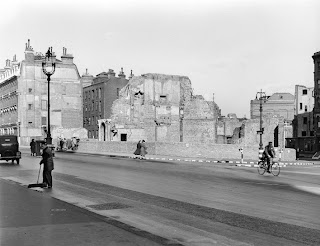
Illustrations, from top: 1/ Erik Zabel in the time-trial prologue to the 2006 Tour de France, from Wikimedia Commons; 2/ A veterinary surgeon and a blacksmith attacking dandies on bicycles; representing the anti-bicycle movement: coloured etching by C. Williams, 1819, from Wellcome Library Iconographic collections; 3/ Lionel de Barri Crawshay, photograph inserted within bicycling log-book, MS.1912; 4/ record of miles cycled, from the same log-book; 5/ photograph of midwife, from National Birthday Trust Fund archives (SA/NBT/H.3/2/2); 6/ bottle of Tabloid Forced March, photograph from Wellcome Images, image no.M0013157; 7/ Snow Hill headquarters of Burroughs Wellcome after bombing, photograph from Wellcome Images, image no.M0020173.