Showing posts with label walking. Show all posts

Tuesday, April 24, 2012

The Right to Roam

"I'm a rambler, I'm a rambler from Manchester way
I get all my pleasure the hard moorland way
I may be a wage slave on Monday
But I am a free man on Sunday."
(Ewan MacColl, "The Manchester Rambler")

Eighty years ago today, massed groups of walkers from Manchester and Sheffield climbed onto the moors of Kinder Scout, defying the landowner's gamekeepers in an assertion of the right to access wild country. There were scuffles, their leaders were arrested and some were jailed, but the Kinder Mass Trespass was to lead, after the Second World War, to the setting up of Britain's National Parks - fittingly, the first one was the Peak District National Park, including Kinder - and eventually to today's Right to Roam. From this distance, aware in hindsight of the way that the trespassers were on the winning side, the politics of walking are less obvious, but this was a fundamental clash of ideologies: the gamekeepers defending the supposedly sacrosanct rights of property, whilst the trespassers embodied a radical tradition that saw much land ownership as the result of expropriation (the Acts of Enclosure or, if one goes back far enough, the Norman Conquest) and, at its most fundamental, questioned whether land could be owned in the absolute and exclusive fashion that portable property can:

"He said, All this land is my master's;
At that I stood shaking my head:
No man has the right to all mountains
Any more than the deep ocean bed."
(Ewan MacColl, "The Manchester Rambler")

On the anniversary of the Trespass, it is appropriate to highlight Library holdings to do with walking. We have, of course, much material on health and exercise, the archive sources in this area being summarised in our online sources guide. Perhaps the highlight, however, comes from the papers of the nutritionists Robert McCance (1898-1993) and Elsie Widdowson (1908-2000), held as collection GC/97. A notebook held as GC/97/B.3, under the unassuming title "Experimental study of rationing", records self-experimentation on a heroic scale. During the winter of 1939/40 McCance and Widdowson were working on nutrition for the government, assessing what the nutritional value of various proposed food rationing arrangements might be. Their approach was simple: they would live on the proposed rations, recording all food and drink intake, and then set out to exhaust themselves on the Lakeland hills, in effect monitoring who lasted longest and on what diet. On 2nd January 1940, for instance, McCance records an itinerary that the Manchester Rambler would know well, although doing it in one day is for the hard-core only: "Robin Ghyll, Stake Pass, Borrowdale, Honister, Scarf [sic] Gap, Black Sail, Wastdale [sic] Head, Boot, Hard Knot, Wrynose, Little Langdale, Elterwater, Robin Ghyll. 35 miles odd, 7000 odd [feet] of ascent and descent. Wizard." All this on a short winter day: had Hitler known of that enthusiastic note "Wizard" he would probably have thrown in the towel then and there.

The law governing access to open country in England and Wales, of course, is not universal, and other countries have different arrangements. Most notably, the Nordic countries - in which feudalism and serfdom did not develop in the same way as further south - have always enshrined in their common law a principle of the right to roam. In Sweden, for example, the constitution recognises the long-standing Allemansrätten, which can be translated literally as "Every man's rights": these give citizens the right to access (which includes walking, cycling, riding, skiing, and even camping) on any land, excluding private gardens, the area immediately around a dwelling house, and land actually under cultivation. Provided they are not legally protected, one may pick wild flowers, mushrooms and berries; similarly, one may swim in any lake, or bring an unpowered boat to it. Disruptive use of the land, then, which harms it for other users (including the landowner) is forbidden, but non-disruptive access of the sort for which the Kinder trespassers argued is a universal right. Here, perhaps, we come closest to the Wellcome Library's own holdings and ethos: through metaphor. One of the inspirational presentations given to library professionals at last autumn's Axiell Symposium in London's Docklands came from information professionals in the Swedish city of Gävle, describing an initiative that promoted the city's libraries, archives and museums together under the slogan "Kulturell Allemansrät" - the cultural right to roam. A library gives its users the same freedom that the Manchester Rambler needed: access to the whole world of knowledge, without restrictions (except for a few on behaviour that harms other people's rights: vandalism, breach of copyright, breach of data protection, and so on), without the concept of trespassing. The world of knowledge is laid out: and readers have the right to roam.


Images:
1/ Kinder Scout: image copyright Peter Barr, made available under Creative Commons via the Geograph website.
2/ Robert McCance's diary of self-experimentation on wartime food rations, GC/97/B.3.
3/ Publicity material for the city of Gävle's "Kulturell Allemansrät" initiative. The goat is a traditional Swedish Yule Goat, which has become an emblem of Gävle because of the city's tradition of building a huge one out of straw every winter (and often burning it).

Saturday, October 30, 2010

Ghost Walk

Halloween in London is ghost walks, tales of terror and horrible history. Ghoulish parties and lots of dressing up. Not trick and treating.

Sunday, September 5, 2010

Hidden Gardens

A hidden garden. A real gem. While I'm away on holiday I'm leaving you tips for places to visit and things to do if you are holidaying in London.

To find out where this is check out Steve's city walks. Not only will you find these places but he knows so much of the history as well. £5 well spent.

Wednesday, December 2, 2009

Queenies Walk

When you're getting on a bit you need transport to get you to your exercise park. Just wish mum wouldn't chat to everyone on the way.

Monday, August 24, 2009

A walk in the Country

It all began with Diamond Geezer's site. At the beginning of August he decided to spend his weekends walking the Lea Valley telling us about each leg of his journey. I was captivated and part way through his adventure I decided I needed to see this beautiful countryside.

In true Mo fashion I decided to do 3 walks in one. My feet will recover. Yes they will I keep telling them they will be able to get back on the road again.

There is just so much to take in along the paths of this river. Ancient ruins, abbeys, mills churches. One of the three remaining of Eleanor's Crosses. I intend to see them all.
Fishing, boating, cycling and walking. All of that outdoorsy stuff. I'm slowing getting hooked. Have even taken to a bit of foraging. I have a bag full of rose hips I intend to make some delicious concoction with. I'll let you know how it turns out.

Until my next country adventure me and my sore feet are glad to back in the city.

Sunday, March 22, 2009

Walk in the Park

Londoners are as concerned about fashion as the Parisians. One must always look one's best. She can walk as briskly as him all day. Hope he massages her feet at the end of the day.

Thursday, February 5, 2009

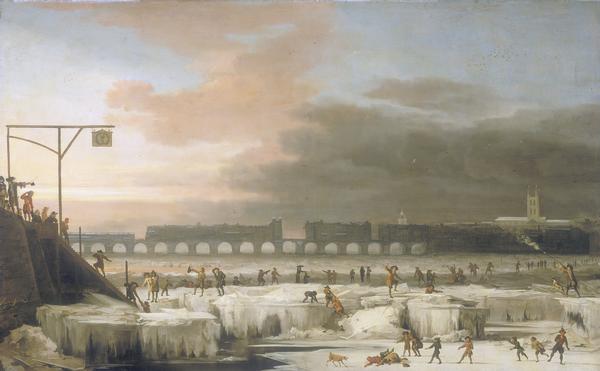
The last Frost Fair

As London reels under its worst "snow event" for 18 years, we're bombarded with archive footage of previous worst winters: 1947 and 1962/3 in particular. The most marvellous of London's winter events, however, last happened nearly 200 years ago: the Frost Fairs that would take place on the frozen Thames in the hardest winters have now died out. The last took place in 1814 and changes to the river mean that they will not happen again: they were dependant on the way the narrow arches of old London Bridge kept the river level upstream of the bridge relatively constant, and the large tidal range that affects the upper river since the bridge was replaced by one with wider arches, makes it impossible for the Thames to freeze so solidly.

In the 1860s, John Hodgkin – a retired lawyer, born in 1800, and the younger brother of the pathologist Thomas Hodgkin – was asked by his children to write down some of his early memories. Among them was a recollection of how, half a century before, he and his brother had seen the last Frost Fair:

"In the winter of 1813-14 occurred the great frost. It commenced the day after or the next day but one after Christmas day. It was ushered in by an intense fog which lasted two or three days, & in which an accident befel the carriage of the Prince Regent, which both alarmed him and detained him a considerable time on a journey he was taking to some nobleman's… The frost lasted till about the 8th or 9th of 2nd month [February: as a good Quaker, Hodgkin does not use the customary names for months or days as these are seen as pagan]… 6 weeks & 1 day.

A fair was held for several days on the Thames between Blackfriars & London Bridge. My Brother and I walked there one day from Pentonville & remained a short time on the River close to the Fair. I do not remember many of the details [Hodgkin's background probably meant that the boys looked at the fair from outside rather than exploring it!] but besides the vast crowds & the usual features of a pleasure fair, we saw a fire & also a large broad wheeled waggon on the ice."

Hodgkin's memories of this time also include skaters on the frozen Serpentine and, more prosaically, the nasty cold he got after walking long distances in the snow then standing in the cold when hot and sweaty. Some things never change: the Frost Fairs are gone but sadly the common cold lives on. Hodgkin's memories can be consulted in the Library quoting the reference PP/HO/E/C5; the huge Hodgkin archive, including many more items relating to the Hodgkin brothers and their relatives, can be explored on the Archives department database under the reference PP/HO.

Monday, January 12, 2009

The Patterson Challenge

Inspired by one of our manuscripts, readers of Londonist are attempting a 20 mile walk across London to track how the city has changed over the last 150 years.

They’re following in the footsteps of James Patterson, a master at the Deaf and Dumb Institution, in Manchester, who recorded a visit to London over Christmas 1858 in his diary. Patterson's seemingly inexhaustible perambulations took him across the metropolis, and the detailed notes he made offer a fascinating view of sights to see for a mid-Victorian tourist.

For more on 'The Patterson Challenge' – including how to take part – have a look here. We'll keep you posted on how these intrepid souls get on.

(A less tiring insight into Patterson is offered here by Dr Chris Hilton of the Wellcome Library, in an article originally published in the Newsletter of the London Topographical Society).