Showing posts with label dandelions. Show all posts

Sunday, September 18, 2011

Fall Wildlfowers - Alternate to the Milkweed Study

Asters
Asters
Many areas do not have milkweed to observe right now and I have had requests for alternate flowers to study. So here are some ideas for an alternative to your More Nature Study #1 Milkweed Study.

Goldenrod
Goldenrod
I mentioned in the challenge that you can find several alternate flowers in the Handbook of Nature Study. Anna Botsford Comstock gives us some ideas and I suggested "check for other fall blossoming wildflowers to observe like: Jewel Weed (Lesson 134), Late blooming Goldenrod (Lesson 132), or Asters (Lesson 133). "

Yarrow
Yarrow
I have been doing additional research and you can also look for mullein (Lesson 146), dandelions (Lesson 144), sunflowers (Lesson 159), and several flowers not found in the Handbook of Nature Study- gentians, yarrow, or chrysanthemum. Hope that helps your family to complete the #1Milkweed Study (alternate study-any fall blooming flower).

Dandelion up close
Dandelion

Mullein September
Mullein in my backyard right now...not very pretty.

Saturday, May 28, 2011

Dandelions Can Grow Two Feet Tall!

Really Tall Dandelion 2

I think we have all read in the Handbook of Nature Study that the dandelion can grow to be two feet or more in height. I had never seen a dandelion that tall but I took her word for it (page 532 in the HNS in the dandelion section).

Today, I saw a dandelion that was more than two feet tall! The photo above show the plant we found alongside our walking trail. I am holding the stem up with the blossom on top.....Kona wanted to be in the photo too. Yes, it was cold enough for a flannel shirt and it did sprinkle on us as we walked. I had on my new Keens though....Keen Newport Sandal (gargoyle and sap green).


Dandelions

Here are the blossoms up close.

Dandelion leaves

I took a photo of the leaves at the base so you can see that it is indeed a dandelion.

Purple Vetch

The purple vetch is really taking over the sides of the trail...my favorite color so beautiful and happy.

Purple Vetch and Little Yellow Flowers

It makes me happy anyway. The bees were loving it too.

So there you have it....two foot high dandelions!

Barb-Harmony Art Mom

Friday, April 29, 2011

2011 Spring Series - Spring Wildflower Study - Dandelions


Our last official Outdoor Hour Challenge for the 2011 Spring Series has arrived. I can hardly believe it but we are going into the month of May next week! With May will come some changes to the Outdoor Hour Challenge, exciting changes for us all! I will be sharing my new ideas and directions for the Outdoor Hour Challenge on May 1, 2011.

4 11 Dandelions
In the meantime, take this week to enjoy hunting up some spring wildflowers and/or dandelions. This was one of the most popular challenges last spring and I look forward to seeing all of your current year dandelion studies in Mr. Linky.

Here is a link to the Spring Wildflower Study- Dandelions.
Please make sure to click over and read all about how your family can study this common plant and be educated on the many things we can learn from this weed/wildflower. 

Please come back and post your link on Mr. Linky after completing this challenge and writing your blog entry. You can also submit it to the Outdoor Hour Challenge Blog Carnival!


    Spring Series CoverSchedule for Spring 2011

    Friday, April 1, 2011

    2011 Spring Series - Queen Anne's Lace Spring Observations/Spring Wildflower

    Queen Annes Lace and Sweet Peas
    Queen Anne's Lace from last summer.....along with my favorite sweet peas.
    I wanted to just briefly mention that the order of the 2011 Spring Challenges is different than the order of the challenges in the Spring 2010 Ebook. You will find the order and topic for each of the 2011 Spring Challenges at the bottom of this post.

    Last year we studied dandelions as part of the spring series but this year I wanted to make sure that we are all on the look-out for our Queen Anne's Lace. This is a plant that we started observing last summer and then continued through autumn and then winter.

    Here are the links to those challenges:
    Summer Study: Queen Anne's Lace 

    Autumn Study: Queen Anne's Lace

    Winter Study: Queen Anne's Lace (free bonus notebook page)

    Inside Preparation Work:
    • If you studied Queen Anne's Lace in the past, you may wish to pull out the completed notebook pages to remind yourself of the appearance and location of your Queen Anne's Lace.
    • Read pages 542-545 in the Handbook of Nature Study (Lesson 148). Glean some new points about this interesting plant that is considered a weed by many people.
    • Remind yourself what Queen Anne's Lace looks like by using the accompanying notebook page or the Handbook of Nature Study. More information can be found here: eNature or the USDA.
    Outdoor Hour Time:
    For this challenge go back to your Queen Anne's Lace patch and make some springtime observations. If this is your first season of observing Queen Anne's Lace, you may need to wait until the flowers bloom before finding your own patch. Still take your 15 minutes outdoors and find any wildflower that you can observe in your yard or neighborhood. 

    Follow-Up Activity:
    Spend a few minutes talking about your outdoor time. Did you see some Queen Anne's Lace? Did your child have any questions about things that they found interesting during your outdoor time? Use this time to complete a nature journal entry or you can use the Spring Queen Anne's Lace Notebook Page available HERE.

    Please make sure to come back and post your link on Mr. Linky after completing this challenge and writing your blog entry. I always love to come by and see what you are up to!

    Planning Ahead!
    Here is a link to a Squidoo page that shows exactly how to color your Queen Anne's Lace with food coloring. I love this idea and we will be doing this over the summer. You may wish to add it to your seasonal activities: Queen Anne' Lace

      Spring Series CoverSchedule for Spring 2011

      Saturday, April 24, 2010

      Our Dandelion Morning

      Dandelion up close

      As part of the Spring Series of Outdoor Hour Challenges, we spent a sunny morning looking for the tallest dandelion in our yard. We have quite a few this year, partly because we have left our "wild side" wild and partly because it is just a good year for dandelions.

      Dandelions in the Lawn
      I gave my boys a ruler and a camera as we went out the door. I challenged them to find the tallest dandelion they could see in our backyard. They knew just where to look and as our dog followed them around, they measured and took photos. I wandered around the yard looking at all the growing things and the number of bees we have in our flowers.

      Kona in the weeds
      They tried to convince me that the dog ate the biggest one. Our dog does love it when you blow the seeds and she will try to catch the seeds in her mouth as they fly around in the air. It is actually quite funny. She will also lay in the dandelions and eat the leaves.

      Dandelion measuring
      So here is the verdict. They found one that measured just at twelve inches high.

      Dandelion nature journal
      They brought a few flowers in to look at and I took the opportunity to draw a few things in my nature journal. I noticed in the evening that the dandelions that were in the vase had all closed up tightly. This morning in the sunshine they were open again.

      Dandelion bracts
      Another day this week we will go out early in the morning and observe to see if the flowers are closed up and if they open up later in the sunshine.

      It was a fun study for all of us and it gave us a really good excuse to be outdoors on a school day.

      Barb-Harmony Art Mom

      Friday, April 23, 2010

      OHC Spring Series #4: Wildflowers-Dandelions

      Outdoor Hour Challenge
      Spring Series #4
      Dandelions

      Inside Preparation Work:
      Read in the Handbook of Nature Study about dandelions on pages 531-535. After reading the suggestions on pages 543 and 535, choose several ideas from the lesson to complete during your Outdoor Hour Time.

      Note: The dandelion lesson is either #143 or #144 depending on your edition of the Handbook of Nature Study. If you have the free download from HomeschoolResource.com, you will find it in the Plants and Trees pdf on page 86. (Thanks again to Angie-Pebblekeeper for the info.)

      Dandelions
      Outdoor Hour Time:
      Spend 15 minutes outdoors this week in your own backyard or a near-by park. As you walk along, keep your eyes out for dandelions.

      Suggestions for Observations
      • See if you can find several dandelions in various stages of growth.
      • Look at the leaves and collect a few for sketching later in your nature journal.
      • If it is growing in your own yard, you might like to dig up the complete dandelion plant and observe the roots.
      • Measure the height of several different dandelion plants and compare them.
      • Examine an unopened dandelion flower.
      • Watch a bee working in a dandelion.
      • Observe the seeds and how they are dispersed.
      • Observe your dandelions on a sunny day and then on a cloudy day. Note any differences.
      Follow-Up Activities:
      Take some time to draw the dandelion in your nature journal or complete the notebook page from the Spring Series ebook. You can also use any notebook pages from the sidebar of my blog. Make sure to record your observations of the dandelion and make a sketch of the leaf and flower. If you would like to see our sample study of a dandelion in our backyard, here is the LINK.

      dandelion big
      Composite Flowers-Supplement to the Study of a Dandelion
      The dandelion is a composite flower and the Handbook of Nature Study has a section to explain just what that means.
      “Many plants have their flowers set close together and thus make a mass of color, like the geraniums or the clovers. But there are other plants where there are different kinds of flowers in one head, those at the center doing a certain kind of work for the production of seed, and those around the edges, doing another kind of work. The sunflower, goldenrod, asters, daisies, coneflower, thistle, dandelion, burdock, everlasting, and many other common flowers have their blossoms arranged in this way.” Handbook of Nature Study, page 503
      • Observe your dandelion, perhaps with a magnifying lens, to see if you can observe the parts of a composite flower:
      • Look at the center of the flower for the disc flowers and around the edges for ray flowers. (illustrated in the diagram on page 575)
      • Examine the disc flowers in the center and see if they are open or unfolded. How many ray flowers are there?
      • Locate the bracts (green cover of the flower before it opens). Can you see the bracts on the back of the flower?
      • More ideas for studying a composite flower are found on page 503 in Lesson 131. Note: This lesson will be Lesson 135 in the older edition and in the Plants and Trees pdf it is on page 68.
      Please make sure to come back and post your link on Mr. Linky after completing this challenge and writing your blog entry. I always love to come by and see what you are up to!

      If you would like all the Spring Series Challenges in one place, I have an ebook gathered for you to purchase for your convenience. The ebook also contains art and music appreciation plans for the spring months as well as custom notebooking pages for each of the challenges. Please see this entry for more details:
      Spring Series Cover
      Spring Nature Study with Art and Music Appreciation

      Barb-Harmony Art Mom

      Wednesday, March 24, 2010

      Our Signs of Spring: Glorious Spring Flowers

      Our world is waking up from a long winter's nap and here are some of our signs of spring.

      Dandelions
      Dandelions are growing everywhere now in our backyard and even though they are in the lawn, they make me surprisingly happy. I refuse to call them weeds. I love to see them poking up in the cracks of our sidewalk and along the path to the garden. They are like little mini sunflowers in the springtime. If you have some dandelions in your yard, don't miss the dandelion challenge in the new Spring Nature Study Ebook. You can also read all about dandelions in the Handbook of Nature Study.

      mullein
      There is also a nice big mullein growing in the backyard and I know from last year's mullein that this is a plant that grows like crazy. We watched a mullein grow in our garden all summer long and it provided a great source of food for the bees, the hummingbirds, and then later the finches. This plant is listed as a weed in the Handbook of Nature Study too. I can't imagine why.


      These are the buds unfurling on my new apple tree. My dear husband brought this tree home and planted it just for me. How did he know I wanted to study the apple tree up close using the Handbook of Nature Study? We are going to be keeping track of its growth as part of the Spring Nature Study Series as well. Let's hope the deer stay away from this tree and we can have a few apples in the fall.

      white flowers on bush
      We have a bush on the north side of our house that is blooming with these pretty white flowers. I do not know what the bush is called, but I think it is rather pretty.

      We also took a few day trips this week....thanks to an early spring break and some glorious weather.

      daphne
      If you have never smelled daphne blooming before you have truly missed out on a springtime delight. We discovered a garden filled with daphne at one of our state parks. I think it something we would like to add to our home garden.

      brewer's blackbirds
      I was sitting under a tree waiting for the boys to meet up with me one afternoon and look who came to inspect. These Brewer's blackbirds flew into the tree overhead and let me take their photo.

      daffodil hill 1
      We visited a farm that has thousands of daffodils blooming this time of the year.

      daffodil hill 3
      I decided that daffodils make me happy.

      daffodil hill 2
      Once again, I had my son as a companion photographer.

      hyacinth and daffodil
      Isn't this a great color combination? I love the mix of daffodils and hyacinths in this garden.

      red tulips
      One last sign of spring from our day trips...tulips. Wow! This one was really red and brilliantly colored.

      I have really enjoyed reading everyone's signs of spring this week. Thank you to all who have participated.

      Barb-Harmony Art Mom

      Wednesday, March 25, 2009

      Wednesday Flower Study #2-What Are You Going to Study This Week?


      This week we studied the dandelion. This cheerful flower/weed is found all over our yard and our neighbor has a whole crop of dandelions for us to study.

      Here are some interesting facts we found out about the dandelion.

      *In the sunflower family-No wonder I think they are happy little flowers.
      *Grows from 2" to 20" tall.
      *It has a hollow stalk.
      *Common name comes from "dent de lion" which is French for "lion's tooth", referring to the teeth on the leaves.
      *The flowers open and close.

      You must read the introductory pages to the dandelion study starting on page 531 of the Handbook of Nature Study. Anna Botsford Comstock writes in such a narrative style that you will enjoy reading the information and I am sure you will remember much of it to share with your children.
      "Professor Baily once said that dandelions in his lawn were a great trouble to him until he learned to love them, and then the sight of them gave him keenest pleasure."
      Handbook of Nature Study, page 531
      I couldn't agree more. I always hate it when my neighbors use the weed eater to remove the thousands of dandelions from their property. I would much rather look at the cheerful yellow flowers than a bare piece of ground.

      The Handbook of Nature Study has a great list of activities in the lesson for the dandelion.

      Here are a few that we complete:
      3. Sketch or describe a dandelion leaf.
      4. Take a blossom not yet open. Note the bracts that cover the unopened flower head.
      7. Note what hour the dandelions on the lawn close and at what hour they open on pleasant days.

      We were able to work on all three of these ideas in our study today.


      Here are the bracts covering the petals before the bloom opens.
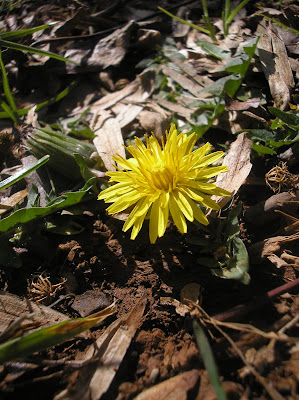

      Really short dandelion that practically is blooming flat on the ground...interesting how some are tall and some are not.


      You can really see the "lion's teeth" in this photo. :)


      Another garden flower/weed is now recorded in our nature journals.

      I think next week we will work on the tulips in our yard that are just starting to really bloom.

      If you would like to join us, see the instructions in this entry: Wednesday Flower Study. You can join us during any week you have a study and blog about it and want to share what you learned with other families. Enter your link in Mr. Linky below.

      Thanks for sharing!
      Barb-Harmony Art Mom

      Monday, February 11, 2008

      Of Dandelions and Paperwhites


      Today was a warm, sunny day in my neck of the woods. I went out with my camera to capture the paperwhites that started blooming this week and look what was waiting to greet me......a dandelion in the grass.

      It made me smile and feel so much better after a week of being sick with a cold and the flu. Isn't it amazing how a little yellow flower can lift your spirits?

      The paperwhites are starting to bloom by the mailbox so now as the days tick on I will have a steady bloom of paperwhites, daffodils, and then day lilies.
      The delicate fragrance is so wonderful as these bloom in the warm sun.


      Here is what the Handbook of Nature Study says on page 534 about the dandelion:
      "The following are the tactics by which the dandelion conquers us and takes possession of our lands: a: It blossoms early in the spring and until snow falls, producing seed for a long season. b: It is broadminded as to its location, and flourishes on all sorts of soils. c: It thrusts its long taproots down into the soil, and thus gets moisture and food not reached by other plants. d: its leaves spread out from the base, and crowd and shade many neighboring plants out of existence. e: many insects visit it, and so it has plenty of pollen carriers to insure strong seeds; it can also develop seeds from its own pollen, or it even can develop seeds without any pollen. f: It develops almost numberless akenes, and the wind scatters them far and wide and they thus take possession of new territory. g: It forms vigorous leaf-rosettes in the fall, and thus is able to begin growth early in the spring. "


      The Handbook of Nature Study has a whole section on dandelions including activities from pages 531-535.


      (click to make the photo larger)
      Doesn't this make you laugh? This is the same cat that thought she could "hide" in the birdfeeder. She really isn't very good at this hiding game. I imagine she is enjoying the view anyway.

      Barb-Harmony Art Mom