Showing posts with label Silas Mainville Burroughs. Show all posts

Friday, October 28, 2011

The Statue of Liberty's sister and S M Burroughs

As well as our own small anniversary, today is also the 125th anniversary of one of the world's most famous cultural artefacts, as it was on this day in 1876 that the Statue of Liberty was dedicated.

Furthermore, there's a connection between the statue and the early days of our founder Henry Wellcome's pharmaceutical business - but it relates not to Henry Wellcome and nor to the statue in New York...


Just visible in the top right of this image is a copy of the Statue of Liberty. As indicated, the image is of Burroughs Wellcome & Co's then head office at Snow Hill in London. It references not only the nationality of the company's founders, but also hints at the activities of Wellcome's business partner, Silas Mainville Burroughs.

The statue that stands in New York was - as every good American schoolchild knows - a gift from the people of France in 1886. What's a lesser-known fact is that a smaller replica of the statue stands in Paris on the Île aux Cygnes - facing west in the general direction of her sibling.

The erection of the smaller statue in Paris was paid for by subscription by Americans resident in Europe to commemorate the centenary of the French Revolution and inagurated on 4th July 1889. Silas Mainville Burroughs was a subscriber to the fund. And here's the evidence - preserved in the Wellcome Library's collections - Burroughs's certificate of subscription (WF/E/02/03/05).

Whilst the certificate does not record how much money Burroughs donated, it does add another detail to the life of Wellcome's business partner: a politically motivated individual, who still stands very much in the shadow of Henry Wellcome.

Saturday, June 25, 2011

The lost world of Snow Hill


The image above captures the popular conception of London's reaction to the Blitz, which was arguably at its most fearsome during May and June 70 years ago. During the night-time bombings, lives were lost and buildings were destroyed. But come the morning... a cyclist trundles by, a roadsweeper brushes up: life goes on.

The remains of the building you see here are actually enormously important to the story of our founder Henry Wellcome, as this is the corner of Snow Hill and Holborn Viaduct in London, the site of the head office of the pharmaceutical company he co-founded, Burroughs Wellcome & Co.


Opened in 1883, three years after Silas Mainville Burroughs and Henry Wellcome entered into partnership, the scale of their head office matched the expectations Burroughs and Wellcome had for their nascent pharmaceutical company.

The imposing building was constructed of red brick, with granite pilars guarding the entrance. The tiled mosaic floor of the was illustrated with images of Commerce and Industry and the rich wood used for the walls was best American Walnut. [1]


Henry Wellcome was personally involved in designing and furnishing the interior of the building: no easy task given the building's curved shape. As the image above shows, Moorish curves were ideal for a building Wellcome himself described as having "not a single right-angle". The interior arrangements were executed under the direction of Christopher Dresser, now regarded as Britain's first industrial designer. Snow Hill was also one of the first business houses in London to be lit using electric light.

The interior alluded to Burroughs and Wellcome's country of birth with models of the Statue of Liberty and the American Eagle (visible towards the back of the image above) and the building captured something of the entrepreneurial get-up-and-go of these two salesmen.

The building also hinted at another aspect of Wellcome's personality: his growing interest in collecting. This is how Wellcome's office was described in a praiseworthy report on the building in Chemist and Druggist:

"It is furnished as a library, although hunting trophies, works of art from countries visited by the occupant...and a varied selection of general literature give it less the look of a commercial room and more the appearance of a bachelor's den". [1]

Fast forward to 1941 and it seems this example of late Victorian architecture was no longer fit for the purposes of twentieth century business: five years after Henry Wellcome's death, the Wellcome Foundation still retained Snow Hill as offices, but sought to build new premises elsewhere in London.

On the night of 10-11 May 1941, during one of the heaviest nights of the Blitz, the Snow Hill building was destroyed. Afterwards, staff were temporarily moved to other Wellcome owned sites - such as the main warehouse where Wellcome's collection was stored in Willesden and to the Wellcome Research Institution on Euston Road (which is now, of course, where the Library and the rest of Wellcome Collection is situated). Not ideal accommodation, but just as for the figures beside the bombed out Snow Hill offices shown above, life had to go on for the employees as well.

But with its carefully designed interior - and his collection-rich office - the lost world of Snow Hill captures something of Henry Wellcome's - often elusive - personality.

[1] Clues to the furnishings of the Snow Hill office remain through drawings which survive in the papers of the Wellcome Foundation Archive, WF/CA/P/01
[2] Chemist and Druggist, 28th January, 1888

Images:
- Burroughs Wellcome & Co Headquarters, Snow Hill, London, after being destroyed in the Blitz, 1941 (Wellcome Images, M0020173)
- Burroughs Wellcome & Co Head Office, Snow Hill, London (Wellcome Images, M0007868)
- Interior of the Burroughs Wellcome & Co building, Snow Hill, London (Chemist & Druggist, 28th January 1888)

Monday, September 27, 2010

Item of the Month, September 2010: Articles of Partnership

Today marks the anniversary - 130 years ago today - of the signing of this legal contract by two young American pharmaceutical salesmen: Henry Solomon Wellcome and Silas Mainville Burroughs.

The document described the business partnership that the two men entered into. The business formed - Burroughs Wellcome & Co (BW&Co) - would by 1900 establish itself as a multinational pharmaceutical company. Indeed, the monetary means for Henry Wellcome to acquire his collections - and the existence of the Wellcome Trust itself - can be traced back to the partnership described in this six page document.

We have previously - and will no doubt continue to in the future - write posts on different aspects of Wellcome's life, so it seems appropriate on this particular anniversary to say a little more about the man he entered into business with.

Born into relative prosperity in Medina, New York, Burroughs was the son of Silas Mainville Burroughs, Sr, an American Congressman. After working as a travelling pharmaceutical salesman Burroughs (Jnr) graduated from the Philadelphia College of Pharmacy in 1877.

Employed as a salesman for the American pharmaceutical business John Wyeth & Bros - leaders in the new field of compressed pills - in 1878 Burroughs travelled to London and founded Burroughs & Co. This deal gave Burroughs sole rights to sell Wyeth supplied products outside the USA and also allowed Burroughs leverage to market and a range of other products under his own name.

As Burroughs's sales exapnded, he sought help from a peer from the Philadelphia College of Pharmacy - Henry Wellcome. Wellcome at this time was working as a salesman for another pharmaceutical firm in the USA - McKesson & Robbins - and was building up a promising reputation amongst his peers. Through a series of letters from late 1879 to early 1880 - and now preserved in the Wellcome Library - Burroughs convinced Wellcome to move to London, perusading Wellcome that entering into partnership with him in England offered more prospects for success than continuing to work in the US.

No doubt due to the fact that he died in 1895, leaving Wellcome in sole charge of Burroughs Wellcome & Co - and perhaps also from the fractious business relationship the two men had by the time of Burroughs' death - Burroughs' role in the partnership has until recently been underrated.

Wellcome has traditionally been regarded as the marketing mastermind behind the company's success. However, Burroughs was no mean salesman himself. For instance, it was Burroughs who introduced to the pharmacy trade in this country the notion of 'detailing' - explaining face-to-face to doctors and chemists the company's products and passing on to them free samples.

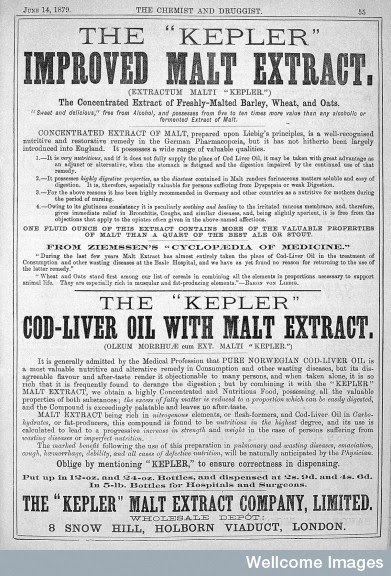
Also, before their partnership, Burroughs had added to the list of products he sold, two brands which would prove to be among the most successful for Burroughs Wellcome & Co: Hazeline (an extract of witch hazel, marketed as face cream) and Kepler malt extracts (to provide nutritional sustenance).

So, when the two men added their signatures to the document shown above, Burroughs was very much the senior partner: he had persuaded Wellcome to move across the Atlantic to London and had put up £1200 in relation to Wellcome's £800. Over the next fifteen years however, and as their business would flourish, their personal relationship would wither. So let's leave Burroughs and Wellcome in September 1880 with the ink still drying on their agreement and their futures ahead of them. The disintegration of their relationship can wait for another Blog post.

Images:
1/ Articles of Partnership between Silas Mainville Burroughs and Henry Solomon Wellcome, 27 September 1880 (WF/E/02/01/02/27)
2/ Silas Mainville Burroughs, photographed in 1885 (Wellcome Library no.
14368i)
3/ Advertisement for Kepler from 'Chemist and Druggist', June 14th, 1879


(For more on Burroughs the salesman, see the following article: Roy Church, 'The British Market for Medicine in the late Nineteenth Century: The Innovative Impact of S M Burroughs & Co', Medical History 2005 July 1; 49(3): 281–298 (available online through PubMedCentral) and the book Burroughs, Wellcome & Co.: Knowledge, Trust, Profit and the Transformation of the British Pharmaceutical Industry, 1880-1940 by Roy Church and E. M. Tansey (Crucible Books, 2007)).