Showing posts with label ducks. Show all posts

Monday, August 29, 2011

Our Mallard Duck Study - Unexpected Place and Time

We have been on the lookout for an opportunity to study ducks this month as part of the Outdoor Hour Challenge newsletter suggestions for August. Our local pond is usually a good spot but we cruised by there earlier in the month only to discover that there were in fact no ducks on the pond right now, only geese. We were a little discouraged and trying to brainstorm another pond in the area to visit. As if they knew we were looking for some ducks to observe, a small group found us while we were out on a near-by lake having some fun with our boat.

Ducks at the Lake 1

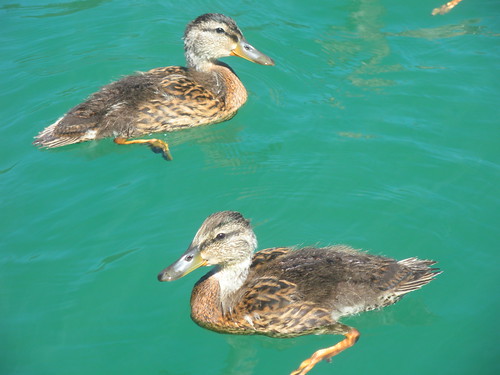
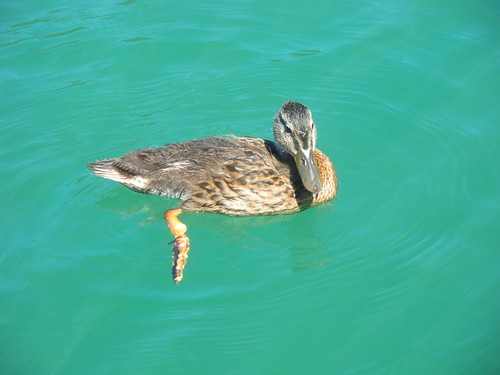
We were out on the lake taking a break from our water sports activities (wakeboarding for Mr. A and water-skiing for the Dad) when a mama and some juvenile mallard ducks came up to visit. There were six smaller ducks that we are assuming were the babies of the female in the group. The water was very clear and we could easily watch them use their specially designed feet to paddle around in the water. We noted that the little ducks had fluffy feathers on their backs and were not as smooth yet as the adult female in the group. We observed the flat long beak that they were dipping into the water. 

Ducks at the Lake 2

I am pretty sure they were inquiring to see if we had any crumbs or goodies to share with them. They were very bold and came right up to the side of the boat...not really quacking but making a sort of peeping/squeaking sound. We didn't see any males out on the water. We did read later that it is the females that incubate the eggs and take care of hatchlings so this fits in with our observations.

Ducks at the Lake 3
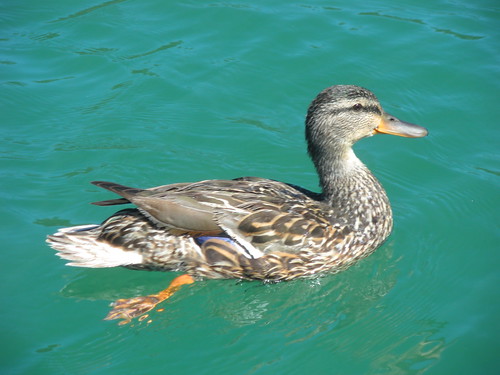
Here is what the AllAboutBirds website says about the female mallard (love the word dabbling):
  • Large dabbling duck

  • Streaked brown and tan overall

  • Dark blue patch on wing

  • Dull orange and black bill

We wondered as always why the females are not as colorful as the males....she does have a pretty blue spot on her wing which really is her only decoration.

We enjoyed our encounter with the lake ducks and it was fun to observe them from the waterside instead of from the shore. We could really see their swimming and paddling abilities in action. We could also note the way the water does really run off the feathers on their back, making them appear water resistant. Maybe next time we will observe some ducks flying....giving us another glimpse into this beautiful creature.

Make sure to submit your entries to the Outdoor Hour Challenge Blog Carnival. Tomorrow afternoon is going to be the deadline for entries since I need to finish it up early this month. You can submit your entries by following this LINK.

Monday, August 1, 2011

Handbook of Nature Study - August Newsletter: Pond Edition

Dragonfly mosaicThe August edition of the Outdoor Hour Challenge Newsletter is ready to be downloaded! The theme for the newsletter is Ponds and Pond Creatures....one of our family's favorite topics to explore this time of year. I have included some new features in the newsletter and hope you find it useful.

Please note that you are encouraged to try to use the topics suggested in the monthly newsletter but if your family finds another topic of interest...always follow your interest. You can still submit the entry to the Outdoor Hour Challenge Blog Carnival. You can submit more than one entry to the carnival. The deadline for the next Outdoor Hour Challenge Blog Carnival will be August 30, 2011.

Here is the August 2011 Outdoor Hour Challenge Newsletter. 

Water Lilies

Exciting Features:
  • Summer Pond Study Notebook Page

  • New Nature Journal Idea

  • Pond Links

  • Newsletter Specials - Autumn Series - Outdoor Hour Challenges

  • Pond Nature Study Grid

  • Marsh Pastels Tutorial

  • Interviews with Outdoor Hour Challenge Families

  • Guest Post Opportunities

I also have put together a new Pond Study page on Squidoo:  
Pond Study Using the Handbook of Nature Study.
I hope you find it helpful!
    (If you have trouble downloading the newsletter and you have Mozilla Firefox, right click the link, save it, then try to open it from your desktop.)

    I drew a random name from those that participated in the July Outdoor Hour Challenge Blog Carnival and Susan from Learning All The Time is the winner of A Kid's Summer EcoJournal. I want to thank all of the participants in yesterday's blog carnival....what a great bunch of entries! Congrats to Susan!

    Saturday, October 2, 2010

    Our Family OHC #2 Geese and Ducks

    We had quite a few false starts on this particular challenge. A couple times we planned to go out after dinner but it is getting dark so early these days that we decided it was too late to go once the dishes were done. Then one of the boys was sick and wasn't up to going.

    Thursday was the day! We went in the afternoon before dinner and we were able to see some geese and ducks.Usually there are more ducks than geese but this particular time there seemed to be more geese.

    Geese and Ducks 9 30 10 (9)

    No Canada Geese this week but we did find these white geese at our local duck pond.There were a few mallard ducks hanging out with the geese as you can see in the background of this photo.

    Geese and Ducks 9 30 10 (15)

    Their necks are so very long that they can do amazing maneuvers like this!

    Geese and Ducks 9 30 10 (10)

    There were a few gray geese like this one as well. They would flap their wings and you could glimpse at how long they were. I love the way when he stood still his feet were on top of each other...really big feet! This guy is definitely going into my nature journal.

    Geese and Ducks 9 30 10 (16)

    The goose in the background shows how they stand on the dry land and poke around in the edges of the pond to find something to eat.

    Geese and Ducks 9 30 10 (1)
    The ducks floated out onto the water and did the bottoms up technique instead.

    We were able to make quite a few observations on this trip because there were not too many people around to distract the birds from doing their own thing. We just stood on the bridge and watched the geese and fairly soon they totally ignored us and went about their business of preening, eating, and honking. The above video shows a few seconds of what they look and sound like in our part of the world.

    We are heading out to the river today to do some kayaking so maybe we will see some Canadian geese there...I will update if we do.

    If you are interested in more bird challenges, you can look on the right sidebar of my blog and see a whole series of bird challenges listed there for you to choose from. Enjoy!

    Barb-Harmony Art Mom

    Friday, September 24, 2010

    Autumn 2010 OHC #2: Birds-Geese and Ducks

    Autumn 2010 Nature Study cover

    Special Instructions for the remainder of the Autumn 2010 Outdoor Hour Challenges: 
    If you completed the Summer 2010 series of Outdoor Hour Challenges, your family worked on using their senses to observe things carefully during your nature study. Each challenge gave ways for you to think about using your sense of taste, touch, smell, hearing, and sight to more keenly become aware of the surroundings.

    For the Autumn 2010 series of Outdoor Hour Challenges, I will be helping you to use another skill in observing: comparing and contrasting. Many times in our nature study it can be helpful to begin to see the similarities and differences between two objects. Anna Botsford-Comstock uses comparing and contrasting in many of her question sets in the lessons found in the Handbook of Nature Study. She uses these questions as a means of helping the child learn to see more clearly the object under study. I have found in our family’s nature study that being about to compare an unfamiliar subject with a familiar one helps us identify it using a field guide. Keen observation skills help us to be more thorough in learning all we can about a subject even from an early age. There will be suggestions in many of the challenges to work on this skill of comparing two objects you find during your nature study and I hope they will give your child a new way to learn about what is in their very own backyard and neighborhood.


    Autumn Series #2
    Bird Study: The Goose
    “And there is not a more interesting sight anywhere in the autumn landscape than the wedge-shaped flock of these long-necked birds with their leader at the front apex.” Handbook of Nature Study, page 133
    Inside Preparation Work:
    1. Read pages 130-135 in the Handbook of Nature Study (Lesson 34). Take special note of the fact that the northern migration of wild geese takes place in April and May, and the southern journey is from October to December. (Check this website for a map of where Canada Geese live in North America.)

    2. Listen to the sound of Canada Geese and Snow Geese. Many times we will hear a goose before we see it flying overhead. Use your sense of hearing to help you identify a goose when the opportunity arises.

    Comparison Ideas:
    Compare a Goose to a Duck
    • What do ducks eat and what do geese eat? (Hint: Where do they look for food?)
    • Compare the duck’s and the goose’s beak, the length of their legs, and the shape of their necks.
    • Compare the color of their feathers, beak, eyes, and feet.
    • Do they both swim in the same way? How about flying?
    • Are there some feathers on the ground to observe and compare?
    • What does each bird sound like?
    • Are they friendly, shy, or aggressive?
    Outdoor Hour Time:
    Take the opportunity during this challenge to find a local duck pond and check to see if there are any geese visiting at this time. You also might try a local farm that may have geese and ducks for you to observe. Use your Outdoor Hour time to observe geese and/or ducks with the suggestions from the Handbook of Nature Study as well as those suggested above. Help your child to find words to compare the goose to some other bird they already know as far as shape, size, and habits.

    If you do not have any geese or ducks to observe, you can observe any of your backyard birds and make some comparisons. This activity is one that can be done with any bird at any time. Work on your observation skills a little each week to sharpen your child’s awareness of their own surroundings.

    Follow-Up Activity:
    Take a few minutes to talk briefly about what you saw during your Outdoor Hour time. If you observed geese and/or ducks, use the gentle reminder questions in the list above to stimulate a little conversation. Your child can also record their observations in their own blank nature journal or use the notebook page from the ebook for convenience. You may wish to pull up the website listed in the preparation work to view more photos of geese to make sketching a little easier.

    If you did not observe a goose or duck, you can still complete a nature journal page or notebook page for any bird you did observe. Use your field guide or AllAboutBirds.org to glean more information if desired.


    Giveaway Birds
    Special Thank You Give-Away!
    As a special thank you for your participation in this particular challenge, I am going to be giving away one copy of the special DVD that I reviewed yesterday: Your Backyard and a copy of the Peterson Field Guides for Young Naturalists: Backyard Birds.

    If you share your bird study link in Mr. Linky before October 10th, 2010, I will enter you name in the drawing for a free copy of this wonderful DVD and a copy of the Backyard Birds field guide.


    One entry per family and you must have the link in Mr. Linky in this entry by 10/10/10. Any bird study you did as part of this challenge will be eligible and it does not need to feature the goose or the duck. If you do not have a blog but would still like to enter, please email me and tell me about your autumn bird study. I must receive your email entry by 10/10/10. harmonyfinearts@yahoo.com

    I will announce the winner on 10/11/10. 

    So don't forget to come back and share your bird study link in Mr. Linky!

    Bird Notebook Page


    Wednesday, January 27, 2010

    Feeding the Ducks

    I'm still nursing my cold so we are taking a dip back into pictures taken a couple of months back. I think the ducks are known to this lady, they started heading to the banks as soon as they saw her approach.

    Monday, May 18, 2009

    City Boys!

    First the bankers, then the MP's with their expenses, now it's the city ducks. Theses chaps were having an altercation over Jessica or maybe it was Jemima, whoever she was she left with another chap and left these two to tough it out on their own.

    Sunday, January 27, 2008

    Snowshoe Adventure: Tahoe Snowshoe Hare

    This was an outdoor weekend spent in the Sierras. We spent an afternoon taking a hike on snowshoes. It looks really cold and dreary in this photo but it was really not all that cold...above freezing by a few degrees. I could have done with a few less layers. :) I took off my gloves for awhile and that helped. Most people we saw on the trail were on cross country skis but we enjoyed the crunch, crunch , crunch of snowshoes. I was on the lookout for mammal tracks.


    (as usual, click to make the photos larger)

    We saw lots of canine tracks beside the trail but as we worked our way up from the lake into the conifers, we were rewarded with these tracks.


    In this area there were many little "rabbit trails" giving us a clue as to what sort of mammal was in the area. I came home and discovered that they are more than likely Tahoe Snowshoe Hare tracks. (Lepus americanus tahoensis) See snowshoe hare.

    We are new to identifying tracks so if anyone thinks they are from a different animal, please leave me a comment.

    Not only did we see some mammal tracks but we were treated to a "new to us" bird. The red-breasted nuthatch. He was seen clinging to the side of this pine, sticking his head into little holes looking for some bark insects. He moved easily in all directions while clinging to the bark. Amazing.

    Red-breasted nuthatch

    I was busy taking photos when a bunch of ducks flew into view. We saw them later eating some seeds that a fellow hiker had left along the shore. They were later joined by a few Canadian geese.


    So I think we had a successful outing....we did manage to find some mammal tracks in the snow and that was our aim.

    From the Handbook of Nature Study, page 217,
    " An interesting relative of the cottontail is the varying hare or snow-show rabbit that lives in the wooded regions of north-eastern North America. Of all animals he is one of the most defenseless; foxes, mink, and other flesh-eating inhabitants of the woods find him an easy prey. He has not even a burrow to flee to when pursued by his enemies.....He has one important advantage over his enemies: twice each year his heavy coat of fur is shed. In the summer the coat is a reddish brown that so blends with his surroundings that he is hardly noticeable; in the winter it is perfectly white so that against a background of snow he is nearly invisible."
    Anna Botsford Comstock has included pages 215-219 with information on the cotton-tailed rabbit. I found these pages very useful in coming up with a way to study our snowshoe hare. Even though the information doesn't completely apply to our hare, we can adapt her activities to our study.

    Winter nature study at its best.
    Barb-Harmony Art Mom