Showing posts with label spiders. Show all posts

Monday, April 23, 2012

Nature Study - Living Science Beyond the Books

Every parent hopes their child receives a solid education in science. This is the case whether our children are homeschooled or attending a more traditional school. Many parents, including myself, know we received very little "real" science education growing up and when it comes time to teaching or supporting science learning in our children, we feel inadequate. This doesn't need to be the case.

Jeannie Fulbright wrote on the Apologia Blog, Overcoming the Fear of Science, which I read with interest. It got me thinking about how I have seen my own children gain a real, living science education using books and experiences.

Frog and Eggs in a Pond

For our family, providing the opportunities for science as part of our every day life has been as easy as opening our back door and doing some exploring together.  Books are a wonderful window to the world but true heartfelt science learning takes place when you learn about things you can see, touch, smell, and hear.

Suspected Spotted Towhee Feathers

Birds in a book are great but birds in your very own feeder are a living and breathing example to learn from. We have found what works best is observation first and then facts. For example, we learned more by trying to identify these feathers...using a feather identification key for the first time, reasoning on which birds we see in our backyard, and then narrowing it down to a few bird choices.We had to learn the different kinds of bird feathers and make careful observations about color and pattern. So much to build on from just this simple feather find from our backyard.

Pollen on the California Lilac

Learning about pollen in a book is interesting but seeing it on a flower, watching a bee covered in it, and then perhaps looking at the flower pollen with a hand lens take it to a whole new dimension. Suddenly you care about the pollen...it means something. My son noticed the little yellow specks on these California Lilacs and we brought them inside for closer inspection...pollen! No wonder the bees are swarming around this plant in our yard!

Garden Spider on a Flower

Mr. A found this spider on a flower blossom and we spent some time watching it together. Direct observation of a spider takes the fear away and allows the awe to settle in for such an amazing living creature. Live and up close is the best kind of learning for science....books are there to support or to generate interest.
"Nature study, as far as it goes, is just as large as is science for "grown-ups". It may deal with the same subject matter and should be characterized by the same accuracy. It simply does not go so far."
Anna Botsford Comstock, Handbook of Nature Study
She supports the idea that beginning with nature study and observation we can build on those ideas and experiences and go farther with more formal science. For a complete picture of how she outlines nature study for families, read the introductory pages of the Handbook of Nature Study (pages 1-24).
"Adults should realize that the most valuable thing children can learn is what they discover themselves about the world they live in. Once they experience first-hand the wonder of nature, they will want to make nature observation a life-long habit. All people are supposed to be observers of nature and there's no excuse for living in a world so full of amazing plants and animals and not be interested in them."
Charlotte Mason, Volume 1
So, I think we are in good company. Thanks Jeannie for the insightful and informative post that got me thinking about this very important topic. We can provide or support science education in our homes if we remember to take advantage of opportunities that present themselves. Open eyes, open hearts, and then open minds...living science.

Blog Logo 1

If you would like some help getting started with nature study using the Handbook of Nature Study, I invite you to read more about the Outdoor Hour Challenges that I offer each Friday here on my blog. The first ten challenges which will help you to become a better nature study guide are all gathered into one convenient ebook along with follow-up nature notebooking pages for you to print. I would love to help you get started on a more meaningful path of science learning.


Sunday, October 16, 2011

Found My Orb Web!

We were busy pulling all of the dead and brown things out of the garden when I spotted it! The most perfect spider web I have seen in a long time was right next to the hose reel. I actually touched it before I saw it and it startled me.

Spiderweb 10 15 11 (3)
The sun was shining just right to see most of it in a photo so I ran inside and snapped a few images to share here on the blog. I called Mr. A and my husband over to take a look and we admired the preciseness of the web and we talked a bit about how it was constructed with a frame and then the web spun around and around.

Spiderweb 10 15 11 (2)
I took the opportunity to see if the inside threads were sticky like we read about in the Handbook of Nature Study which led to a short video (30 seconds) to show our experiments.


Isn't that grand? I love learning new things alongside my boys....

"The radii or spokes, the guy-lines, the framework, and the center of the web are all made of inelastic silk, which does not adhere to an object that touches it. The spiral line, on the contrary, is very elastic, and adheres to any object brought in contact with it. An insect which touches one of these spirals and tries to escape become entangled in the neighboring lines and is thus held fast until the spider can reach it. If one of these elastic lines be examined with a microscope, it is a most beautiful object. There are strung upon it, like pearls, little drops of sticky fluid which render it not only elastic but adhesive." Handbook of Nature Study, page 440.
Thanks Anna Botsford Comstock for bringing such an amazing detail to our attention. We have a heightened sense of awe over something we have overlooked our entire lives. Now I can rest our web study for the season, unless a new web presents itself.

Wednesday, October 5, 2011

So Many Webs - So Many Questions

Fall Pots - Red Gerbera Daisy
No webs in this image, just a pretty flower.

Looking for spider webs can become a little obsessive. We have been hypersensitive to webs over the past few weeks in anticipation of the Fall Web Challenge, spotting them just about everywhere. Are there always this many webs and is it only because we are focusing on them right now that they seem to pop up in so many places? I guess that is a question we will answer over the next few months. We are in the middle of a huge rainstorm so I am glad that I have been snapping photos as we went along...it is very wet out there today.

Fall Web 3

We seem to see the most of this kind of web....very filmy and not at all like a web you would draw or think of when the word is mentioned. They seem disorganized and messy, that is until you get up close and really look at the structure.

Fall Web 5

There they are...the outline lines of the web. We wonder how they get from here to there and back again since the distances are quite far. We could never actually see a spider spinning a web which is now on our list of things to be on the lookout for in the months to come. We could not determine if this was truly a "filmy dome" as described in Lesson 113 of the Handbook of Nature Study.

Fall Web 4

These photos were all taken in our backyard and were mostly in the crepe myrtle bushes.

Fall Web 2

See how the web seems to almost encase the leaves and branch? We observed many of these webs in our backyard and although they were a great source of interest, we were disappointed that we didn't see a pretty orb web. We all decided that this will be a study we save for when the opportunity presents itself, to study a web up-close and maybe, just maybe to see the spider spinning the web.

We are looking forward to this Friday's challenge....the current rainstorm has started the leaves falling and I even spotted a few colored ones! We did have snow up the road from our house this morning but it has melted already in the rain. This is going to be an interesting autumn.

Friday, September 30, 2011

OHC More Nature Study #4 Webs of All Kinds

More Nature Study Button
"The great danger that besets the teacher just beginning nature study is too much teaching, and too many subjects.  In my own work I would rather a child spent one term finding out how one spider builds its orb web than that he should study a dozen different species of spiders."
Suggestions for Nature Study, Anna Botsford Comstock, 1904.


OHC More Nature Study 
#4 Fall Webs- Cobwebs, Funnel Webs, Orb Webs, and Filmy Domes

Inside Preparation Work:
  • Read pages 436-444 in the Handbook of Nature Study. This will be Lessons 110-113 on cobwebs, funnel webs, orb webs, and filmy domes.
  • View images of different types of webs: Web Types (scroll down for images)
  • Watch a spider spin a web on YouTube: Spider Building a Web
Outdoor Hour Time:
  • Use your Outdoor Hour time to go on a web hunt. Look for webs stretched between limbs of bushes, between fence posts, or in corners of windows. If you find a web, sit quietly and observe the location, the size, the shape, and any spiders you can see. Use lots of descriptive words and if you brought along your nature journal, sketch the web for your page.
  • Use some of the suggestions from the lessons in the Handbook of Nature Study to glean further knowledge about your spider web and the spider. Try to determine what kind of web you found.
  • Take a photo of your web if you wish to include it in your nature journal.
Follow-Up Activity:
  • Spend a few minutes after your outdoor time to review your experience. Help your child remember some of the descriptive words they used when they observed their web. Use a few well chosen questions to bring out their experience.
  • Give the opportunity for a nature journal entry, a notebook page, or to look up information in a field guide or reference book. If your child was more interested in the spider, try to identify it and make a record of that in their nature journal.
  • Advanced Follow-Up: Write a paragraph telling how the threads of the spider web are arranged, a second paragraph describing the threads, and a third paragraph about the spider that made the web. You can use the accompanying notebook page provided in this ebook (ebook users only).
Additional Links:
More images of spider webs on National Geographic Kids
Beautiful Spider Webs on Squidoo—preview for age appropriateness

Wednesday, June 8, 2011

Ideas for Garden Critter Nature Study - June Newsletter Suggestions

Roses in the Garden

As part of the June Newsletter, I suggested that you try to find a garden critter to observe and study using the Handbook of Nature Study. There are already quite a few challenges that feature critters that you may come across in your own garden. Using the Outdoor Hour Challenge does not need to take a lot of time. In fact, I originally started the challenges and expected participants to only spend 10-15 minutes outdoors with their children. You do not need to make your nature study into a unit study or complicated. In fact, the simpler the better since it usually means the children are following their interests. If you already own the Getting Started ebook, you can use the first five challenges along with the suggestions in the June Newsletter.

Here are a few links to challenges that you may wish to think about using as part of the Garden Critter suggestion in the June Newsletter.

Beans and Sunflowers Sprouts

Have fun exploring your garden or yard for something interesting to learn more about in your nature study. You might try to go outside early in the morning or later in the evening when the temperatures are cooler and there may be more critters moving around.

Make sure to follow up your study with the chance for a nature journal entry. Look up the answers to any questions your children may have either in the Handbook of Nature Study or at your local library. After you make your blog entry about your garden critter, submit it to the Outdoor Hour Challenge Blog Carnival. Remember every entry to the carnival is an entry in my June Newsletter Giveaway for a Squirrel Buster Birdfeeder.

Friday, June 26, 2009

Exploring with Pollen: Black-Eyed Susans


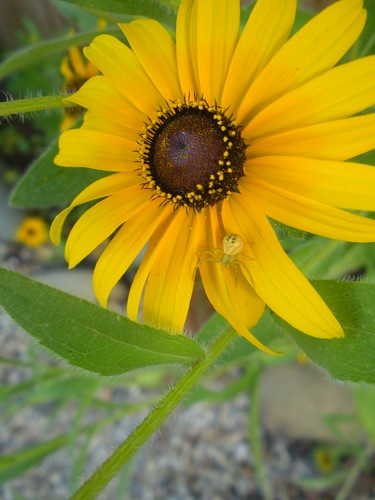
We were out working in the garden this morning and the topic of pollination came up. We were talking about the different ways that plants pollinate and as if to illustrate one way, this spider obliged us with his example. We were really examining these black-eyed susans and their pretty pollen spots and we realized that this very yellow spider was sitting right there in front of us. Isn't he pretty?


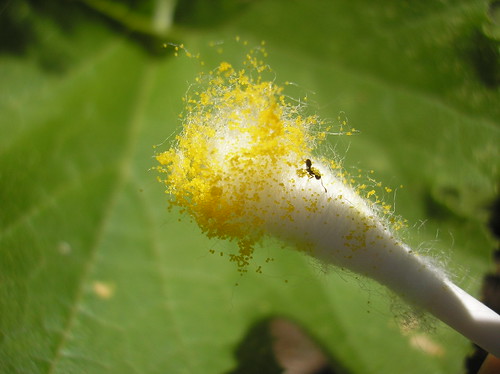
I ran inside and gathered a few things to use in exploring the garden and its pollens. I brought out a few Q-tips and a hand lens for gathering some pollen from the flowers and looked at it up close. We also found that many of the flowers and veggies that we observed had ants crawling in around the inside of the flower. Pollination.


Pollen on a day lily

We took a few minutes more to look at various ways that plants hold their pollen and watched a few bees at work and then we came inside.

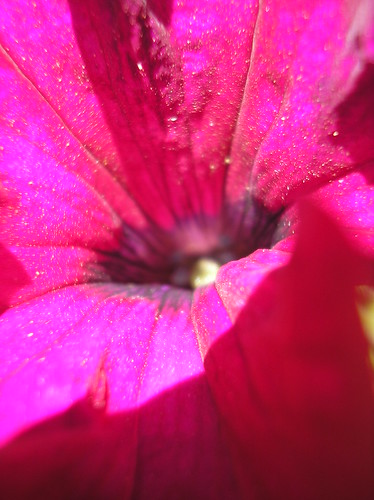
Pollen on a petunia

It was a short nature study but the best kind......stemming from curiosity about something we had close at hand.

Have a great weekend.
Barb-Harmony Art Mom

Friday, November 30, 2007

Wrapping up our Fall Term Study of Insects

We have had several insects that we have seen and identified but not taken great photos of for the blog. One was an earwig that I found in my kitchen. I hate earwigs.

The Handbook of Nature Study does not have any information on the earwig but it is a great insect to identify the parts of an insect with. I knew what kind of insect it was so we did a quick internet search and found loads of information about it.

We also found a millipede which we quickly discovered was *not* an insect. It is an invertebrate. You can find an illustration of a millipede and a caption about it on pages 448-449 of HNS.


We also found a tarantula in our garage, dead and stiff. This made for some interesting observations. At first I was horrified by its appearance but then, after I knew it was dead, I was able to observe its parts and really see it up close. I don't care to do that too much but it was interesting this one time. :) So even though it technically isn't an insect, we did learn something about tarantulas.

Here's what the Handbook of Nature Study says on page 435-436:
"There is an impression abroad that all spiders are dangerous to handle. This is a mistake; the bite of any of our common spiders in not nearly so dangerous as the bite of a malaria-laden mosquito. Although there is a little venom injected into the wound by the bite of any spider, yet there are few species found in the United States whose bite is sufficiently venomous to be feared. With the exception of the tarantulas of the Southwest, and the hourglass or black widow, which seems now to be extending its range from the South, the spiders of the United States are really as harmless to handle as are most of our common insects."

Believe me, I will not be handling any tarantulas in the near future. :)

We are wrapping up the focus on insects and we will be moving on to mammals for now. I am sort of excited to start since I know we are going to learn so much about what has been under our very noses and we have missed it.

Barb-Harmony Art Mom

Monday, October 22, 2007

Little Red Spider


I just love these photos of a little red spider in the middle of a dahlia blossom. It reminds me of a Georgia O'Keeffe painting.

Although the Handbook did not help me identify the spider, I was able to skim down the table of contents to find the section on spiders in the book.

Here is from page 435:
"The spiders are the civil engineers among the small inhabitants of our fields and woods. They build strong suspension bridges, from which they hang nets made with exquisite precision; and they build airplanes and balloons, which are more efficient than any that we have yet constructed; for although they are not exactly dirigible, yet they carry the little balloonists where they wish to go, and there are few fatal accidents. Moreover, the spiders are of much economic importance, since they destroy countless millions of insects every year, most of which are noxious-like flies, mosquitoes, bugs, and grasshoppers."


I looked online and found out that it may be a spider called a "Flower Spider" or Misumenops but I have to do a little more research.

Barb-Harmony Art Mom


Thursday, October 4, 2007

Where There is a Web: Fall Webworm

Yesterday we went looking for more insects in our backyard. We saw some more daddy longlegs...actually lots of daddy longlegs. We saw a tiny little spider on the marigolds but he would not hold still for a photo. I took this pretty photo of my marigold anyway. Look closely and you can see the pollen.

Then we found this wonderful web on the crepe myrtle bush. I looked high and low but did not see what made the web. After doing some research, I discovered this to be the web of a Fall Webworm or
Hyphantria cunea. In the larval stage, they create these great webs where they feed entirely inside the web. The adult is a moth that has white wings and has grayish-brown spotting on the forewings.


From page 295 of the Handbook of Nature Study:
"While the young pupils should not be drilled in insect anatomy as if they were embryo zoologists, yet it is necessary for the teacher who would teach intelligently to know something of the life stories, habits, and structure of the common insects."

I am finding this to be essential to our study of insects. I need to know a little information about each thing we find and weave it into our study. It doesn't take much time to open the Handbook of Nature Study, skim the table of contents, and turn to the page for more information. I am finding that just having read the introductory pages to the section on insects has provided more than enough information to get started.

From page 295:
"From the eggs, larvae (singular larva) issue. These larvae may be caterpillars, or the creatures commonly called worms, or perhaps maggots or grubs. The larval stage is devoted to feeding and to growth."

Now I have a little vocabulary to use with the boys when we see caterpillars. I can point out that these are insects in their larval stage and their main objective in life is to eat. We can find this stage annoying when they are eating the leaves of our garden plants but we can understand a little more about it.

We observed a bee dancing in the pollen of a cosmos flower. He was digging into the pollen and practically rolling in it. Here is a slightly blurry photo of him...try to get a bee to sit still. You can see the pollen on his body.


My favorite photo of the day is this one. It is a close-up of my son's dahlia flower. There had been a little insect on it that I was trying to capture but he was too quick.


Well, that is what we saw and observed yesterday. I am finding the more we look, the more we realize that we have to see.

Barb-Harmony Art Mom