Showing posts with label sketching. Show all posts

Thursday, October 14, 2010

Review: Observing Nature-A Journal Sketching Guide to Discovering Your Natural Environment

Observing Nature - A Journal Sketching Guide to Discovering Your Natural Environment

The moment I printed this plan out and put it into a binder, I knew I was going to like the approach taken to help teach children (and adults) how to tap into their observation skills and translate them into their nature journals. This is a wonderful plan for homeschoolers to use on their own or through a co-op. If you are interested in learning how to help your children learn how to create wonderful nature journal entries...read on!

There are two parts to this review.
Observing Nature Teacher's Manual
Observing Nature-Teacher's Manual

This 18 page teacher's manual is very well put together and gives enough detail that you would feel confident to teach a whole group of students about sketching and journaling. The targeted age group is 8 years old and up but I did not feel it was too easy for my high school age boys.

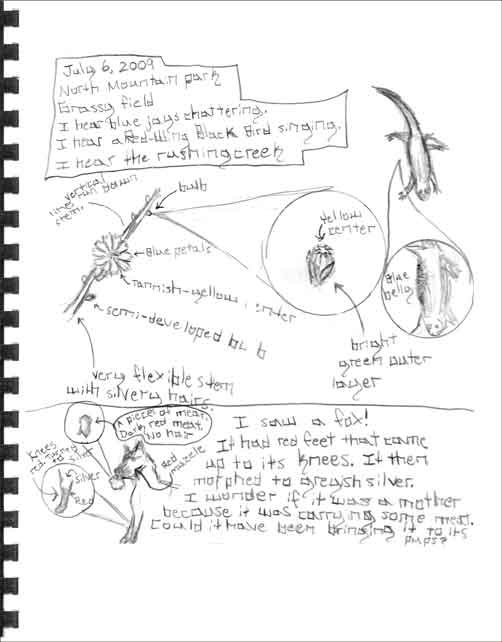
Here is a link to the Course Objectives and example of a completed journal page.

Valuable aspects of the Teacher's Manual:
  • Directions for gathering and displaying observation trays.
  • Supply checklists.
  • Thorough instructions for teaching the three student projects, see LINK.
  • A class plan with suggested time values if you are going to be teaching this course to a group of students. Also a plan for an assistant if you are so lucky to have one in your co-op. The author suggests teaching the entire workshop in one session but after that you can practice the skills over a period of time.
  • Template to print out for making collection or observation boxes...very handy.
  • $24.95 as a PDF download.
Observing Nature Guide
Observing Nature Student Guide
  • This workbook style guide will work alongside the activities suggested in the teacher's manual. 
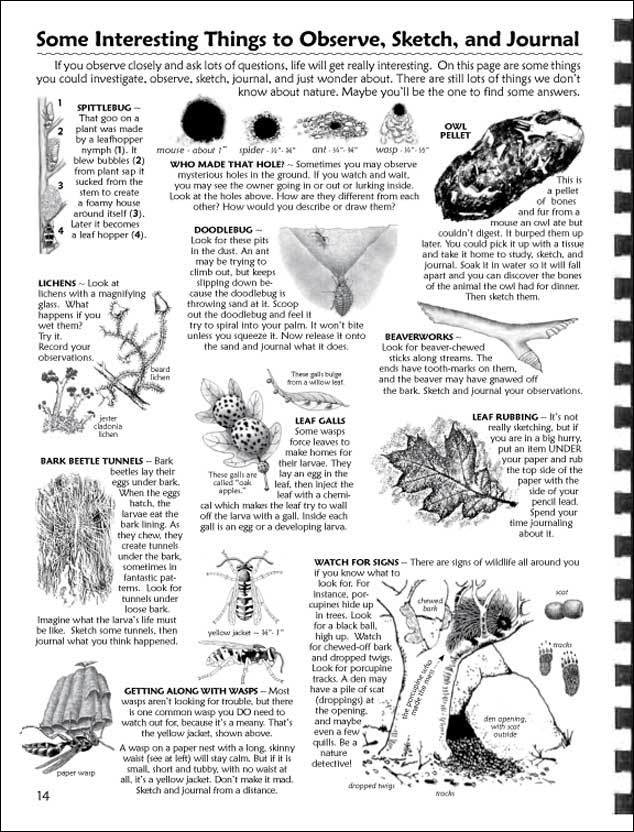
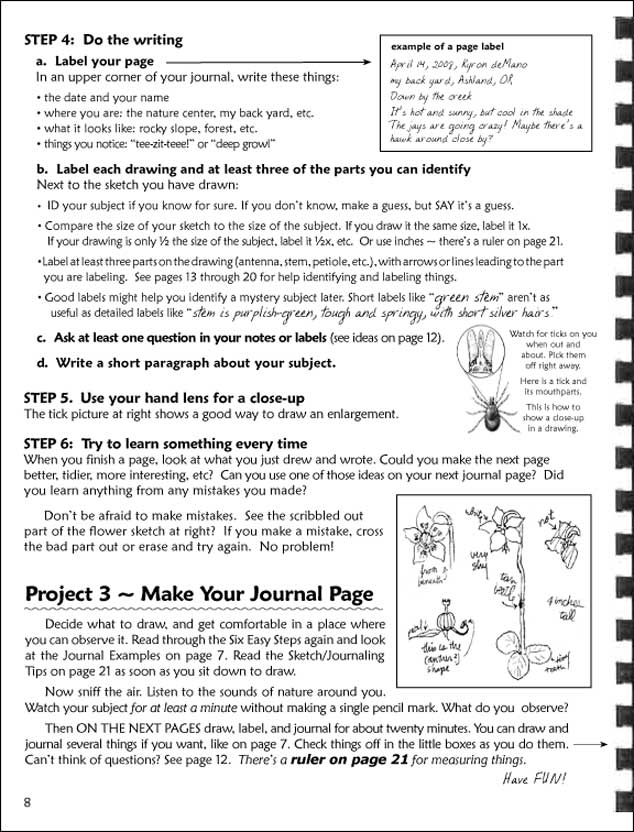
  • There are exercises right in the guide that will help your child become better observers and as a result, better at recording their observations in a nature journal. (SAMPLE)
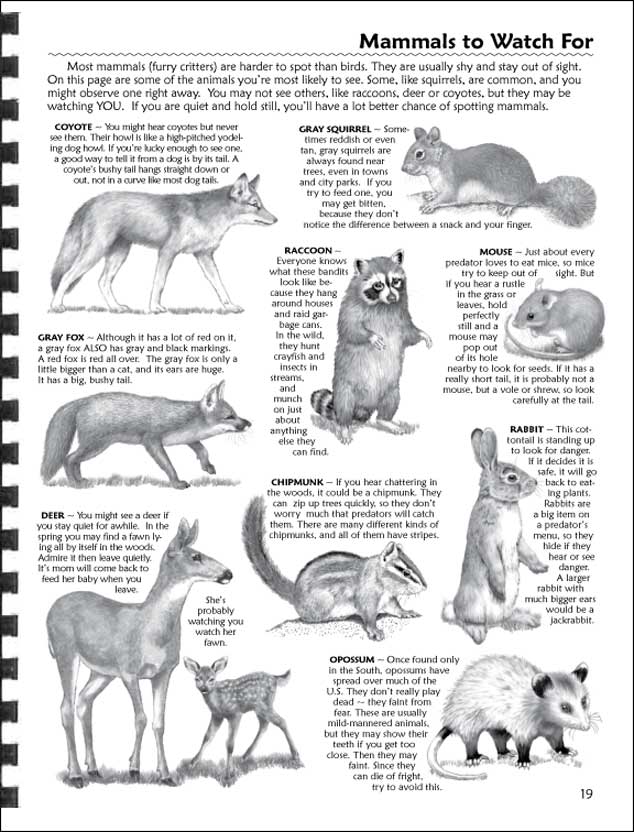
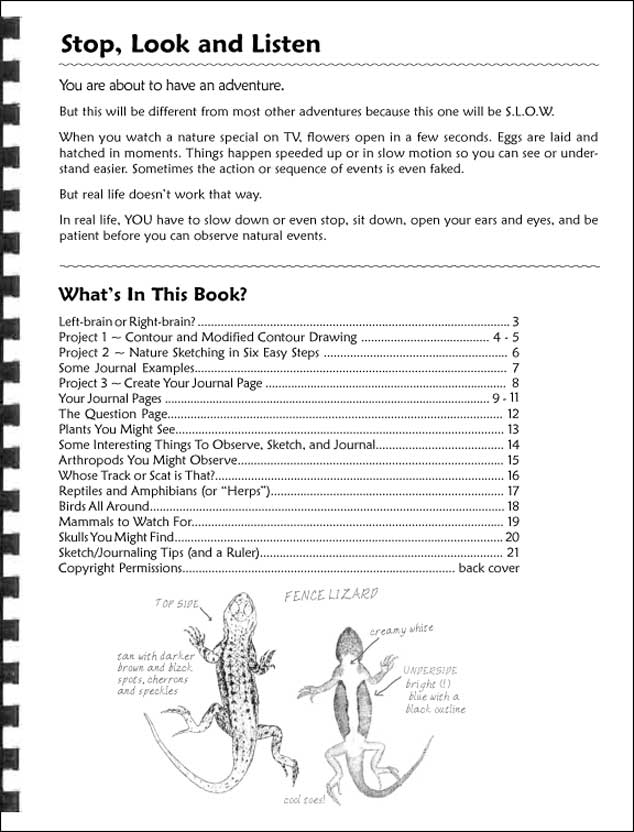
  • There are plenty of examples to view and in the back of the workbook there are reference drawings for plants, insects, reptiles, birds, mammals (SAMPLE) and tracks. 
  • My favorite part of the guide is the Question Page. This page gives your child lots of journal prompts to make the nature journal entries come alive with their own words.
  • There are blank journal pages in the guide for your child to use in getting started with their own sketching. We were able to glean some fresh ideas from these pages for our own personal journals.
  • Once you buy the student workbook you can print as many copies as you need for your family or co-op.
  • $24.95 for PDF download.
I would give this plan a big thumbs up as far as value, content, and organization. These may be the plans your family needs to jumpstart your nature journals and/or breathe some fresh air into some nature journals that are becoming ho-hum.

Please note:
I received these ebooks in exchange for a fair and honest review. I only review items I have personally used and would recommend to my readers.  Also, I am not affiliated with Nature Works Press and I will not receive any compensation if you purchase these ebooks. My sole motivation for writing this review is to share another valuable tool with families that might like this sort of guide to use personally or in a co-op setting.

Wednesday, July 23, 2008

Drawing and Your Nature Journal


I decided to do a reposting of this blog entry from my old blog because I thought it might help someone who is a newer reader of my blogs. I wrote this awhile back and it contains a lot of my personal thoughts and experiences with keeping a nature journal.
"The sun illuminates only the eye of the man, but shines into the eye and the heart of the child. The lover of nature is he whose inward and outward senses are still truly adjusted to each other; who has retained the spirit of infancy even into the era of manhood."
-Ralph Waldo Emerson, Nature
I was asked to post a little about my personal nature journal. I decided I would share, not because I feel as if I have the "right" answer but because I think it will be helpful to see how I have struggled through the years to find something that works for me. I am not an authority on nature journals, if there is such a thing, but I have been attempting this life project for many years now and have grown to love keeping a record of my experiences.

***Note to those just starting out with nature journals***
Everyone feels that little twang the minute a blank page is opened in the journal itself. I want my journal to be perfect and wonderful and worthy of awe but I don't always seem to get what is in my head down onto the actual page so be comforted when you feel as if you are the only one that views your first efforts as inadequate.

I will try to explain what I have learned about nature journals and include some of my actual nature journal pages from the last eight years to help illustrate what I have discovered. Please know that it takes a lot of courage on my part to share my feeble beginnings and to show just how much I still have room to grow. Sharing these pages, others can see that this is a work in progress even for those of us who have been at the process of nature journaling for a number of years. (You can click on any of the images and they will enlarge.)
nature journal tracingnature journal spider
nature journal people
Here are some pages that show how I just do the best I can to get down on paper what I am seeing at the time. I don't draw faces very well so I just left it blank. I also will sometimes just trace something like a leaf or a flower into my journal and then add a bit of color. It works.

The process of finding something you want to include in your journal is more important than the actual journal entry.
When you are trying to keep a nature journal, you actually need to have some sort of contact with nature and that is the first step....usually the hardest step is just getting out the door of your house. The actual getting outside into your little square of nature is more valuable than the journal entry itself if you really think about it. You are outside under the big, beautiful sky. You are spending time with your children and showing them by your example that you value being out-of-doors. Anything that happens while in the process of finding something to record in your journal is the real experience of the nature journal.
nature journal not artisticnature journal birdwatchingnature journal weather
Nature journals are not meant to necessarily be artistic. Once I took the pressure off myself to have a journal like the examples in How to Keep a Nature Journal, I noticed that I was having more fun keeping a record of my experiences. The point of a nature journal is to record things that inspire you and you want to remember. Your experiences out-of-doors should spur you on to make a record of those memories that are worthy of remembering just like a scientist keeps a lab book. Sketches, arrows, cross outs, diagrams, lists....these are all found in my nature journal. It is my journal and it can be any way that I wish it to be.
nature journal sunflower B
Here I am trying to show the progress of our garden.
nature journal pressed flower
I opened my journal this morning and this pressed flower fell out. I had pressed it between the folds of a napkin and put it in my nature journal. You can also find leaves pressed between the pages of my nature journal.
nature journal lists
Sometimes I just like to list what I take photographs of and not take the time to actually sketch or draw and that is what I did on this day. I still like the entry and I could go back and put the photos on the next page if I want to but for now it is just a list.

Keeping a nature journal is a long-term life project. I have one nature journal that I have been working in for over eight years. It is a work in progress. My favorite entries are those that are not necessarily the most artistic but they hold the memories of my time spent in God's creation. My nature journal goes with me on every trip we take....I have packed it three times to Hawaii, to Yellowstone, on countless trips to Yosemite, and on most every little day trip I make. Do I always remember to pull it out and record things? No. Do I wish I would have made more entries? Yes. There is the lesson.
nature journal trip accountnature journal unfinished entry
Sometimes my nature journal doubles as my travel journal. On these two pages I wrote and sketched about our time at Redwood National Park. I didn't have time to finish the sketch but it still is something that reminds me of that time.

If you want your drawing skills to improve, you must practice.
Gulp. That is a tough one for most of us. I did not come from an artistic background so giving myself permission to try to learn to draw or paint or do anything artistic took a big shove from my husband. He encouraged me take a drawing class at the college. This was so far out of my comfort zone but I really wanted to learn how to draw past stick figures. It took time and effort. My suggestion for people who are striving to do a better job in sketching is to go to your library and go to the children's section first and check out "how to draw" books and use them along side your children. I checked one out on how to draw insects and one on how to draw birds and then found some nature sketching books to try. These experiences with the book open in front of you and your sketching from the step by step instructions will eventually spill over into your nature journal. There is no magic formula but your success is equal to the effort you are willing to put into it. I started to work with watercolor and I was brave enough this summer to actually do a watercolor straight into my nature journal. You can decide what you need to teach yourself in order to make your nature journal your own expression of your experiences in nature.
nature journal watercolor
This is a more recent journal entry that I made *after* working through the book Sketching in Nature. I can already see the difference. I am starting to be able to take some of the ideas of others and make them my own in my personal nature journal. I am working on drawing the water so that it looks like it is moving...it is coming along.

I have recently become fascinated with the journals of Lewis and Clark and those of John Muir, the conservationist. The connections between their journals and their legacy is indisputable. Our journals and those we encourage our children to keep will be a link to their deepened understanding of how wonderful and exciting a world was created for us to live in.

Barb
Harmony Art Mom

Friday, May 23, 2008

Outdoor Hour Challenge #15 How to Draw A Flower

“The making of drawings to illustrate what is observed should be encouraged. A graphic drawing is far better than a long description of a natural object.”
Handbook of Nature Study, page 13
As your family makes progress with their nature journals, you will find that there is a desire to start making things look a little more realistic. I thought we would take this week to challenge ourselves to practice drawing flowers with some help with internet tutorials.

Please remember that the nature journal is not the place to give drawing instruction but you could use the tutorials during your art time and then gently remind your children when it comes time for a nature journal that they can incorporate some of their new drawing skills if the opportunity arises.


I would suggest that if you have younger children, take a few minutes to educate yourself first and then share with them little hints as they try to draw garden flowers. This is a perfect opportunity for you to model positive behavior about your own sketches, showing how to make your nature journal an expression of what you found interesting during the Green Hour. If your children are a little older and you are comfortable with them following the tutorials on their own, the link below is perfect for them.

Here is a link to get you started:
HowStuffWorks: How to Draw Flowers and Plants
This is a fantastic page that lists common garden flowers and how to draw them step by step.

Make sure to bookmark this tutorial page for future reference. You could use the lessons as you progress through the next few weeks during your art or sketching time as a way of learning the techniques of drawing flowers in your nature journal. If you start with this challenge and draw at least one flower in your nature journal every week until the garden focus is over, you will have five flower sketches completed. Wouldn't that be great? Remember no one else needs to see your drawings....we would love it if you would share but you can keep them private too.
"The book should be considered the personal property of the child and should never be criticized by the teacher except as a matter of encouragement; for the spirit in which the notes are made is more important than the information they cover."
Handbook of Nature Study, page 13
I guarantee you if you start working in your nature journal, your children will be more comfortable drawing in theirs too.
"As soon as a child is old enough, he should keep his own nature notebook for his enjoyment. Every day's walk will give something interesting to add-three squirrels playing in a tree, a bluejay flying across a field, a caterpillar crawling up a bush, a snail eating a cabbage leaf, a spider suddenly dropping from a thread to the ground, where he found ivy and how it was growing and what plants were growing with it, and how ivy manages to climb.....The skill of drawing may be addressed in some other way, but not in his nature notebook, that should be for him to fill as he sees fit." Charlotte Mason volume 1, page 54-55
One last thing before this week's challenge. I found another flower parts diagram worksheet that I like even better than the first one I posted. Here it is if you want to print it out for your children's nature notebook.
Flower Parts Diagram

Outdoor Hour Challenge #15

How to Draw Lesson-Flowers


1. Read pages 13-15 in the Handbook of Nature Study-The Field Notebook. This will refresh your memory about what is the purpose and aim of the nature journal.
“Nature-study offers the best means of bridging the gap that lies between the kindergarten child who makes drawings because he loves to and is impelled to from within, and the pupil in the grades who is obliged to draw what the teacher places before him.” Handbook of Nature Study, page 17
Keep all this information in your mind as you gently go about your nature study time and then encourage journal drawing.

2. Take your 10-15 minute outdoor time to look for some garden flowers that you can draw in your nature journal. The object this week is to find something that sparks your child’s interest and that he desires to record in his journal. If it is a flower, great. If it is something else like a spider or a bird, allow them to draw that instead.

3. Give an opportunity for a nature journal entry, work on drawing another garden flower in your nature journal. If you are growing seeds, use this time to record their growth perhaps measuring and recording the plants height or counting the number of leaves it has so far. All of these subjects make great additions to the nature journal.

4. Add any new flowers to your list of garden flowers. If you are making field guide cards for your garden flowers, add another card this week.

5. Add any flowers you collected to your flower press. We have found you can add another sheet of paper and another cardboard sheet to the mix and you will have a multi-layer press. Check on your flowers from last week and see if they are ready to go into your nature journal. See challenge 14 for more information.

6. Post an entry on your blog sharing your experiences and then come back to the Outdoor Hour Challenge post and add your blog link to Mr. Linky.

Garden Flowers Cover

This challenge is part of my Garden Flowers ebook. This ebook has ten garden related challenges that will walk you through a study of garden flowers using the Handbook of Nature Study. In addition to the challenges already written, there will be more photos, nature journal examples, book lists, and totally new notebook pages designed to go with each of the Garden Flower Challenges.
Follow the link below to view the ebook! Over 50 pages for $6.95

Please note: Mr. Linky is for linking to your Outdoor Hour Challenge blog post only. Please do not link to your blog in general because then when others want to read your challenge post, they have to dig around in your blog to find it.


Thursday, May 1, 2008

Nature Study for Young People


"As soon as a child is old enough, he should keep his own nature notebook for his enjoyment. Every day's walk will give something interesting to add--three squirrels playing in a tree, a bluejay flying across a field, a caterpillar crawling up a bush, a snail eating a cabbage leaf, a spider suddenly dropping from a thread to the ground, where he found ivy and how it was growing and what plants were growing with it, and how ivy manages to climb."
Charlotte Mason Volume 1 Home Education page 54.

Here are some other thoughts on nature study from Charlotte Mason.
  • The skill of drawing should not be addressed in the nature notebook. pg. 55
  • If the child is too young to write, the mother should do it. pg. 58
  • Encourage your children to sit quietly and patiently and to look closely. pg. 57
  • Some children are born naturalists but all have a natural curiousity that can be encouraged. pg. 58
  • Most children will think of a million things to put in his nature notebook. pg 55
Here are some of my own observations on nature study.
  • It takes my children a long time to explore outdoors and they can do it very well without my interfering. I try to follow their lead and not rush them.
  • I need to participate in the nature study myself. I try to model how to find a subject for my notebook and really observe the object.
  • Drawing the object in the notebook is the last step in really "seeing" the object.
  • There is no use in forcing a child to work in a nature journal. Regular exposure to the outdoor life will eventually lead to a desire to keep a record of what they see that interests them.
  • Every nature journal is unique to the owner. I tend to record scenes in my journal. My daughter usually finds something pretty to draw. My boys find "things" to record in their journals like sticks, bugs, leaves, and seeds.
  • Don't limit your journals to sketches. Sometimes we include photos in our journals. We have taken rubbings of bark or leaves. We have even taped small objects into our journals. Variety in our journals make them more interesting.
We have been working diligently in our notebooks this summer, recording our adventures. It is comforting to look back on the sketches and remember what fun we have had exploring the outdoors.

Have a great weekend.
Barb
Harmony Art Mom

Note: This is an old blog post from my old blog.