Showing posts with label romania. Show all posts

Friday, September 17, 2010

Embroidery Design in Bucovina

Illustration: Traditional Bucovina embroidery designs.

Of the many distinctive and cultural areas that go to make up the present day country of Romania, Bucovina although one of the smallest regions, does still have an individual presence in Romania.

Bucovina, although technically a part of the Romanian region of Moldova, not to be confused with the neighbouring independent country of the same name, has a long and substantial history of craft traditions, one of the most interesting and long standing of which is that of embroidery.

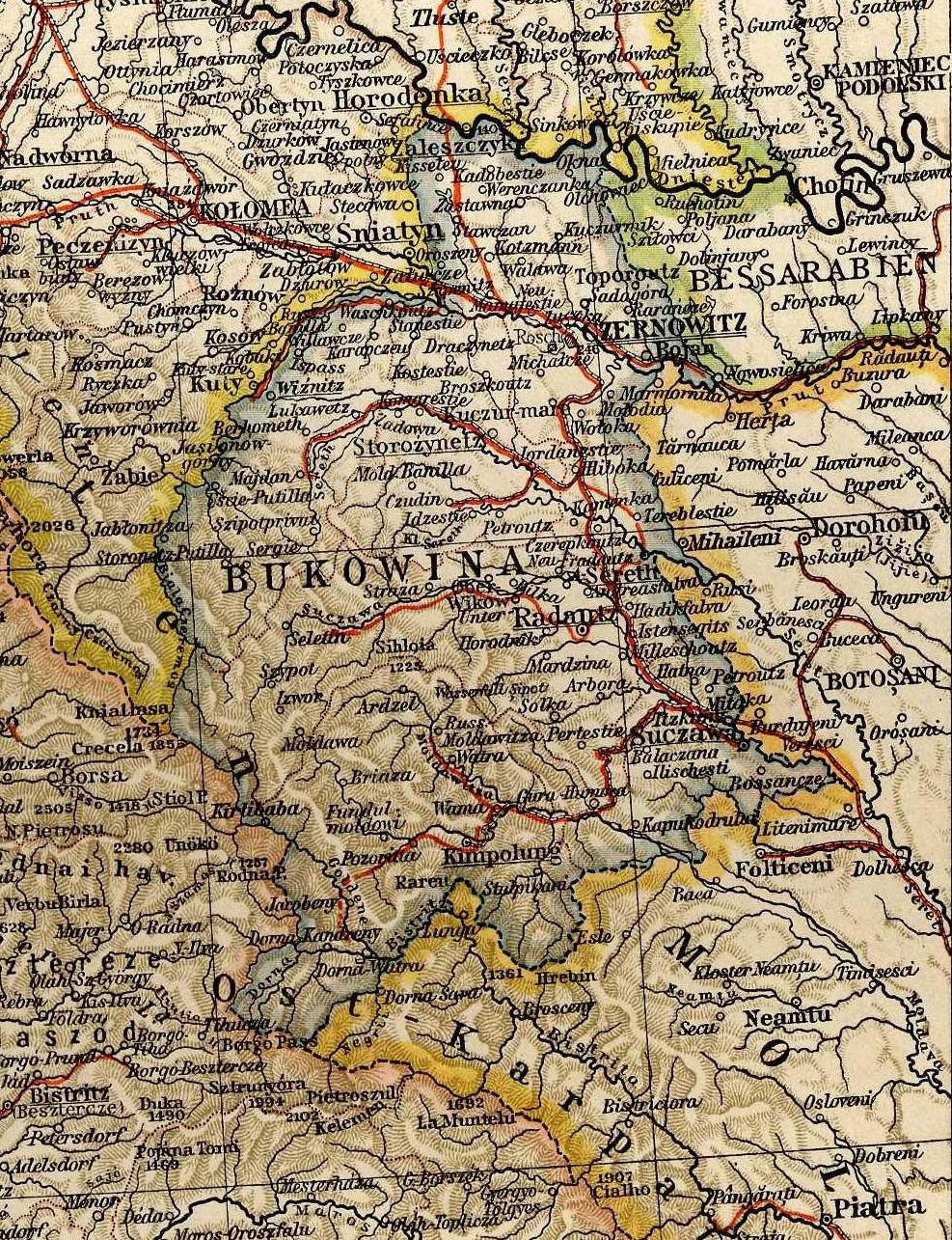
Illustration: Map showing Bucovina in 1901.

European embroidery has always been identified regionally, particularly when considering the work produced in Central and Eastern Europe. Bucovina has for centuries been ruled and occupied by a series of various nations and empires from Poland, through to Turkey, eventually becoming part of the multi-national Austro-Hungarian Empire. Through all of these various differing cultural and political systems, Bucovina maintained its own identity. However, being part of a larger European crossroads of cultural and traditional exchanges, decoration and crafts within the region were obviously influenced and the embroidery examples shown here give some impression as to the range of Bucovina decorative work.

Traditional embroidery pattern work of Bucovina is that of a relatively strict geometrical style with linear design work being particularly popular, although abstract floral work is also incorporated in the naturally traditional style of the region. It must be said in all fairness that this is not a style reserved exclusively for Bucovina. It can indeed be found across the differing areas that make up modern Romania. However, although many see this geometrically linear decorative style as being typical of areas such as Bucovina, the larger region of Romania is a complex patchwork of cultural and ethnic layers, many overlapping. This has made identifying and disentangling true regional styles all the more complicated.

Illustration: Traditional Bucovina woman's embroidered blouse.

To add to the complexity of the situation even just in Bucovina itself, there is a range of embroidery styles that span from strict geometrical pattern work to that of true representational floral work, some even incorporating the two extremes of embroidered styling within the same costume. The non-abstracted floral style in particular, could be seen as the work of influential styles being introduced into the region from a number of directions, whether that be Hungary, Poland, Russia or Turkey, all at one time immediate neighbours or occupying powers of Bucovina and all having this particular style of floral work within their own decorative vocabulary.

Rather than seeing the complexity of embroidery work in regions such as Bucovina as a dilution or contamination of the traditions of the region by outsiders, it might be better instead to celebrate the multi-layered fusion of styles that recognises the important role of cultural crossroads that Bucovina, its people and its craft work played over the centuries. It would be a mistake to see regions such as Bucovina, which is by no means singular in its experience, as a form of European regional backwater that contributed very little and was bypassed by the major cultural and decorative movements of the continent.

Illustration: Traditional Bucovina embroidered jacket.

The accumulation of varying styles and traditions within generations of craft work such as embroidery, have added an inestimable amount of experience and inspiration to artists and designers across the whole region of Central and Eastern Europe for much of the nineteenth and well into the twentieth centuries. It is the stored vocabulary of regions such as Bucovina, that have helped to expand the parameters of the decorative arts of Europe, and their experience within the craft world can only continue to add to that richness.

Anyone interested in the fascinating and complex history of Romanian regional folk costume of which Bucovina is a part, should follow the link in the Reference links section below to the Romanian Museum site where over one hundred distinctive styles are listed and illustrated along with regional maps identifying the complex cultural and ethnic diversity of modern day Romania.

Illustration: Traditional Buckovina woman's embroidered blouse.


Further reading links:
Romanian Museum: Folk Costumes of Romania website
Bucovina: A Travel Guide to Romania's Region of Painted Monasteries
Embroidered Textiles: A World Guide to Traditional Patterns
Peasant art in Austria and Hungary
Romanian embroidery: A dying folk-art
Folk art in the Rumanian People's Republic: Costumes, woven textiles, embroideries
Leather embroidery in Romanian folk art
Embroidered Textiles: A World Guide to Traditional Patterns
Helen M. Stevens' World of Embroidery
Embroidery: Traditional Designs, Techniques, and Patterns from All over the World
Priscilla Wallachian Embroidery c.1908 - Ethnic Romanian Embroidery Technique
Romanian embroidery: A dying folk-art
Folk art in the Rumanian People's Republic: Costumes, woven textiles, embroideries
Romanian Point Lace

Monday, May 10, 2010

Hungarian Embroidery in Transylvania

Illustration: Torocko Man's costume.

All of the images in this article represent traditional examples of Romanian embroidery. However, the story is much more complex than at first appears. The images specifically represent Transylvanian embroidery and within that theme, they also represent the work of ethnic Hungarians living within Transylvania. To be even more distinct, these images portray embroidered jackets that originated in the Hungarian village of Torocko in western Transylvania.

Illustration: Satellite map of Transylvania

Toroczko, now also known by the more Romanian sounding Rimetea, was an important centre of embroidery skills. Transylvanian Hungarians tended towards similar decoration work as that of Hungary proper further to the west. However, a mixture of styles, at least to some extent, would have been seen within the work. Influences from both native Romanians and that of the Turkish Empire would have been particularly strong. There was also an added influence from outside the region, that of native German settlers who also occupied areas of Transylvania alongside both Hungarians and Romanians. 

Illustration: Torocko man's costume.

Torocko embroidery is specific and was traditionally coloured either red or blue, rather than a mixture of colours and tones. The illustrations shown in this article are of either leather or felted jackets, both sleeved and sleeveless, two with blue embroidery and one with red. The actual embroidery motif work was often floral as in Hungarian embroidery, with tulips being particularly important. The materials used were often the same as in many other areas of Transylvania and Romania as a whole, cotton or linen, but more often linen.

Interestingly, the illustrations shown here of Torocko costume, were originally produced by the Hungarian artist and craftsman Alador Kriesch-Korosfoi.

Illustration: Torocko woman's costume.

Romania itself, let alone the ethnically diverse Transylvania, has got to be one of the most complex and fascinatingly diverse areas of Europe. It is said that there are well over a hundred distinct and individual folk costume areas within the country, with countless smaller local variations. The way that today's Romania has incorporated independently distinctive ethnic areas, including Transylvanian Hungarians, has added to the richness of the culture and particularly the textile crafts, so that Romanian embroidery is now seen as one of the richest and most varied in Europe. 

This library of ethnic and cultural diversity is part of Romania's heritage and there are a number of online sites that now deal with this heritage. The RomanianMuseum.com is a particularly good site and is well worth visiting for anyone interested in the folk costumes of Romania. Also provided are a couple of links to Torocko/Rimetea, as well as a number of books and music of Transylvanian Hungarians all available at Amazon.com

Further reading links:
RomanianMuseum.com
Torocko.hu
Rimetea accommodation
Peasant Art in Austria and Hungary
Embroidered Textiles: A World Guide to Traditional PatternsTündérkert / Fairyland - Hungarian and Romanian Folkmusic from Transylvania (Collected by Zoltán Kallós, Edited by Ferenc Novák)
Hungarian Folk Music From Transylvania
Romanian and Hungarian Music from Transylvania
Hungarian Folk Music from the Kis-Küküll? Region of Central Transylvania, Romania
Hungarian Music from Transylvania
Transylvania: A land beyond fiction and myth
Ethnic History of Transylvania
The Land Beyond the Forest 2 Volume Paperback Set: The Land Beyond the Forest: Facts, Figures, and Fancies from Transylvania (Cambridge Library Collection - Women's Writing) (Volume 2)
Charted Peasant Designs from Saxon Transylvania (Dover Needlework)

Wednesday, April 7, 2010

Traditional Bucovina Rug Work

Illustration: Traditional Bucovina rug design.

Traditional rug and carpet design comes in a number of different styles within the confines of the borders of modern day Romania. Regional variations used to be much more acute than perhaps they are today, due to better transport, communication and general interaction. The individual styles of various craft forms that were built up over centuries across Europe, had much more to do with geographical isolation than it did with any significant cultural purity, though this of course cannot be ruled out.

Illustration: Bucovina, 1901.

The rug work produced in the Romanian province of Moldova is unique within Romania as it is in Europe itself. However, within the province of Moldova itself, rug making can be defined within various geographical areas with some having a distinct and long tradition of work that has a separate identity to that even of Moldova. Bucovina, a province of the old Austro-Hungarian Empire and now split fairly evenly between Romania and Ukraine, is one of those areas. Southern Bucovina now makes up an area of north-western Romanian Moldova and is famed for a number of unique textile craft traditions including that of weaving.

Illustration: Traditional Bucovina rug design.

Woven products took a number of forms in Bucovina with various domestic household items being woven from towels to bags, but it is the tradition of rug and carpet weaving that has made weavers in Bucovina consistently well regarded over the generations.

Overall, the style of Bucovina weavers and Moldovan in general was that of a more geometrical form than floral, though these were also included within the framework of Bucovinian work. The examples shown here cover both styles though the geometrical formats seem much stronger and more confidently produced. Whether the design work originated in part at least from ideas brought into the region by the spread of the Turkish Empire into Europe, is debateable though the similarities with rug design work in Turkey, the Caucasus and beyond seems more than a coincidence.

Illustration: Traditional Bucovina rug design.

In the latter nineteenth century during the period of the Austro-Hungarian Empire, what was considered traditional peasant and folk art was collected avidly by both private and state individuals. Vienna and Budapest, as well as most sizable cities throughout the empire had their own ethnographic libraries, museums and galleries where local traditional crafts, as well as those further a field were collected, documented and conserved. This practise went on all over Eastern Europe and despite the turbulent political history of the region over much of the twentieth century, many of the collections remain intact and in state hands. Most cities and indeed many towns throughout Eastern Europe have ethnographic museums, which are now an invaluable storehouse of traditional crafts and skills, many of which are either no longer practised or have been drastically altered over the last century.

Illustration: Traditional Bucovina rug design.

The rug work of Bucovina was as avidly collected as any other regional craft style, and examples can still be seen in various cities throughout the region. However, the best way of seeing Bucovina woven rug work is in Bucovina itself. The Ethnographical Museum at Radauti which is a town in the north of the region, has a full complement of traditional craft skill examples from ceramics to metal and wood and including costumes and woven carpets and rugs.

Rug weaving is still being produced in Bucovina, though mostly as a support to the tourist industry. Tours both craft orientated and general, often include visits to weaving workshops within their itinerary. Some of these tours have been listed below.

Further reading links:
Ethnographical Museum of Radauti
Bucovina & Transylvania Explorer Tour
Bucovina Monastery Tour
Romanian Monasteries.org
Bucovina Tourist Area
Astro Travels - Bucovina
Traditional Folk Art website
Bucovina: A Travel Guide to Romania's Region of Painted Monasteries
A short history of Bessarabia and northern Bucovina (Romanian civilization studies)
Romania: An Illustrated History (Illustrated Histories)
Lonely Planet Romania (Country Travel Guide)
The Rough Guide to Romania 5 (Rough Guide Travel Guides)
Lonely Planet Romania and Moldova (2nd Edition)
The Mountains of Romania (Cicerone Mountain Guide)

Wednesday, January 27, 2010

Carpathian Embroidery

Illustration: Embroidered trousers for a man.

It can be confusing to designate exactly where Carpathia is and who indeed are the Carpathians. The Carpathian Mountains themselves are an area of eastern Europe that straddle parts of present day Poland, Slovakia, Hungary, Ukraine and Romania, but for a number of centuries it was seen as being an integral part of the Austro-Hungarian Empire being the northern border of Hungary. Although Carpathia itself does not exist as a political entity, as a cultural area it does have some integrity.

Carpathia has a long, rich, and diverse embroidery history, taking in and re-using the contacts and cultural craft skills of the diverse population that makes up the area. The ethnic makeup of the general area of Carpathia has always been incredibly rich and complex. Throughout its history, the area has been home to Hungarians, Ukrainians, Slovaks, Russians, Jews, Germans, Roma, Czechs, Romanians, Greeks, and Armenians. From this patchwork of peoples, it is understandable how rich and layered the craft skills of the area truly are.

Illustration: The Carpathian Mountains.

Interestingly Carpathia is one of the few areas of Europe where men are involved in embroidery. It has a long tradition of male embroiderers who were seen as professionals rather than amateurs. They produced ever more complex and detailed embroidered embellishment work for male coats and trousers. These were to be seen externally and so there was always an element of genuine pride in the skilled work that had been achieved, but inevitably, there was also an element of male posturing. Shirt embroidery, on the other hand, was less noticeable and so was therefore produced by women, usually on an amateur basis by a member of a family, rather than at a professional level.

Illustration: Pasul Bran, Romania.

It is difficult to trace the source of all the elements that go to make up Carpathian embroidery design and decorative work. In an area of Europe that has managed to maintain a relatively ethnically diverse population, compared to the rest of the continent, this task is made all the more confusing and complex. However, rather than trying to literally and culturally unpick the threads that go to make up Carpathian embroidery, it is probably best to celebrate the many peoples and cultures that make Carpathian embroidery the astonishing feast for the eyes that it is today.

I am including some links to the general area of the Carpathian Mountains. Anyone wishing to visit this fascinating and extraordinary part of Europe, or just to learn more about the area should take a look at the Reference links section below.

Further reading links:
Romanian Carpathian Mountains
Ukrainian Carpathian Mountains
Romanian Carpathians imagery
Ukrainian Carpathians imagery
The Complete International Book of Embroidery
Embroidered Textiles: A World Guide to Traditional Patterns
Treasures from the Embroiderers' Guild Collection