Showing posts with label webs. Show all posts

Sunday, October 16, 2011

Found My Orb Web!

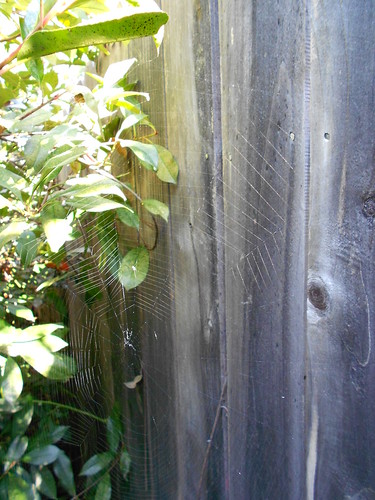
We were busy pulling all of the dead and brown things out of the garden when I spotted it! The most perfect spider web I have seen in a long time was right next to the hose reel. I actually touched it before I saw it and it startled me.

Spiderweb 10 15 11 (3)
The sun was shining just right to see most of it in a photo so I ran inside and snapped a few images to share here on the blog. I called Mr. A and my husband over to take a look and we admired the preciseness of the web and we talked a bit about how it was constructed with a frame and then the web spun around and around.

Spiderweb 10 15 11 (2)
I took the opportunity to see if the inside threads were sticky like we read about in the Handbook of Nature Study which led to a short video (30 seconds) to show our experiments.


Isn't that grand? I love learning new things alongside my boys....

"The radii or spokes, the guy-lines, the framework, and the center of the web are all made of inelastic silk, which does not adhere to an object that touches it. The spiral line, on the contrary, is very elastic, and adheres to any object brought in contact with it. An insect which touches one of these spirals and tries to escape become entangled in the neighboring lines and is thus held fast until the spider can reach it. If one of these elastic lines be examined with a microscope, it is a most beautiful object. There are strung upon it, like pearls, little drops of sticky fluid which render it not only elastic but adhesive." Handbook of Nature Study, page 440.
Thanks Anna Botsford Comstock for bringing such an amazing detail to our attention. We have a heightened sense of awe over something we have overlooked our entire lives. Now I can rest our web study for the season, unless a new web presents itself.

Friday, September 30, 2011

OHC More Nature Study #4 Webs of All Kinds

More Nature Study Button
"The great danger that besets the teacher just beginning nature study is too much teaching, and too many subjects.  In my own work I would rather a child spent one term finding out how one spider builds its orb web than that he should study a dozen different species of spiders."
Suggestions for Nature Study, Anna Botsford Comstock, 1904.


OHC More Nature Study 
#4 Fall Webs- Cobwebs, Funnel Webs, Orb Webs, and Filmy Domes

Inside Preparation Work:
  • Read pages 436-444 in the Handbook of Nature Study. This will be Lessons 110-113 on cobwebs, funnel webs, orb webs, and filmy domes.
  • View images of different types of webs: Web Types (scroll down for images)
  • Watch a spider spin a web on YouTube: Spider Building a Web
Outdoor Hour Time:
  • Use your Outdoor Hour time to go on a web hunt. Look for webs stretched between limbs of bushes, between fence posts, or in corners of windows. If you find a web, sit quietly and observe the location, the size, the shape, and any spiders you can see. Use lots of descriptive words and if you brought along your nature journal, sketch the web for your page.
  • Use some of the suggestions from the lessons in the Handbook of Nature Study to glean further knowledge about your spider web and the spider. Try to determine what kind of web you found.
  • Take a photo of your web if you wish to include it in your nature journal.
Follow-Up Activity:
  • Spend a few minutes after your outdoor time to review your experience. Help your child remember some of the descriptive words they used when they observed their web. Use a few well chosen questions to bring out their experience.
  • Give the opportunity for a nature journal entry, a notebook page, or to look up information in a field guide or reference book. If your child was more interested in the spider, try to identify it and make a record of that in their nature journal.
  • Advanced Follow-Up: Write a paragraph telling how the threads of the spider web are arranged, a second paragraph describing the threads, and a third paragraph about the spider that made the web. You can use the accompanying notebook page provided in this ebook (ebook users only).
Additional Links:
More images of spider webs on National Geographic Kids
Beautiful Spider Webs on Squidoo—preview for age appropriateness