Showing posts with label garden. Show all posts

Monday, July 30, 2012

How to Make a Waxed Paper Pouch For Your Nature Journal or Notebook

Pressed Flower Pouch button
I have been experimenting with a variety of ways of putting pressed flowers and leaves in my nature journal. The latest way is to use a small piece of waxed paper, folding it to make a pouch. The pouch can then be adhered to the nature journal page or notebook page

Steps for Making a Waxed Paper Pouch 
for Your Nature Journal or Notebook Page

Pressed Flower Pouch (2)
Step 1: Cut a strip of waxed paper about 6 inches wide.

Pressed Flower Pouch (3)
Step 2: Fold the two long edges and one small edge up about half an inch.

Pressed Flower Pouch (4)
Step 3: Remove your pressed flower from your press. For instructions on how to make a flower press with cardboard, copier paper, and rubber bands, see my tutorial in this entry: How to Make a Plant Press.

Pressed Flower Pouch (8)
Step 4: Place the pressed flower into the pouch with the folds of the waxed paper holding it in place.

Pressed Flower Pouch 9
Step 5: Fold the top flap over, crease the wax paper, and insert the flap behind the bottom fold. This will keep the flower from slipping out of the pouch and it will allow you to open the flap and view the pressed flower when desired.

Pressed Flower Pouch (7)
Step 6: Adhere the pouch in your nature journal or onto your notebook page using double sided tape or a tape runner.

You can custom make the pouch to fit any size space you have in your nature journal. Adjust the amount of paper you start with and how large you fold the pouch. 

Adding pressed flowers and leaves to your nature journal gives them a more personal touch and will remind you of your time outdoors. Enjoy!

Tuesday, July 10, 2012

Gardening for Birds - Expect to Be Dazzled By Who Comes to Visit


Finch in the Sunflowers

Our garden and our bird list is very interconnected. The birds are coming and enjoying a variety of things in our garden habitat. I learned from Angie at Petra School that it takes about twenty minutes before the birds forget that you are watching. I have tried to find a spot to sit or stand in the garden and just wait to see who will come back during that twenty minute's time.

The results?

I can confirm that she is right on! Usually after a few minutes the jays come back and the nuthatch and the grosbeaks come fairly quickly too. But some of the birds take a good long time before they reveal their hiding places in the trees and in the shelter of the bushes we have at the edges of our yard.

It is worth the wait. I decided that this week's garden/bird entry would be a photo essay with lots of colorful images and very few words. Enjoy!

Birdbath for the Birds
Day lilies and our back birdbath

The birdbaths are a frequent stopover for the neighborhood birds.

Blackberries for the Birds
Our little wild patch of blackberries just behind the birdfeeding station.

The blackberry bushes are a perfect shelter for birds to rest and to wait their turn at the feeder.

Finches eat the Sunflower leaves
The leaves on our sunflowers are being eating by nibbling finches.
The sunflowers and birch trees are attracting the Lesser Goldfinches...who are eating the leaves and seeds.

Black Headed Grosbeak in the Feeder
Black Headed Grosbeak who visits our feeder everyday now.
The Black-headed Grosbeaks and the Western Scrub Jays are in and out of the feeders all day long.This is the best image I could get this week...they are fast in and out of the feeder. They have a sweet little song as well.
Sage Lavender Butterfly Bush
Sage, Lavender, and Butterfly Bushes
The Mourning Doves and California Towhees are pecking around under the feeders.

The White-breasted Nuthatches, House Finches, Titmouses, and House Sparrows are always found in the seed feeders.

Fruits for the Birds
Not sure what kind of tree this is but it sure is messy...the birds love it though.

The European Starlings and Robins are busy eating the fruits from the neighbor's tree that hangs over the fence into our yard.

Starling Eating Fruits
Starling in our neighbor's yard with a fruit from the tree.
The birds are making a huge mess by taking the fruits all over the yard and eating them. They leave the pits behind and they are covering our driveway. This starling will leave the pit in our neighbor's grass and next year it may start to grow into a tree. I know this from experience.

Hummingbird in the Butterfly garden

The Anna's Hummingbirds are everywhere. They still come to the feeders but they also are in the trumpet vine, the roses, the bee balm, the butterfly bushes, and several of my potted plants.

The neighborhood Great Horned Owl is heard once it is dark and still outside. I envision him hunting the rodents that get into my birdfeeders.

The mockingbird sings all the time...almost round the clock. 

Additional bird notes:
We have heard the Steller's Jay and their "shook-shook-shook" several times in our neighborhood but we have yet to see one. This would be a new to our neighborhood bird.
We have heard the Nuttall's Woodpecker lots of time but only once in our back tree. I need to remember to fill the suet feeder.
The Starlings come everyday now which is new for this year as well. Their buzzing sound is now a familiar backyard bird sound.
The Black-headed Grosbeaks are also a new every day bird. Their flash of color at the feeders is beautiful.


Jami's Tuesday Garden Party meme is open from Tuesday to Thursday so there is still time for you to jump in and participate!

You may be interested in reading my entry, If You Build It, They Will Come, entry that shows the butterflies that are frequently found in our yard.

What are you doing to make your yard attractive to birds and butterflies?


Tuesday, June 26, 2012

You Build It and They Will Come - Butterfly Garden

Painted lady
This is the summer of the butterfly! We have been observing many kinds in our front yard garden...it is amazing to watch as several flutter around from flower to flower. The American Lady butterflies are smaller than we expected but they are daily visitors to the butterfly bushes.

We planned this garden for bees, butterflies, and birds and they are now moving in and taking advantage of our neighborhood oasis that we have created. Our neighbors all stop by to tell us how much they enjoy seeing our yard as they walk and drive up the street. It makes me smile.

Creating this wildlife habitat has been a dream realized. I can honestly say that we have spent time every single day enjoying the wonderful things in this space. 

Western Tiger Swallowtail
The Western Tiger Swallowtails are the most frequent of the larger butterflies to visit every day. They spend lots of time on the butterfly bushes but they also land on the lavender from time to time. I think they are my favorite butterfly.

Butterfly Bush 1
The white butterfly bush is the color that attracts the most butterflies from our casual observation. It has larger amounts of flowers so I think they may be the attraction.


Monarch in the Butterfly Garden
We have had a few Monarch butterflies in the past week. This one looks a little tattered. It is exciting to see a Monarch though...this is exactly why we created this habitat. We looked forward to having our nature study subjects come to us...and they have.

Butterfly Bush
This long thin purple flower cluster is my favorite shape and color. This could be called my purple section since I have purple lavender, sage, and butterfly bushes literally bursting out all over. The bees have found this space and they are here all day long.

Butterfly Bush - Favorite
The deep purple bushes line the front street and there are hummingbirds that can be seen landing on the blossoms as they take a break from collecting the nectar. The blooms don't even dip down...those hummers must be super lightweight.

There are a few more butterfly varieties that have come to visit but I haven't caught them with my camera....yet. I will share when I do.

Just for the record, the bee balm and nasturtiums started blooming this week in the back yard. Beautiful!


Jami's Tuesday Garden Party meme is open from Tuesday to Thursday so there is still time for you to jump in and participate!


Monday, June 11, 2012

Cleary Garden

A haven in the city, not far from Mansion House is the tranquil Cleary Garden. A garden has existed here since the middle ages when the vintners used the site for trading and growing vines. It has undergone a number of remodels since that time with a total recreation after WWII. In 2007 it was redesigned with vines and aromatic plants from the Loire Valley. A little piece of France in the heart of the City of London.

Tuesday, June 5, 2012

Garden Color and Fragrance - Early June Delights

Daisies June 2012
My garden is full of promise...the promise of beautiful things to look at and delicious things to eat.

The daisies are filling in a big spot in the back cutting garden and we are anxious to study them as part of the Outdoor Hour Challenge later in the summer. There are coneflowers, sunflowers, and zinnias as well that have buds so stay tuned for some updates on those in a few weeks.

Star Jasmine
Some things are already smelling like heaven...the star jasmine is in full bloom and already needed a trimming back from the sidewalk. The cats lay under these plants since they make wonderful shade in the afternoon sun. Wouldn't that be delightful?

Disneyland Roses June 2012
Last week when I was working with the window open I could smell this rose on the gentle afternoon breeze. It is a Disneyland Rose and it has been a faithful bloomer these past few years. It is loaded with pink/peach flowers. This rose is what I imagine the perfect rose fragrance would be...a signature scent.

Hydrangeas (1)
The hydrangeas are bursting open this week and the delicate color of the flowers on this particular bush is one of my favorites.

hydrangea nature journal (2)
A few years ago, I used my watercolor pencils to capture the pastel colors of this lovely flower and then used a fine tip marker to outline it a bit. Keeping track of my favorite garden flowers in my journal is a wonderful way to pass an afternoon.

Jerusalem Sage
This is something new in the backyard this year and it is really taking off. We added this Jerusalem Sage to a spot that gets super hot and dry in the afternoons up against the house. So far it is thriving...I did put it on the drip system until it is established and then I think I can back off with the water. The texture of the leaves is soft and fuzzy which adds a nice layer of interest to this side of the garden. 

Purple Butterfly Bush
The front yard has been joined by the blooming purple butterfly bush! The hummingbirds have been seen enjoying this particular bush...actually fighting over it in the early evening hours. My cat friend Cocoa is like my garden shadow these days. She seems to pop up wherever I go. You can see my sage growing in two spots in the background of this photo. It is just starting to bloom.

Red Hot Pokers June 2012
Another favorite of the hummingbirds is the Red Hot Poker plant. This is Mr. A's favorite plant in the garden and he has been eagerly waiting for it to bloom. It looks good this year and I may end up dividing up the plant in the late fall to fill in a few spaces in the front garden.

Apples - June 2012
We have started to see quite a bit of growth in our backyard fruit. The apples are looking like apples! Not too many apples on the limbs but enough for each of us to enjoy a crisp apple come the end of the summer.

Someone asked in a comment a few weeks ago whether we had any lawn left in our yard. The answer is yes and you can see it in this photo. We have a small plot of grass left in the backyard, mostly for the dog to enjoy. We use it as her ball throwing spot and she loves to lay in the shady grass on the hot afternoons. Since it gets so hot here and there is very little rain during the summer months, we do have to water this part of the yard. I have it set on a timer and it waters five minutes a day and so far that is enough to keep it green. (I need to write a post showing how we have cut our water usage to a fraction of what it was two years ago and still enjoy a lush green garden.)

Figs on the Tree
Of course the figs are loaded as usual....this is not my favorite fruit but we eat a bit and then leave the rest for the birds and other critters. We have tried several times to eliminate this tree but every time we cut it down it comes back full and loaded with fruit within a year.

Blackberries - Early June
I do LOVE blackberries and we have our little patch just loaded with blossoms right now. This is exciting and it really seems like summer now that the berries are maturing. My blueberries are still all plant and no signs of blossoms or berries. I hope to get a bit of fruit from them this year. We shall see.

We have rain today so the garden is getting well watered but tomorrow we are going to see the end of the rain and be back to our warm temperatures. I am grateful for the rain but I am ready for the summer heat.


More Nature Study #4 Cover image
Just a few reminders to participants of the Outdoor Hour Challenge:
The first of the summer challenges will post on  June 8, 2012..that is this Friday!

Don't forget to send in your June blog entries to the Outdoor Hour Challenge Blog Carnival by Friday, June 29, 2012.

The June (Ocean Beach) edition of the Outdoor Hour Challenge Newsletter has published. You must be subscribed to the blog in order to receive the download link. It is a beautiful and informative edition that I know you are going to want to have in your collection. You can subscribe on the sidebar of my blog. 


Jami's Tuesday Garden Party meme is open from Tuesday to Thursday so there is still time for you to jump in and participate!

Friday, May 25, 2012

OHC More Nature Study Book 3 - Iris Study

It hardly seems possible that this is the last challenge from the More Nature Study Book 3 Spring Splendor series! This season has gone by so very fast. Let's all make an effort to get outside this week and view some garden flowers whether they are in our own backyard, at a near-by park, or at a garden nursery. Take advantage of the opportunity to enjoy this last spring challenge outdoors with your family...fifteen minutes can be squeezed in first thing in the morning or right after lunch if that works for your schedule.

More Nature Study #4 Cover imageThank you so much to all the participants who have shared their outdoor adventures this season through the links of the Outdoor Hour Challenge Blog Carnival. Keep sending in your entries! We will be taking a little break from the challenges until June 8, 2012 and then we will start our Summer Sizzle series of challenges at that time. The new ebook is available and ready for you to download in preparation for a summer of enriching nature study. I hope to see some summertime entries from all the OHC families!

Spring Flower Study - Iris button
More Nature Study Book 3
Garden Flower - Blue Flag Iris
“Each iris flower has three side doors leading to the nectar wells; and the bees, in order to get the nectar, must brush off the pollen dust on their backs” Handbook of Nature Study

Inside Preparation Work:
  • Read Lesson 157 in the Handbook of Nature Study (pages 571-574). View the diagram on page 573 showing the parts of the iris labeled. 
  • View these YouTube videos: Blue Flag and Iris and Bee
  • Advanced Study: You can determine what kind of native irises you have in your area by viewing the maps at the bottom of this page: USDA Iris.
Outdoor Hour Time:
  • This lesson is valuable for learning about wild irises and garden irises as well. Take your outdoor time for this challenge and view an iris if possible. The lesson also suggests that observations of the flower can take place inside but the viewing of the bee visiting the iris is the most interesting way to learn about this flower. You may need to file this study away until you can visit an iris in person. 
  • Alternate activity: Spend time watching insects and flowers in your garden or at a near-by park. Use the information about the iris and the information you learned in the Poppy-Buttercup Challenge to make comparisons between flowers. Remember to use proper flower part vocabulary in your conversation. Ebook Users: You can use the Spring Flower notebook page if you would like as part of this challenge. 
  • Watch any pollinators in your yard and observe their behavior.
Follow-Up Activity:
  • Allow time for a nature journal entry where your child can sketch and record their iris study or complete a coloring page. This site may be helpful in carefully drawing the iris and labeling its parts: The Iris Flower (USDA). Advanced Study: Use colored pencils and draw your iris in your nature journal (see an example HERE). How about a video?
  •  Discuss any pollinators you viewed as part of this challenge and record any interesting thoughts in your nature journal. See the list of questions above. 
  •  Advanced Study: If you live in the United States, you can use this website to determine what plants and pollinators you have in your neighborhood: Pollinator Partnership. View your guide to determine five plants that you can add to your garden to encourage pollinators to visit. If you already have native plants, make a list of them in your nature journal. Alternate activity: Record information in your nature journal for one native iris to your area.
Additional Activities:
Great Sunflower Project: If you enjoy watching bees visit your garden flowers, you may be interested in participating in this citizen science project. It is simple enough for even very young children to get involved with and it doesn’t take a lot of time. Click over to their website to learn more.

Blue Iris Time Lapse video (for fun).
More Nature Study Book 3 Button


Don't forget to share your Spring Splendor Walk blog entries with the Outdoor Hour Challenge Blog Carnival. All entries done in May are eligible for the next edition. The deadline for entries is 5/30/12 and you can send them directly to me: harmonyfinearts@yahoo.com.

Friday, May 18, 2012

More Nature Study #3 Garden Snail Study


Image Source: Flickr

More Nature Study Book 3
Snail Study
“Perchance if those who speak so glibly of a ‘snail’s pace’ should study it, they would not sneer at it, for, carefully observed, it seems to be one of the most wonderful methods of locomotion ever devised by animal….The snail carries his dwelling with him, and retires within it in time of danger. He can climb on any smooth surface.”
Handbook of Nature Study 


Inside Preparation Work:
  • Read the Handbook of Nature Study pages 416-422 (Lesson 106). There are lots of interesting details about the snail’s life history and its behavior. Highlight a few things you can share with your children.
  • Choose a few of the suggested activities to use as part of your snail study.
  • YouTube videos for preparation and building interest: Garden Snail Video (excellent), Escargot, and Two Garden Snails and this one (preview) Garden Snail
Outdoor Hour Time:
  • Go on a snail trail hunt! Although snails are nocturnal, you can look for snail trails during the day which may lead you to some snails hiding in moist places like pond areas or near the garden. Continuous trails are from slugs while trails with breaks belong to snails. Snail trails will glisten in the sun or shine at night with a flashlight.
  • If you find a snail or a snail shell, make careful observations. If you have a container, gather a snail for more indoor observations. Use a magnifying lens to view the snail’s eyes or other body parts. Handle the snail carefully and wash your hands afterwards. Use the suggestions from Lesson 106 to guide your careful study of the snail.
Follow-Up Activities:
  • If you found a snail, record your observations in your nature journal. Describe the color, size, and behavior of your snail. Put it into a clear container with some leaf litter and source of moisture like a can lid filled with a bit of water. Put in some bits of lettuce and watch the snail eat. Watch the snail as it climbs the clear walls, observing the underside of the snail.
  • If you found an empty snail shell, take careful notes of its appearance. Advanced study: Identify the type of snail you found. Draw your snail shell in your nature journal. (See link below.)
  • Advanced study: Research the Phyllum of Mollusca. Record your findings in your nature journal along with a list of other mollusks.
  • Advanced study: Develop a question about snails that you can answer by observation. Design an activity or experiment to answer your question. Carry out your activity and then record your results in your nature journal. For example: How fast does a snail crawl? How does it eat? How does a snail protect itself? How does a snail react to light? Ebook users: Notebook page included in the ebook.
Additional Links:


More Nature Study Book 3 Button

Don't forget to share your May OHC blog entries with the Outdoor Hour Challenge Blog Carnival. All entries done in March are eligible for the next edition. The deadline for entries is 5/30/12 and you can send them directly to me: harmonyfinearts@yahoo.com.


This is an awesome and fun YouTube video: Snail Art

Thursday, May 10, 2012

Updated Wildside-New Garden Arch-Delighted Nature Mama

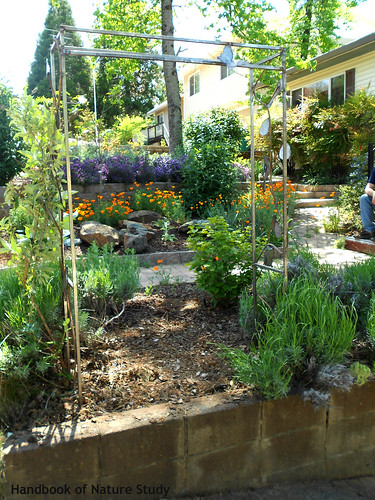
Arch frontyard - frame
This was a big week in the garden.

My dear sweet husband surprised me by making a new garden arch for my front yard. We had talked about adding a decorative arch, kicked around a few ideas, and then he added his creative touch. I love the way it makes a sort of  "window frame" to the lower part of the garden. He is going to fill in the bare spot with another sage. The poppies are filling in naturally and I think by next year they will be to this lowest part of the yard.


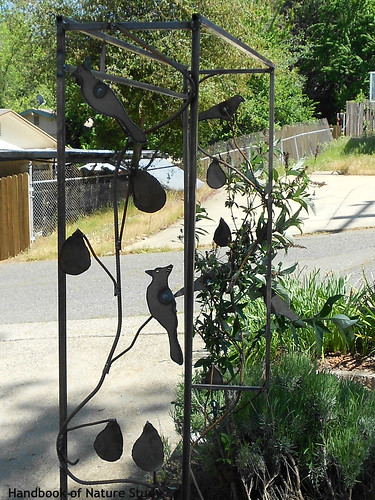
Arch frontyard closeup
He added a few of my favorite things....birds, butterflies, vines. (Maybe all this garden beauty will distract me from my neighbor's falling down fence.)

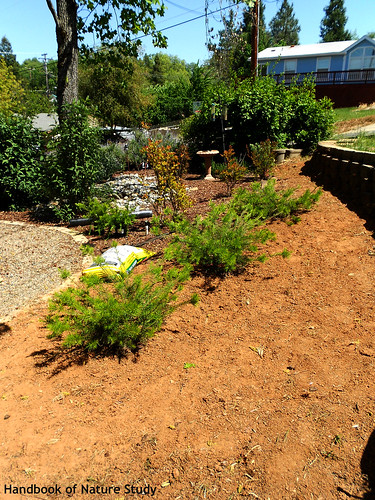
Tilled Wildside
He didn't stop there. He finished up the top terrace of the front yard....he eliminated much of my wildside garden but now it is going to be filled with more wonderful color. Just a note: He used the idea I found on Pinterest to spray a solution of vinegar and water on the weeds before trying to remove them. He sprayed last weekend and let it sit for a week. It was awesome how easy those weeds just hoed out of the ground. He was able to do this entire area in less than an hour! I didn't get a "finished" shot....I will soon.

DSCN3541
We are adding more yarrow...a different color this time. The yarrow in our front yard is amazing right now...what a great performer with no water and lots of sunshine.


DSCN3549
Maybe someday this new section will be as colorful as the established part of the garden. Here is an image from the top terrace looking down onto the yarrow, lavender, butterfly bush, poppies, and dogwoods. We also added some lamb's ear among the rock garden. I am going to see if spreads too much but it has added a new texture to the yard.

Switch gears now and head to the back butterfly garden.

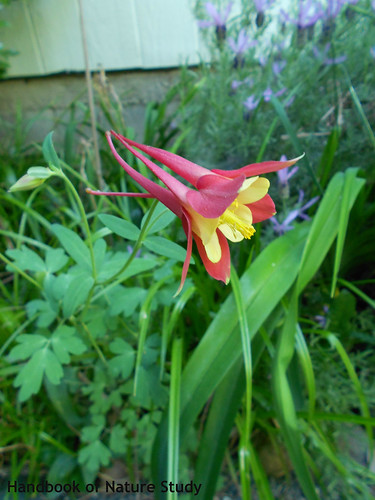
Columbine red yellow beauty
The columbine is starting to bloom! This is such a wonderfully happy flower that loves my semi shady spot in the butterfly garden. Look at those colors!

Columbine red yellow
How about the shape? Isn't it interesting to see how different the back of the flower looks from the front? I am adding this image to my nature journal...I think watercolors.

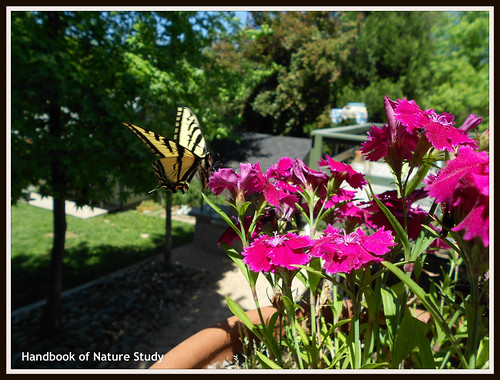
Swallowtail in the garden
Last but not least, I wanted to share another one of my swallowtail visitors to my back garden. This magnificent butterfly spent quite a bit of time yesterday fluttering among my potted plants. He seemed to like the bright pink dianthus the best.


So now you know what I am one delighted nature mama. I love this time of year!


Jami's Tuesday Garden Party meme is open from Tuesday to Thursday so there is still time for you to jump in and participate!