Showing posts with label United Kingdom. Show all posts

Tuesday, April 17, 2012

Health of the People -- British style

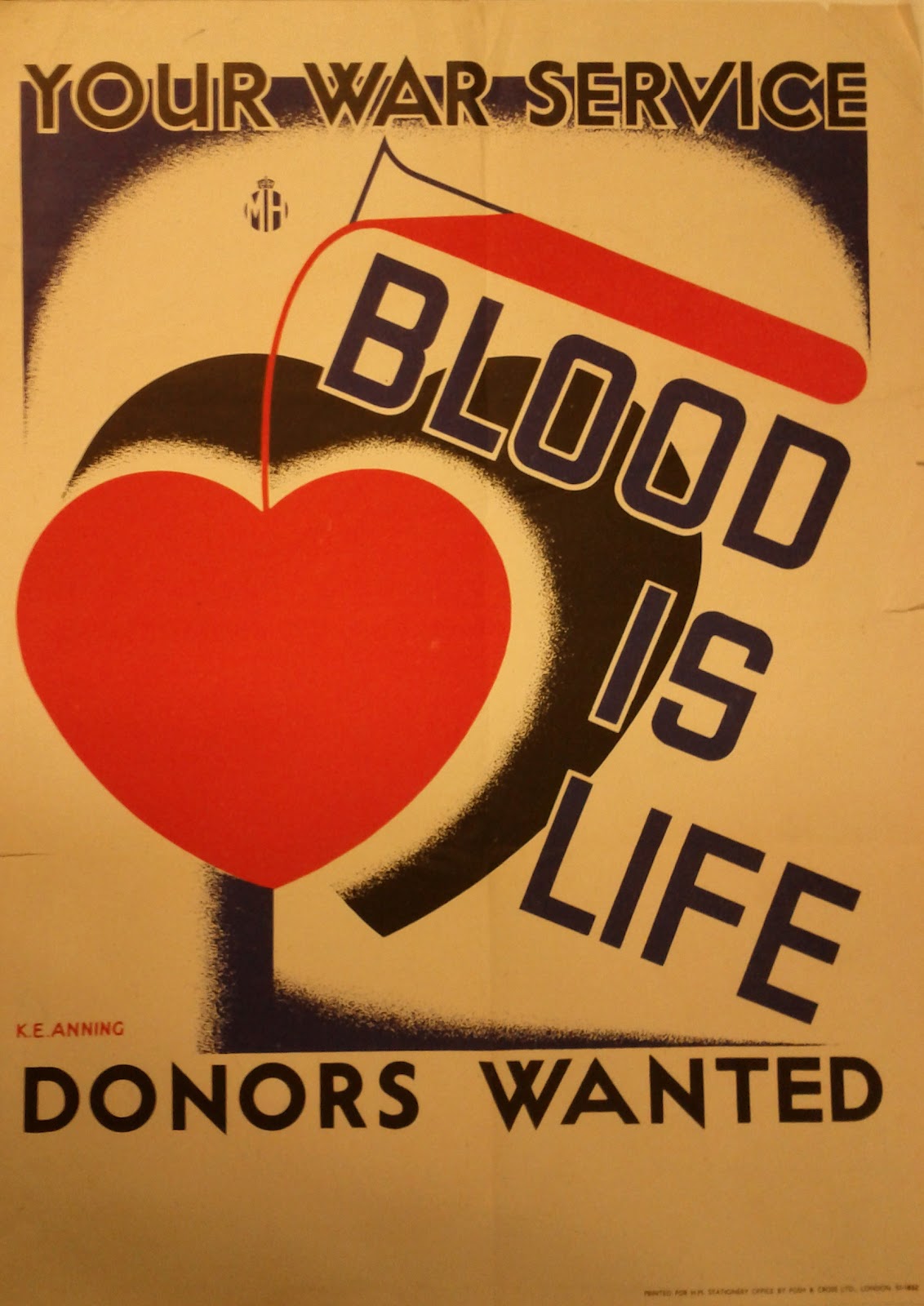
The Wellcome Library has acquired a collection of 600 British posters dating from the 1940s to the 1990s advertising the health-maintenance activities of the British state. Most were produced by the Central Office of Information for the U.K. Ministry of Health (subsequently Department of Health and Social Security, subsequently Department of Health).

The posters cover the following subjects: Blood donation (135); Children (44); Diseases (121: AIDS, asthma, colds and flu, diphtheria, epilepsy, meningitis, rabies, rubella, tetanus, tuberculosis); Drugs or narcotics (53); National Health Service services and charges (80: ambulance service, cervical screening, community care, emergency GPs, evaluation, fares to hospital, NHS 30th anniversary, prescription charges, spectacles); Nurses and midwives (87, including recruitment, Queen's Institute of District Nursing, etc.); Organ donation (44), Travel and health (8); and Miscellaneous (26: air-raids, disability, health and safety, health of the nation, hearing, incontinence, mental health, and teeth).

Proof pulls and storyboards are included as well as finished versions. Named designers include Reginald Mount, K.E. Anning (above), and Abram Games.

The posters are accompanied by a large collection of photographs, drawings, etc. which have not yet been explored, except for one item, a photograph album (Wellcome Library no. 811058i) recording an exhibition from 1948 called Health of the People. This exhibition was put on by the Central Office of Information in Oxford Street, London (but where in Oxford Street?) apparently to publicize the introduction of the National Health Service (NHS) in that year. On display from May to June 1948, the exhibition was an ambitious attempt to communicate the history of public health and the difference that the NHS would make between the past and the future. Much attention was given to new laboratory-based services.

The photographs makes it look like a halfway-house between Britain can make it at the V&A in 1946 and the Festival of Britain on the South Bank in 1951. No names of contributors (commissioners, writers, designers, manufacturers) are given, but surely they must be recorded somewhere; possibly in the unexplored parts of this same collection. The script which accompanies the album makes much reference to the Public Health Act of 1848, the centenary of which was being celebrated.

Did this period see the high-water mark of state involvement in health in the British Isles? If so, our successors will no doubt look on these documents with incredulity. Only time will tell. 
Displays in the Health of the People exhibition, 1948. Left, "the health team, consisting of the family doctor, dentist, nurse etc". Above, stands on protection of towns, water supply etc. Top, the staircase between floors.

Wednesday, January 12, 2011

"Mental: a history of the madhouse" available again (briefly)

Mental: a history of the madhouse is "a documentary which tells the fascinating and poignant story of the closure of Britain's mental asylums". It was originally broadcast on 17 May 2010 and in July 2010 was discussed in a posting on the Wellcome Library blog.

The film is now once again available for UK viewers free of charge on the BBC iPlayer for a limited period (11-21 January 2011). The Wellcome Library offers free internet access, so anybody who does not have easy access to the internet and can visit the Wellcome Library may watch the film in the Library free of charge.

Thursday, July 8, 2010

Asylum portraits

"Mental: a history of the madhouse" was a 60-minute television documentary in the BBC Four/Open University "Out of Mind" Season, broadcast in the UK in May 2010. [1] It told the story of the closure of Britain's mental asylums. To quote the press release, "In the post-war period, 150,000 people were hidden away in 120 of these vast Victorian institutions all across the country. Today, most mental patients, or service users as they are now called, live out in the community and the asylums have all but disappeared. Through powerful testimonies from patients, nurses and doctors, the film explores this seismic revolution and what it tells us about society's changing attitudes to mental illness over the last sixty years." Powerful? Overwhelming.

Among the interviewees were patients, members of medical and nursing staffs, the historian Dr Peter Barham, and Dr Henry Rollin FRCP FRCPsych, emeritus consultant psychiatrist at Horton Hospital, Epsom, and former Librarian of the Royal College of Psychiatrists. Dr Rollin described the grimly low levels of medical care in many of those asylums, and of care in general. Historic film footage of crude brain surgery was shown. Of prefrontal leucotomy Dr Rollin confessed "I had the misfortune to recommend sixteen patients [for the operation] ... it was of no benefit whatsoever, and some of them had the tragedy of personality change." It seemed at times that the only escape from the tyranny of routine lay in the menace of maltreatment. A former psychiatric nurse in Newcastle told of a difficult patient being dragged away and having a bucket of cold water being poured over him by a staff member who then jammed the bucket on the patient's head. A young woman who suffered panic attacks went to one asylum and ended up staying inside for thirty-three years.

As an illustration of a classic old-style asylum, the programme focused on High Royds near Leeds (illustration top), which had all the right qualifications: a Psycho-type silhouette at twilight, miles of corridors, once fine but now decayed Victorian decoration, the indispensable looming water-tower, and of course a proposal to turn it into luxury residences when it closed in 2003.

High Royds. Drawing by Paul Digby, 2003-4. Wellcome Library no. 643245i

The Wellcome Library has a large drawing made by an artist in High Royds in 2003-2004 as part of the ritual commemorations that were felt to be required at the time of its decommissioning. It looks like drawings done by patients to describe their gloomy life in the asylum. In fact, as film of the High Royds corridors showed, the drawing is merely an atmospheric representation of the actual interior in which patients spent their "empty and repetitive asylum life". There was a "quasi-prison atmosphere" (Dr Rollin again). The film-makers found articulate people who were able and willing to describe their experiences at High Royds and other asylums, whether as patients or as staff. These interviews are priceless.

The film-makers were careful not to make High Royds seem like a scapegoat: after describing episodes of brutality towards patients, the commentary stated that there was "no evidence of this kind of treatment at High Royds" which on the contrary was "in the forefront of the drugs revolution" in therapy. Some of the reminiscences on the High Royds website are quite complimentary, though others, it must be said, recall much unpleasantness. Other asylums in Newcastle, Sussex and Buckinghamshire also featured in the narrative, often with superb historic film footage.

The film showed the long process leading to the closure of the asylums. The first real "breaking point with the Victorian period" (Barham) was the 1959 Mental Health Act. Dame Pat Hornsby Smith MP called for "sympathy and understanding" to be the principles underlying treatment of the mentally ill. In 1961 Enoch Powell as Minister of Health 1960-1963 started a war on the asylums with a remarkable speech seizing on the image of the "looming water-tower and chimney combined" as the emblem of the asylum. Powell urged "the elimination of by far the greater part of this country's mental hospitals as they are today". He lost battles but won the war when Care in the Community was introduced. But Dr Rollin was no happier about the new arrangements than about the bad old days of the asylum. "The whole concept of Community Care is a disaster: I don't think the community cares" (NIMBYism was one of the problems he had in mind).

Mental illness is always with us, but individuals and institutions can be better than the film's account of what was offered in the asylum regime that Powell and others deplored. Last month I visited Bethlem Hospital to see an exhibition of a suite of portrait prints of patients and doctors at the Bethlem and Maudsley Hospitals in south London. Bethlem Royal Hospital is now in the London Borough of Bromley, and is approached by Monks Orchard Road, a leafy avenue with fine large houses down one side and the hospital's extensive grounds on the other, shielded by attractive woods and shrubberies. Inside the hospital grounds, as open as any ordinary hospital, one almost seems to be arriving at a National Trust country house: there's the chapel, there's the main house, where's the old stable block for cream teas?

On the other side of a meadow of wild flowers is a low building marked as The Bethlem Gallery, where the exhibition had been installed. (Note, behind the gallery, even here is the inevitable "looming" water-tower.) Most of the other people there are staff, and talking to them, it is striking how many of them are aware of the hospital's infamous history in formidable and less therapeutic buildings, first in Robert Hooke's palazzo in Finsbury (1676-1815: below left) and later in the building that now, shorn of its wings, houses the Imperial War Museum (1815-1930: below right). They appreciate the present environment of the hospital, and it is hard to believe the patients do not do so too, at least those in convalescent mode.

Two views of Bethlem: above left, drawing by Thomas Rowlandson, 1789; above right, coloured aquatint, 1817. Wellcome Library nos. 536228i and 39200i.

Access to the Gallery and to occupational art-activities is provided. The portraits on show in the Gallery are colour etchings by Gemma Anderson, a talented artist from Northern Ireland who trained in printmaking in London at the Royal College of Art. The artist is present (right), and it is touching to see her talking to a former patient, "Frederick", who sat to her for his portrait (below). In the clear light of the white-walled gallery, the etchings are beautifully exhibited in frames, each one a finely wrought tribute to an individual person.


So striking are the portraits, and so unusual, that the Wellcome Library has bought the sixteen prints that form the complete set Portraits: patients and psychiatrists. They mark a new step in psychiatric portraiture that mirrors the transition from the closed asylums of the past to the hope for a better present and future. They deserve a notice of their own, if not more than one: watch this space.

[1] Director: Chris Boulding. Producer: Adam Jessel. Executive Producer: Denys Blakeway. Archive Researcher: Peter Scott, for Blakeway Productions. No longer available on television but the Wellcome Library has a DVD of it.

Wednesday, July 7, 2010

The 'Medical Directory' and the Zeitgeist

One of the advantages of the Wellcome Library's annual summer Closed Week is that, in the course of putting a lot of things right which had become not quite right, the staff get the opportunity to work with documents for which they have no responsibility for the remaining 51 weeks of the year. Last week it fell to me to get the the British Medical Directory back into shape. The Wellcome Library's run goes back to its first publication in 1870, and the volumes are all still on the open shelves for easy consultation, not in closed stores.

What could have been a tedious task was relieved by the changing format of the publication. Until 1967 the two volumes were split between A-L and M-Z. But in that year of existential liberation 1968, the alphabetical sequence was split between A-Mac and MAD-Z, even though the pagination didn't require it. It seems as if the editorial staff thought there would be mnemonic value if volume 1 ended with clans of Scots and volume 2 began with MAD. This division continued until 1992 when they had to split the annual volumes into three instead of two volumes. Publication reverted to two volumes in 1998, after which normality returned and the volumes were once again split into A-L and M-Z.

Up to and throughout the 1950s the spines were always lettered in serifed type, as befits a publication which defines a professional establishment. The economy was growing: why rock the boat? But in the 1960s the establishment was buffeted by satire and the Beatles, and the wind of change affected even the typography of the Medical Directory: in 1972 the old typeface followed the fate of pounds shillings and pence, and a sansserif face was introduced (above). Paradoxically, the Wellcome Library has since rebound the first volume of 1972 with serifed lettering.

By 1978 casualness had gone too far. Inflation was destroying the currency. A return to selected traditional values was called for by Mrs Thatcher: in 1981 the Medical Directory brought back the serifs.

By 1997 the call for "Back to basics" had petered out. New Labour took the country through to the Millennium celebrations. Breaking with protocol, the Prime Minister and his wife crossed arms with H.M. the Queen to sing Auld Lang Syne in the Millennium Dome. And in the same year 2000, to mark the reign of "Cool Britannia", the Medical Directory ... yes, you've guessed it ......reverted to sansserif.

There has been one change since then: from 2002, the publishers started to tell us that A-L was vol. 1 and M-Z was vol. 2. Previously people had had to work that out for themselves. Was it changed for the benefit of computers? or had weary packers previously been shipping two identical volumes in place of the complete set by mistake?

Can we foretell the typography of the Medical Directory by analysing the policies of the present Conservative/Liberal Democrat coalition? If so, we might predict that, to save money, the information in the volumes will become available in electronic form only, in the typeface of your choice – just like this blog. Then the Hegelian dialectic of typefaces would be resolved, and the British Medical Directory would continue to verify Hegel's assertion of a Volksgeist or national Spirit that "imparts its common stamp to [a nation's] religion, its political constitution, its social ethics, its legal system, its customs, but also to its science, its art and its technical skills". [1]

[1] G.W.F. Hegel Vorlesungen über die Philosophie der Geschichte, as cited by E.H. Gombrich, In search of cultural history, Oxford 1969, p. 9

Wednesday, February 3, 2010

Schnaps: public messages about alcohol

This graph (left: Wellcome Library no. 689465i) is one of the latest works to enter the Wellcome Library catalogue. Unexciting to look at, perhaps, despite its outlandish subject. It combines two graphs in one: the top half shows new admissions of alcoholics at twenty-three Swiss cantonal lunatic asylums between 1908 and 1928, and the bottom half shows fluctuations in the price of fruit brandy in Switzerland over the same period. So during the First World War, the price of fruit brandy rose like the Matterhorn and the percentage of alcoholics among those entering cantonal lunatic asylums collapsed. Fruit brandy (non-grape brandy, Schnaps or Schnapps) is presumably mentioned owing to the use of much of the fruit grown in Switzerland for that purpose. As shown in the two examples below, the support of fruit-growers always seems to be prominent in earlier Swiss anti-alcohol campaigns, long before drunken driving became the theme of choice.

Right, Wellcome Library no. 689357i : colour lithograph after H.B. Wieland, urging a "Yes" vote in the referendum of 6 April 1930 on alcohol reform.


Left, Wellcome Library no. 689394i: colour lithograph after M. Goetz for the Swiss league of women abstainers, ca. 1905.

The graph (to return to that) looked strangely familiar. The reason was, that the British media in January 2010 were awash with discussion of a report on the same subject issued by the House of Commons Health Committee, bluntly entitled Alcohol. Appropriately, the report was released just before Christmas 2009.

The House of Commons Committee took evidence from four historians who have published on different aspects of the history of drinking and intoxication: Dr James Kneale (UCL), Dr Angela McShane (Royal College of Art/V&A Museum), Dr James Nicholls (Bath Spa University) and Dr Phil Withington (University of Cambridge). Their presence shows the strength of the tradition of cultural and social history in the UK. Their work informs chapter 2 of the report, which deals with the history of alcohol in the UK from 1550, and puts the recent increases in consumption into context by emphasizing "the huge decline in consumption from the late 19th century to the mid-twentieth, and its subsequent rise". One of the historians who gave evidence to the Committee also pointed out that there was a long history of British select committees examining the problems associated with alcohol.

A point much taken up by the media has been the association between consumption of alcohol and price: the Committee recommended both the introduction of a minimum price for alcohol and an increase in the rates of duty. The effect of low pricing was stressed by the President of the Royal College of Physicians (Professor Ian Gilmore, a high-profile opponent of excessive drinking). Several graphs in the report make similar points to those in the Swiss poster, though without trying to match price against side-effect in the same graph. This one shows the decline in the relative price of alcohol:

The effect on liver disease was mentioned over 60 times in the report and illustrated in this alarming graph:

In the 1929 Swiss poster, and others in the same series in the Wellcome Library, liver disease is not mentioned, and one might doubt whether a statistic for it would have been obtainable at that time. In the 2009 UK report, admissions to psychiatric services are not prominent. In the interval, clinical pathology services and statistics have increased while psychiatric hospitals have closed and the inpatient in general has become a relative rarity (unless the aged are accounted as such). Alcohol stays the same but the culture changes around it. Hence the relevance of historians who are not mere chroniclers of a single subject but are able to weave rich social and intellectual contexts around, and into the fabric of, a subject.

Also striking is the willingness of the Swiss publishers in 1929 to put a graph on a poster. Most designers today would be horrified, which may say more about designers than about the relative efficiency of graphs as against other forms of exposition.

Wellcome Library no. 659413i

Another poster from the same period (above) provides a better topical comparison, in that it conforms more with the taste of today's advertising industry. It shows a Swiss farmer bringing home a herd of 25,000 cattle, which meander through a vast Alpine valley. The value of the herd is the same as the annual cost of alcoholism to the Swiss Confederation. The composition (attributed to the Bernese artist Viktor Surbek) is certainly vivid, and the message could well be effective in a country where people have both a sense of responsibility to their local Commune and a feeling for how much a cow costs. But probably neither of those two criteria applies to the student binge-drinkers attending the "Carnage UK" events described in the House of Commons Committee report.

For further comment see the blog of the BBC's Home Editor Mark Easton, and the reactions to the report published there. For entertainment of a rather cruel kind, the grilling of the drinks industry's PR people by members of the committee is hard to beat: the MPs reprint it verbatim in their report.