Showing posts with label Cicely Williams. Show all posts

Sunday, November 14, 2010

Hard Science

"Who are the hardest, bravest men and women in the history of science?" asks Ian Sample on The Guardian's Science Blog.

The resulting list - and slideshow - make for interesting reading and the nominated scientists feature a number of figures whose papers we now hold in the Wellcome Library.

These are Sir Henry Head ("Operated on his own arm to investigate how sensations change when peripheral nerves are cut and left to regenerate"), Elsie Widdowson ("Biochemist who studied at Imperial College London. Widdowson and her colleague, Robert McCance, endured minimal diets for long periods to study the effect of calorie restriction on health"), Cicely Williams ("...specialised in children's diseases and developed life-saving high-protein diets while working in Africa. During the second world war, Williams was captured after the fall of Malaya and was held in two different Japanese prison camps, where she continued to treat patients despite coming close to death herself") and Alice Stewart ("took on the British and American governments with research that showed that the adverse effects of low-level radiation were more serious than either officially admitted").

It's good to see these scientists being brought to a wider audience through Sample's article and intriguing too to see the further suggestions given in the comments thread which follow it. As for our own suggestions, if self-experimentation is seen as a sign of bravery, then those featured in the 2007 BBC series Medical Mavericks are fine candidates for a place on the list.

Image: Photograph of the injection into Dr Elsie Widdowson's arm of iron, calcium and magnesium (GC/97/B.2)

Monday, August 16, 2010

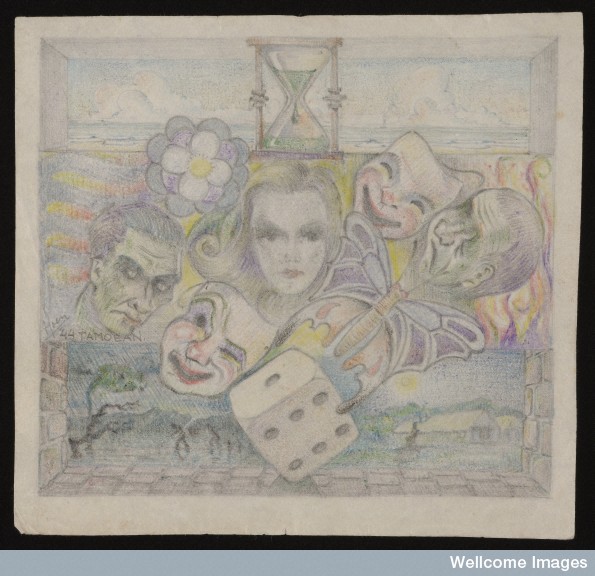
Item of the Month: Pencil drawings by an unknown Prisoner of War


The picture above was drawn in 1944, when the artist was interned in Tamuang camp, Thailand. This drawing, along with two others by the same artist, came to the Wellcome Library as part of a small collection of papers belonging to Dr. John Simpson. We do not know how Simpson acquired this drawings, but the signature is clearly not his. John Simpson was a Flight Lieutenant in the medical branch of the RAF. In late 1941 24 year old Simpson was posted to Singapore, which fell to the Japanese shortly afterwards.

From the time of his arrival in Singapore until June 1943, Simpson kept a record of his movements by making brief notes in his RAF ID. From this, we can see that he spent the first months of his internment being moved around between a total of six different camps within Indonesia. On 25th February 1943 he was put on board the former SS Kinta, one of the notorious hell ships, and transported to Thailand, via Singapore, to become one of the 60,000 allied POW's working on the Thailand-Burma railway.

Whilst he was a Prisoner of War, John Simpson treated his fellow POW's for conditions such as oedema and cholera, both of which were common results of the poor conditions within the camps. He recorded details of the patients he saw on scraps of paper. Unfortunately, however, the high turnover of people within the camps means that it is not possible to see how often his advice was followed, or what happened to his patients.

Despite a 6 month long battle with diarrhea in 1943, and an eighteen month bout of fever in 1943-1944, Simpson was one of the lucky ones. The Burma-Thailand railway was nicknamed the “Death Railway” because of the number of people who died during its construction, estimated to be over 100,000. The building of the Thailand–Burma railway is considered a war crime.

After the war, John Simpson returned home to Britain. He used his experiences of treating prisoners of war to write his thesis “A Syndrome of Painful Feet and Retrbular Neuritis Occurring Amongst British Prisoners of War in the Far East”, a copy of which is included in the archive.

Nothing is known about the fate of the artist.

The Wellcome Library Archives and Manuscripts department holds a number of items relating to the experiences of Prisoners of War in the Far East, including the papers of Cicely Williams, Surgeon-Captain John Allison Page, and the Royal Army Medical Corps.