Showing posts with label British Psychological Society. Show all posts

Friday, March 9, 2012

War and the psyche

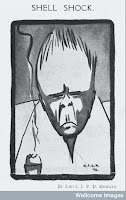
Lt J P D Hewatt, 'Shell Shock', 1917
Readers who consult the online Archives and Manuscripts sources guides may have noticed some recent changes to the guides on war, medicine and health. In order to streamline these somewhat, the content has been rearranged, into War, Medicine, and Health: general and guides relating specifically to World War I and World War II, and a significant amount of material relating to psychiatric and psychological issues to do with warfare pulled out to create a new guide, War, Psychiatry and Psychology.

We already held some important materials on these latter subjects, such as the observations by Charles McMoran Wilson, later Lord Moran, of the new phenomenon of 'shell shock' on the Western Front during the Great War, material in the Bowlby and Winnicott papers on the effects of wartime evacuation on children, records of S H Foulkes' work with the 'Northfield Experiment' during the Second World War. However, a number of more recent acquisitions, such as the papers of H V Dicks relating to his involvement in 'de-Nazification' of Germany after the war and his writings on the psychology of totalitarianism, and several collections of papers of individual psychologists received along with the records of the British Psychological Society have additionally developed our strengths in this area and this is reflected in the creation of  this new guide.

This turns out to be especially timely given the news of this forthcoming event, Psychoanalysis in the Age of Totalitarianism, bringing together historians, social theorists and psychoanalysts to explore the impact of the Second World War and totalitarianism on psychoanalysis, and of psychoanalysis on the understanding of the war and totalitarian systems. Organised under the auspices of the Institute of Psychoanalysis, the Pears Institute for the study of Antisemitism (Birkbeck, University of London), Birkbeck College, University of London, and the Centre for Psychoanalytic Studies of the University of Essex, it will take place in the Wellcome Collection Conference Centre, 21-22 September 2012.

Monday, October 17, 2011

'Stories of Psychology' Symposium report

Last Tuesday (11th October) the Wellcome Collection Conference Centre was the venue for the symposium ‘Stories of Psychology: Archives, Histories and What They Tell Us'. The event was held as part of the collaboration between the British Psychological Society (BPS) and the Wellcome Library, which has seen the Society’s extensive psychology archives transferred to the Library (and which we've flagged up in previous posts on this Blog).

The afternoon's proceedings begun with Professor Richard Bentall (University of Liverpool), talking on “How we have changed the way we think about madness”. His lecture offered a broad overview of developments in the field, touching upon such key developments as the classificatory work of Emile Kraepelin, Walter Freeman and psychosurgery and the rise of the treatment of mental illness through psychiatric drugs. Understandably, psychology featured strongly in this narrative, with Bentall discussing the behaviourist influence of B F Skinner, offering a personal recollection of "the token economy" at work in a mental hospital and also an interpretation of the work of Carl Rogers on the value of therapeutic relationships. There were some provocative comparisons to be drawn with other branches of medicine: during the years in which psychology has existed as a discipline, he pointed out, prognosis for diseases such as leukemia has improved beyond all measure in the developed West, whilst the prognosis for psychotic states remains much the same.

For his paper, Dr Peter Hegarty (University of Surrey) re-evaluated the work of sexologist Alfred Kinsey through the prism of Kinsey's early research on Gall Wasps. Hegarty's lecture was particularly interesting for how it interrogated the way that notions of the frontier in American society permeated Kinsey's work, both in how the values of insect society were interpreted, and in his account of the sexual behaviour of American men in rural areas (as a result Hegarty's audience may never watch be able to watch Pixar's A Bug's Life in the same way again).

Prof Michael Billig (Loughborough University) took a more personal approach: his paper, “Archival knowledge versus personal reminiscence: The case of social psychologist Henri Tajfel”, was based around Billig's personal memories of Tajfel (Billig was one of Tajfel's research students). It discussed how Tajfel's work on the social construction of groups was strongly influenced by his experiences in growing up in 1930s Europe, but also spoke of the construction of biography through personal and working papers, and how this differed from an individual's personal memories of a colleague. Particular pertinent views from the perspective of the Library, as with the transfer of the BPS archive we now hold Tajfel's papers.

In “Psychological knowledge and the making of the modern state”, Dr Rhodri Hayward (Queen Mary University) questioned the traditional narrative of understandings of psychiatry in the UK in the 20th century, arguing that in the proto-Welfare State of inter-war Britain there was an increased awareness of psychosomatic illness in discussion of states hitherto seen as “malingering”. His wide-ranging talk included analyses of the condition of "Busman's Stomach" in the 1920s and of how notions of stress and emotion became the basis for industrial negotiation as the century progressed. Pertinent issues, particularly with the importance recent Governments have placed on the "emotional wellbeing" of the British population.

Prof Sally Shuttleworth (University of Oxford) concluded the day with “Studying the child in the nineteenth century”. This paper examined the interplay of literature and research, and how the rich and evocative descriptions of childhood in the literature of the 1840s (e.g. Dombey and Son or Jane Eyre), influenced the growth of child psychiatry in the UK, so much so that by the 1890s, developments in the field were feeding back into literature (e.g. Edmund Gosse's Father & Son). Her talk also spoke of the important role played by women in the development of child studies in the nineteenth century and the present day difficulty in tracking down many of child development journals produced in the period.

This last point was indicative of a symposium which illustrated the variety of areas and issues which research into the history of psychology can explore. One hopes the papers of the BPS now held in the Wellcome Library will inspire and encourage further exploration.

Image: Henri Tajfel (from European Association for Social Psychology).

Tuesday, August 16, 2011

Spearman and Intelligence

The papers of influential British psychologist Charles Edward Spearman (1863-1945) were deposited in the Wellcome Library by the British Psychological Society in 2008. They are once more available to the public, now accompanied by a new expanded catalogue (PSY/SPE).


Charles Spearman is known for his seminal work on the testing and measuring of human intelligence. In 1904 he posited, in the prestigious American Journal of Psychology, his famous two-factor theory of intelligence. Its components were soon abbreviated to g to represent general intelligence and s for specific ability. It can be said that Spearman spent much of his academic career developing, explicating and defending his theory of the g factor (general factor) as well as devising the necessary mathematical tools for reliably interpreting test data, pioneering the use of Factor Analysis and developing what is now known as Spearman’s Rank Correlation measure (or Spearman’s Rank Correlation Coefficient).


Following a prolonged stint in the British Army, Spearman, much influenced by German psychology of the late 19th century, headed to Germany in 1897 to work in Wilhelm Wundt’s psychology laboratory in Leipzig. On permanent return to England in 1907 he headed up a psychological laboratory at University College London and went on to help create the ‘London School’ of psychology which was characterized by its emphasis on statistical and psychometric methodologies for studying human ability.


Spearman’s The Abilities of Man: Their Nature and Measurement (London: Macmillan, 1927) represented an accumulation of his experimental and philosophical evidence in support of his theory of human intelligence.


(For a detailed exposition of Spearman’s work and achievements in experimental psychology and psychometrics, as very much a layman on this topic, I strongly advise the reader to scrutinize Spearman’s own works and the numerous published biographical sources).


The Spearman papers provide a fascinating insight into Spearman’s work from the turn of the twentieth century through to the early 1940s.


Material relating to actual intelligence test data and test design in the 1930s in the UK and USA is present throughout the collection. Of notable interest will be the material in section PSY/SPE/3 containing material relating to the so-called 'Chicago experiments' on school children conducted by Karl J. Holzinger and Frances Swineford in the 1930s to which Spearman contributed. Their studies resulted in the Preliminary Report of Spearman-Holzinger Unitary Traits (Chicago University, 1934) and, after further studies conducted in Chicago, A Study in Factor Analysis by Holzinger and Swineford (Chicago University, 1939).


Important to students of the history of psychometrics, the material also amply illustrates varied socio-economic and cultural constructs during this period on the origins, nature and cause of intelligence and contemporary motivations behind the development of aptitude testing, cognitive ability rating and problem solving exercises which became popular as access to education broadened in the late 19th and early 20th century.


In series PSY/SPE/1/4-6 there is a significant amount of Spearman’s correspondence with the great and good operating in his fields of interest at the time. Notable correspondents include William Stephenson (1902-1989), Joseph Zubin (1900-1990), Karl J. Holzinger (1892-1954), Edwin B. Wilson (1879-1964), Arthur Bowley (1869-1957), Ronald A. Fisher (1890-1962), Truman L. Kelley (1884-1961), Louise L Thurstone (1887-1955) and Cyril Burt (1883-1971). Much of the correspondence discusses Spearman’s two-factor theory and g, intelligence testing methods, statistical analysis formulae and the variables involved in causing and assessing intelligence.


Spearman’s papers also contain much fascinating material on sensation analysis and spatial, visual and auditory perception. These are mainly in the form of his notes and lecture notes (PSY/SPE/1/3).


Section PSY/SPE/2 comprises a large grouping of reference material gathered by Spearman over many years, alphabetized by author or terminology. Both psychological and philosophical concepts are covered, notably theories of intelligence, perception, cognition, sense memory and their development, testing and measurement; notions of understanding, assimilation, association, unity and conation; memory; concepts; mental fatigue; child development; the nervous system; reasoning capabilities; mind training and learning ability; attention and attention span; images and thought; Gestalt theory; psychopathology.


A Note on Provenance:

The Spearman collection was originally held by the Charles Myers Library, London, and given to the British Psychological Society in 1974.


The Charles Myers Library had its origins in the National Institute for Industrial Psychology (NIIP), co-founded by Myers and Henry J. Welch in 1921. By 1930 the NIIP employed about 50 people and a librarian had been appointed to look after its reference collections. Spearman contributed his papers to the library, who received it on his death in 1945. After Myers himself died a year later the Council of the NIIP renamed the library the Charles Myers Library in his honour. In the 1960s the NIIP faced a number of problems and its financial situation had gravely worsened by the 1970s. It was at this point that collections were dispersed to other libraries and institutions. In 1977 it was wound up permanently.


Further reading:

A. R. Jensen, 'Charles Spearman: Founder of the London School', Galton Institute Newsletter, March 2000

P. Lovie and A. D. Lovie, 'Charles Edward Spearman FRS (1863-1945)', Notes and Records of the Royal Society 1996, 50 (1), pp75-88


Images:

- Charles Spearman, from Portraits of Statisticians

- Learning to solve problems: Illustration depicting a child's development of problem solving skills through the use of games and puzzles (Bill McConkey, Wellcome Images, 2004)


Author: Amanda Engineer

Monday, July 4, 2011

Dream a little dream…


In May 1940, Birmingham schoolteacher and army reservist, Kenneth Davies Hopkins, was captured by the Nazis in France, and sent to a succession of Prisoner of War camps in Germany. Whilst interned he had the idea of recording the dreams of his fellow POWs in order to later analyse them. His interest in psychology had been awakened in the 1930s when his MA Education dissertation had been supervised by C. W. Valentine, who, like Hopkins, was interested in the psychology of dreams

Over the next two years, Hopkins meticulously kept records of the dreams reported to him, using only a pencil and the rough paper he had available to him in the camps. This provides an exceptional record. As Valentine said to Hopkins in a letter dated 8th November 1940 "it would be a unique contribution, as far as I know, to have reports on dreams of prisoners of war while entirely separate from their normal environment", before going on to suggest that Hopkins look out for "wish-fullfilment dreams, fear dreams based upon war experiences, regression to childish memories, and symbolism in dreams" (PSY/VAL/4/6).

If it wasn’t for this letter, we would never have known of this important resource. In 1945, Major Hopkins’ dream research notebooks were found abandoned in a liberated camp. The letter to Valentine was with them, so the camp liberators forwarded the books to him in the hopes that he could reunite Hopkins with his notes. Unfortunately, Kenneth Hopkins had developed bronchial asthma and emphysema in 1942 whilst interned near Hildburghausen in central Germany, and had died there.

The notebooks remained in the possession of Professor Valentine until they were donated to St. Martin’s College Library, Lancaster, who deposited them on permanent loan with the British Psychological Society. In September 2008, Valentine’s papers were deposited with the Wellcome Library, along with other collections from the British Psychological Society History Centre.

In addition to the Hopkins material, the C. W Valentine archive held by the Wellcome Library includes notebooks created Valentine during observational studies of the infant psyche, drafts of his works Psychology and its Bearing on Education and The Psychology of Early Childhood, both of which are held by the Wellcome Library, along with notes from his university days.

Picture credit: The dream of a patient in Jungian analysis: left, a rocky wall; right a swirling wave; at the end, six people. Drawing by M.A.C.T., January 1971. Iconographic Collections, 658096i

Friday, June 3, 2011

Archives and manuscripts cataloguing, May 2011

May was, for the most part, a month of steady progress in the Archives and Manuscripts department, with several collections in train but the majority carrying on into June rather than being completed within the month. Nearly 400 records were added to the online database before the month's end. The majority remain invisible for the moment, awaiting the completion of the projects to which they belong, but May did see the release of several noteworthy sets of papers, now available for study in the Wellcome Library.

Our long-running project to repackage and make available material deposited here by the British Psychological Society passed another milestone, with the papers of Charles Wilfred Valentine (1879-1964) (PSY/VAL) being made visible in the database. Valentine was a specialist in educational psychology (and a life-long friend and colleague of Cyril Burt) and many of the papers relate to child development. In some tests, for example, he tracked the reactions of infants from birth to the age of three, monitoring such things as whether the sound of a ticking watch obtruded on their attention enough for them to stop feeding and whether this changed over time. He also wrote on the psychology of aesthetics, and on dreams. One particularly interesting section of the collection comprises notes kept by his one-time research student, Kenneth Davies Hopkins (d.1942). Hopkins, a Birmingham teacher, studied for an MA in Education under Valentine's supervision in the 1930s. A Territorial Army officer, he served in the Second World War and was captured in northern France in 1940. Whilst interned as a Prisoner of War, he embarked on a project to record his dreams and those of his fellow PoWs, with Valentine's encouragement. (Prisoners of war, with all too much time on their hands, undertook many scientific projects during the Second World War: much pioneering work on bird behaviour, for instance, dates from this time.) Sadly, Hopkins died of a lung condition in a PoW camp in 1942; his notebooks were found when the Allies took control of the vacated camp in 1945, and sent to Valentine. The Library is pleased to make them available now, as a small tribute to Major Hopkins' determination to continue scientific work under the most unpromising of circumstances.

War is a leitmotiv of this month's new material: another major tranche of papers relates to the Strangeways Research Laboratory's work during the Second World War. The papers form part of the existing SA/SRL collection of papers from the laboratory (SA/SRL), described as a new section M. The Laboratory spent the war researching substances that might be used in chemical warfare, and agents that might counteract them, in collaboration with the War Ministry's Porton Down Laboratory. An earlier blog post has described these papers in some detail.

On a lighter note, MS.8767 takes us travelling in nineteenth-century Italy. It comprises an account of a journey undertaken in 1855 by C.J.W. Bosanquet, whose identity remains unknown. Starting in Milan, Bosanquet takes us eastwards to Como and the Lakes, then into Switzerland and via Geneva to Lyon; he records sights seen, the weather, his experiences with officials when crossing borders, and religious reflections inspired by all of these. Drinkers of bottled water may be a little unsettled by his note that "We slept at a dirty little place called Evian." We can only applaud his taste, however, in how he opens the journal: its first words are "There are some very curious manuscripts in the Library." There are indeed; and several more are now available to be seen in the reading room.

Image: the travel journal of C.J.W. Bosanquet, 1855, showing geological formations near Geneva (MS.8767).

Wednesday, May 11, 2011

Archives and manuscripts cataloguing, April 2011

It’s (almost) all in the mind: the focus of this month’s completed cataloguing is largely on the mind, on psychology and psychiatry. As has been mentioned in previous blog posts, the archives of the British Psychological Society have been deposited at the Library and there is a long-running project making these available: the material is being repackaged in acid-free folders, and the catalogue records updated to take account of its new format. Last month we highlighted several collections from this source that had been released and this month another became available: papers relating to the behavioural psychologist Edward Chace Tolman (1886-1959) (PSY/TOL). Tolman’s papers are described in detail in their own blog posting; of particular interest are the items relating to his work on rats learning in mazes and, in complete contrast, those on his political stance during the McCarthyite period in the USA, when in the interests of academic freedom he took legal action against the imposition of a Loyalty Oath.

Remote on the spectrum from Tolman’s behaviourism is the work of Roger Money-Kyrle (PP/RMK), a leading Kleinian psychoanalyst with personal links to many other figures already documented in our holdings (for example, Melanie Klein herself, and Henry Dicks whose papers were recently released and described in another blog post). Money-Kyrle’s papers have been described here; the bulk of them consist of case histories and his development of these into writings.

Turning from the mind to the brute physical facts of war, this month the archives and manuscripts department acquired and catalogued a fascinating memoir of service by a woman doctor in the Second World War. Dr Muriel "Molly" Newhouse is primarily remembered for her work in occupational health and in particular establishing the connection between asbestos and mesothelioma: however, like many other medical men and women she found herself in 1942 (having qualified in 1936) called up into the Royal Army Medical Corps. Her unit followed the D-Day forces into Normandy and, as is described in a blog post, she found herself called upon to treat the sick, carry out surgery and on at least one occasion plunge into midwifery, delivering the baby of a local farmer’s wife. In her time in Normandy she never went more than seven miles inland: subsequent postings took her further afield, to India and to Singapore, where she cared for prisoners recently released from the horrific conditions of Japanese PoW camps. A blog post has described her memoir, and the item itself can be viewed in the catalogue as MS.8766.

Image: Fowler's phrenological head, from Wellcome Images (image number L0057592).

Tuesday, April 19, 2011

Stories of Psychology

Between 2008 and 2009 the British Psychological Society deposited in the Wellcome Library both its own institutional records and the archives of over 30 individual psychologists and small organisations. Since then, work has been proceeding to re-house these collections and to integrate them into our on-line catalogue. Followers of this blog will have noticed that papers relating to Charlotte Wolff (PSY/WOL), Henri Tajfel (PSY/TAJ), and E. C. Tolman (PSY/TOL) have already been opened to public access (and described in earlier blog posts: click here for information on Wolff, Tajfel and Tolman). Other material available includes papers relating to Albert Cherns (PSY/CHE), Grace Rawlings (PSY/RAW), L. S. Hernshaw (PSY/HEA) and C. S. Myers (PSY/MYE). More is scheduled to follow during the coming months.

To celebrate this collaboration between the British Psychological Society and the Wellcome Library, the Society is organising a half-day symposium on the afternoon of Tuesday 11 October 2011, to be held in Wellcome Collection Conference Centre. The theme will be Stories of Psychology: Archives, Histories and What They Tell Us. Speakers include Richard Bentall, Michael Billig, Rhodri Hayward, Graham Richards and Sally Shuttleworth. The symposium is free to attend, but registration is essential. For more information and to register, go to www.bps.org.uk/stories.

Monday, April 11, 2011

Edward Chace Tolman

Recently made available to researchers is a small collection of material relating to the career of U.S. behavioural psychologist, Edward Chace Tolman (1886-1959). The material was collected by Professor W. G. Leytham, biographer and former student of Tolman, and as a result contains significant information on Tolman’s life, long career at the University of California, Berkeley, and the influences he had on his students.

Tolman is famous for his study and experiments on learning in rats using maze techniques. This is touched on in two files of reprints (PSY/TOL/2/5-6) in the Tolman collection. However, of particular interest may be file PSY/TOL/1/9, comprising copies of a questionnaire completed by former students, containing their (highly complimentary and admiring) views, reminiscences and anecdotes relating to Tolman the teacher and the individual. There are notable insights in this file (as well as in files PSY/TOL/1/3, 1/4 and 1/8) regarding his resolute stance against signing the Loyalty Oath imposed by the University of California. Unwilling to adhere to anything that infringed upon academic freedom, Tolman became one of the victims of the McCarthyite ‘witch hunt’ era, being dismissed from his position as Chairman of the Psychology Department in 1950. He became leader of the ‘non-signers’ in the university and took legal action against the Loyalty Oath ruling. He was ultimately reinstated a few years later, after the California State Supreme Court held that the oath, prescribed by the University of California Board of Regents, was illegal.

The Tolman papers form part of the archive collections of the British Psychological Society, currently deposited with the Wellcome Library, Archives and Manuscripts. Other material relating to Tolman is housed by the archive repositories of the University of Akron, Ohio, and University of California, Berkeley.

Image: Edward Chace Tolman, circa 1936. University of California History Digital Archive, University Archives,The Bancroft Library, UC Berkeley

Author: Amanda Engineer

Friday, January 22, 2010

Henri Tajfel Papers – Now Available to Consult!

The papers of Henri Tajfel (1919-1982), the Bristol University Professor of Social Psychology and eminent social psychologist, following the completion of the cataloguing process, have today become accessible at the Wellcome Library. An extensive obituary for Tajfel appeared in the Journal of Language and Social Psychology, Vol. 1, No. 1, 87-89 (1982). He also has an entry in the Oxford Dictionary of National Biography and an extensive Wikipedia biography where he is credited as the principal co-developer of Social Identity Theory. This theory, developed by Tajfel and Turner, suggests that people categorize themselves into groups which Tajfel and Turner called “in-groups”, and categorize everyone else into other groups, called “out-groups”. This categorization helps to promote a sense of identity but this leads to unfavourable comparisons between the in-group and the out-group and the enforcement of boundaries between the groups which can result in conflict in various guises.

The Tajfel papers at the Wellcome Library do not cover the development of Social Identity Theory to any great extent and anyone wishing to discover more about this and related theories would be better advised to read one of the following books:

• Tajfel, H. (Ed.). (1978). Differentiation Between Social Groups: Studies in the Social Psychology of Intergroup Relations. London: Academic Press.
• Tajfel, H. & Turner, J. C. (1979). "An Integrative Theory of Intergroup Conflict". In W. G. Austin & S. Worchel (Eds.), The Social Psychology of Intergroup Relations. Monterey, CA: Brooks-Cole .
• Tajfel, H. (1981). Human Groups and Social Categories. Cambridge University Press, Cambridge.
• Tajfel, H. & Turner, J. C. (1986). "The Social Identity Theory of Inter-group Behavior". In S. Worchel & L. W. Austin (Eds.), Psychology of Intergroup Relations. Chicago: Nelson-Hall

However, what the Henri Tajfel papers do cover is his extensive involvement with numerous social psychological societies, journals and books, particularly the Academic Press series of books which Tajfel edited, the European Monographs in Social Psychology. Tajfel’s files cover his lecture notes from the early 1960’s and are full of papers submitted for publication in various journals and books and presented at the many conferences/seminars which he attended in the 1960’s, 1970’s and 1980’s. There is also extensive correspondence concerning books, journal articles and letters both published and unpublished by other social psychologists of the time.

To date, Henri Tajfel has not benefited from a full biography covering his life and works. For those interested in his place in the history of social psychology theory, his legacy has been discussed in numerous books and journals in the almost 30 years since his death and one place to start is by referring to John C. Turner’s, “Henri Tajfel: An introduction”, which appears in W. P. Robinson (Ed.) Social groups and identities: Developing the legacy of Henri Tajfel. Oxford: Butterworth Heinemann (1996). Professor John Turner began as a research associate working for Tajfel at Bristol University and they worked together over many years.

Rather than repeat what has been said about Tajfel in these many sources, I thought it would be illuminating to see what Tajfel chose to write as his own biography in 1981, the year before his death. The following biography, written by Tajfel, is taken from the Cambridge University Press “Advance Information Sheet” produced in April 1981 for the book “Human Groups and Social Categories”.

“Professor of Social Psychology, University of Bristol. Born 22 June 1919 in Poland. Educated in several European countries. Prisoner-of-war in Germany June 1940 - May 1945. In the first few years after the war, working in various European countries for international organisations concerned with the rehabilitation of children and adults, victims of war. First degree and Ph.D. in Psychology, University of London. 1954-56, Assistant, University of Durham. 1956-67 in Oxford, University Lecturer in Social Psychology and Fellow of Linacre College. 1967, Professor of Social Psychology, University of Bristol. Longer-term visiting appointments at Harvard University; University of Western Ontario; Centre for Advanced Study in the Behavioural Sciences, Stanford, California; University of Leiden; Ecole des Hautes Etudes en Sciences Sociales, Paris; The Van Leer Foundation, Jerusalem; University of Bologna. Short visits to a number of universities in Europe and North America including Katz-Newcomb Lecturer, University of Michigan and Special Lecturer, University of Helsinki. Fellow of the British Psychological Society. Past President of the European Association of Social Psychology. Past Chairman of the Social Psychology Section of the British Psychological Society. First Annual Gordon Allport Intergroup Relations Prize, S.P.S.S.I.. Co-author and editor of several books in social psychology and publications in a variety of psychological journals in Britain, U.S.A., Canada, France, Italy, Germany, etc. Editor of the European Monographs in Social Psychology, Academic Press, London.”

What is clear from the 64 boxes of Tajfel papers, part of the deposit of the papers of the British Psychological Society at the Wellcome Library, is how hard Henri Tajfel worked, how many organisations he belonged to, how many books and journals he contributed to, how many conferences and symposia he attended, and how many people with whom he corresponded both agreeing and disagreeing with points made in private and in public. His prodigious output did not stop with issues of social psychology and where he felt newspapers or even the school curriculum was biased against matters dear to his heart such as the coverage of Israel, he would take up his pen and begin a lengthy correspondence. Henri Tajfel died at the relatively young age of 62, and given the amount of work that he had demonstrated that he could tackle and that he was still planning to get through in early 1982, it can only be imagined how much more he would have been able to contribute to the field of social psychology had he lived for just a few years longer.

The catalogue of the Tajfel papers can be consulted on the Wellcome Library's archives and manuscripts database, under the reference PSY/TAJ. The papers of the British Psychological Society will be released gradually as they are made ready for consultation. An earlier blog post has already described the papers of Charlotte Wolff, from the same source.

Author: Jon Cable