Showing posts with label Arthur Mourant. Show all posts

Thursday, February 9, 2012

Digitising the archives of blood research

Blood transfusion has become such an integral part of life-saving procedures used today that it is hard to imagine a time when operations were extremely risky affairs.

The emergence of the Blood Transfusion Service in 1946 was a blessing, though unfortunately too late for many war wounded. It was the losses incurred during the war that intensified the work of the Blood Group Unit, a successor to the Galton Laboratory Serum Unit that was established in 1935.

As part of the Library's large-scale digitisation programme, scanning of the Blood Group Unit archive (which covers largely the period from 1940s to 1970s) has just been completed and will be available online later this year.


Under the directorship of Dr Robert Race at the Lister Institute for Preventive Medicine, many familiar names worked within this group: among them, serologists Arthur Mourant (whose archive was recently digitised, see earlier blog) and Race's wife, Ruth Sanger. These partnerships resulted in many significant advances in blood group science, as revealed in the archives (see File ref: PP/SAR for the personal archive of Ruth and Robert Sanger also held within the library but not yet digitised).


Between them, they produced a manual entitled 'Blood Groups in Man' (see File ref: PP/SAR/C/16 for Race's summary of the multiplicity of blood groups in man that he delivered to the British Association, Brighton, 8-15 Sept1948). This book became a bible for transfusion specialists, so much so, it became known simply as 'Race and Sanger'.

It is not suprising that they became the most well-known names in blood group science in the period following WW11 up to 1980. The international press quickly picked up on their ground-breaking work: The Dallas Morning News, November 13 1946, featured a mug shot of Dr Race beneath the heading: 'RH factor expected to bare man's origin' (File ref: SA/BGU/B.1/3/1) as revealed at an International Hematology and Rh conference in Dallas, Texas and Mexico City, 1946. The study of RH blood incompatability was paramount to solving many genetic problems during the 1960s.



As a double-act, Race and Sanger were remarkable, which is suggested in a letter from Amos Cahan of the Knickerbocker Foundation in New York October 30 1959:

"I don't know if you know what a thrill it is for us to watch you - how you take a thing like the Reiger serum - pick up the trail of a tiny irregularity - force it to yield it's secrets and lead you to new and unexplored land. We feel privileged to be allowed to take part" (File ref: SA/BGU/F.1/46/1)

The work of the Blood Group inevitably involved studying families which meant close cooperation was necessary, but not always possible. Communication with the families of interesting case-studies was problematic at times. Perservance was required to get continued samples, as indicated in a general letter from Race in February 1950 seeking permission from volunteer blood donors:

"We realise that you have already helped the Blood Transfusion Service a great deal but hope that you will not mind being asked to help again in another way. This Unit is investigating the inheritance of a new blood group; in order to do this small samples of blood are needed from families consisting of both parents and two or more children of any age. Two or three drops of blood from a prick of the finger or ear lobe is all that is required ... Our work is primarily concerned with research into human blood groups, which is of the utmost importance in the practical problems of blood transfusion and certain blood diseases of the newborn" (File ref: SA/BGU/G.3/2/1).
At other times, blood supplies were too plentiful, as Ruth Sanger wrote in a letter to Dr M Pickles of the Radcliffe Infirmary Oxford about a mutual case of interest on 5 April 1977:
"Sorry to be so long in writing, but we've had one of those remarkable deluges of blood, lots of interesting things all at once and exhaustion setting in "
(File ref: SA/BGU/F.20/9).
When Dr Race retired from the Unit in 1973, Dr Ruth Sanger became director. Further progress was made in the identification of blood groups and human genetic problems. One area of continued research interest was differing blood types in twins (SA/BGU/F.20) which revealed the problem of Chimerism, a rare disorder that affects twins when chromosomes are mixed in a single organism resulting in 2 sets of DNA. Evidence of this problem was first published by Sanger along with Race and fellow haemotologists in 1957 in the British Medical Journal (see full article).

The MRC Blood Group Unit moved from the Lister Institute to premises at University College, London in 1975 but was disbanded in September 1995, although its work continues in other research centres.

Images:

A wounded soldier indicating the need for blood donations. Colour lithograph after Reginald Mount, Issued by the Ministry of Health in 1945, Copyright of Central Office of Information, Ref: 22648i, for other publicity issued see, File ref: Archives and Manuscripts GC107/1

Race and Sanger at an International Conference in Washington, 1972, File ref:
SA/BGU/L/1/11

Front cover of 'Blood Groups in Man', Oxford: Blackwell Scientific Publications, 1975 (image courtesy of Google Books)

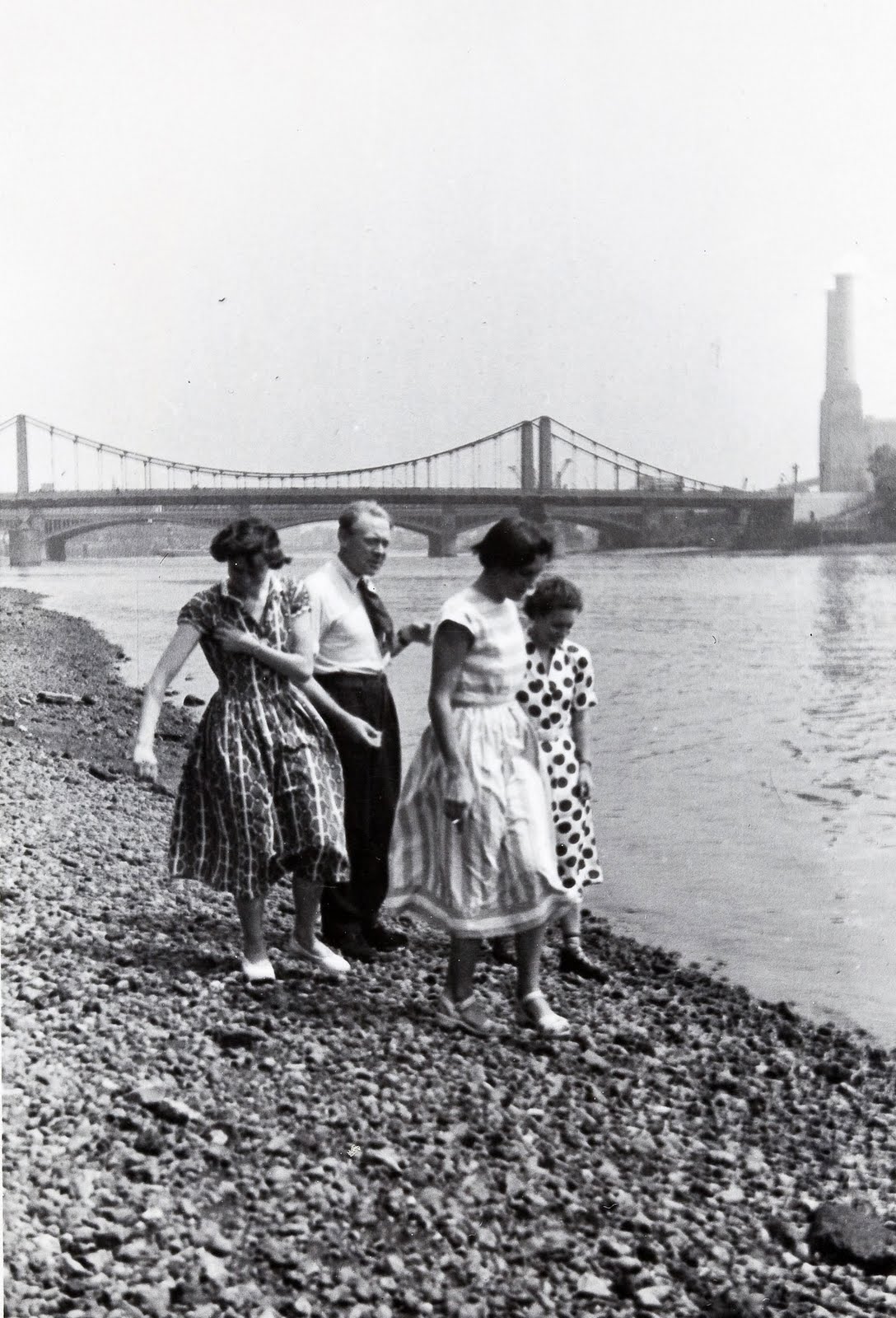
Race and Sanger with 2 colleagues on streets of 1950's London, File ref:
SA/BGU/4/5

Blood Group Unit at play beside the Thames, 1950's, File ref: SA/BGU/5/2

Tuesday, March 1, 2011

A Jersey connection: Arthur Mourant and Jacqueline du Pré

The Wellcome Library is not known particularly for its holdings of musical celebrities but the archives often reveal some unexpected items. The fate that struck the talented cellist, Jacqueline du Pré does fall within the Wellcome Library’s remit however, given that it was multiple sclerosis that robbed her early of a longer brilliant musical career. Readers would not expect to find material from her within the personal papers of the serologist Arthur Mourant, that have just been digitised as part of a wider project dedicated to "Modern Genetics and its Foundations".

Yet, here we find correspondence of a very personal nature that reveals the close relationship that Mourant had with her Jersey-born family. In one letter dated 9 September 1942 from Jacqueline's father, Derek du Pré, Mourant is invited to be god-father to her older sister, Hilary Anne (File ref: PP/AEM/A.262).

Mourant’s papers include several other letters from Derek, many press cuttings from the 1960s relating to Jacqueline’s brilliant career and private life as well as all Jacqueline’s concert programmes and tickets Mourant attended.

In his autobiography Mourant includes childhood reminiscences of Jacqueline’s sister, Hilary and his relationship with the Du Pré family. She remembers him as a warm and generous man who played with the Du Pré children and “took delight in listening to their weekly concerts”. Mourant was known as the 'Pied Piper' in the children's games, as well as ‘Lalla’ and ‘Uncle Arthur’ (Blood and Stones: an autobiography by A.E. Mourant, La Haule, Jersey: La Haule Books, 1995, p.96). A bachelor until late in life, Mourant enjoyed feeling a part of their family. Also within the papers is a poem that is dedicated to the musically gifted Jacqueline, here re-named ‘Dame Josephine’:


It is touching to find Mourant retained an undated drawing given to him by Jacqueline when she was very young.


The drawing sits in the archive alongside a letter dated March 2nd 1961 from Jacqueline to Mourant: "Dear Uncle Arthur, what a wonderful bouquet! It gave me such pleasure when I came home and arranged the lovely variety of Spring flowers (at 3 a.m!)… with lots of love from Jackie". This letter was sent the day after her debut concert at Wigmore Hall at the tender age of 16 - his brochure and ticket are retained within the same files (PP/AEM/A.267):


Just over 10 years later after extensive concert performances, Jacqueline was forced to retire from the platform apparently from ‘nervous exhaustion’ that was later correctly diagnosed as multiple sclerosis. She died at the age of 42 on 19 October 1987. Following du Pré’s diagnosis, Mourant wrote a letter in Feb 1972 to R.J. Berry of the Royal Free Hospital, London requesting information about the disease according to a responding letter dated 23 Feb 1972 containing multiple-sclerosis statistics (File ref: PP/AEM/K.194).


Picture references:
Photo of Jacqueline du Pré by Lotte Meitner-Graf taken from a Royal Festival Hall concert programme 21 November 1965, File ref PP/AEM/A.268
Drawing and letter given to Mourant by Jaqueline du Pré, n.d. File ref. PP/AEM/A.267
Mourant’s poem dedicated to Jacqueline, n.d. File ref PP/AEM/A.272
Cover of Wigmore Hall concert programme, File ref PP/AEM/A.268


Authors: Rada Vlatkovic and Julia Nurse

Tuesday, November 9, 2010

The father of serology - Arthur Mourant

Following on from Francis Crick, preparation work for digitisation continues through the enormous quantity of archival material related to the theme of Modern Genetics and its Foundations here at the Wellcome Library, with the personal papers of Jersey born Arthur Mourant (April 11, 1904 – August 29, 1994).
A man of many talents, it seems, from his initial interest in geology, archaeology and anthropology to his area of expertise later in life – haematology. He was a recipient of many awards and honours during his life-time, but most importantly for his blood transfusion work: in 1945 he discovered a serum with antibody to the e factor; his subsequent development of the Antiglobulin_test which ensured the compatibility of blood in transfusion, paved the way to the modern day Blood Transfusion Service. The effect this test had on the detection of blood-borne diseases was, needless to say, ground-breaking.
An ‘exceedingly promising’ science student at school [File ref: PP/AEM/A.57 1920], the young Mourant went on to Oxford graduating with first class honours in chemistry and philosophy in 1926. He digressed to follow his interest in geology in the following years and proved to be an accomplished draughtsman according to a number of geological and botanical sketches within the collection [File refs: PP/AEM/A.86, PP/AEM/A.91, PP/AEM/A.92 all dating to 1926]. Despite the difficult post-war economic slump, Mourant managed to secure a position at The Geological Survey in 1929: File: PP/AEM/B.1 contains his Official pass with photo for Dept of Scientific and Industrial Research and a pass 'To Walk Upon The Line' of London Midland and Scottish Railway Co. Examples of his field work sheets are held within File ref: PP/AEM/B.2.
However, unsatisfied by the priorities of the Survey, Mourant resigned in 1931 following the ending of his probation according to File ref: PP/AEM/B.6: on the basis that he was “not likely to prove an efficient field geologist of the type that we require on this staff”. The subsequent depression years put paid to this particular career path it seems: File PP/AEM/A.112 contains a handwritten list of all the posts (largely for chemistry master in numerous colleges and schools) that Mourant applied for between 1931-7. He was forced to resort to taking a course in medical chemistry and returned to his childhood home of Jersey, where he set up a chemical pathology laboratory (1933-38) which later became the States of Jersey Pathology Laboratory.
Restless again, Mourant returned to his medical studies in 1939 at St. Bartholomew's Medical College, in London just before the German occupation of Jersey in 1940. As with all archives, there are some revealing insights into the life of their creator. During this period of his life when he was isolated from his family, the numerous letters that Mourant receives from his mother reveal a fascinating, if personal insight into what life was like in Jersey during the German occupation – she writes:

“I bought a jar of honey yesterday, & this week we have marmite … we have plenty of food (& nice things too). This week we have had a nice lot of chocolate & it is a treat to have bacon...”
Aside from these culinary benefits, more significantly, she reveals:

“In going to St Mary's we passed the huge heap of stones as high as this house that the Germans dug (abandoned) out to make their underground hospital”
[File ref: PP/AEM/A.189]. This vast underground hospital was built in 1944 to protect the German troops from the expected allied invasion that never occurred. It has since been carefully restored as a museum of the German occupation in Jersey. A regular stream of parcel exchanges it seems kept the family spirits up during this period – while Mourant sent his mother ‘nylons’ from America, she offered ‘black butter', a traditional preserve still made in Jersey with liquorice.

By 1946, Mourant had become Director of the Blood Group Reference Laboratory at the Lister Institute in London where he discovered his life’s work. From there on numerous publications were produced, notably ‘The Distribution of the Human Blood Groups' (1954). However, funding, it seems always remained an issue. Numerous letters refer to the movement or closure of his laboratories (File ref: PP/AEM/D.2 contains a letter from Michael Perrin of The Wellcome Foundation Limited 28 Oct 1964 regarding Mourant's use of the space for a lab unit at Boundary House, 91 Charter- house Street, London E.C.1) and even more files contain numerous letters of reference in an attempt to find his staff other work in the field of serology. In a letter of 6 May 1970, Mourant writes:

"One thing which is not down for discussion is the ultimate fate of the enormous masses of data and of frozen blood specimens which we now hold and which ought to continue to be readily available to the next generation of workers in this field'
[File ref: PP/AEM/K.223]. His correspondence with many fellow serologists to obtain blood samples from a variety of races in far flung locations across the globe reveals the logistical and often legal difficulties of transporting the samples safely and in a way that maintained their freshness.

Although this archive generally lacks the ascerbic wit of Francis Crick’s archive, it does have its moments: Mourant evidently took an interest in the story about the 'The typist with the touch of pink', a story reported in the Daily Mail in 1960 (?) concerning a girl who sweated pink due to consuming turmeric that had reacted and sent the dye through her pours! [From a collection of cuttings related to blood issues in File ref: PP/AEM/E.28].

With such a hectic and varied career, it is no surprise that Mourant did not have time to marry until the age of 74 when he retired back in Jersey at Dower House, his family farm in St Saviour. It was here he wrote his autobiography ‘Blood and Stones’ (published posthumously in 1995). The appendix to this book lists an unbelievable 460 known publications, proof of Mourant’s prolific career as a writer. The archive includes a typescript copy of this book (in File ref: PP/AEM/A.4) which was published in 1995.
Many more letters were penned from Dower House, not just to his serological comrades, but to his many geological contacts, notably the Société Jersiaise who had a bust of him installed outside the museum there in 1995 by John Doubleday to honour his contribution to the heritage of Jersey.

Images:
Top: Blood for transfusion, Wellcome Images, Image ref: C 27213
Bottom: Bust of Mourant by John Doubleday, Image source: wikipedia